
If the video above is not available, here are two other ways to view:
Bathsheba and the God of the Second Chance
060514AM
DSS-19
Transcript
.jpg)
This Mother’s Day, let’s open to Matthew chapter 1. In our studies of the lessons that God has given to us from the life of David, His servant, we’ve come to a woman in the life of David. That woman is named Bathsheba. Bathsheba is only mentioned by name in the Old Testament, which occurs 11 times, but for a very special purpose, and especially this Mother’s Day, Bathsheba is found also in the New Testament in Matthew chapter 1.
.jpg)
As you’ve seen this morning in America, we celebrate moms in many different ways, but there’s a list of mothers that God honored in a very unique way. God has singled out and highlighted five mothers out of all the hundreds of mothers that are described, 327 to be exact, in the pages of Scripture. Out of those 327 women who are named, God has singled out five in this chapter in a very special way. He placed them in a special place. These five are on the pathway through which Christ Jesus came.
But I wonder, have you ever studied the ones God picked, the mothers that God picked to highlight in this passage? It’s a very unusual presence to have five women included in the genealogy of Matthew 1. Interestingly, no women are listed in any of the other genealogical records of the Old and New Testament, except for this one in Matthew. So, it means that it’s there intentionally and purposefully. Matthew 1, verses 1 through 16, lists five special mothers in the line awaiting the coming of the promised One.
The reason women weren’t usually listed is that they weren’t highly regarded in the ancient world. They lived in a man’s world, and that made life difficult for them. So, God profiles five courageous and gifted women because they were part of His team. Their lives were part of God’s plan to bring a ray of light to herald the sunrise. That’s what God calls the birth of Christ. The sunrise, the dayspring from on high that brought light to us who sat in darkness, in the shadow of death. Thus, through the sunrise in the night of sin that had come into our world through their line, the promised Savior was going to be supernaturally born. Five women in a long list of genealogical records, all of whom have something in common. Each of these women, during their lifetime, was subjected to a moral scandal. Every one of them. Each of them would be what we may call stained, either by allegation or by participation in sin.
.jpg)
Let’s meet them as we read Matthew chapter 1. I’m going to read verses 1 through 6 and then verse 16. Matthew 1:1-6 and 16. The book of the genealogy of Jesus Christ, the son of David, the son of Abraham. Abraham begot Isaac, Isaac begot Jacob, Jacob begot Judah and his brothers, Judah begot Perez and Zerah by Tamar. There’s our first in the list. Perez begot Hezron, and Hezron begot Ram. Ram begot Amminadab, and Amminadab begot Nahshon, and Nahshon begot Salmon. Salmon begot Boaz by Rahab. Verse 5, the second one. Boaz begot Obed by Ruth. Obed begot Jesse, and Jesse begot David the king, and David the king begot Solomon, look at this, by her who had been the wife of Uriah. That’s a back-door way of saying Bathsheba. Her name isn’t mentioned, but we know who she is.
Now, zip down to verse 16, and Jacob begot Joseph, the husband of Mary. Notice how clearly that is delineated to show that Jesus Christ was not the son of Joseph. He was just the husband of Mary, of whom, that is of Mary, was born Jesus, who is called Christ. Let’s bow for a word of prayer.
Father, I pray that we would learn a good lesson from this highly unusual list of mothers. A list that You specifically chose to write. You went in a different direction than any other list of genealogical records that was recorded anywhere in Your Word, so that they would stand out. I pray that they would stand out in our hearts and minds today. And that the lessons and the lives behind these names, and the purpose that You recorded them in Your Word, through Your Spirit, would teach us this morning, would prompt us to a decision. That we would, by Your grace, choose through the truth, the doctrine that we learn from Your Word this morning, to respond in obedient faith. Be glorified. Be exalted. Open our minds. We ask in the name of Jesus, we pray, Amen.
.jpg)
As you look at verse 6 and look at Bathsheba, who had been the wife of Uriah, I’d like to just talk about Bathsheba first. Bathsheba is a Hebrew name that means the daughter of an oath, a promise, or a covenant. So, Bath, daughter of, Sheba, oath, promise, covenant. So, every time you say her name, in Hebrew, you’re saying daughter of an oath, a promise, or a covenant. What is so interesting about that name is that it belongs to a woman who didn’t keep her oath, her promise, her covenant. That’s the fascinating lesson of Bathsheba’s life.
What comes to your mind first when you hear the name Bathsheba? Most often, it’s the sin of adultery that David and Bathsheba together committed against God, and against their marriage covenant, oath, and promises. But do you also think about Bathsheba’s loyal and faithful husband Uriah, who was betrayed by the king he served? He was left to die there at the walls of Rabbah, under a barrage of arrows, because Bathsheba didn’t keep her promise to him.
Do you think about what it must have been like as Bathsheba watched the army of Israel bring back Uriah’s dead body to Jerusalem after carrying him back 44 miles from Rabbah to Jerusalem, where he fell in battle because Bathsheba didn’t keep her promise? Do you think of what it must have been like for her to have stood at the funeral as he was honored as a fallen war hero, knowing that deep within her womb was the growing life whose conception prompted the murder of her own husband because Bathsheba failed to keep her promise? Do you think of a tiny grave that held the infant son who died by God’s judgment because Bathsheba didn’t keep her promises? Do you think of how many times in the years that followed, when a place or person reminded Bathsheba of her youthful days of meeting and marrying her husband Uriah, that Bathsheba wouldn’t again remember why he died, because she didn’t keep her promises?
So, Bathsheba, the daughter of a promise, married Uriah, whose name means the Lord is my light. So, Uriah, the Hittite, took a Hebrew name that was a very clear expression of a believing family. Most scholars believe that Uriah was no longer a Hittite, but he was a true follower of the true and living God. So, when Bathsheba, daughter of promise, married Uriah, the Lord is my life, they became a wonderful picture of all the best that God offers us in this life. But after one very bad choice that Bathsheba made, whenever we think of her, we’re reminded that we also like her to fail to keep our oaths, our promises, and our covenants, but God does not.
.jpg)
The lesson of Bathsheba’s life is that when we fail to keep our promises, our oaths, our covenants, God never does. He always does what He promises. Bathsheba will always remind us that there are dire and inescapable consequences for sin. So, Bathsheba is forever associated with David and their sin, and that’s because she failed to keep her promises. And because of the consequences that came from sin, Bathsheba was stained, and her life was marred.
So, is that the end of the story? No. The blessing is that she’s in the New Testament, and on this side of the cross, we see God’s gracious, forgiving, and cleansing grace. So, Bathsheba, as we open to the New Testament, and it opens in Matthew 1, we find one last mention of Bathsheba in a whole new light. It’s the light of grace. Bathsheba’s name in the opening paragraph of the New Testament, right in conjunction with the coming of the One, who it says in verse 18 and verse 23, the promised One, Jesus, who would save his people from their sins. It reminds us of the One who came, as Paul said in Romans 5:20, but where sin abounded, what? Grace abounds more. That’s the reminder that God wanted us to have. Bathsheba, on this side of the cross, is a forgiven sinner and a portrait of God’s grace. Matthew 1 is the final mention of Bathsheba, the woman who became the stain on David’s record.
.jpg)
Do you remember the last time we saw the little postscript to David’s life? I’ll read it to you again to remind you because I said that this postscript, which 1 Kings 15:5 adds to David’s life, should sober us, should cause us to think about where our life, our habits, and our secret intentions of our heart are heading us. It says in 1 Kings 15:5 that David did what was right in the eyes of the Lord and did not turn aside from anything God commanded him all the days of his life, except. I have that marked, bolded, and highlighted in my Bible. Except in the matter of Uriah, the Hittite. God forgives sins. God forgets the iniquities, but the consequences and loss are recorded in the Bible, God’s forever settled Word in Heaven.
Even here in Matthew 1, notice what God says, and let it be a warning to flee sin and avoid lust at all costs. If you and I don’t, it will cost us dearly. Verse 6 is a subtle reminder in Matthew 1 that Jesus Christ came through the line of David, the king who begot Solomon by her, the wife of Uriah. What’s interesting is that wife is in italics. God remembers Bathsheba as belonging to Uriah. The murder and the sin did not remove the reality of how God saw her, but God’s grace forgives sins. God forgets the iniquities, but the consequences and loss are recorded.
None of these women, the five that are listed, or any of the women in the Bible, is more special than any other. They’re just all objects and pictures and portraits of God’s grace. But these five precious wives and mothers tucked away in the genealogy of Jesus Christ are there because God placed them there in the usually men-only section of the Bible. As you read through, think about, and ponder what we study of their lives today, remember that these women are there as a testimony from their lives, from their forgiven lives, of what God can do. Their lives give hope to those who have failed and feel it’s impossible to ever go on and please the Lord. If anybody should have thought that they had no future, it was these five. But God says, no. I give hope. If I can use these five, I can use you for my glory.
Their lives give comfort to those who ache with pains from wounds and sorrows and hurts that God has allowed to invade their lives. For some of these women, it wasn’t their choice, Mary, especially. Mary did not want to be thought of as an unwed mother all of her days, as having a child with an unknown father all of her days, as breaking the vows, her covenant vows to the one to whom she was betrothed. She didn’t choose all that. God chose it for her. So, there’s comfort for those of us whose lives ache with pain from wounds and sorrows and hurts that God has allowed and that we have not personally, consciously, willfully caused ourselves.
Their lives are also an incredible source of strength to those who have a long struggle ahead, knowing that God helped them. By the way, just because they were going to be included in this list, it didn’t give them a pass from trouble. Ruth had a terribly struggling life. Tamar had a terribly struggling life. Rahab had a very difficult, struggling life. Mary struggled to the end of her days with the aspersions of Christ’s origins. It doesn’t give us a pass. It gives us an incredible source of strength. We can keep going because we have confidence that no struggle will ever exceed God’s grace and His power to uphold us. That’s what these women’s lives tell us this morning.
Each of these women was stained either by their own sin or the sins of another, or the scandalous plots of others. Only one word can adequately describe what God did in their cases individually and collectively. That one word is that these women are portraits of grace. God’s grace is sufficient to forgive them, sufficient to encourage them, sufficient to cleanse them, and sufficient to sustain them to the end.
.jpg)
I’d like to consider the fourth woman first on this list. Look at verse 6, [at] Bathsheba. The reason Bathsheba is here in this chapter is to remind us of the doctrine of God’s forgiving grace. This doctrine reminds us that all of us are like Bathsheba, and no stain we’ll ever encounter is too deep in our lives for God’s grace. When you think of Bathsheba, the daughter of the covenant, oath, and promise, think of grace that is greater than all our sins.
This is the story of the fourth woman we’ve already studied in depth in 2 Samuel 11 and 12. Bathsheba was in the wrong place at the wrong time in all these areas. We could call her defeated. She was unwise at best to have washed herself, unclothed outside of her home. She was immodest in her display. She responded to David’s interest in her even though she was another man’s wife and he was another woman’s husband. She muffled her heart’s warning as God’s conviction was upon her conscience. She stifled the virtuous vows she had made of a lifelong loyalty to Uriah. She ignored the fact that God had given her a wonderful, courageous, loyal warrior husband, and she yielded herself to passion and the sin that would follow.
So, what did Bathsheba reap from all that defeat? Her husband, Uriah, was murderously slain. The baby she conceived by David choked out his life and death. Bathsheba and David, grieving and sorrowing mother and murderous adulterous father, faced great sadness. After Nathan spoke to David about his sin, the world would forever know that Bathsheba was a defeated woman.
Her life became the most monumental of all time. Numerous movies have been made about her illicit romance, which is both public and shameful. Some people may think, oh, I can do that, and no one will ever find out, we can cover our tracks. But the Scriptures say, whatever we sow, we’ll reap. Do you think David and Bathsheba thought anybody would find out? Absolutely not. Do you think that they thought they could cover their tracks? Absolutely, and they did everything possible. But God says what you say in secret and do in secret will be shouted from the rooftops, and don’t be deceived, I’m not mocked. What you sow in secret I will make you reap in public, and God will not be mocked, and He wasn’t.
.jpg)
What did God do in placing Bathsheba in Christ’s genealogy? He graciously lifted her out of her pit of defeat. In doing so, God was saying, here’s a woman who is unworthy, who is a sinner, and though she’s done many things wrong, I’m going to let her be one through whom I bring Christ into the world. God poured out His grace upon David through Solomon, from whom we’ve received a great deal of our Scripture. Through him, we learn about what it means to live wisely, to be someone after God’s own heart. According to God’s perfect plan, Bathsheba will forever be a beautiful portrait of His grace in her life.
Bathsheba reminds us that Jesus loves to forgive and cleanse. He is waiting today just like he was waiting in Revelation 2 and 3 as He visited the churches; He visits us this morning. Jesus is loving to forgive, loving to cleanse if we will hear His voice, if we will repent of our sin, if we will let Him wash us clean. Revelation 1 says that Jesus wants us to know Him, to experience Him as the one who loved us and washed us and freed us from our sins. Bathsheba tells us no stain of the past, no sin of our youth, no failure in our home, no destruction of our marriage is too deep for the God of the second chance.
On this Mother’s Day, many emotions can flood your mind. You may think of something as a mother, in the past, that you deeply regret. You may think of maybe children that don’t love you, maybe a husband that left you, maybe a life of woe and sorrow, or of joy and gladness, but Jesus offers to all of us the reminder that no failures are permanent with Him.
What are we to do, and what does Bathsheba tell us? We need to take our burdens to the Lord right away, and we need to start over with Him. He is the God of the second chance to those who come to Him. If we come to Him, be we are estranged from our mother, our father, our children, or our grandchildren, Jesus can help us. We can bring our deep pain and our sorrows to Him right where we sit this morning, and we can place them at His feet. He says to bring your burdens to the Lord, cast them upon Him.
It reminds me of the old story of the man who was struggling to carry the 60-pound bag of produce to the market, and someone offered him a ride in their wagon. So, he climbed up in the wagon and sat there with the load still on his shoulder, and they said to him, we asked you into the wagon so that you would unload your burden. We come to the Lord, and we go through life still bearing it, and He says, cast your burden on the Lord. He will sustain you. We need to take our burden to the Lord, right where we sit, and place it at His feet. The Christian life is a continual offer from God of new beginnings. If this morning, you’ll bow before Jesus and start over as a mother or as a father for God, as a man, or as a woman of God, as a husband or wife of God, as a godly boy or girl, He’ll give you the grace right now to go forward from here and to use you for His glory.
.jpg)
When we look at the rest of these women, in the remainder of this chapter, we’ll be looking at women who were also beautiful portraits of God’s grace. Women who were defrauded, defiled, despised, and defeated, yet all were given a part in God’s grand and glorious plan. Even as I say this, if you’re like most mothers on this Mother’s Day, life is overwhelming. Life is hard. It’s hard to just live your own life, but a mother has to live the life of her family. A mother has to care for the children, care for the husband, care for the home, care for the needs, plan, and prepare endlessly.
In fact, this morning, as we were all gathered around in tradition around the bed and serving mama, who was supposed to be asleep, and of course, we made so much noise and banging and slamming of doors that she was quite awake, but we all said just a brief word to her. I think of something different every year. I said, I’m so thankful that for so many months out of the year, underneath the bed gets so piled up as the presents and all the plans for parties grow. In our closet, I have to reach to get the clothes because the hidden bicycle or whatever is in the closet at that moment. You think about how mothers live, not only all the challenges of their own life, but they live their life for their family.
If you’re like most mothers, there have probably been times you’ve been ready to quit. Whenever that type of emotional tidal wave happens to sweep over you, remember these five incredible mothers. They overcame great obstacles, and they shine through the centuries with the rare and precious jewels that they became by God’s grace.
.jpg)
Let’s meet the second mother. If you look back at the list, I want you to look at verse 3 with me because God, in Matthew 1:3, points out the first woman in the historic genealogical order. She is brought forth. That woman reminds us all that we’re like Tamar, that no pain is too great for God’s grace. If I were to classify her life, she was a woman who, out of her excruciating pain, made bad choices and did things she shouldn’t have done.
Now, in our culture, we would say she was a victim, and what she did was okay. In God’s culture, God doesn’t ever say what we do is okay. He just says, I will forgive you. I do not condemn you, but I do not excuse you. A price has to be paid, and I’ll pay it for you. That’s the wonderful story of salvation. But Tamar, her life began 38 centuries ago. If you want to read about her and don’t turn there now, she’s in Genesis 38. 38 centuries ago, Genesis 38. An interesting little correspondence there.
Whenever you think of her, think of a woman who is defrauded. Basically, the story is this: one of Judah’s, the tribe of Judah, beginning progenitor, Judah himself, had one of his sons married to her, but he was personally the son struck dead by God because he was so wicked. Now, there’s a little portrait of what the new covenant’s like. God does not strike us dead on the spot because we’re so wicked anymore. That’s the old covenant. Aren’t you glad we live on this side of the cross? Judah’s sons, Er and Onan, were both struck dead by God because they were so wicked. They were wicked in their hearts. They were wicked in sexual sins. They were just wicked men, and God killed them on the spot because they were wicked sinners and rebellious.
So, Judah promised, as was the custom, that he’d get Tamar a new husband. So, Tamar put on her widow’s raiment and waited, and she waited. But as the years went by, she knew she was forgotten. Judah had taken care of everything else except for her. So, Tamar was lied to, overlooked, and finally, she took the law into her own hands, posing as a harlot. She had an incestuous affair with her own father-in-law, Judah. A child was born out of wedlock, which resulted and God never condoning what she did. God just described what she did.
Tamar was defrauded by many things. She was defrauded of a normal life. She didn’t have that normal life that people want. She was defrauded of a happy marriage. How would you like to be married to a man so bad that God kills him on the spot? Must have been an unhappy marriage. She was defrauded of a good name. She was known as the widow of the guy who got killed because he was so wicked. She was defrauded of a sterling reputation because of what she did.
She was robbed of all these normal expectations by one thing, sin. She was a woman who was deprived by losing her husband. She was overlooked by her husband’s father. She allowed sin to cause her to take matters into her own hands through an illicit union, but despite all that, God compassionately looked down at her and said, I have a plan for Tamar because she portrays My plan. I take wicked sinners, forgive them, and give them a new start. That’s My grace. Because of that, she was allowed to be part of the line that would bring the redeemer to humanity, Christ. The One who perfectly portrays God’s grace and God graciously placed Tamar in Christ’s family tree.
Look again at verse 3 of chapter 1. Judah begot Perez and Zerah by Tamar. You know what’s interesting? It doesn’t say Tamar, the wife of the wicked man. Tamar, the illicit seducer of her father-in-law. Tamar, probably a Canaanite. It doesn’t say any of that, just Tamar, the one that God used for His glory.
.jpg)
I wonder this morning, do you have a pain in your life of being wronged or defrauded by someone who promised to love you, who took everything you had, and then deserted you? That’s basically the story of her life. That’s a common occurrence in our world today. What do you do when that happens? For just a minute, turn with me out of Matthew to 2 Corinthians chapter 12. So, it goes Matthew, Mark, Luke, John, Acts, Romans, 1 Corinthians, 2 Corinthians. There it is, chapter 12. Because if you have been deserted, defrauded, and harmed by another who made promises to you, whether it be a husband or others, and you’re experiencing that pain and that overwhelming desire to right that wrong. You might even be ready to do something wrong because you think that you can right it by a wrong, and God says, in My map, two wrongs never make a right. How do you make it through there?
Paul gives us a word on that because he was often wronged and harmed by others. Through our pain, we need to listen to the voice of Jesus as He whispers to us as He did to Paul in verse 9 of 2 Corinthians 12. This is what Jesus whispered, and this is what the life of Tamar whispers into the life of every mother this morning, every woman, and every person who’s ever known pain and defrauding and broken promises. Jesus whispers, 2 Corinthians 12:9, My grace is sufficient for you. My strength is made perfect in your weakness.
Now, so far, that’s just words on the page. It’s just a historic record. To believe that Jesus died on the cross, that He rose from the dead is just historic faith. That makes you not a Buddhist; it doesn’t make you a born-again Christian. It’s just a fact. It’s just historic faith. But to believe that Jesus Christ died on the cross and rose again for my sins, for me, is saving faith. It’s reality. Paul said that My grace is sufficient for you, which Jesus told him. That My strength is made perfect in your weakness. That’s just the truth on the page.
How do we get it into our hearts? Believe the truth. Go on with life. Let God fill you with the comfort and strength of His Word. You notice that God did not make Tamar’s dead husband come back to life. God did not make the stigma she had go away. Neither did it go away from Bathsheba. Neither did it go away from Rahab. Neither did it go away from Ruth, and neither did it go away from Mary. God does not remove the troubles. He doesn’t remove the stigmas. He doesn’t remove the way that people look at us. What He does remove is the stain of sin, and says, My grace is sufficient, believe Me, and go on.
This morning, if you’re struggling, you have kids that you invest your life in, and they don’t care about you, don’t call, don’t write, don’t do anything. You can either go on in life, deeper and deeper, pained and embittered and discouraged, and just lose all your joy. Or you can just say I hear You whispering Your grace is sufficient for me. And that Your strength is made perfect in my weakness, and I’m weak. I ask for Your grace, and you go on through life. That’s a choice we can make.
Remember, the reason these women are here in this chapter is to remind us of the doctrine of God’s forgiving grace, and that doctrine reminds us that no pain is too deep like Tamar, no stain is too deep like Bathsheba, that we can find the grace to help us in times of need.
.jpg)
Just a couple of moments. Let’s go to one more. Look back at Matthew chapter 1. Now, I want to cover with you the next woman in this list whose life equally speaks to us, if we’ll let the Lord speak to us. Because the doctrine of God’s forgiving grace reminds us, we’re also like Rahab. No past is too bad for God’s grace. No matter what your past is like, it was not too bad for God’s grace. God is a God who loves to have the vilest offender, who truly believes that moment from Jesus, a pardon to receive.
God specializes in taking the chiefest of sinners. Remember, that’s what Paul called himself. I don’t think he called himself that because he had the longest record of sins. I think he was saying that on our behalf because Paul said, I know the Word of God and I know myself, and I’m the worst sinner I know. Do you know what one of the great beginnings in our Christian life is? When we realize that we’re the worst sinner that we know of in the whole world. I don’t really know other people’s sins. I suspect things, see a few things here and there, hear them say this and that. But I do know my desperately wicked, deceitful heart. So, I can say that I am the worst sinner that I know of in the whole world. You should come to a place where you can say that, and then together we can say that we’re like Rahab; no past is too bad for God’s grace.
If we were to identify the woman of verse 5, which says, Matthew 1:5, Salmon begot Boaz by Rahab, we would identify Rahab with one word, and that would describe her past. We call her Rahab, the what? The Harlot. Yes. She was defiled. Her life story is introduced in the second chapter of Joshua. It’s 1406 years B.C. It’s 15 centuries before Christ. The children of Israel are facing the walls of Jericho, and a woman was living up on those walls right by the gate. That woman was a very smart businesswoman. She had two ancient businesses all rolled into one. She kept an inn for travelers, which was an ancient business, and she was also a prostitute, a harlot. She not only provided lodging, but she also gave men sinful substitutes for what God ordained only in marriage. In every sense, the woman of verse 5 had a past that defiled her.
She was a sexual sinner. She was a member of the cursed Canaanite race that God said to destroy them all. She was a city dweller, doomed because Jericho was about to be annihilated. She was literally sitting on a time bomb because God’s judgment was about to cause the walls to fall. She lived on the walls, and part of the deal was that God was going to make the walls fall down. Those walls were so big that there was no way of surviving the stones that would’ve crushed her and her family as they cowered in their home. However, God in His mercy said, I’m going to destroy everyone and everything in Jericho except for that little tiny section of the wall where the little red cord is out the window. He said, the whole city’s going to fall down, but I’m going to save that part. It’s an interesting thought. That little family huddled together at the end there. God said, I’m going to save them.
Can you imagine what it must have been like on that day of destruction? To have been huddled in your home and to see the 60-foot-high walls crumbling and falling around you, and your portion of the wall staying up, kind of like a column, while the whole city just fell down, and that part of the wall just stands like a column. To witness the Hebrew army marching in, walking up the rubble to slice and demolish every living thing in their path, to watch the city you lived in and worked in all your life suddenly go up in flames. Can you imagine what Rahab witnessed?
.jpg)
Nevertheless, Rahab, through faith, heeded God. She listened to the spies. She stayed inside her house. She hung the red cord out the window, and it was promised that she would be saved. So, that day in Joshua 2, God reached down and plucked Rahab and her family out of the inferno of His destruction that He was pouring out on Jericho.
Think about that. Have you ever met anybody like Rahab? Think about her. She was terminally ill, defiled in every sense. Destruction was looming. Her story becomes one of the most beautiful pictures of how God saves lost people. Why? She was part of a doomed race facing destruction, and so are all of us all because every descendant of Adam is facing terminal illness through sin to death, and then the second death, and then endless destruction.
See, we’re all part of a doomed race. Do you know that some of the human race don’t even realize that they have the terminal illness of sin? Some people know the name of their terminal illness; they say cancer or emphysema or whatever. They have a debilitating this or that, and they know it. But most of us don’t even know yet what’s going to get us. One thing is certain: death will get us all because all have sinned and the wages of sin are always death. So, all of us have a terminal illness.
In fact, one of my current favorite ways of starting to witness, I’ve been doing this one lately. For some reason, people, I guess, see my family or whatever, and they say to me, oh, you have a wonderful family. I say, oh yes. The children all have their mother’s good looks and her personality. I say that over and over again on purpose. Inevitably, they say what did they get from you? And I say, the sin nature. What’s interesting is that about half of them will say, what do you mean by that? And that’s an invitation to go on. The other half walk away because they think, what a weirdo. I don’t want to listen to him.
But you know what? That is true that we’re all terminally ill with sin, and we need to share the Good News of Jesus Christ. We are going to die. The germ that will kill us is called sin, and no one gave it to us. We received it by inheritance from our forefather Adam, who fell into sin. Every one of us is guilty of sin, and each of us will face judgment. We’re in a world that God is going to destroy just like Jericho. But by God’s grace, we can be eternally saved if we’ll have that red cord, as the old Bible teachers used to call it, the scarlet cord or line of redemption, the blood of Jesus Christ.
Rahab’s life is quite a portrait of salvation by God’s grace. The Lord needed no spy report. How did she even hear the Gospel? Because God told two spies He wanted them to check out Jericho. Do you think that God needed an on-the-spot spy report to know what was going on in Jericho? No way. This week, we found out that the government’s got a record of all of our phone calls and that the NSA has been targeting all of us. America is looking with its satellites to know everything we’re doing with pictures and everything. If the NSA and everybody else can do that, can you imagine what God has, what He had on Jericho? He didn’t need a spy report. God graciously wanted Rahab. To put this defiled woman in His plan, she had to be sent a witness, and those spies went to her home and hid under her flax on her rooftop so that they could tell her about the God of Heaven, because God wanted her as a beautiful picture of His redeeming grace.
.jpg)
If your past is less than sterling, and whose isn’t, always remember that God’s offer of grace is open. I always think of the voice of Jesus as He spoke to another woman, so much like Rahab in the New Testament, who wept about her sinful past at His feet. Jesus said this in Luke 7. Remember, He was reclining at the banquet, His head toward the center, eating the meal with all the religious bigwigs. Jesus’ feet were outward in the shadows, and this woman of the street came in, and in the darkness wept and washed His feet with her tears. Then anointed Him and wiped His feet with her hair. Do you remember Jesus talking to her in Luke 7:47? Jesus said, her sins, which are many, are forgiven, for she loved much. But to whom little is forgiven, the same loves little.
A stained past forgiven is the opportunity to love Christ much, to love a wonderful, loving Savior who forgives much. If you’ve never received Christ’s forgiveness, you can have it today. One greatly defiled man knelt at Jesus’ feet and looked up at Him and said, if You’re willing, You can cleanse me. And what did Jesus say back? I am willing, be cleansed.
The lesson of Rahab is that Christ’s sweetest words, His cleansing forgiveness today, are all we need. All we have to do is come to Him and say, I need Your touch. I want to turn away from my sin, and that’s called repentance. I want to believe You are my only hope. That’s called saving faith. He will do the rest. He said, all who come to Me I’ll never cast out. In fact, if you want a prayer from the Bible, one of the most beautiful prayers Jesus Christ Himself wrote as He recorded the publican, who was so smitten by his sin, who couldn’t even look up at God in Heaven. He just raised his hand, and he said, God, be merciful to me, the sinner. That is the heart attitude that God cannot resist, and that will always be responded to. Jesus said, all who come to me, I will never cast out. He invites us to come to Him today.
None of these women deserves to be a woman of grace. None of them deserves God to use them. All of them were women with a mark against them. Yet God lifted each of these special ladies as an example of His fathomless grace. Through their life experiences, women of all time can learn that no pain is too great, but that God can heal it. No past is too bad, but what Christ can forgive and cleanse it. No problem is too big, but what Jesus whispers, my grace is sufficient for you. It can help us to go on. No stain is too deep that it cannot be cleansed through Christ’s blood. No task, even the task of being a mother in an overwhelming life in a busy world, that God cannot sustain and cause you to someday hear His well done, good and faithful servant. Women, portraits of God’s grace.
.jpg)
Let’s bow before our gracious God this morning. With heads bowed and eyes closed on this Mother’s Day, you’ve clearly heard the doctrine of God’s forgiving grace. If you have never lifted your hand of faith, your heart of love to Jesus Christ, on this Mother’s Day, be you a mother, a father of a child, or a visitor with us, you can receive His cleansing, forgiving, gracious salvation. Just where you are, ask for it. Say, I believe You’re my only hope. That’s a confession of your need. I want to turn from my sin. I want Your power to say no to sin. That’s repentance. I believe that You can cleanse me. He says, I’m willing to, be cleansed. Wouldn’t it be wonderful on Mother’s Day to remember that you received Jesus Christ?
Father in Heaven, thank You this morning that we can honor mothers. Thank You for the five You honored. Thank You for the picture that they are of the doctrine of Your forgiving and cleansing grace. Oh, God of new beginnings, may every one of us have a new beginning in You today and go on knowing that Your grace is sufficient for whatever pain, whatever past, whatever stain, whatever defrauding broken promises we’ve faced in our lives. Your grace is greater than all our sins. We thank You in the name of Jesus, and for God’s glory, we praise You. And all God’s people said, Amen.
Notes
 Please open with me to Matthew 1.
In our study of the lessons God has given us from the life of David His servant, we have come to a woman named Bathsheba. Bathsheba is only mentioned by name in the Old Testament (11 times). But for a very special purpose she is also found in the New Testament.
In America we celebrate moms in many different ways; but there is a list of mothers that God has honored in a most unusual way.
God has singled out and highlighted five mothers out of all those hundreds described in His Word. And He placed them in a special place—in the pathway through which Christ came. Please open with me to Matthew 1.
Have you ever studied the women with whom God chose to surround Christ’s coming to earth? I am talking about the highly unusual presence of five special women included in His genealogy in Matthew 1. It is interesting that no women are listed in any of the genealogical records of the Old and New Testaments except for Matthew’s. Matthew 1:116 lists five special mothers in the line awaiting the coming of the Promised One.
Women weren’t highly regarded in ancient times; they lived in a man’s world. This fact made life very difficult for them. God profiles these five courageous and gifted women because they were a part of God’s team. Their lives were part of God’s plan to bring a ray of light to herald the sunrise on the night of sin that had come into our world. Through their line, the promised Savior was going to be supernaturally born!
Five women in a long list of genealogical records, all of whom have something in common. Each of them, during their lifetime, were the subject of moral scandal. Each of them would be what we may call—stained by sin.
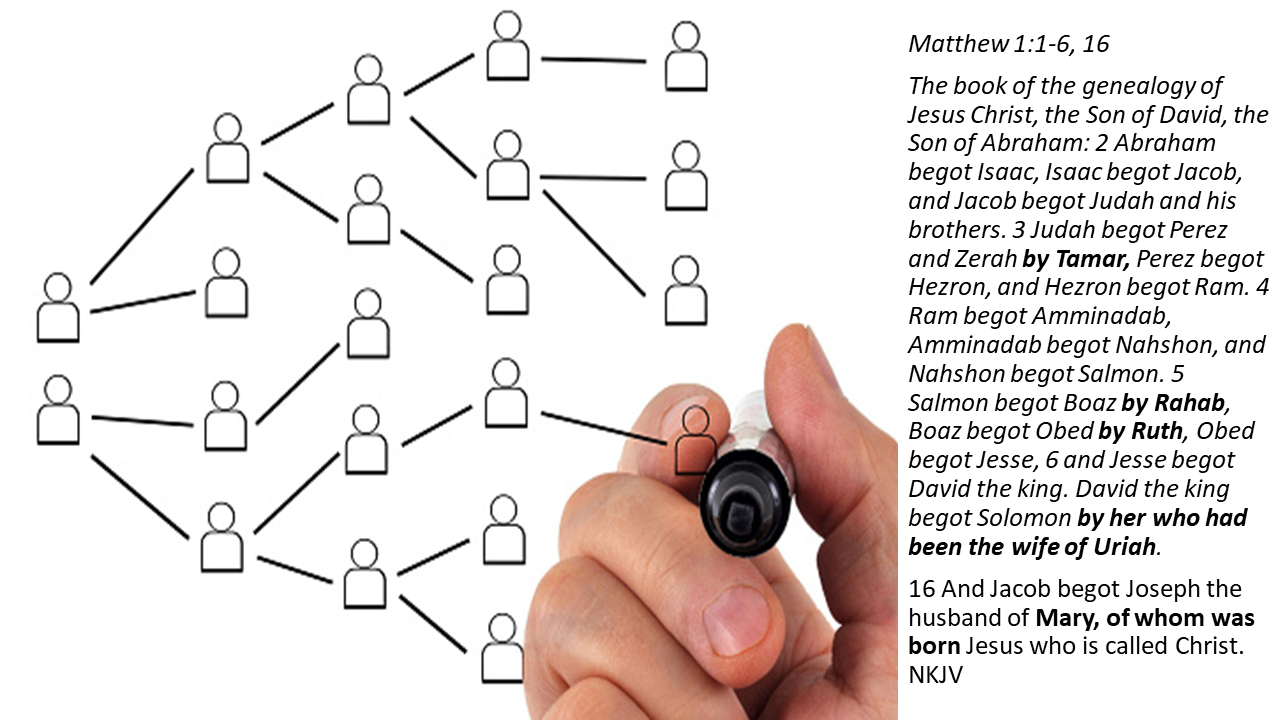
Matthew 1:1-6, 16 The book of the genealogy of Jesus Christ, the Son of David, the Son of Abraham: 2 Abraham begot Isaac, Isaac begot Jacob, and Jacob begot Judah and his brothers. 3 Judah begot Perez and Zerah by Tamar, Perez begot Hezron, and Hezron begot Ram. 4 Ram begot Amminadab, Amminadab begot Nahshon, and Nahshon begot Salmon. 5 Salmon begot Boaz by Rahab, Boaz begot Obed by Ruth, Obed begot Jesse, 6 and Jesse begot David the king. David the king begot Solomon by her who had been the wife of Uriah. 16 And Jacob begot Joseph the husband of Mary, of whom was born Jesus who is called Christ. NKJV
Read and pray.
Bathsheba is a Hebrew name that means ‘daughter of an oath, promise, or covenant’. What is so interesting about that name is, that it belonged to a woman who didn’t keep her oath, promise, and covenant.
What comes to your mind when you hear that name Bathsheba? Most often it is the sin of adultery that David and Bathsheba together committed against God and their marriage covenant, oath, and promises.
- But do you also think of Bathsheba’s loyal and faithful husband Uriah, betrayed by the king he served–as he was left to die under a barrage of arrows? Because Bathsheba failed to keep her promises…
- Do you think of what it must have been like as Bathsheba watched the army of Israel bringing Uriah’s body into Jerusalem after carrying him back the 44 miles from where he fell in battle? Because Bathsheba failed to keep her promises…
- Do you think of what it must have been like for her to have stood at the funeral for a fallen war hero and know that deep within her womb was the growing life whose conception prompted the murder of her own husband? Because Bathsheba failed to keep her promises…
- Do you think of a tiny grave that held the infant son that died by God’s judgment? Because Bathsheba failed to keep her promises…
- Do you think of how many times in the years that followed, when a place or person reminded Bathsheba of her youthful days of meeting and marrying her husband Uriah–and wouldn’t Bathsheba again remember why he died? Because Bathsheba failed to keep her promises…

So when Bathsheba (daughter of a promise) married Uriah (the Lord is my light) they became a wonderful picture of all the best that God offers us in this life. But after one very bad choice Bathsheba made, when ever we think of her we are reminded that when we fail to keep our oaths, promises, and covenants—God does not.
Bathsheba will always remind us that there are dire and inescapable consequences for sin.
So Bathsheba is forever associated with David and their sin. And that is because she failed to keep her promises. And because of the consequences that come from sin, Bathsheba was stained and her life marred.
But is that the end of the story? No, as we open to the New Testament we find one last mention of Bathsheba in a whole new light—the light of grace. Bathsheba’s name in the opening paragraph of the New Testament reminds us of the One who came as Paul says in Romans 5:20:
“… But where sin abounded, grace abounded much more” NKJV
Bathsheba on this side of the cross is a forgiven sinner and a portrait of God’s grace. Matthew 1 is the final mention of Bathsheba, the woman that became the stain on David’s record. Remember last time we saw that incredible postscript to an incredible life? Has God’s Word stopped you yet and made you soberly think about where your life, habits, and secret thoughts are headed?
Listen as I read and emphasize again that one word God emphasizes for us.
1 Kings 15:5 because David did what was right in the eyes of the Lord, and had not turned aside from anything that He commanded him all the days of his life, except in the matter of Uriah the Hittite. NKJV
God forgives the sins, and God forgets the iniquities. But the consequences and loss are recorded in the Bible, God’s forever settled in Heaven Word. Even here in Matthew 1 notice what God says and let it be a warning to flee sin and avoid lust all costs. If you and I don’t—it will cost us dearly.
None of the women—of all the women of the Bible—are more special than the five who actually open the pages of the New Testament. Who are they? They are the five precious wives and mothers tucked away in the genealogy of Jesus Christ. Why would God place them there in that usually “men only” genealogical section? You will see, as you read this chapter, encouraging applications these women offer as a testimony from their lives:
- Their lives give hope to those who have failed, and feel that it is impossible to ever go on and please God.
- Their lives give comfort to those who ache with pain from wounds, sorrows, and hurts that God has allowed to invade their lives.
- Their lives are an incredible source of strength to those who have a long struggle ahead. Knowing that God helped them, sustained them, and kept them going fosters confidence that no struggle will ever exceed His grace and power to uphold.

Each of these women was stained either by her own sin, the sins of another, or the scandalous plots of others. Only one word can adequately describe what God did in their cases—grace!
First, we will consider the fourth woman in that list who is alluded to in Matthew 1:6. The reason Bathsheba is here in this chapter is to remind us of the doctrine of God’s forgiving grace. That doctrine reminds us all that we are like…
Bathsheba—No Stain Is Too Deep for God’s Grace
The story of this fourth woman we have already seen in 2 Samuel 11 and 12. Bathsheba was in the wrong place at the wrong time—in all these areas we could call her “defeated”:
- She was unwise at best, to have washed herself, unclothed outside of her home.
- She was immodest in her display.
- She responded to David’s interest in her, even though she was another man’s wife, and he was another woman’s husband.
- She muffled her heart’s warning as God’s conviction was upon her conscience.
- She stifled the virtuous vows that she had made of lifelong loyalty to Uriah.
- She ignored the fact that God had given her a wonderful, courageous, loyal warrior husband.
- She yielded herself to passion, and the sin that would follow.
What did Bathsheba reap from all that defeat? Her husband, Uriah, was murderously slain, and the baby she had conceived by David choked out his life in death. Bathsheba and David—the grieving, sorrowing mother and the murderous, adulterous father—faced great sadness. And, after Nathan spoke to David about his sin, the world would forever know that Bathsheba was a defeated woman.
Her sin became monumental for all time. Numerous movies have even been made about her illicit romance, which was both public and shameful. Some people may think: Oh, I can do that, and no one will ever find out. We can cover our tracks! But the Scriptures say that whatever you sow, you will reap; and whatever you whisper in secret will be shouted from the rooftops (Matthew 10:27; Galatians 6:7-8).
What did God’s placing Bathsheba in Christ’s genealogy do? He graciously lifted her out of her pit of defeat. In doing so, God was saying, “Here’s a woman who is unworthy, who is a sinner. Though she’s done many things wrong, I’m going to let her be one through whom I will bring Christ into this world.” God also poured out His grace upon David and Solomon, from whom we’ve received a great deal of our Scripture. Through them, we learn about what it means to live wisely—to be someone after God’s own heart. And, according to His perfect plan, Bathsheba became a beautiful portrait of His grace, as we find in Matthew 1:6: “David the king begot Solomon by her who had been the wife of Uriah.”
Jesus loves to forgive and cleanse. He is waiting today, as He was in Revelation 2-3, for us to hear His voice, repent of our sin, and let Him wash us clean. Revelation 1:5 says that Jesus wants us to know Him as the One who “loved us, and washed us [kjv] and freed us [niv] from our sins.” No stain of the past, no sin of our youth, no failure in our home or marriage is too deep for the God of the Second Chance.
No failures are permanent with Him.
Take your burdens to the Lord right now, and start over. You may be estranged from your mother, father, or children, or grandchildren—Jesus can help. Bring that deep pain and sorrow to Him right where you sit and place it at His feet. The Christian life is a continual offer from God—new beginnings.
Bow before Jesus and start over as a mother or father for God, as man or woman of God, as a husband or wife for God, or as a godly boy or girl—right now.
When we look at the rest these women in the remainder of this chapter, we will be looking at women who were His beautiful portraits of grace—women who were defrauded, defiled, despised, defeated, or determined—yet, all were given a part in God’s grand and glorious plan!
If you are like most mothers, there have probably been times in your parenting when you have felt ready to quit!
Whenever that type of emotional tidal wave happens to sweep over you, remember these five incredible mothers who overcame great obstacles to shine through the centuries like the rare and precious jewels they are in God’s sight!
Now then, let’s meet the rest of these special women individually. Remember the reason these women are here in this chapter is to remind us of the doctrine of God’s forgiving grace. That doctrine reminds us all that we are like…
 Tamar—No Pain Is Too Great for God’s Grace
Thirty-eight centuries ago, in Genesis 38, we are introduced to Tamar. Whenever you think of her, think of a woman “defrauded.” One of Judah’s sons had married her, but was personally struck dead by God because he was a wicked sinner, a rebellious man. Judah promised, as was the custom, that he would get her a new husband.
Tamar put on her widow’s raiment and waited, and waited, but she was forgotten. Judah had taken care of everything else except for her. Tamar was lied to and overlooked, and she finally took the law into her own hands. Posing as a harlot, she had an incestuous affair with her own father-in-law. A child born out of wedlock resulted. God never condoned what she did; He just described it. Tamar was defrauded of many things:
- She was defrauded of a normal life.
- She was defrauded of a happy marriage.
- She was defrauded of a good name.
- She was defrauded of a sterling reputation.
Tamar was robbed of all these normal expectations by one thing— sin. She was a woman who was deprived by losing her husband. She was overlooked by her husband’s father. She then allowed sin to cause her to take matters into her own hands through an illicit union. But, in spite of all that, God compassionately looked down at her and said, “I have a plan for Tamar! She is a woman who portrays My plan—a wicked sinner, forgiven!” She was allowed to be part of the line that would bring the Redeemer to humanity— Christ, the One who perfectly portrays God’s grace! God graciously placed Tamar in Christ’s family tree, as recorded in Matthew 1:3: “Judah begot Perez and Zerah by Tamar ….” Do you have the pain of being wronged or defrauded by someone who promised love, took all you had, and then deserted you?
Then through your pain listen to the voice of Jesus as He whispers to you, like He did to Paul, “My grace is sufficient for you. My strength is made perfect in [your] weakness” (2 Corinthians 12:9).
Believe the truth and go on; let God fill you with the comfort and strength of His Word!
Remember the reason these women are here in this chapter is to remind us of the doctrine of God’s forgiving grace. That doctrine reminds us all that we are like…
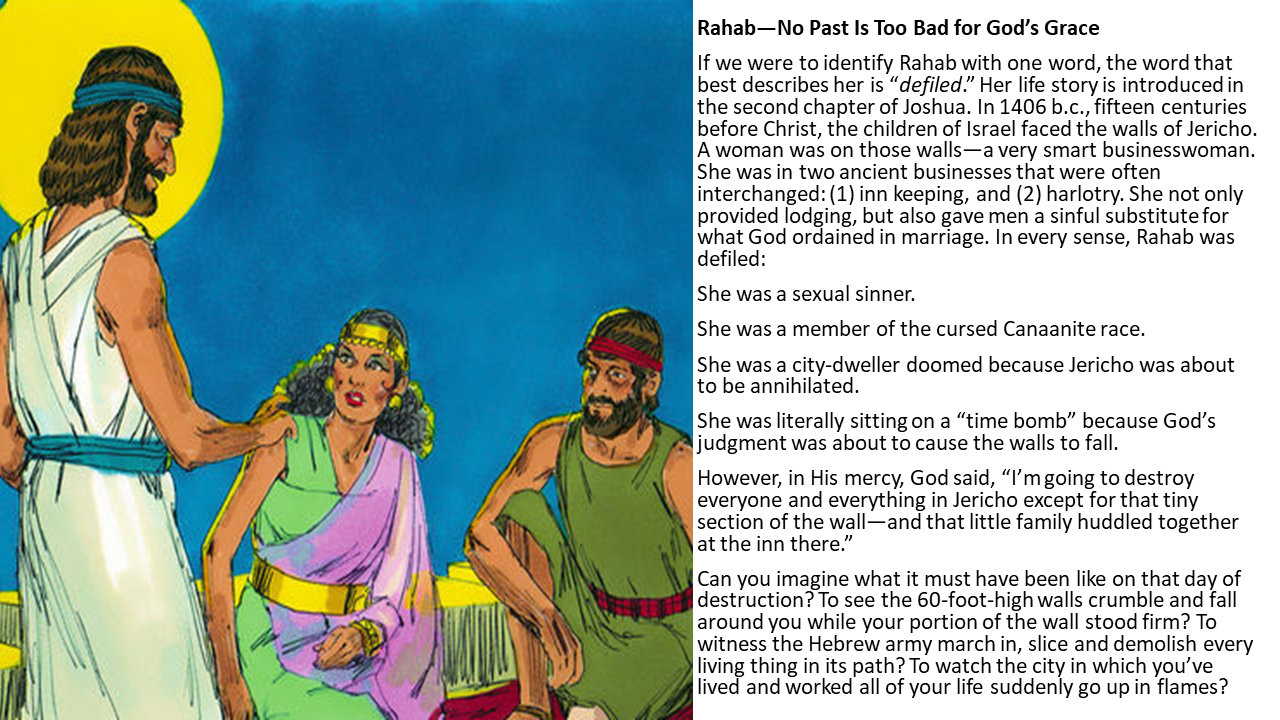
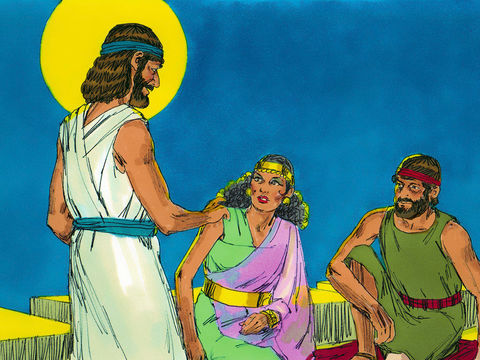 Rahab—No Past Is Too Bad for God’s Grace
If we were to identify Rahab with one word, the word that best describes her is “defiled.” Her life story is introduced in the second chapter of Joshua. In 1406 b.c., fifteen centuries before Christ, the children of Israel faced the walls of Jericho. A woman was on those walls—a very smart businesswoman. She was in two ancient businesses that were often interchanged: (1) inn keeping, and (2) harlotry. She not only provided lodging, but also gave men a sinful substitute for what God ordained in marriage. In every sense, Rahab was defiled:
- She was a sexual sinner.
- She was a member of the cursed Canaanite race.
- She was a city-dweller doomed because Jericho was about to be annihilated.
- She was literally sitting on a “time bomb” because God’s judgment was about to cause the walls to fall.
However, in His mercy, God said, “I’m going to destroy everyone and everything in Jericho except for that tiny section of the wall—and that little family huddled together at the inn there.”
Can you imagine what it must have been like on that day of destruction? To see the 60foot-high walls crumble and fall around you while your portion of the wall stood firm? To witness the Hebrew army march in, slice and demolish every living thing in its path? To watch the city in which you’ve lived and worked all of your life suddenly go up in flames?
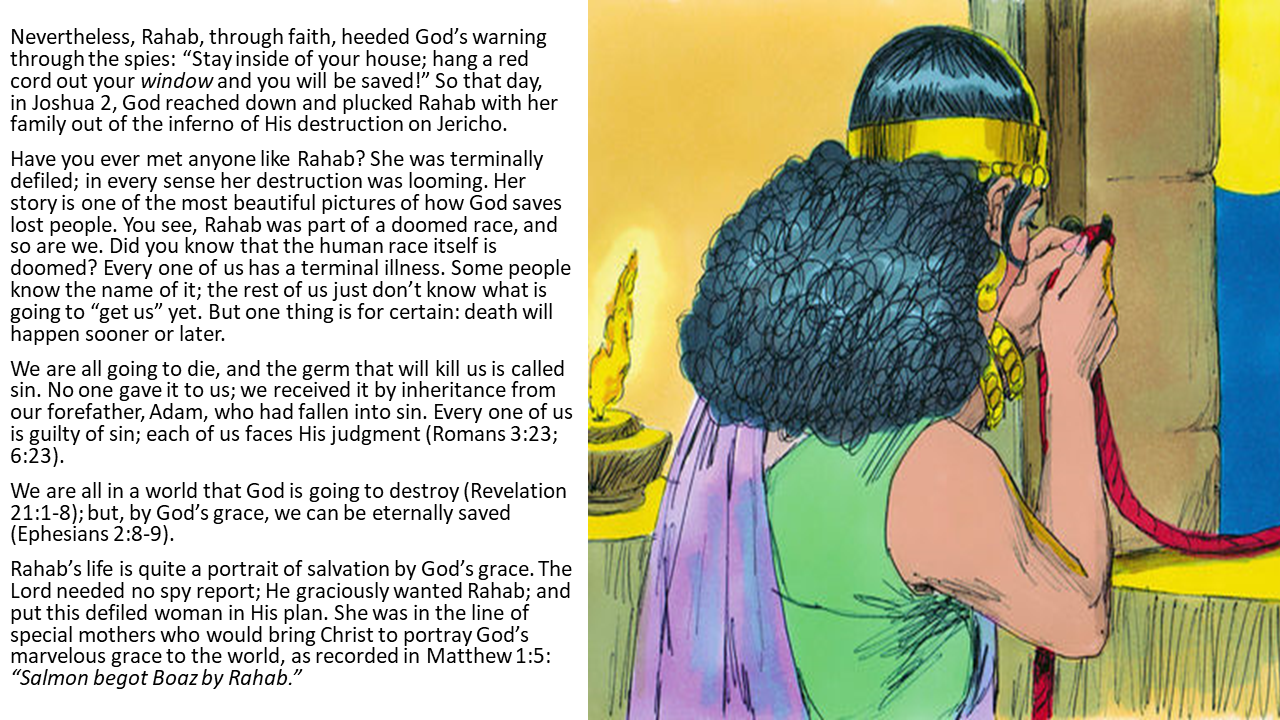
Nevertheless, Rahab, through faith, heeded God’s warning through the spies: “Stay inside of your house; hang a red cord out your window and you will be saved!” So that day, in Joshua 2, God reached down and plucked Rahab with her family out of the inferno of His destruction on Jericho.
Have you ever met anyone like Rahab? She was terminally defiled; in every sense her destruction was looming. Her story is one of the most beautiful pictures of how God saves lost people. You see, Rahab was part of a doomed race, and so are we.
Did you know that the human race itself is doomed? Every one of us has a terminal illness. Some people know the name of it; the rest of us just don’t know what is going to “get us” yet. But one thing is for certain: death will happen sooner or later.
We are all going to die, and the germ that will kill us is called sin. No one gave it to us; we received it by inheritance from our forefather, Adam, who had fallen into sin. Every one of us is guilty of sin; each of us faces His judgment (Romans 3:23; 6:23).
We are all in a world that God is going to destroy (Revelation 21:1-8); but, by God’s grace, we can be eternally saved (Ephesians 2:8-9).
Rahab’s life is quite a portrait of salvation by God’s grace. The Lord needed no spy report; He graciously wanted Rahab; and put this defiled woman in His plan. She was in the line of special mothers who would bring Christ to portray God’s marvelous grace to the world, as recorded in Matthew 1:5: “Salmon begot Boaz by Rahab.”
If your past is less than sterling (and whose isn’t?), always remember that this too is God’s offer of grace. What do I mean? Listen to the voice of Jesus as He spoke to another woman so much like Rahab in the New Testament, who wept about her sinful past, at His feet: “Her sins, which are many, are forgiven, for she loved much. But to whom little is forgiven, [the same] loves little.” (Luke 7:47) A stained past “forgiven” is the opportunity to “love much”—a wonderful, loving Savior who forgives much!
If you have never received Christ’s forgiveness you can have it today. One greatly defiled man came once to Jesus and said to Him, “If You are willing, You can cleanse me.” To which come Christ’s sweetest words, I am willing—be cleansed”!
To receive His cleansing forgiveness today all you need to do is to come to Him and say I need Your touch, I want to turn away from my sins (that is called repentance) and I believe You are my only hope (that is called faith). He does the rest.
Jesus said that all who come to Him—He will never cast out! Come to Him today.

None of these five special women deserved to be a woman of grace. None of them deserved for God to use them. All of them were women with a mark against them, and most were unqualified to serve in such a manner. Yet, God lifted up each of these special ladies as an example of His fathomless grace! Through their life experiences, women for all time can learn that:
- No pain is too great to be healed.
- No past is too bad to be forgiven.
- No problem is too big to be solved through Christ.
- No stain is too deep to be cleansed through Christ’s blood.
- No task is too great for God’s enablement.
As we look at the fourth woman and mother in this chapter, remember the reason these women are here in this chapter is to remind us of the doctrine of God’s forgiving grace. That doctrine reminds us all that we are like…
Ruth—No Problem Is Too Big for God’s Grace
It is in the second part of Matthew 1:5 that we see another special mother in Christ’s lineage. Ruth—could be described as having been “despised.” Yet, her life represents such a beautiful portrait of grace that God devoted a full Book to tell about it.
Ruth’s story began way back in Genesis 19. Ruth’s distant forefather—Abraham’s nephew, Lot—in the midst of a drunken orgy with his two unscrupulous daughters, sired Ruth’s race. It is noteworthy that in Scripture God doesn’t cut out any of the facts because they capture lessons He wants us to learn. He has always condemned drunkenness, and the various evils that accompany it. It should come as no surprise that the sins, which produced the tribe of Moabites, would lead to a people under God’s judgment.
These people whom God had cursed because of their wickedness were protected until Deuteronomy 23. Because the Moabites were from such a defiled and despised race, God announced that no Moabite could enter God’s assembly for ten generations. Therefore, though Ruth had done nothing personally to deserve it, she was despised by the Jewish people. Remember all the strikes against her?
- She was of the wrong race.
- She was out of the wrong family.
- She was tainted by a bad past.
- She was hounded by someone else’s sin.
- She was scarred by a family scandal.
- She was plagued by the darkness of a stain.

Additionally, after a short marriage, Ruth’s husband died; and a famine was all around them. God tells, in the Book of Ruth, one of the sweetest Old Testament stories of grace that has ever been written! What did He write? He reported how He graciously reached down and took a woman from a cursed race, a despised people, and said, “You come into My family!” Thus a man named Boaz took Ruth to be his wife, and she then, upon that marriage, became a woman of hope. Like Tamar and Rahab, Ruth was one through whom Christ would come—one through whom God gloriously portrayed His grace, as recorded in Matthew 1:5: “Boaz begot Obed by Ruth ….”
Adversity reveals who we really are. Its fires burn away only what is temporary, and leave behind what is permanent. What are your trials revealing? Peter said that God’s grace accepted in trials purifies us, and we become precious like costly gold. Give those big problems to the Lord; allow Him to refine you and do something you could never plan or imagine—and then He will get all the glory! Finally, we remember the reason these women are here in this chapter is to remind us of the doctrine of God’s forgiving grace. That doctrine reminds us all that we are like…
Mary—No Task Is Too Great for God’s Grace
The word that best describes the final woman of Matthew 1 is “determined.” What is interesting about Mary is that we have heard a lot about her that is not true, and we know very little about her from what the Bible records. In fact, books and books have been written about Mary, none of which contain facts from the Bible. What is in the Bible?
We know this to be truth: Mary was born a sinner. There is nothing in Scripture which says Mary was anything else other than a very normal sinner. She came to faith in the true God by acknowledging that she was lost without Him (Luke 1:47)
She quoted from the Old Testament, talking about the fact that God lifted her up out of the ash heap, out of the dung hill (I Samuel 2:7-8; Luke 1:52).
Mary, who wanted to know God’s Word and obey it, even as a young woman became quiet and determined. She kept on following and obeying the Lord—even through all this:
- She fell in love, and was engaged.
- She was visited by an angel.
- She received an unusual commission.
- She supernaturally conceived a child.
- She faced possible stoning because that was the penalty for fornication.
- She was scorned by others and falsely accused.
- After Christ’s birth, Mary patiently endured public shame for one third of a century—through the entire life and ministry of Christ.
- She was even “put in her place” by Jesus.
- She was continually saddened by her unbelieving sons.
- She never gave up; she determinedly pressed on in faith for God’s glory!
All that Mary was experiencing fit perfectly with God’s gracious plan: He had chosen her to be the “Mother of the Promise.” She bore Christ. She partook of grace. She rejoiced and said, “Oh, God, my Savior!” (Luke 1:47)
She ultimately became the one through whom “The Promise” arrived: “And Jacob begot Joseph the husband of Mary, of whom was born Jesus who is called Christ.” (Matthew 1:16)
The lesson for us today is to decide now that we are in this for the duration. We see our husband and children not just as they are, but how they will be by God’s grace. We do what we are called to do, staying in close personal touch with the Lord—and persist.
Mary is never mentioned again after Acts 1, yet she was so used of the Lord. Keep on keeping on—whether you are noticed or ignored, loved or rejected, needed or abused— and determine by God’s grace to persist no matter how great and overwhelming the challenge may seem.
Experiencing God’s Fathomless Grace

None of these five special women deserved to be a woman of grace. None of them deserved for God to use them. All of them were women with a mark against them, and most were unqualified to serve in such a manner. Yet, God lifted up each of these special ladies as an example of His fathomless grace! Through their life experiences, women for all time can learn that:
- No pain is too great to be healed.
- No past is too bad to be forgiven.
- No problem is too big to be solved through Christ.
- No stain is too deep to be cleansed through Christ’s blood.
- No task is too great for God’s enablement.
Have you personally ever been defiled by sin? Defeated? Defrauded? Despised? The good news is that “God [is] able to make all grace abound toward you, that you, always having all sufficiency in all [things], may have abundance for every good work. ”a. Regardless of your present circumstances, there is hope in Christ for the future! By God’s grace, you can partake of “The Promise.” You can trust Him, your Savior, to wash away whatever sin has been dragging you down—as far as the east is from the west. b.— so that He can look upon you in the righteousness of Christ!
Will you, then, as each of these five special mothers did, determine that by His grace you too will be energized by hope? What do I mean by that? Every child you bear, Mother, is marked by sin. All of them are already defiled. All of them, because they are sinners, are already defrauded out of the inheritance God wanted to give them. Every one of them is despised. Every one is defeated at birth by sin. But today, like the “Mothers of the Promise,” you can point your children to Christ; your life can be a portrait of God’s grace to them—a portrait of hope!
Will it be easy? No. Will it be worth it? Absolutely! And as long as you trust Christ to be your strength, you will never walk alone, for:
“He Giveth More Grace” He giveth more grace when the burdens grow greater, He sendeth more strength when the labors increase; To added affliction He addeth His mercy, To multiplied trials, His multiplied peace. When [you] have exhausted [your] store of endurance, When [your] strength has failed ere the day is half done, When [you] reach the end of [your] hoarded resources, [Your] Father’s full giving is only begun. His love has no limit; His grace has no measure, His power has no boundary known unto men; For out of His infinite riches in Jesus, He giveth, and giveth, and giveth again! — Annie Johnson Flint
Slides


Check Out All The Sermons In The Series
You can find all the sermons and short clips from this series, David’s Spiritual Secret here.
Looking To Study The Bible Like Dr. Barnett?
Dr. Barnett has curated an Amazon page with a large collection of resources he uses in his study of God’s Word. You can check it out here.