
Christ the Tabernacle
NR3-12 TAB-09 XAS-16
020609PM
The Tabernacle is God’s photo journal documenting salvation.
It is not an afterthought; it is His premeditated explanation of what Jesus would do perfectly on the Cross. The Tabernacle is the clearest portrait of Christ and His redemption to be found in any part of the Old Testament.
While God only uses one verse to record Creation (Genesis 1:1) and two chapters (Genesis 1-2) to explain it, He takes 15 chapters (Exodus 25-40) to describe the construction of the Tabernacle and 27 more to detail its operation (Leviticus).
This task was so important that God did not depend on the ingenuity of craftsmen to follow a blueprint; He came into them through His Spirit (Exodus 31:1-6) and guided each step of their work.
Before God sent a Person named Jesus Christ, He sent a picture called the Tabernacle. The Tabernacle is a photo album of the most detailed explanation of salvation in the Old Testament. The Tabernacle is the ABCs of Christian Doctrine, it is a systematic Theology that Paul actually uses in Romans to explain salvation. In the Old Testament, the Tabernacle is the dwelling place of God. In the New Testament, the Church becomes the dwelling place of God.
Transcript
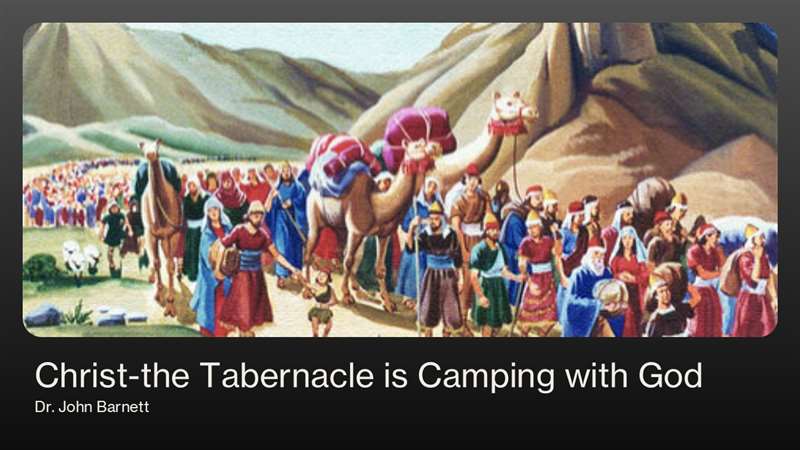
Let’s open our Bibles to the 10th chapter of Hebrews this evening. Tonight, we’re going to go on a camping trip, and we are going to go, as it were, camping with God. Our goal is, as you see on the screen, to look at the doctrine of Christ, to get a strategic grasp of the Bible. And tonight’s edition is going to be Camping with God in the Wilderness. Chapter 10 of the book of Hebrews, and I’m going to read the first 10 verses in just a moment.
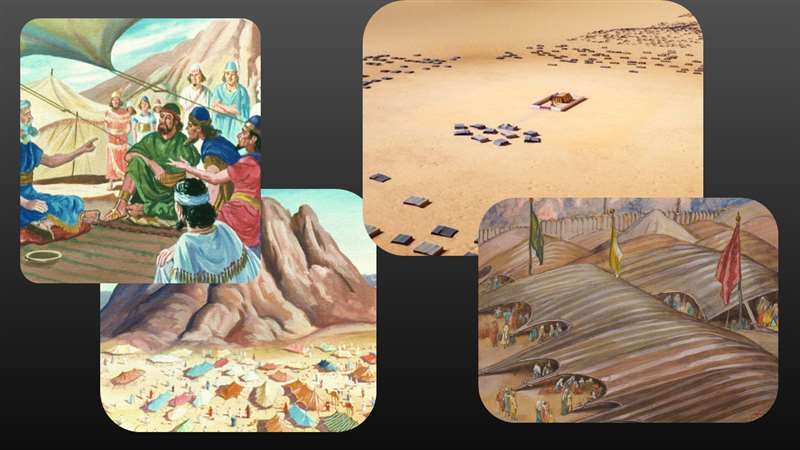
Camping with God in the Wilderness, there it is, and the next slide shows you what we’re looking for, and that is looking at the big picture of what God is doing. Remember, the Scriptures tell us that in the Old Testament we have the copy and shadow of the heavenly things. Now, that means the heavenly things are far better, and this is just a mere shadow of it. And therefore, in the book of Ezekiel and the book of Hebrews chapter 8 verse 5, and again chapter 10 where we’re going, and the book of Revelation, what we see is so awesome that the heavenly must be, as the prophetic writers found, just hard to express some of the things we’ve seen, and I’ll quickly review in the Old Testament, and the next slide will show that. You’ll have to go real fast on these men up there. We saw the whole outline of the camp of Israel. That’s what I mean, camping with Israel. You remember, the tribes were parked around the centerpiece of the tabernacle—Reubenites, Ephraimites, Danites, and Judites—all camping facing in. If you look at it on the next slide, a little bit more distant, we find by the numbers that if you look at the whole configuration from up above the camp, it was just a beautiful cross. If you add together all those tribes and numbers one through six, the next slide shows us that that is a beautiful picture of Christ. The four Gospels—the Gospel of Mark the Ox, John the Eagle, the perfect Son of Man in Luke, and the Lion of the tribe of Judah in the book of Matthew. So, that’s just summarizing what we saw last time.
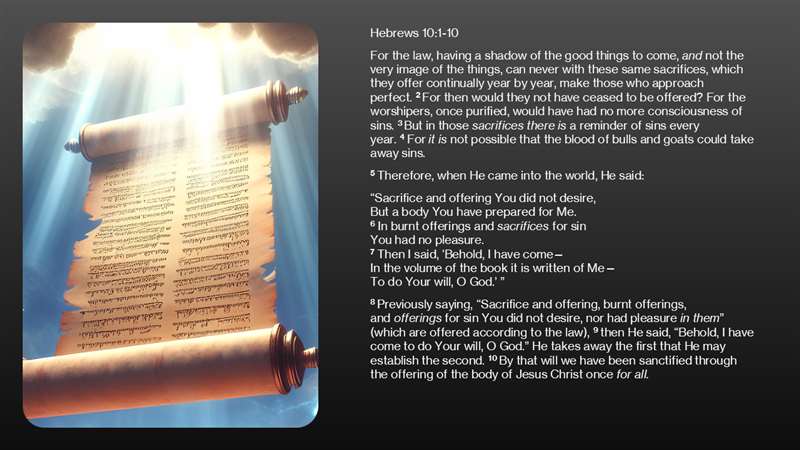
The next slide tells us this, that Christ is in all the Scriptures beginning at Moses and all the prophets. They are the ones that speak of Him. Now, look at chapter 10, and we’re going to read together in the book of Hebrews chapter 10, the first 10 verses, and we’re going to focus on that 7th verse. Okay? So, now that you have it, let’s stand together for the reading of God’s Word, and let’s look at these precious words. Hebrews 10, you follow along. For the law, by the way, it’s not just a tabernacle that’s full of pictures; the law of offerings, the law of feasts, the law of purification, all of those things. For the law, having a shadow of the good things to come, and not the very image of the things, just a shadow can never with these same sacrifices, which they offer continually year by year, make those who approach perfect. For then would they not have had ceased to be offered? For the worshiper[s], once purified, would have had no more consciousness of sins. But in those sacrifices, there is a reminder of sins every year—talking about the whole Levitical system. For it is not possible that the blood of bulls and goats could take away sin.
Therefore, when He—now we’re shifting gears talking about what’s better than that, the ultimate sacrifice, Christ. Verse 5, when He came into the world, He said. And now we start quoting the Old Testament; this is a prophetic picture of Jesus. Sacrifice and offering You did not desire, but a body You have prepared for Me. This is the Son talking to the Father and just a wonderful reminder of the triunity of God, the Father, the Son, and Holy Spirit. And here we find the Son speaking to the Father. In burnt offerings, verse 6, and sacrifices for sin You had no pleasure. In other words, God was not satisfied by those offerings. He was just covering over but not removing those sins. His wrath was not satisfied. His justice was not satisfied. It was just in abeyance; it was held back. Then, verse 7, I said—and this is Jesus again speaking—behold, I have come. Now, look at this: in the volume of the Book, it is written of Me—to do Your will, O God. Jesus came, and in the volume of this Book, and that’s why, to get a strategic grasp of the Bible, to make what we usually call the boring parts, Exodus, parts of it; Leviticus, most of it; Numbers, a lot of it; Deuteronomy, a lot of it, to make those parts come alive, you have to see what it says right there in verse 7. In the volume of the Book it’s written of Me. Jesus said, this whole Book is about Me. And that’s why, in the Scripture on the screen, He expounded them in all the Scriptures the things concerning Himself.
So, tonight we’re going to go camping with God in the wilderness. Let’s bow together. Father in Heaven, I thank You that in the volume of this Book, You wrote about Your Son who is our Savior. Thank You for what we learn about Him. He came to do Your will, and we who are Your children through the sacrifice of Christ, we who are fellow heirs with the Lord Jesus could do no better than to say the same and to say, we come to do Your will too. And so, we want to look in the volume of the Book at Christ. We want to see Him, and we want to lay hold of these truths. And then we want to say, O Lord, we want to do Your will, and we can do it tonight, and we can do it in the morning and until you come or call, as long as You give us breath. So, energize our hearts. It’s been a long and a full day, and it’s summer, and there’s so much happening in our lives, but we want to go camping with You, and we want to go to the wilderness, and we want to see that structure that’s such a beautiful picture of Your Son. And then we want to learn the lessons that You taught from it. And I pray You just enlarge our hearts, and our capacity, and our minds, and that You would open our wills, that we would say, we want to do Your will, O God. In the name of Jesus we pray, amen.
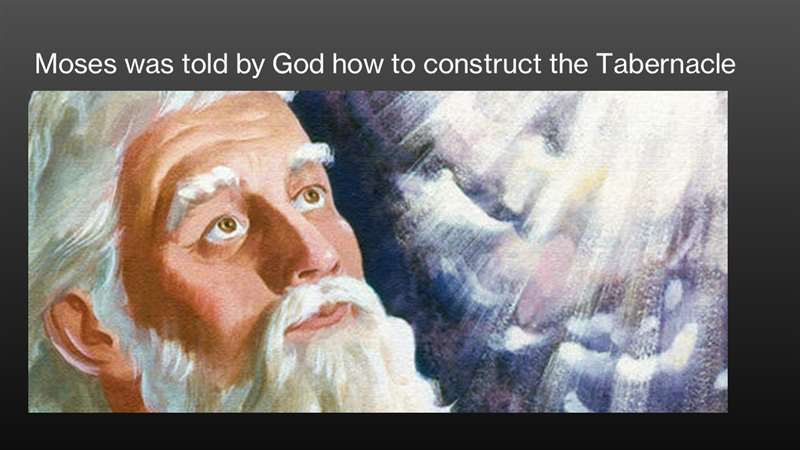
You may be seated. Next slide is a little reminder about the tabernacle, Christ tabernacled among us. In addition to those two tablets of the Law that were written and inscribed with the finger of God, Moses got the specs for the tabernacle. God dictated that. Moses also saw representation of what the heavenly sanctuary looked like and patterned the earthly one after that. The Scriptures devote, and we already saw this, more space, over 50 chapters, to what we’re talking about tonight than any other single object or topic in the Scriptures.
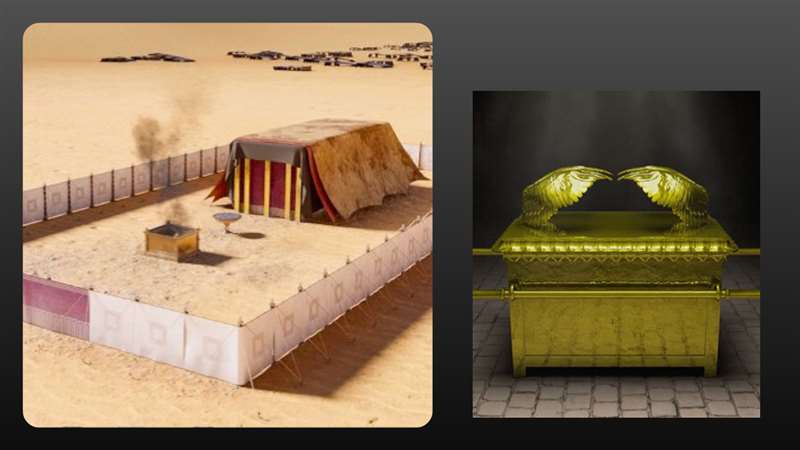
In the next slide, we see this structure. Now, this is where we’re going to slow down and think about it because the tabernacle, what you’re looking at, and this has just got all the little details. The 60 pillars on that left side supported a linen fence that was taller than any human being that was in the children of Israel. That’s seven and a half feet high. Then it gives all the dimensions; you see there the gate on the east side. It’s interesting, if you add together the circumference of the tabernacle, it exactly equals the size of the ark, and so it is just a little interesting. There are only three arks that are mentioned in the Bible: the ark of Noah, the ark that Moses was put in, and the ark of the covenant. And all three of them speak of a refuge, and safety, and something that brings God’s people deliverance. And so, the tabernacle is God’s photo journal that documents salvation. It is God’s premeditated explanation of what Jesus would do. And perfectly every single object right down to the boards of acacia wood, exactly how they were fitted together, every part of it. Even the mercy seat, which was made of the hardest known wood, that was the perfect wood to build with, overlaid with gold. Perfect grained wood overlaid with gold speaks of the deity of Christ and the perfections of His humanity. God even picked the right wood and the right metal to put over it.
But all of this reminds us that the tabernacle is the clearest portrait of Christ, of His redemption, that’s found anywhere in the Word. And before God sent a Person we know as our Lord Jesus Christ, God sent a picture ahead of time. Have you ever had to meet someone at the airport? We have often had to meet speakers or missionaries that we had never met that we were supposed to meet at the airport. And so, often they would send us ahead of time a picture. And I can remember many times standing there with a picture watching all those people come off, and I found out that speakers don’t give current pictures. They give a picture when they used to look nice, and so a lot of times they walk up and they say, ah, that’s me, I’ve changed a little bit! But before God sent a person, Jesus, He sent a perfect picture of Him, and that’s what we’re looking at tonight in the tabernacle. The key to the tabernacle, then, is Christ. And as we see in Hebrews 10, in the volume of the Book, it was written of Him. As a whole, this whole square, and in each individual parts, of the parts, the tabernacle foreshadowed the person and the work of Christ. Each detail is typified in some part of His ministry. Every detail from the purification laws to the cleansing laws, to the Firstfruits laws, to the whole sacrificial for overt sin, and just the regular offerings, every single part of it is typified, and foreshadowed, and fulfilled in the work of Christ.
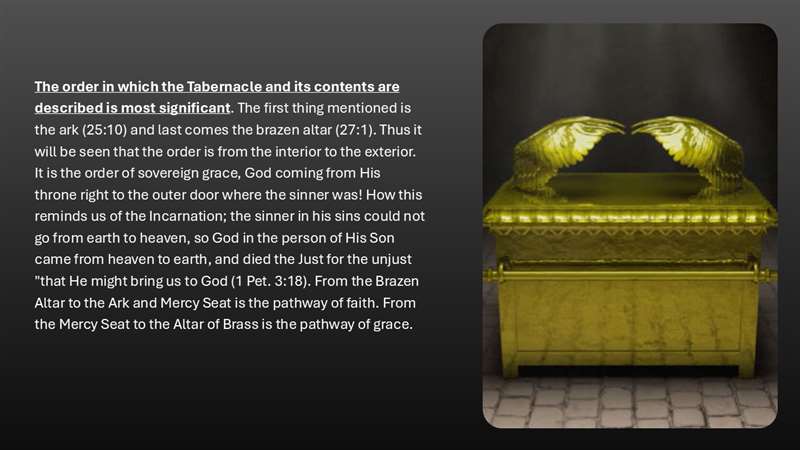
Well, let’s look at this. Number one, and I remind you every piece of furniture, every one we’re going to see, even the order, the placement, every one of them, every color God picked. Remember, He dictated it, so there’s a reason for it. Every material! I mean, God starts with the ugliest stuff on the outside. Boy, not us. We put the prettiest stuff on the outside. Not God. He put on the outside of the tabernacle proper goats’ hair, and badger skins, and stuff like, He just, or sea porpoises. He put the ugly stuff on the outside, and the further in you get the more beautiful, and the more lovely, and the more heavenly and divine it gets. And that has a purpose too. Every placement of the object says we’ll see, they all speak of Me. That’s what Jesus says to us tonight. Let’s begin with number one. Number one is this: the order of God’s introduction of the tabernacle is significant. It speaks of Christ. Now, what do I mean by that? Turn in your Bibles, chapter 25 verse 10, and this is the first three I alerted you of last week. But if you weren’t here last week, or if you weren’t paying attention, or if you just want to be reminded, okay, chapter 25 of the book of Exodus in verse 10. Look at the order. The first thing mentioned is the ark, Exodus 25:10. Now, this is God specifying what’s supposed to be made. The first one He mentions is, from His perspective, the most important, and that’s the ark and the mercy seat. Last, chapter 27 verse 1, comes the brazen altar. Now, that’s most important to us. That’s our entrance key, the cross of Christ. But the order of God’s instructions is very important. It’s the order of sovereign grace, God coming from His throne. Where was God enthroned with the children of Israel? He was enthroned over the cherubim in that first object, in chapter 25 verse 10. Over the ark of the covenant, over the mercy seat, over the cherubim, hovered the Shekinah, which was the visible representation, and so that was God’s throne. And so, this reminds us that from God’s throne, where He reigns—that’s typified and foreshadowed over that Shekinah—all the way to the front door where the sinner entered, that is a picture of His sovereign grace. Now, what is it a picture of? It’s a reminder to us of the incarnation, of the sinner and his sins who couldn’t go from Earth to Heaven, so God and the person of His Son came from Heaven to Earth. And so, God says, you can’t come to Me, so I make this tent, and I’m going to be sitting enthroned over the mercy seat, and you can approach Me if you come the right way. And that’s what’s in the background. The picture of the right way, through only one door, through a brazen altar that is burning there, and through the laver, and finally through the holy place into His presence. And so, from the brazen altar to the ark and the mercy seat is the pathway of faith to go in through that doorway, and walking in was the pathway of faith. But from the very back at the mercy seat all the way out to that door is the pathway of grace because it’s God that made the way for us. That’s His grace, and it’s us who come by faith. That’s the pathway of faith. And so, the order of God’s introduction of all of these objects speaks a very important message.
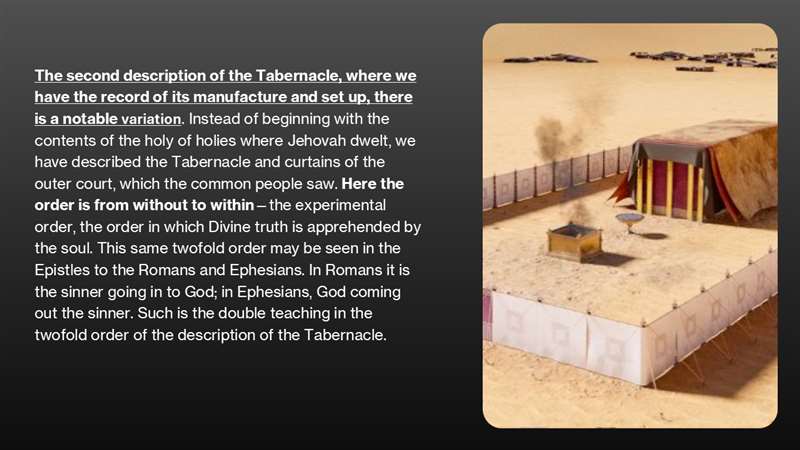
Number two, the second description of this tabernacle, the order God had it built was also significant. And that, as I told you, when you get past chapter 27, it starts recounting, and it starts in the exact opposite order. After 27:10, after the brazen altar is done, God flips around and starts at the doorway and describes it going toward Him. That is significant. The second description of the tabernacle, where we have the record of its manufacturing setup, there’s a total variation from the first account from 25:10 to 27. Instead of beginning with the contents of the holy of holies where Yahweh dwells, we have described the tabernacle, the curtains of the outer court. The first thing that people would see walking in from the desert was a pure white wall. Those outer walls, which you see there were really that color. The outside wall was pure white linen, and it was a reminder that God is holy, and you can’t approach Him in anything less than holiness, and so that’s where He starts. And so, the common people saw first those outer curtains, and here the order, secondly, is from without—that’s outside the gate—to within. It’s the order of experience. It’s the order of divine truth that’s apprehended by the soul. We come to God; we find He is holy, and so we walk all the way around this tent, and we find there’s only one door in. See, it’s the experiential finding the truth about God by looking at this tent, so the children of Israel had this thing parked in the center as a living object lesson every day. It would do us good to have some object lessons. Sometimes we get so detached, and the things of God get so abstract. Of course, they start worshiping the objects, and that’s why God gets rid of them. But I reminded you last time that the two orders, number one, going from the mercy seat out to the gate; and the second one we’re talking about going from the gate into the mercy seat, is a picture of the way that God has revealed the approach to Him. In the book of Romans, the sinner goes to God. Chapter 1 starts with all of us, the decline of all the human race, and we go all the way to the mysteries of God in 9, 10, and 11. That’s the whole flow of the book of Romans. Ephesians is exactly opposite. Ephesians starts, as it were, at the mercy seat and comes out. And the book of Ephesians starts in the heavenly places and comes to us. So, we see there’s such a great teaching in the twofold order, the description of the tabernacle.
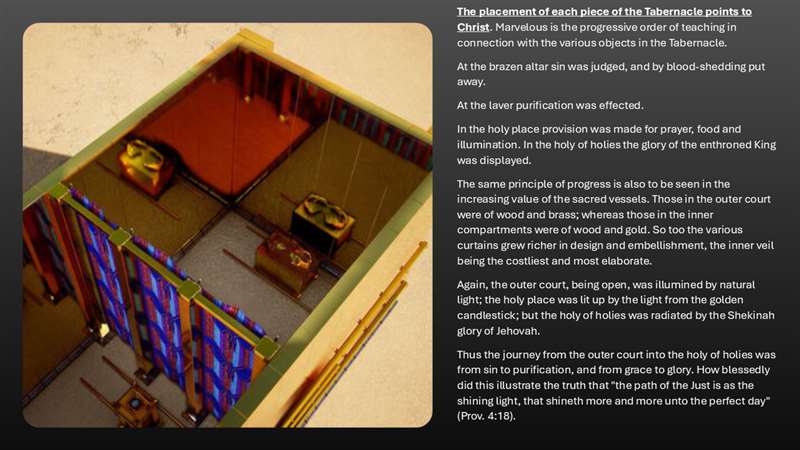
Thirdly, third slide, the placement of each piece of furniture is so important. And you say, what do you mean by that? Each piece, where it was put in there, points to Christ. What do I mean? Look at the next slide. God says, this is what I want you to do. I want you to put at the very back the mercy seat and the ark of the covenant. Then I want you to put at the exact opposite end the burnt offering altar, the brazen altar. Now, there are two altars. The brazen altar is the one that’s out here where the burnt offering and sacrifice was. There’s another golden altar, which is just before the veil, that’s where the incense was. But you see the placement of the ark of the covenant then in the center of the holy place that golden altar of incense, then the laver, then the burnt offering, brazen altar. But look how God had them put the lampstand way over on the edge and the table of showbread way over on the other edge to show the arms reaching out. And so, there is a beautiful picture of Christ even in the placement. At the brazen altar, as you walked in, sin was judged by blood shedding, which put it away. At the laver, purification was affected. In the holy place, provision was made for prayer. That’s what the altar of gold was with incense that was lit from a coal burned from the brazen altar in the holy place. Not only was prayer shown, but food, that’s the showbread, illumination. In the holy of holies, at the very back, the glory of God enthroned.
The same principle of progress is also seen in the increasing value. Everything outside of the holy of holies and the holy place was made of brass. Everything inside had to be made of gold. On the outside of this was the goats’ hair, black goats’ hair dyed red. Does that speak of anything? My heart was black with sin until the Savior came in. His precious blood I know—that’s red—has made me what? White as snow. You ever learn the kids’ songs? I did children’s church too many years; I think in children’s songs. That’s the picture. God had that whole ark, I mean that whole tabernacle. The back tent section was black, black with red on it. What a picture of my black sin and Christ’s blood, which covered in the Old Testament, and now washes away. The outer court were all wood and brass before the tent, whereas those in the inner court were all wooden and gold. The various curtains grew richer in design and embellishment, the inner veil being the most elaborate. So, the further in you get, the more precious it gets.
In the outer court, it was open, it was illumined by the sun, but when you get in the inside, it’s only illumined by that menorah, that little candlestick that’s over on the left side. But when you get into the holy of holies, there’s no human light. It was lit by the Shekinah burning glory out of God. So, it shows that the natural man might be able to understand this, but only with special illuminations can you understand the holy place, but no one can understand what’s going on in there apart from God. And so, there’s the progressive nature of the illumination shown by the lighting. And finally, the journey from the outer court to the holy of holies was from sin, which was dealt with out there at that brazen altar, to purification at the laver, to worship and fellowship with God to access into His presence. So, every placement of the pieces blessedly illustrates God inviting us into His presence.
Well, number four, let’s look at the next slide. And that is, the tabernacle was dictated by God Himself. This is where we ended last week, and I told you that no less than seven times, God says, nothing is left to your wisdom. Nothing is left to chance. Everything is to be in exact accord with His Word, and that’s why it’s so important for us to ponder what the Scriptures say.
Number five, the tabernacle was made to be temporary like our blessed Lord who stayed here on earth only temporarily. The tabernacle, only if you really study closely, from leaving Egypt to Sinai was a year, to the whole giving of the revelation and to the construction. If you take that until they got within sight of the Promised Land, that tabernacle was not in use in its normal way of being a portable tent any longer than 35 to 37 years. Very interesting, our Lord’s earthly pilgrimage was temporary too. And He lived probably 33 years on Earth, not very much less than that tent was in use. Now, at Shiloh, they permanentized it when they got to the promised land, but God said this thing, the one that we’re looking at, was to be very temporary. And so, that reminds us that our Lord Jesus Christ, His stay was brief. He lived also less than 40 years on Earth, and like the tabernacle, He abode not long in any one place but was constantly on the move. He was unweary. As the tabernacle was temporary, so Jesus Christ was temporarily abiding on Earth. As the tabernacle was not long in one place, Jesus Christ was not long. And one of the key phrases of the Gospel is that Jesus of Nazareth passeth by; He was always coming through, and He was temporarily there, and they needed to respond to Him while He was there. The fifth slide, the tabernacle was temporary.
Number six, the tabernacle was made for use in the wilderness. The wilderness is a striking reminder of the conditions into which Jesus tabernacled among us when He came. In the wilderness, the home of the tabernacle, it reminds us of the simplicity of Christ’s birth. He was born in a stable. This tent was made with common materials that the people had. God didn’t drop stuff from Heaven. They produced stuff from their homes to make it. Now, God made it very special in its design, but it was made of common materials. And so, we see that Jesus Christ was much like in the wilderness portrayed by the tabernacle. He had no place to lay His head. The borrowed tomb for His sepulcher. A careful study of the chronology reminds us that Jesus Christ was in the wilderness and was spending that time for 40 days fighting with the devil and overcoming him, and it’s a reminder of Jesus was prepared by God His whole early life growing up for that moment when He overcame Satan by perfectly obeying God. And so, this tabernacle was developed and for almost 40 years was to be a perfect way for the people to see how they could also overcome the world, the flesh, and the devil’s effects as they perfectly obeyed God. If they would’ve done what the tabernacle signified, they would’ve never had a problem just as Jesus Christ exactly fulfilled the volume of the Book and never had a problem seeing Satan defeated. It was a picture of the wilderness, and it’s a picture for us, as we’ll get to when we get to a little further, of even how to overcome temptation and how we can have victory in our lives when we see even the way that God designed it for approach and access to Him.
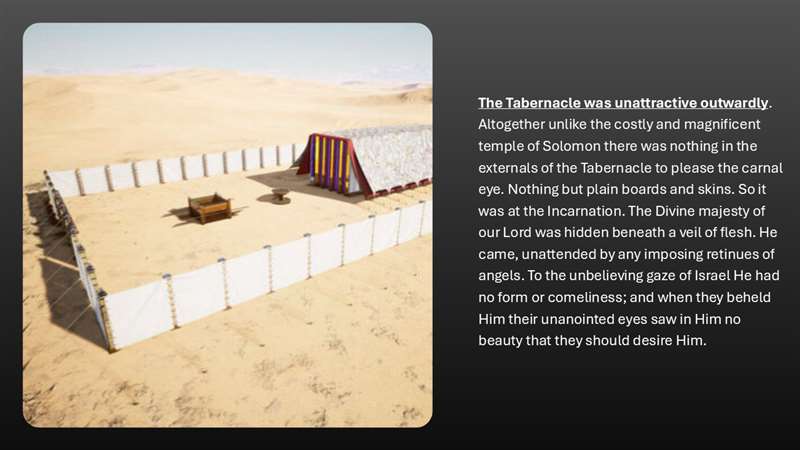
I don’t want to get off. Number seven, let’s go to the next one. The tabernacle, seventhly, was outwardly quite unattractive altogether. Unlike the magnificent temple of Solomon, which made the Queen of Sheba faint away, which made every nation envious to capture, and sack it, and loot it, and take away the billions of dollars. Conservatively, if we take a hundred-pound talent, and if we take David to have given exactly what it says—which I take the Bible literally—the temple of Solomon was worth in excess of $35 billion in gold and silver. A hundred thousand talents of gold and a million, that’s a hundred million pounds, of silver. That’s unbelievable. Unbelievable! But that’s not what this thing looked like. This thing was outwardly unattractive. There was nothing on the externals of the tabernacle to please our eyes, nothing but plain boards and skins over it. Isn’t that what Jesus Christ was? What does it say in Isaiah 53? He had no form or comeliness; when we look at Him, there’s nothing that we should desire. Did you ever think about the fact that Jesus was never described in the New Testament as striking? People didn’t go, oh wow. Oh man. Oh, never saw anybody that looked like that. What’d they say? Never heard anybody that what? Spoke like that. But His appearance was not remarkable. In fact, Isaiah says that there was nothing to look upon Him desirably. Now, it’s speaking of His disfigurement. But even in the Gospels, no one ever comments on the physical appearance of Christ, and that’s the first thing we note about people: what they look like, what their face looks like, what they’re dressed like. The tabernacle was outwardly quite unattractive. Jesus Christ, in His earthly pilgrimage, laid aside His glory, His splendor, His beauty, and was quite unattractive except to us that know Him, and love Him, and seek Him. So, it’s something to think about, to the unbelieving gaze of Israel as that tabernacle was not very pretty, so to the unbelieving eye of lost people, Jesus is not attractive. But when they behold Him with anointed eyes, when they saw the picture of this tent, when they saw the meaning of it, it became beautiful to them. And so, when we see Jesus Christ in His beauty and His glory, as we see Him with the eye of faith revealed in His Book, He becomes more precious than gold or silver. As we heard this morning, He becomes beautiful.
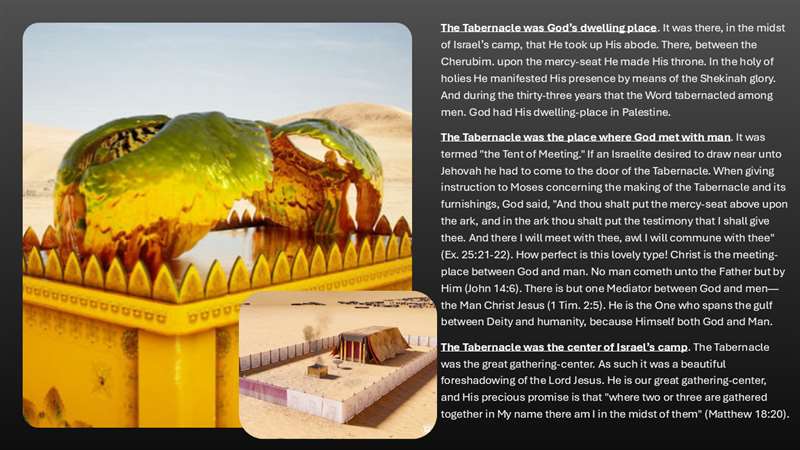
Well, number eight, the tabernacle also was God’s dwelling place. It was in the tabernacle, and there alone, in the middle of Israel’s camp that God took up His abode. He hovered, as it were, between the cherubim; upon the mercy seat, He made his throne. In the holy of holies, He manifested His presence by means of that glory cloud. And during the 33 years that Jesus tabernacled on Earth, God was with us. Very same picture. The only place the visible representation of God was during the wilderness time was over that tent. In fact, there’s a beautiful spot. Most people, when they think of Orlando, they think of all the movies, but there is a biblical site there. It’s called, what’s it called? The Holy Land Experience. It’s the Friends of Israel, or Zion’s Hope headquarters is there. And they have rebuilt this whole thing, and they have the most amazing thing. They make a glory cloud come right up over the mercy seat. You go in this special effects room, and they put this flaming cloud over it, and it’s very moving. It reminds you a tiny bit of what that must have looked like as over the mercy seat there was that Shekinah cloud. And straight up over that tent was the pillar of fire by night and the pillar of cloud by day, and that is where God says, I dwell. And that was where the visible presence of God was manifested. And so, when Jesus was promised to come, it says, thou shall call His name Immanuel, which being interpreted is what? God’s with us! He’s tabernacling among us. Jesus tabernacled for 33 years; God let this tent be with them for maybe 37 years. But those two remind us that that’s the presence of God.
Next, number nine, the tabernacle was not only where God dwelt, but it’s where God met with mankind. It was termed the tent of meeting. And then if an Israelite wanted to come near to Yahweh, he had to come to the door of the tabernacle. When giving instructions to Moses about making it and its furnishing, God says this. In fact, let’s turn, you’re in Exodus 27, turn back to Exodus 25. I want to show you this. Exodus 25:21, He says, I will put the mercy seat above upon the ark, that’s Exodus 25:21, and in the Ark, thou shall put the Testimony I shall give you. Now look at this, verse 22, and there I will meet with thee, and I will commune with thee. If you wanted to meet with God, you had to come to this tent. Isn’t that interesting? You couldn’t meet with God out somewhere on the mountain side. You had to have a locality then, and God was very localized then. And He said, if you want to come to Me, you must come to this tent, and you must come the right way, and you must come with the right procedure and protocol through the sacrificial system. And so, the tabernacle was where God met with man. Isn’t that what we see with the Lord Jesus Christ? Jesus Christ tabernacled among us, and how perfect and lovely is Christ as our meeting place between God and man! No one comes to the Father but by Him, John 14:6. And there is but one Mediator between God and mankind, the Man Christ Jesus, 1 Timothy 2:5. He is the One who spans the gulf between God—deity—and man—humanity. And it’s Jesus who has become the meeting place that joins Heaven to Earth, that joins the divine to the human. And so, as the tabernacle was where God met with man, Jesus and Him alone is where we meet with God. The tabernacle. In the volume of the Book, it speaks of Him. That was the only place you could have an appointment with God. Jesus is the only way to get access, an appointment, with God.
Number 10, the tabernacle was placed in the center. Now, I alluded this earlier, but the idea is this, God didn’t want it off their mind. He wanted them to know that was where He dwelled, and that was where they had to meet with Him. And so, to remind them, He put it right in the middle of the camp. Now, after they sinned, if you remember, they moved it out temporarily. And remember, Moses had to go outside the camp to meet with God because God was disgusted with their sin and their turning away from Him and wanted to destroy them, and so they moved the tabernacle. But God originally placed it right in the center of Israel’s camp, and the Tabernacle was a great gathering center. It was a beautiful foreshadowing of Christ. He is the One who said, where two or three are gathered in My name, I’m in the midst of that. And He says, if you gather, I’m there. Now, I know the context of that has to do with church discipline, but I don’t take that Matthew 18. I make Matthew 28 my verse. He said, lo, I’m with you always. I’m with each one of you individually, anywhere you are, especially when you’re involved in outreach for Me. But the tabernacle was in the center of Israel’s camp, and that’s a reminder that if you want to have a home that has God’s blessing, then the meeting with God and His Word should be in the center of your home.
It should not be a foreign thing to find the Bible opened and read aloud in your home, and in your marriage, and in your life. This Book should be, whenever you think of packing, this should be on your list. Whenever you think of grabbing something and going, this should be on your list. Whenever you think of having a moment to do something. Yesterday, the buddies wanted to go swinging at the park, and so I just grabbed my Bible, and I let them swing and I was reading. And one of the people came by and says, what are you doing? I said, I’m reading the Bible. People come to you, and you can witness to them. If you just sit with a Bible, they watch you. But God says, I want to be in the center of Israel’s camp. I want that to be on their mind.
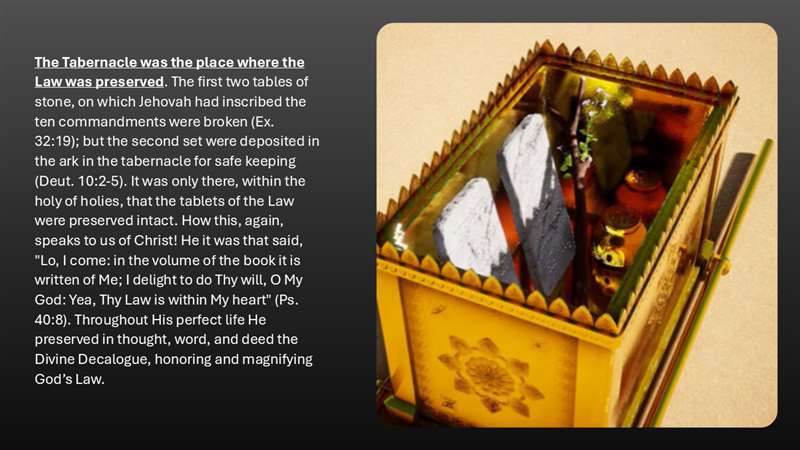
Number 11, the tabernacle, eleventhly, was where God’s Law was kept. The tabernacle is for the preservation of the Law. It says in Exodus 32 :19 that the first set of 10 Commandments that were broken were to go there. The second set was deposited there in the ark of the tabernacle for safekeeping; it says that in Deuteronomy 10. It was there and only there inside the holy of holies that God’s personal, written-with-His-finger-in-the-stone copy of His Word was to be preserved. It was kept under the mercy seat. It was there that the Law was preserved. And how interesting that that reminds us of Christ again. Because it says, in the volume of the Book it’s written Me—I delight to do Your will. Thy law, Psalm 40 and verse 8, is within my heart, Jesus [David] said. Jesus perfectly preserves the Word of God too. His heart contains God’s law, and that’s why when we let Him into our lives, the Word of Christ and God’s Word richly dwells in us because Jesus in us brings God’s Word inside of us. Just as the tabernacle was where God’s law was kept, we should keep Jesus Christ and His Word within us. We should let Him be at home, as it says in Ephesians, it says that Christ should be at home in our lives, that He should be a welcomed Guest, that He should be a part of our lives, that we should acknowledge Him often as we open this Book and invite His presence and Him speaking to us.
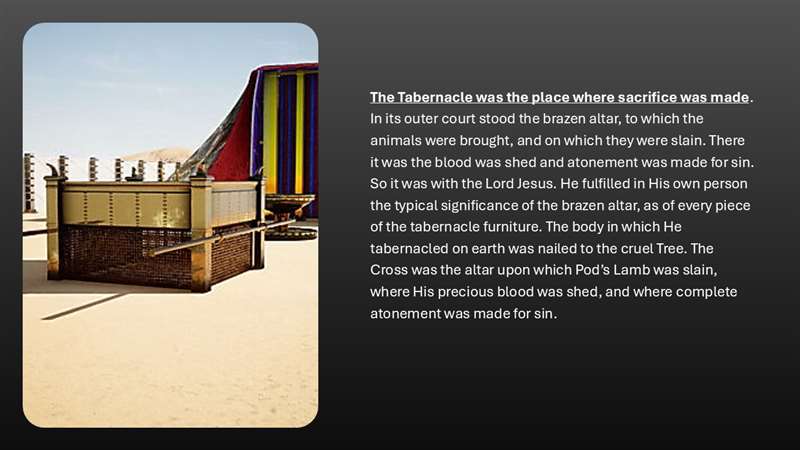
Twelfthly, the tabernacle was the place where the sacrifice was made. The outer court with the brazen altar, where the animals were brought and which they were slain, and where the blood was shed, and where atonement was made is the only place that sacrifices could be made. Only there. That’s where sacrifices were made. In that tabernacle, you couldn’t go off and do your own thing anymore. You had to do it there. So, Jesus Christ, He is the One that is our sacrifice. It was His body in which He tabernacled on Earth that was nailed to the tree. The cross was the altar on which God’s Lamb was slain. It was His precious blood that was shed, where complete atonement was made for sin. As that tent was where sacrifice was made, Jesus’ body is where the ultimate sacrifice was made. Such a complete parallel there.
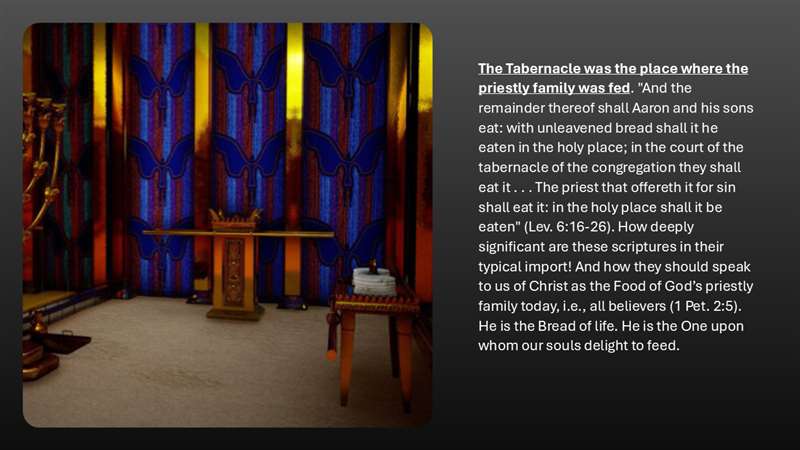
Number 13, the tabernacle was where the priests and their families ate. It’s just a little sideline, but it says in Leviticus 6 that the remainder Aaron and his son[s] shall eat, and that’s verses 16 to 26, and it says that they eat it in the holy place. They had to go in there inside the confines of that, those walls to eat. And it’s fascinating that the priests had to eat there. Now, for just a second turn to 1 Peter 2. That’s all the way to the other end of your Bible because you say, now there couldn’t possibly be a correlation there. Yes, there is, 1 Peter 2 and verse 5. It says, the priest that offers in Leviticus shall eat in the holy place. And how significant are these Scriptures when we’re reminded that they speak to us as Christ, as our food for the priest. Now look what it says in 1 Peter 2:5. It says, you also, as living stones are being built up a spiritual house. That’s the idea of this tabernacle. We are built up as God’s spiritual house. And then continuing, as a holy priesthood, we offer up spiritual sacrifices acceptable to God through Jesus Christ. Now, what about the eating? Back up to verse 2 and 3. As newborn babes, desire the pure milk of the Word, if indeed you’ve tasted the Lord is gracious. He’s talking then about, He’s the One that feeds us. In Hebrews 5 says, we should not keep on the milk; we should get the meat. So, don’t just stay with the milk; grow and mature. But just as the tabernacle was where the priests and their families ate, so we come as priests to Christ, and He is our bread of life. And that’s why I don’t just read this Bible because I’m supposed to, or because I have a chart, or because someone’s going to ask me. I’m hungry! Are you hungry? Look at what it says in 1 Peter 2:2, as newborn babies, desire the Word.
When one of our children was born, he lost almost half of his birth weight within the first couple weeks. Talk about a good diet! Some of you would really like that, but you don’t need it. He almost died. He just plummeted like that. We found out he had a broken shoulder. It hurt so much to nurse, he wasn’t interested. There was something wrong with him. He didn’t have an appetite, and he almost died. You know what? We see Christians, they’ve lost more than half their birth weight. They haven’t eaten for days, for weeks, for months, and they’re not hungry. And they’re walking around as emaciated, anorexic skeletons. Now, we don’t see that; we just see they’re wearing their church clothes and smiling, but God sees that they are not desiring the Word. And you know what? That calls for emergency measures. If you don’t have a hunger for God’s Word, if you are not a priest feeding in the holy place on the bread of life, Jesus Christ, then you’re sick, and you should get immediate attention. You should come to the Great Physician and say, search me, O God, and know my heart; and see what wicked way is in me that’s taken away my appetite. Every time the kids come to the table and they’re not hungry, we know that they have been eating before the meal. Right? Every time your wife makes a great meal, and you come home, and you’re not hungry, she finds out that you were snacking at the office or whatever else. That’s what happens. It takes away our appetite. Jesus says, I want you to come as a priests ate with their families in the holy place, I want you to come to Me and eat.
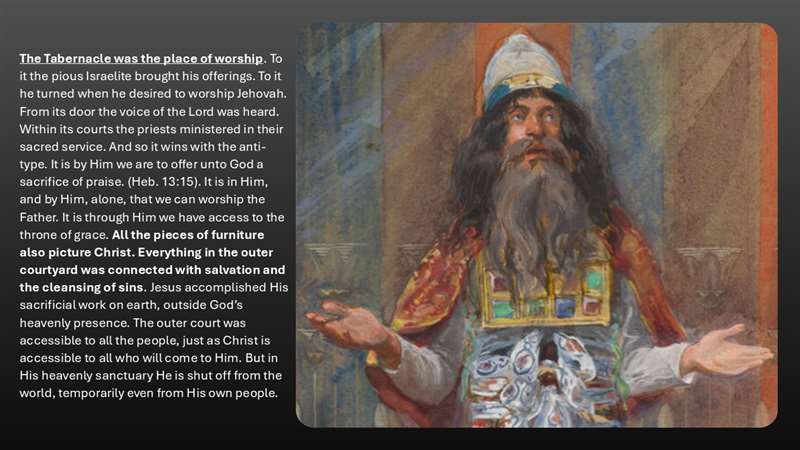
Let’s continue, number 14. As we’re learning about the tabernacle, fourteenthly, the tabernacle was the place to worship the LORD. To the Israelite, as he brought his offering, when he turned in desire to worship Yahweh, he had to come to this place. From the door, the voice of the LORD was heard. Within its courts, the priests ministered their sacred service. Now, you’re in Peter. Turn back to Hebrews chapter 13 and look at verse 15. This is so beautiful. If you wanted to worship God, that was the place you worshiped Him. You came there, you came bearing your offering, you came God’s way, and you came in. And through the progress of all the order and the steps, you offered your worship to God. Now look at Hebrews 13 and verse 15. Therefore, actually let’s back up. It’s talking about verse 10, we have an altar from which those who serve in the tabernacle have no right to eat. For the bodies of those animals, whose blood is brought in the sanctuary by the high priest for sin, are burned outside the camp. Hebrews 13:12, therefore Jesus also, that He might sanctify the people with His own blood, suffered outside the gate. That speaks of Him being crucified outside the city of Jerusalem, outside the Damascus gate, which is something we celebrate every time we go there. Verse 14, but we have no continuing city, but we seek one to come. Now look at this: till we get to Heaven. Verse 15, therefore by Him let us continually offer the sacrifice—using a little tabernacle term there—of praise to our God, that is, the fruit of our lips, giving thanks to His name. That was the place to worship the LORD. Now God says you can worship Me anywhere, but you can’t worship Me any way. You still have to come My way, and you still have to offer with clean hands, with clean heart. With a mouth, as Isaiah said, that is sanctified and purified by God, like the tong with the coals from the altar in Isaiah 6, and the seraphim cleansed his mouth. We have to offer with clean lives the sacrifice of praise, and that’s what God wants. What a reminder to us that the tabernacle was the place of worship, and it was in Him and by Him alone, Jesus Christ, that we can worship the Father. Through Him we have access.
Turn back to Hebrews chapter 4 and verse 15, another reminder. And we do not have a High Priest, Hebrews 4:15, that can’t sympathize with our weaknesses, but was in all points tempted as we are, yet without sin. Verse 16, therefore, let us therefore come boldly to the throne of grace, that we may obtain mercy and find grace. Do you see all of the throne and mercy? That’s the throne of God, the mercy seat, portrayed in the tabernacle but now embodied by Jesus Christ. See, we come boldly to Him and approach the very throne of God. You want to worship? You can worship anywhere, but you can’t worship any way. You have to come through the way of Jesus Christ, in His name, cleansed. That’s why the brazen altar reminds us that sin had to be dealt with, but the laver has to do with us keeping cleansed so we can come into His presence. That’s why if I regard iniquity in my heart, I have to stop at the laver. I have to have the washing and the sanctifying of God’s Word so that I can be cleansed. That’s why you know that if you don’t have a hunger for the Word, if you have not today found time to get into God’s Word and get God’s Word into you, and tomorrow and the next day go by, then you cannot worship God. You can’t approach Him because He cannot hear us, because our sins and iniquities separate us. That’s why we have to keep short accounts and keep cleansed.
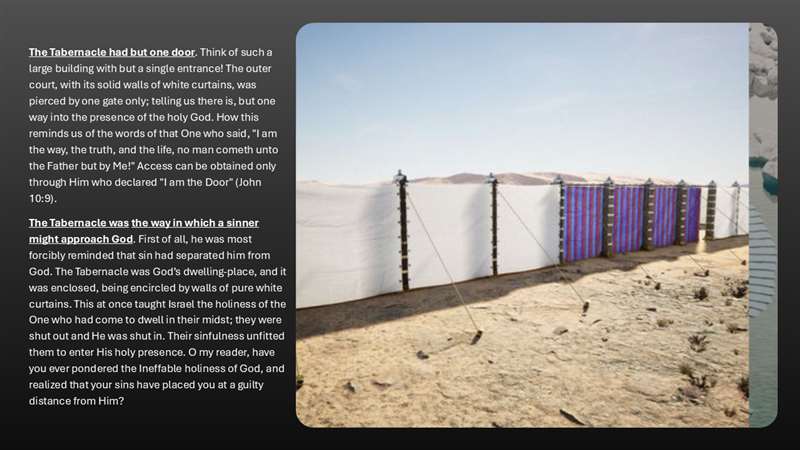
Number 15, we see that the tabernacle had but one door or one entrance, with such a large building, but only one entrance. The outer court with its solid walls, its white curtains, was pierced by only one gate, telling us that there is only one way into the presence of the holy God, and this reminds us of the words of Jesus who said, I am the way, I am the truth, I am the life. No one can come to the Father but by Me. And as we saw this morning, access can be obtained only through Him who said, I am the door. I am the door, as we saw this morning, John 10:9.
Finally, the tabernacle, number 16, the tabernacle was God’s way for a sinner to approach Him. God was reminding forcibly that sin had separated the sinner from God. That’s why he would come up and bump into that wall of white and that gateway where a priest stood and said, do you have your offering? You couldn’t come in, and God couldn’t be approached unless you came God’s way. Nothing has changed, and we have a world that is steaming toward ecumenical worship, and there is this growing idea of syncretism. We take a little bit from all the religions. We learn something from all of them, and God has many names, and God has many faces, but He’s the one true God. And snake handlers, and Hindu practitioners, and Christian Science practitioners, and Mormons, Unitarians, they can all come and talk to that one true God. He says, no, you can’t talk to Me. The tabernacle was God’s way for sinners to approach Him, and Jesus Christ reminds us forcibly that He is the One. And neither is there salvation in any other, for there is no other name under Heaven given among men whereby we must be saved. And our sinfulness unfitted us to enter God’s holy presence, and therefore the ineffable holiness of God is only approached by the perfect sacrifice of Christ.
Okay, so what can we conclude from this? That was just my introduction. Turn to Exodus 23. Okay, we have three minutes to get to conclusion. Exodus 23, and you might want to jot these in your Bible, okay. I call these lessons from camping with God, and the first one is in Exodus 23:15. And if you want to write by 23:15, I’ll tell you what, next time you read, when it comes to be January and you get steamed up to read the Bible through and you say, I’m going to try it this time. When you’re running out of gas and you get to Exodus 23, you’ll see this note in your margin: God desires our worship. Look at Exodus 23:15. It says, you shall keep the Feast of Unleavened Bread (you shall eat unleavened bread seven days, as I commanded you, at the time appointed, for when you came out of Egypt; none shall appear before Me empty). You know what He says? I don’t want you to come empty. I want you to come and worship Me. I want you to, now you say, wait a minute, what’s He specifically saying? Turn over to Exodus 28 now, verse 38. Same idea, but I want you to see it again, and I want you to really get this part all marked up, okay. Exodus 28:38, it says, so it shall be on Aaron’s forehead, that Aaron may bear the iniquity of the holy things and the children of Israel shall hallow all their holy gifts; and it shall always be on his forehead, that they may be accepted before the LORD. God wants us to worship Him. He wants to receive our worship. In the Old Testament, God says, I want, and I desire you to come. Don’t come empty handed; come and give Me something. So, lesson number one, this whole tabernacle, that whole sacred tent, tells us God desires our worship.
Now, look at chapter 25 of Exodus and verse 8. Here’s the second one. God not only desires to receive our worship; He wants to dwell with us. Exodus 25:8 says, let them make Me a sanctuary, that I may dwell among them. Now, that reminds us of what Jesus said. He says, behold, or Matthew said, behold, the virgin shall be with child, and bear a Son. You should call His name Immanuel, which is God with us. God, who desired in the Old Testament to dwell with them and said, I want a sanctuary, now He says, I’ve come to dwell with you, and whoever will call on My name, I will move into their life. I desire to dwell with you. That’s the whole idea of Exodus 25:8, God.
And a lesson from camping with God is number one, God desires to receive our worship. Number two, God desires to dwell with us. Number three, look at 25:22 of Exodus. And number three is God not only wants to receive our worship and dwell with us; God wants to meet with us. If nothing else draws you, this is what draws me. I’m as tired, probably, as all of you are, but every morning I have this insatiable desire to have the first and most important meeting of my day. God wants to meet with me; He waits to meet. Look what it says in chapter 25:22, talking about the mercy seat, but that’s our Lord Jesus Christ. And it says in Exodus 25:22, and I have written in my margin, God desires to meet with us. And He says, there I will meet with you, and I will speak with you from above the mercy seat, from between the cherubim which are on the ark of the Testimony, about everything I will give you command. God wants to meet with us, and God will speak with you. Isn’t that a blessing? Isn’t that a promise? Should make you wake up early tomorrow morning.
Okay, next, and the fourth point is in chapter 29 verse 42, and that’s where I want you to write this one. God, the God who desires to receive worship from us, and dwell with us, and meet with us. Chapter 29, verse 42 says this, there should be a continual burnt offering throughout your generations at the door of the tabernacle, Exodus 29:42, before the LORD, where I will meet to speak with you. God desires to speak with us. When He meets with us in His Word, if we have a prepared heart. That’s why I always pray the same verse, Psalm 119 verse 18, open my eyes, that I may behold wonderful things from Thy Word. I ask the Author that every time I open the book, and every time I open the book, if I have forsaken all known sin and sought His cleansing, and if I am not regarding iniquity in my heart and not longing and desiring something that displeases God, if that is how I prepare myself, then God will speak with me, and He talks to me through His Word. And I always listen to Him—reading His Word—before I talk—prayer. George Müller, the one of the greatest champions of prayer of all the history of the Church. George Müller, early in his life, used to pray and then read the Bible. He had his half hour prayer and then he read the Bible, and he found out his life dramatically changed when he asked God to open his heart, a brief prayer, and then he went into the Word, and after he read the Word, then he prayed. And so, first let God speak with us through His Word, then we speak to Him is the lesson of Exodus 29:42.
Number five, 29:46, you’re right there in the 29th chapter. If you want to write this there, God, the God who wants to dwell with us, and get our worship, and meet with us, and speak with us, wants to reveal Himself to us. It says in 29:46, and they shall know that I am the LORD, who brought them out up out of Egypt, that I may dwell among them. I am the LORD their God. He wants to reveal Himself to us. God wants to reveal Himself to you in your home. He wants to reveal Himself to you at work. He wants to reveal Himself to you in your personal and private life and all of our struggles. He wants to reveal Himself to us. This is what Jesus says, and I have written by all these points in the Old Testament a New Testament verse, and it says this in John 14:7 through 9, if you had known Me, you would’ve known My Father. Verse 8, Philip said, show us the Father. And Jesus said to him, in verse 9, he that has seen Me has seen the Father. God desires to reveal Himself to us, and He’s revealed Himself to us in Jesus. What does it say in Hebrews 1:3? Who is the express image of His glory and the exact representation of His person. God reveals Himself to us through Christ.
Now, to the book of Leviticus. Here’s the sixth point. Leviticus chapter 1, God desires, Leviticus 1 and verse 4, the same God who desires to receive our worship and dwell with us, and meet with us, and speak with us, and reveal Himself to us, number six, God desires to accept us. Now, think about that. People struggle with acceptance, and they feel that they have a poor self-image and all that stuff. I’ll tell you what, what will bolster how you feel about who you are: when God accepts you. It says in Leviticus 1:4, he shall put his hand on the head of the burnt offering, and it will be accepted on his behalf to make atonement for him. What is that? At that front door, see the guy leading the ox in? That man would stop there, and the priest would examine it to make sure that it was pure, and then the man would put his hands on the head of that animal, and he would be accepted by identifying his sins and his family sins with that substitute, that animal. Now, what does the New Testament say? Ephesians 1:6, to the praise of the glory of His grace, by which He has made us accepted in the Beloved. They had to be accepted by an ox. They put their hands on that smelly thing and got all this bloody gore. Now we’re accepted because Jesus Christ, once and for all, died in our place. God desires to accept us, and He accepts us into the Beloved through Jesus Christ. That’s the lesson you get from camping with God.
Here’s the last one, Leviticus 4 and verse 20, and then we’re done. By the way, I’m not here next week, and I always find out that they only go for about, till 10 to 7:00, so I’m giving you two weeks’ worth because they let you out early when I’m not here, so that’s why we’re going five minutes over, okay. Here we go. Leviticus 4 and verse 20, and it says, he shall do with the bull as he did with the bull as a sin offering; thus, he shall do it. And the priest shall make an atonement for them, and it shall be forgiven them, Leviticus 4:20. And then verse 26, look at the end of verse 26. All this stuff about burning the fat and all that stuff, and the priest will make an atonement for his sin, and it shall be, what does it say at the end of verse 26? Forgiven him. Look at verse 31, all this stuff and the priest burn[s] it and all that, and it says at the end of verse 31, and it shall be forgiven him. Look at verse 35, and he shall remove all the fat, as the fat of the lamb, removed of sacrifice of the peace offering. The priest will burn it on the altar, according to the offering made by fire. When the priest does all that stuff, look at the verse 35. It shall be forgiven him. What’s the lesson from this camp? God desires to forgive us. God wants to forgive us. He’s not holding back and saying, no, not one more time. I’m not sure I’m going to forgive you this time. The whole message of this tabernacle was God placed it right in the middle of the camp, and He says, you’re a sinful people and I know you’re going to transgress Me often, so I’ve made provision for that. You come this way with this offering, and I want to forgive you. Don’t ever forget that! God wants to forgive us. He doesn’t want us to walk around in condemnation and feeling like we’re unforgiven and unforgivable and we’ve gone too far. What does it say in the New Testament? Ephesians 1:7, in Him we have redemption through His blood, even the forgiveness of sins, according to the riches of His grace. In the Old Testament, every time they sinned, they had to bring a sacrifice. It held it off; it covered it over for a while longer. In the new covenant, we find that once and for all, 1970 years ago, God the Holy Father offered His own Son on the altar of sacrifice, on a cross of wood, and Jesus the Maker was crucified with carpenter’s tools on a cross of wood because God says, I desire to forgive. I desire it so much, I offer my Son, and God wasn’t absent that day. 2 Corinthians 5 says, unbelievably so, God was in Christ as He hung there, looking out through Christ, reconciling the world to Himself.
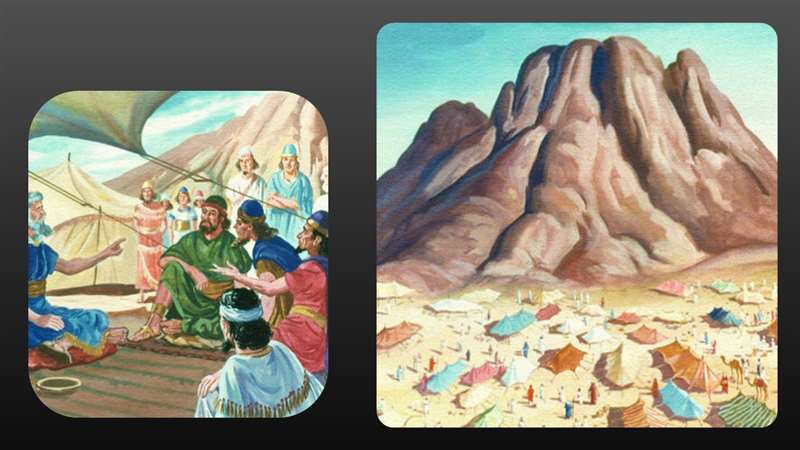
What are the lessons we get from camping with God? And that’s the last slide. What are the lessons from camping with God? Number one, Exodus 23 says God wants to receive worship from us. Exodus 25 says God wants to dwell with us. Exodus 25 again says God wants to meet with us. He wants to speak with us. He wants to reveal Himself to us. He wants to accept us, and He wants to forgive us. Let’s camp with God this week. Let’s camp out in this Book, and let’s start out going backward and say, God, You want to forgive me. I accept Your forgiveness! God, You want to accept me. I accept! I’m a part of your group. I am in Your family. That should give you the ultimate confidence in life. God wants to reveal Himself. Say, Lord, reveal Yourself to me. God wants to speak with us. Say, I’m all ears. God wants to meet with us. Say, when? My schedule’s open. You have an important, somebody you’re really looking forward to, some big wig, or some job you want, you say, oh, anytime. Anytime, I’m free anytime. Do you ever say that to God? Anytime. Anytime, meet with me anytime. No, we say, oh, I don’t have time for You. Let’s see, I’ll try and find, I didn’t have time today. How about tomorrow? See, we don’t treat Him like who He is. He desires to meet with us. When He meets with us, He speaks with us. He dwells with us, that’s why we fear not. And through all that, He wants to receive worship from us. I hope you’ll spend time camping with God this…
Let’s all stand and be dismissed with a word of prayer. My heart is that we dwell with God and let Him dwell with us. Let’s bow together. Father in Heaven, teach us to live what You say; make us children who’ll obey. Help us this week through the ministry of Your Spirit and Your Word to be holy in all that we do so that we can bring glory to You. To be like You, Lord Jesus, tonight, until we’re blissfully asleep; in the morning, when we first come to consciousness, may our hearts desire to be more like You. Thank You that You give us some lessons about camping with You. Thank You that You camped here temporarily on the Earth, in the wilderness of sin, to bring us to You, O God. Thank You, Lord Jesus, for having an earthly body, and thank You that You came to do the will of the Father. That’s what we want, and we pray that Your Spirit, through Your grace, through the power of the new covenant, would give us such a longing that we will be hungrier for You than for our necessary food and desire You more than wealth, or power, or pleasure. In the name of Jesus, all of God’s servants pray and say, amen. God bless you as you go.
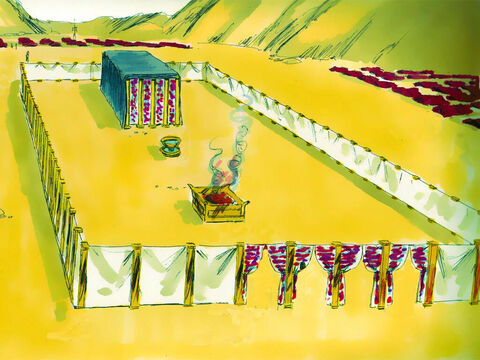
Before God sent a Person named Jesus Christ, He sent a picture called the Tabernacle.
The Tabernacle is a photo album of the most detailed explanation of salvation in the Old Testament. The Tabernacle is the ABCs of Christian Doctrine, it is a systematic Theology that Paul actually uses in Romans to explain salvation. In the Old Testament the Tabernacle is the dwelling place of God. In the New Testament the Church becomes the dwelling place of God.
The key to the Tabernacle, then, is Christ. In the volume of the Book it is written of Him. As a whole and in each of its parts the Tabernacle foreshadowed the person and work of the Lord Jesus. Each detail in it typified some aspect of His ministry or some excellency in His person. Proof of this is furnished in John 1:14: “And the Word became flesh and tabernacled among us” (R. V. margin). The reference here is to the Divine incarnation and first advent of God’s Sea to this earth, and its language takes us back to the book of Exodus. Many and varied are the correspondences between the type and the anti-type. We take leave to quote from our comments on John 1:14.
- The order in which the Tabernacle and its contents are described is most significant. The first thing mentioned is the ark (25:10) and last comes the brazen altar (27:1). Thus it will be seen that the order is from the interior to the exterior. It is the order of sovereign grace, God coming from His throne right to the outer door where the sinner was! How this reminds us of the Incarnation; the sinner in his sins could not go from earth to heaven, so God in the person of His Son came from heaven to earth, and died the Just for the unjust “that He might bring us to God (1 Pet. 3:18). From the Brazen Altar to the Ark and Mercy Seat is the pathway of faith. From the Mercy Seat to the Altar of Brass is the pathway of grace.
- The second description of the Tabernacle, where we have the record of its manufacture and set up, there is a notable variation. Instead of beginning with the contents of the holy of holies where Jehovah dwelt, we have described the Tabernacle and curtains of the outer court, which the common people saw. Here the order is from without to within—the experimental order, the order in which Divine truth is apprehended by the soul. This same twofold order may be seen in the Epistles to the Romans and Ephesians. In Romans it is the sinner going in to God; in Ephesians, God coming out the sinner. Such is the double teaching in the twofold order of the description of the Tabernacle.
- The placement of each piece of the Tabernacle points to Christ. Marvelous is the progressive order of teaching in connection with the various objects in the Tabernacle.
- At the brazen altar sin was judged, and by blood-shedding put away.
- At the laver purification was effected.
- In the holy place provision was made for prayer, food and illumination. In the holy of holies the glory of the enthroned King was displayed.
- The same principle of progress is also to be seen in the increasing value of the sacred vessels. Those in the outer court were of wood and brass; whereas those in the inner compartments were of wood and gold. So too the various curtains grew richer in design and embellishment, the inner veil being the costliest and most elaborate.
- Again, the outer court, being open, was illumined by natural light; the holy place was lit up by the light from the golden candlestick; but the holy of holies was radiated by the Shekinah glory of Jehovah.
- Thus the journey from the outer court into the holy of holies was from sin to purification, and from grace to glory. How blessedly did this illustrate the truth that “the path of the Just is as the shining light, that shineth more and more unto the perfect day” (Prov. 4:18).
- The Tabernacle was dictated by God Himself. No less than seven times are we informed that Moses was commanded to make the Sanctuary after the pattern of it which was shown him in the Mount—see Exodus 25:9; 25:40; 26:30; 27:8; Numbers 8:4; Acts 7:44; Hebrews 8:5. Nothing was left to man’s wisdom, still less to “chance”; everything was to be in exact accordance with the Divine model. Does not this teach us that everything concerning Christ and His people has been wrought out according to the eternal purpose of Him who worketh all things after the counsel of His own will! May Divine grace enable us to rest there in perfect peace and Joyous worship.
- The Tabernacle was made to be temporary. Like when our blessed Lord tabernacled here among men. His stay was but a brief one—less than forty years; and, like the type. He abode not long in any one place, but was constantly on the move, unwearied in the activity of His love.
- The Tabernacle was for use in the wilderness. The wilderness strikingly foreshadowed the conditions amid which the eternal Word tabernacled among men at His first advent. The wilderness-home of the Tabernacle unmistakably foreshadowed the manger-cradle, the Nazareth-carpenter’s bench, the “nowhere for the Son of man to lay His head,” the borrowed tomb for His sepulcher. A careful study of the chronology of the Pentateuch seems to indicate that Israel used the Tabernacle in the wilderness rather less than thirty-five years!
- The Tabernacle was unattractive outwardly. Altogether unlike the costly and magnificent temple of Solomon there was nothing in the externals of the Tabernacle to please the carnal eye. Nothing but plain boards and skins. So it was at the Incarnation. The Divine majesty of our Lord was hidden beneath a veil of flesh. He came, unattended by any imposing retinues of angels. To the unbelieving gaze of Israel He had no form or comeliness; and when they beheld Him their unanointed eyes saw in Him no beauty that they should desire Him.
- The Tabernacle was God’s dwelling place. It was there, in the midst of Israel’s camp, that He took up His abode. There, between the Cherubim. upon the mercy-seat He made His throne. In the holy of holies He manifested His presence by means of the Shekinah glory. And during the thirty-three years that the Word tabernacled among men. God had His dwelling-place in Palestine.
- The Tabernacle was the place where God met with man. It was termed “the Tent of Meeting.” If an Israelite desired to draw near unto Jehovah he had to come to the door of the Tabernacle. When giving instruction to Moses concerning the making of the Tabernacle and its furnishings, God said, “And thou shalt put the mercy-seat above upon the ark, and in the ark thou shalt put the testimony that I shall give thee. And there I will meet with thee, awl I will commune with thee” (Ex. 25:21-22). How perfect is this lovely type! Christ is the meeting-place between God and man. No man cometh unto the Father but by Him (John 14:6). There is but one Mediator between God and men—the Man Christ Jesus (1 Tim. 2:5). He is the One who spans the gulf between Deity and humanity, because Himself both God and Man.
- The Tabernacle was the center of Israel’s camp. The Tabernacle was the great gathering-center. As such it was a beautiful foreshadowing of the Lord Jesus. He is our great gathering-center, and His precious promise is that “where two or three are gathered together in My name there am I in the midst of them” (Matthew 18:20).
- The Tabernacle was the place where the Law was preserved. The first two tables of stone, on which Jehovah had inscribed the ten commandments were broken (Ex. 32:19); but the second set were deposited in the ark in the tabernacle for safe keeping (Deut. 10:2-5). It was only there, within the holy of holies, that the tablets of the Law were preserved intact. How this, again, speaks to us of Christ! He it was that said, “Lo, I come: in the volume of the book it is written of Me; I delight to do Thy will, O My God: Yea, Thy Law is within My heart” (Ps. 40:8). Throughout His perfect life He preserved in thought, word, and deed the Divine Decalogue, honoring and magnifying God’s Law.
- The Tabernacle was the place where sacrifice was made. In its outer court stood the brazen altar, to which the animals were brought, and on which they were slain. There it was the blood was shed and atonement was made for sin. So it was with the Lord Jesus. He fulfilled in His own person the typical significance of the brazen altar, as of every piece of the tabernacle furniture. The body in which He tabernacled on earth was nailed to the cruel Tree. The Cross was the altar upon which Pod’s Lamb was slain, where His precious blood was shed, and where complete atonement was made for sin.
- The Tabernacle was the place where the priestly family was fed. “And the remainder thereof shall Aaron and his sons eat: with unleavened bread shall it he eaten in the holy place; in the court of the tabernacle of the congregation they shall eat it . . . The priest that offereth it for sin shall eat it: in the holy place shall it be eaten” (Lev. 6:16-26). How deeply significant are these scriptures in their typical import! And how they should speak to us of Christ as the Food of God’s priestly family today, i.e., all believers (1 Pet. 2:5). He is the Bread of life. He is the One upon whom our souls delight to feed.
- The Tabernacle was the place of worship. To it the pious Israelite brought his offerings. To it he turned when he desired to worship Jehovah. From its door the voice of the Lord was heard. Within its courts the priests ministered in their sacred service. And so it wins with the anti-type. It is by Him we are to offer unto God a sacrifice of praise. (Heb. 13:15). It is in Him, and by Him, alone, that we can worship the Father. It is through Him we have access to the throne of grace. All the pieces of furniture also picture Christ. Everything in the outer courtyard was connected with salvation and the cleansing of sins. Jesus accomplished His sacrificial work on earth, outside God’s heavenly presence. The outer court was accessible to all the people, just as Christ is accessible to all who will come to Him. But in His heavenly sanctuary He is shut off from the world, temporarily even from His own people.
- From His heavenly place now, Jesus lights our path (pictured by the golden lampstand), “While I am in the world, I am the light of the world,” Jesus said (John 9:5). When He left the world, the world was left in darkness, and only for believers is He the light of life. He is the light that directs our paths, the One who, through the Spirit, illumines our minds to understand spiritual truth. He is the One who, by the indwelling Spirit, guides us through the world of darkness. He is our light.
- He feeds us (pictured by the table of sacred bread), and Jesus is our sustenance. He is our table of sacred bread. He is the One who feeds us every day, who sustains us with the Word. The Word is not only our food but our light. And the oil is the Spirit of God, who lights the Word for us.
- He intercedes for us (pictured by the altar of incense). The altar of incense pictures Jesus interceding for us, the perfect Sacrifice becoming the perfect Intercessor.
- The Tabernacle had but one door. Think of such a large building with but a single entrance! The outer court, with its solid walls of white curtains, was pierced by one gate only; telling us there is, but one way into the presence of the holy God. How this reminds us of the words of that One who said, “I am the way, the truth, and the life, no man cometh unto the Father but by Me!” Access can be obtained only through Him who declared “I am the Door” (John 10:9).
- The Tabernacle was the way in which a sinner might approach God. First of all, he was most forcibly reminded that sin had separated him from God. The Tabernacle was God’s dwelling-place, and it was enclosed, being encircled by walls of pure white curtains. This at once taught Israel the holiness of the One who had come to dwell in their midst; they were shut out and He was shut in. Their sinfulness unfitted them to enter His holy presence. O my reader, have you ever pondered the Ineffable holiness of God, and realized that your sins have placed you at a guilty distance from Him?
Seven conclusions about the heart of God
- God desires to receive worship from us. Exodus 23:15 “You shall keep the Feast of Unleavened Bread (you shall eat unleavened bread seven days, as I commanded you, at the time appointed in the month of Abib, for in it you came out of Egypt; none shall appear before Me empty); Exodus 28:38 “So it shall be on Aaron’s forehead, that Aaron may bear the iniquity of the holy things which the children of Israel hallow in all their holy gifts; and it shall always be on his forehead, that they may be accepted before the Lord. Now he receives our worship in Jesus. Hebrews 13:15 Therefore by Him let us continually offer the sacrifice of praise to God, that is, the fruit of our lips, giving thanks to His name.
- God desires to dwell with us. Exodus 25:8 “And let them make Me a sanctuary, that I may dwell among them. Exodus 29:45-46 “I will dwell among the children of Israel and will be their God.46 “And they shall know that I am the Lord their God, who brought them up out of the land of Egypt, that I may dwell among them. I am the Lord their God. Now He dwells in us through Jesus Matthew 1:23 “Behold, the virgin shall be with child, and bear a Son, and they shall call His name Immanuel,” which is translated, “God with us.” John 14:23 Jesus answered and said to him, “If anyone loves Me, he will keep My word; and My Father will love him, and We will come to him and make Our home with him.
- God desires to meet with us. Exodus 25:22 “And there I will meet with you, and I will speak with you from above the mercy seat, from between the two cherubim which are on the ark of the Testimony, about everything which I will give you in commandment to the children of Israel. Exodus 29:42-43 “This shall be a continual burnt offering throughout your generations at the door of the tabernacle of meeting before the Lord, where I will meet you to speak with you.43 “And there I will meet with the children of Israel, and the tabernacle shall be sanctified by My glory. Now He meets us in Jesus 2 Corinthians 5:19 that is, that God was in Christ reconciling the world to Himself, not imputing their trespasses to them, and has committed to us the word of reconciliation.
- God desires to speak with us. Exodus 29:42 “This shall be a continual burnt offering throughout your generations at the door of the tabernacle of meeting before the Lord, where I will meet you to speak with you. Leviticus 1:1Now the Lord called to Moses, and spoke to him from the tabernacle of meeting, saying, Now He speaks to us through the word of Jesus John 1:1In the beginning was the Word, and the Word was with God, and the Word was God. John 8:43 “Why do you not understand My speech? Because you are not able to listen to My word. 47 “He who is of God hears God’s words; therefore you do not hear, because you are not of God.” Hebrews 1:2 has in these last days spoken to us by His Son, whom He has appointed heir of all things, through whom also He made the worlds;
- God desires to reveal himself to us. Exodus 29:46 “And they shall know that I am the Lord their God, who brought them up out of the land of Egypt, that I may dwell among them. I am the Lord their God. Now HE REVEALS himself in Jesus John 14:7-9 “If you had known Me, you would have known My Father also; and from now on you know Him and have seen Him.”8 Philip said to Him, “Lord, show us the Father, and it is sufficient for us.”9 Jesus said to him, “Have I been with you so long, and yet you have not known Me, Philip? He who has seen Me has seen the Father; so how can you say, ‘Show us the Father’?
- God desires to accept us. Leviticus 1:4 ‘Then he shall put his hand on the head of the burnt offering, and it will be accepted on his behalf to make atonement for him. Now he accepts us in Jesus. Ephesians 1:6 to the praise of the glory of His grace, by which He has made us accepted in the Beloved.
- God desires to forgive us. Leviticus 4:20 ‘And he shall do with the bull as he did with the bull as a sin offering; thus he shall do with it. So the priest shall make atonement for them, and it shall be forgiven them. 26 ‘And he shall burn all its fat on the altar, like the fat of the sacrifice of the peace offering. So the priest shall make atonement for him concerning his sin, and it shall be forgiven him. 31 ‘He shall remove all its fat, as fat is removed from the sacrifice of the peace offering; and the priest shall burn it on the altar for a sweet aroma to the Lord. So the priest shall make atonement for him, and it shall be forgiven him. 35 ‘He shall remove all its fat, as the fat of the lamb is removed from the sacrifice of the peace offering. Then the priest shall burn it on the altar, according to the offerings made by fire to the Lord. So the priest shall make atonement for his sin that he has committed, and it shall be forgiven him. Now he forgives us through the sacrifice of Jesus. Ephesians 1:7 In Him we have redemption through His blood, the forgiveness of sins, according to the riches of His grace.
Check Out All The Sermons In The Series
You can find all the sermons and short clips from this series, Christ in all the Scriptures here.
Looking To Study The Bible Like Dr. Barnett?
Dr. Barnett has curated an Amazon page with a large collection of resources he uses in his study of God’s Word. You can check it out here.