
If the video above is not available, here are two other ways to view:
Crash Site – Suffer Loss Like Saul
060226AM
DSS-09
1st Corinthians 3
Transcript
.jpg)
You can turn with me if you’d like to Galatians 6. As you turn there, I’d like to share with you that I spent all week long sifting through the debris at the crash site of King Saul’s life.
.jpg)
I thought of the NTSB, the National Transportation Safety Board, which always rushes in whenever there’s a crash of a commercial airliner. They always go there, and they look at every twisted piece of wreckage and any little clue they can get. They are always looking for one thing. Remember, they always, even if it’s over the ocean, they go down and look until they find the black box, the flight recorder. So, this week, actually, it was a privilege to actually look at the flight recorder, the record of the life, and sift through all the little details that the Bible gives about why King Saul crashed and burned, why his life was, in God’s estimation, a waste.
Now, we might think we waste time, and you might think that someone wastes this or that, their money or their time, or their talent or whatever, but that’s just our opinion. But when God says that was a really serious waste. The flight recorder and all the debris trail of his life points to exactly why God said King Saul, one of the most monumental characters in the Scripture, one of the most gifted men that’s recorded for us in this book, God’s Word tells us why the flight got off course and why it crashed, and why he didn’t follow the flight plan that God laid out for him.
So, starting in chapter 6 of Galatians, I want to share the conclusion of all my siftings. Because I actually went through, again, everything recorded about his life, both in the Old and the New Testament. I sorted through and found no less than two dozen; there are two dozen specific themes in his life, King Saul’s life that are recorded that tell us. God points out something he did in opposition to or contrary to or against God’s revealed will. These are the clues that, when you piece them together, show why he was rejected, why his life suffered loss.
.jpg)
But before we go to the Old Testament and you sift with me through his life, I want to tie together first of all why we even want to do this. Why would we, as New Testament believers, even care about the first king of Israel? That’s the Old Testament; that’s the boring part of the Bible. The part that a lot of people don’t even really pay attention to nowadays. They aren’t sure what it’s about and why we even should read it. So, what I’d like you to look at is starting in Galatians 6. How did Paul and the other New Testament writers operate in their ordinary lives? How did they keep from crashing, or how did they keep from getting off course? That will help us because I don’t think any of us will ever be kings of Israel, but I think that all of us want to, in ordinary life, live a life that will not crash and burn, that will not, as we’ll see in a moment, Paul said, I don’t want to suffer loss. I don’t want to be disqualified. I don’t want to have my work that I offer the Lord rejected by Him.
So, as we look at Paul, we find that not just Paul, but those who are the most visible servants of the Lord in the Scriptures all operated the same way with the little things in life. The Lord said it’s not how you are in the big things. It’s he that is faithful in that which is least will also be faithful in the big things. A lot of times, we are just worried about the big things. Am I going to do this or do this? But it’s those little choices in life we’ll see from Scripture that make all the difference.
What is fascinating is that every one of the visible writers of Scripture all seems to keep track of their life, kind of like a day trader. You know what a day trader is? It’s someone who, due to the new electronic means, trades stocks and commodities on a daily basis. They just jump in and jump out of the market, and they always know how much they have and how much they can take as they hit or as a gain, and they just get out. They’re day traders, and there are a lot of people who do that.
In fact, with wireless laptops, if you go to a lot of resort places, you’ll see them as day traders making an income from their quick in and out of the different markets. Each of the New Testament writers, like a day trader, knew their investment and sought a return on each day’s work. That’s a keyword we’re going to see starting in Galatians 6 in verse 4. If you read closely, half of the books the Apostle Paul wrote in the New Testament, you find a common thread. God is going to examine Paul’s life individually for his works. Paul was really concerned about his work.
Now, in our segment of Christianity, evangelical Christianity, we’re so deaf to people’s works of righteousness that we’ve almost lost the reality that we were saved and created by God for good works. We so want to separate from those who think they’re earning their way to Heaven and think that their good works are going to outweigh their bad works, and they’re going to somehow get to Heaven because they have done a little extra, or given, or been something that we don’t emphasize good works. Paul did. Paul emphasized it emphatically.
What he said is that God is going to examine us individually for our works. Our works are what we did with our time, what we did with our energy, our resources, and what we did with our bodies. Starting in verse 4 of Galatians 6, but let each one examine his own work. Then he’ll have rejoicing in himself alone and not in another. In other words, it’s a very personal thing. It’s not a group project. I remember in school, you could coast sometimes. You could get into this group project, and if you had a really smart kid there, you knew you got an A. You just kind of showed up, and you just kind of all got the same grade in one work. He says, no, no, no, no. Verse 4: examine your own work. This is not a group project. This is an individual project.
Turn to the next book after Galatians. That’s Ephesians chapter 2, and look at verse 10. We know 8 and 9 for by grace are you saved through faith, and that not of yourself. Everybody knows that, but a lot of us stop short of verse 10. Look at Ephesians 2:10, for we are His workmanship created in Christ Jesus. Here’s the purpose of our being alive on this planet this very moment, indwelt by the Holy Spirit of God, created in Christ Jesus for good works. That’s why we’re here. That is what God is recording. That is what this flight recorder, the Bible, records about the lives of people; whether or not they were racking up by the power and energy of the Holy Spirit through the time that each of us is given the 168 hours a week, if they were getting recorded in God’s recorder with good works because that’s what we were created for.
Look at the next book. Let’s flip over Philippians and go to Colossians chapter 1 of verse 10. We’ll come back to Philippians, but Colossians 1:10, that you may walk worthy of the Lord, fully pleasing Him, and look what it says, being fruitful in every good work. The Apostle Paul wanted and prayed and longed for this church that he had never visited personally, never seen these people face to face. He says that later in the second chapter. He says, those of you whom I’ve never met personally. But yet his prayers and his teaching went to them, and that was that they would be fruitful in every good work that they would just be seeking in every way to be fruitful in redeeming time and making it good works for the kingdom of God.
I heard a great testimony this morning. Bob Nichols rushed down and was at the bedside of his almost 109-year-old grandmother, who died this week. He got there, and he said what struck him the most, not only was the glory of her passing into the presence of the Lord, but he said he looked up at the hospice and the caregivers that surrounded her at her death, and he saw the tears running down their faces because they so loved this woman that they had cared for. Now, I don’t know about the souls of those two women, but that was a beautiful picture of how you can redeem everyday life as a caregiver, as a nurse, as a person who’s working with the less fortunate, or the handicapped, or whatever. You can do that with the compassion and love of Christ in the name of Jesus.
We just had someone stop by yesterday off the street. They walked in, they were wandering around, and of course, they sent them to me. This person, the first thing they said was I am a satanist. I’m a servant of Satan, but I’m in desperate need. I thought, what a bad way to introduce yourself in this church. But I listened to the story, a drug addict, an alcoholic just released, and all this terrible stuff, and everything. I looked at them and shared the Gospel. Every time I said the name that is above every name, the name of Jesus, they just winced like that because I really believed they were probably inhabited by foul demons.
But when I got all done, I said, yes, I’ll help you because Jesus said, as much as lies with us, do good to all men. I said, so I’m going to give you something. I said something temporal and something lasting. I put the two together, and I said, I’m giving you this in the name of Jesus Christ. I don’t know what they did with that gift. They said they needed a ride to Austin. They might have just gone down here and drank it away. But you know what? If you offer it in the name of Jesus Christ, if you redeem your time, your treasures, your caregiving for Him, then we will be, verse 10 of Colossians 1, fruitful in every good work, increasing in the knowledge of God.
Keep going to 1 Timothy. Go to the right. Colossians, 1 and 2 Thessalonians, 1 Timothy. Look at chapter 6. This is to those successful business people who were living in Ephesus at the end of the 1st century, and Ephesus was the kind of New York City of the day. It was a great place. Paul is encouraging the pastor of that church, that great church, Timothy, to teach the successful business people. Look what he says in verse 18 of chapter 6 of 1 Timothy. Let them do good. Look at verse 18, right in the middle, that they may be rich in good works. Rich in good works.
Do you ever measure your wealth in good works? Not in corporate profits, not in the class of stock preferred, not in the dividend rate, not in the return on investment, not in the appreciation of the market value of whatever, not in the explicit collectibles and how they’re retaining their value. But are you ever measuring, verse 18 of 1 Timothy 6, your wealth as being rich in good works? That’s how God measures that. That’s how the flight recorder at the crash site recorded negatively that King Saul was not rich in God’s sight. He crashed and burned, and his life was rejected because he did not live out God’s purposes. He wasn’t rich in good works.
Look at the next book. 2 Timothy, then Titus chapter 3. So, go to 1 Timothy 6, and then 2 Timothy, the four chapters, and go to the third chapter of Titus, and look what it says. This is a faithful saying, Titus 3:8. And these things I want you, Titus, another disciple of Paul, another young pastor that he was nurturing, cultivating, and explaining how he was supposed to do as an island ministry out there in Crete. This is what I want you to know, Titus 3 in verse 8. These things I want you to affirm constantly that those who have believed in God, that’s us today, like them back then, should be careful to maintain good works.
I’ve been maintaining my roses. Around Christmas time, I always trim them right down to within a threat of their lives. Boy, I have roses all the way through till October. If you take care of them and give them what they want. I just found a secret ingredient. I’m not going to tell any of you about the secret ingredient that you get for free. They throw it away, and you can get these big bags of coffee grounds at Starbucks, and they’re free, and it makes your roses really good. A lot of you think I drink that coffee. I don’t. I take the grounds home and give it to my roses. They drink it. But if you maintain them, your flowers, your animals, whatever you have, your machines, they will produce what they’re intended to.
Look what it says here. If we believe in God, we should be careful to maintain good works. These things are good and profitable to men. God rewards us for maintaining and harnessing our energy in the service according to His will of others and of His kingdom. So, those who believe in God, Titus 3:8, should carefully maintain good works.
.jpg)
Okay, let’s look at Peter. So, go by Titus, Philemon, Hebrews, and James. Look at 1 Peter. Keep going to the right. We’re doing that, but Peter said the same thing. He strongly urged the saints in 1 Peter 1 in verse 17 to be careful what they did with their days and hours. He says, and I call on the Father who, without partiality, 1 Peter 1:17, judges according to each one’s works. So, Peter was caught up with this whole concept of the fact of being judged for good works.
Now, John. Keep going past 1 and 2 Peter, look at 1 John 2, and verse 28. Because John the Apostle was also convinced that we would either welcome Christ coming or wither and shame before Him when He looks into our little basket, when He looks into what our treasures are, what we live for, our work. 1 John 2:28 is what the Apostle John said. He said, and now little children abide in Him. This is the same fellow who wrote John 15, recording Christ’s words about abiding. So, he picks up that same idea of how to live the Christian life. He says, and now little children, believers, 1 John 2:28, abide in Him. Abide in Christ. Abide in the one who is your vine. So that when He appears, and He’s going to appear, and He’s coming. John wrote the most about that in the next book, Revelation, which he wrote. But he says, and when He appears, verse 28 says, we may have confidence.
But here’s the other option: by neglect, by default, by not heeding, not following, not walking in the Spirit, look what can happen, verse 28. And not be ashamed before Him at His coming. The same thread goes all the way through the New Testament. Jesus warned that some servants, He’s going to say, you were not a good and faithful servant. That’s picked up by the apostles. Paul said, I don’t want to be disqualified. I don’t want to suffer loss. I am pressing toward the mark, the prize of the high calling. I want to hear His well done. Peter says, watch out, this judge is going to judge everyone according to their works. John says, you don’t want to get in a position when He comes that you’re ashamed in the presence of the one who loved you and gave Himself for you. Don’t live in such a way, don’t produce works, the harnessing of your life, and your time, and your energy, and your body into things you’re going to be ashamed of at His coming.
What’s going to happen at His coming? We’ll look at the very end, the last chapter of the Bible. It is always fun when something’s in the very last chapter, so you can say the very last word. The last chapter, Revelation 22, and verse 12. In fact, John records the closing words of the Bible, and at the very end, the Bible points to the same truth. This is what the Lord Himself says in Revelation 22 in verse 12. And behold, I’m coming quickly. My reward is with Me. Misthos, that word reward is the same word all the way through, reward, reward, reward. When it talks about the rewards for believers, and rewards, and rewards, it’s the same concept. There’s no breaking from this flow to the very last chapter. It’s the thread that’s continuous. My reward is with Me.
But how do you get it? To give to everyone according to his work. It’s not a group project. It’s not being in the right church. It is not being on the right team. It’s what you did individually. According to His work. It’s an individual assessment. John says, and we saw in chapter 2:28 of his first epistle, he says, we can be ashamed before Him, or now we have to back up.
Look at 2 Timothy 4. Here’s the other choice. Either be ashamed or 2 Timothy 4, look how Paul was at the end of his life. He wasn’t ashamed. It says in 2 Timothy 4 verses 7 and 8, these are his last words as it were, the Apostle Paul. He said, I’ve fought the good fight. I’ve agonized the good agony is what he said. Agōnizomai, I have agonized through life. These people who think that Christians are supposed to have skies always blue and flower-strewn pathways all their life through don’t read the Bible. Paul looked at the Christian life as agony. He didn’t take two Advil’s to try and get rid of it. He went through agony, spiritually agonizing, struggling through with his flesh, with all the duties of life. He says, I fought a good fight.
He continues. I have finished the race. Paul was convinced that the Christian life was a race and there was a finish line, and those who crossed it and kept in their lane were going to get a prize. That’s all he lived for. He says, I have finished, I fought the good fight, I finished the race. I have kept the faith. Verse 8, finally, there’s laid up for the crown of righteousness, which the Lord, the righteous judge, will give me on that day. Wow.
.jpg)
So, if God is going to analyze our lives and judge us by our works, what should we be doing? Now, keep backing up to Philippians. I told you we’d get there. Back up now to Philippians, one of the favorites of all the New Testament books. Look with me at Philippians chapter 3 because God is going to analyze our lives, and Paul was looking forward to that. God is going to judge us by our works. If you’re a believer, you’re going to be judged based on your works. I’m going to be judged based on my works. I’m clothed in Christ’s righteousness. That’s how I get there. But what I am there is going to be based on my works because the Scriptures clearly say there are going to be differing degrees of reward in Heaven. Our capacity, our very appearance, as Daniel puts it, those who turn many into righteousness will shine like the stars forever. It’s just amazing. Paul says in 1 Corinthians 15 that there, just as there are many different magnitudes in the celestial realm of stars, he said there are going to be differing types of rewards. Very fascinating to meditate and ponder on this.
But look what he says in verse 12, because in Philippians 3:12, Paul takes us back and challenges us with a picture. This picture shows that our life is spent in the production of building materials. Each day, we either spend merely living for the temporal or for what is endless and eternal. He says, not that I’ve already attained. He said, I’m not there yet. Verse 12, not that I’m already perfect. There’s no perfection on this side of glory. But I, and here’s his life, press on that I may lay hold of that for which Christ has also laid hold on me.
He says, Jesus picked me, He chose me, He grabbed me, He laid hold on me. He said, He laid hold of me for the purpose, Ephesians 2:10, I was created for good works. He grabbed me, and He’s holding me as a tool in His hand, and He wants to use that tool for good works. That tool is going to cooperate, and it’s going to fulfill all of God’s will and purposes, for that tool is not. That’s why it says in Timothy that there are some vessels for honor and dishonor, and some for noble use and some for ignoble use. Be a vessel that is fit for the Master’s use. Be a tool in his hand, and he says, that’s what I’m pressing toward. I want to know why He laid hold of me.
Look at verse 13. I don’t count myself to have apprehended, but one thing I do, forgetting those things which are behind: all the failures, and all the waste, and whatever that has not been of God. I reach forward to those things which are ahead. Verse 14, here’s the whole heartbeat of Paul’s life. I press toward the goal for the prize. What was that prize? That’s going to be what we’re going to read.
.jpg)
So turn back even further to 1 Corinthians chapter 3. Often, I’ve taken you to 2 Corinthians chapter 5 and neglected 1 Corinthians 3. Let’s look at that this morning.
In 1 Corinthians chapter 3, Paul expands on the idea. He says, our works, our deeds, our actions are transformed into either wood, hay, and stubble every day, or gold, silver, and precious stones. Look at verse 13. He said, each one’s work will become clear, 1 Corinthians 3:13, for the day before the judge, before the throne, the finish line, the end of the race, standing at last in his presence. He calls it the day. The day will declare it because it will be revealed by fire.
It’s interesting. I had a little buddy sitting on the edge of our fireplace last night, and he asked one of those big questions in life. He said, what is fire? It was so beautiful. Trees that had been alive just a month or two ago in our yard were just spluttering and beautifully burning in the fireplace last night. You know what fire is? It’s very consuming. It’s very merciless. You put the wrong thing in the fire, and you’ll be sorry because it’s just gone. You drop something, you throw something, and it accidentally falls in. Fire is merciless. It’s consuming. What he’s saying here is that everyone is going to have their life revealed, verse 13, by fire. The fire, verse 13, will test each one’s work; what we were created to do, what we spent our life doing, our works. It’s going to test them, whether they were good. It’s going to assess them in God’s sight of what sort it is. Verse 14, if anyone’s work, which he has built on, it endures.
By the way, what is on it? The foundation. We don’t have to lay the foundation; that’s already laid. It’s Christ. That’s earlier, that was before where we started reading. So, the foundation is laid. The building materials are our choice, so we don’t have to worry about the foundation. But if what we built on it, our works, endure…, continuing in verse 14, he will receive a reward, misthos. That’s the same word we saw in the last few verses of the Bible. That the Lord is coming with His rewards and He’s going to give them according to our works. So, the whole Bible is totally congruent. It all fits together. It’s seamless, the way it fits together.
Continuing, verse 15. Here’s the sad part. Here’s where we get to the crash site that we’re going to look at today and tonight. If anyone’s work is burned, that means if the life materials that they chose to build their life with are consumed by the fire and burned up. If anyone’s work is burned, verse 15, he will suffer loss, but he’ll be saved yet, so as by fire. It’s a very sobering picture of the judgment seat of Christ. I think a lot of people just can’t wait. They’re just looking forward to this, and they’re just going to run into Heaven. They go, oh whoa, what’s this? Oh, it’s kind of like the security check thing at the airport. I’m going on a trip. Yeah, we got a little stop here. We’re going to run your life through this conveyor belt. We’re going to see what makes it. Whatever wasn’t lived in the way that God wrote in the recording book here that we’re supposed to live is going to not come out the other end. Whatever doesn’t come through, look at verse 15. If anyone’s work is burned, he will suffer loss, yet he’ll be saved yet so as through fire.
1 Corinthians 3, and I want to read the first 11 verses. You follow along in your Bibles. And I, brethren, could not speak to you as to spiritual people, 1 Corinthians 3:1, but as to carnal, as to babes. Carnal, the idea of fleshly, dominated by the flesh. I fed you with milk and not with solid food. You couldn’t understand the Bible because until now you weren’t able to receive it. Even now, you still aren’t able to, you’re still fleshly or carnal. How do you know you’re fleshly and carnal? Because you have envy and strife and divisions among you. Aren’t you carnal, and behave like mere men? When one says, oh, I’m of this group. This is my hero, Paul. Now this says, no, no, I’m of this group. I’m of Apollos. Aren’t you carnal when you divide into these little groups? Who then is Paul, and who is Apollos, but ministers through whom you believed, as the Lord gave to each one. So, God does use servants. Look at the servants, you look past them, he says.
Verse 6, I planted, Apollos watered, but God gave the increase. We’re all on this team. So, neither he, verse 7, who plants is anything nor he who waters. It doesn’t matter who the tool is, but God who gives the increase. Remember, we’re all zeros, and He’s the one. Don’t forget that. Don’t think your zeros are bigger. We’re all zeros. It’s God who gives the increase. He’s the one who makes meaning out of this.
Verse 8. Now, he who planted and he who waters are one. And each one will receive his own reward according to his own labor. For we are God’s fellow workers. You are God’s field. You are God’s building. The field is where we’re sowing the seed of the Word of God. The building we’re building our lives in with these materials.
Verse 10, according to the grace of God, which is given to me as a wise master builder, I have laid the foundation, and another builds on it. But let each one take heed how he builds, for no other foundation can anyone lay than that which is laid, which is Jesus Christ. Remember C.T. Studd’s great little saying? Only what’s done for Christ will last. That’s where he got it from, right here. Only Jesus Christ, only what’s laid and built on the foundation of Christ, His way is going to last.
Verse 12. Now, if anyone builds on the foundation with gold, silver, precious stones, that’s permanent, enduring, eternal, and what God wants. Or wood, hay, straw; that’s temporal, and that’s what I get caught up in. It’s a lot of self, there. Verse 13, each one’s work will become clear, for the day will declare it because it will be revealed by fire, and the fire will test each one’s work of what sort it is. If anyone’s work that he has built on endures, he’ll receive a reward. If anyone’s work is burned, he will suffer loss, but he himself will be saved yet so as through fire. Let’s bow together.
Father, I pray that we would learn again anew, afresh, and more deeply that it does matter. Every moment we have for the rest of our lives is precious, and I pray that we would not squander the breath, the life, the time You give us till You come or call. Help us not to suffer loss by making choices today, in the time that we have, to build Your way, according to Your Word, because You’re going to reward us according to our works. Quicken us to that end. Help us to make conscious choices to live for what will not burn. In Jesus’ name we pray, Amen.
Turn back with me to Acts 27. I want to define real quickly what this loss stuff is. Remember, the best commentary on the Bible is the Bible. Acts 27 contains the very same word, okay, in the same life of a person, the Apostle Paul. He picked a word that he had experienced personally and had seen graphically. And Acts 27 is a beautiful story.
.jpg)
What does suffering loss mean in relation to our lives as believers? When Paul said in 1 Corinthians 3:15, if anyone’s work is burned, he will suffer loss, what was he thinking about? Paul uses this word repeatedly in his New Testament writings, but the most vivid usage of it is in chapter 27 of Acts. I want to start in verse 10 because I want you to see Paul, and you remember he was on the ship, it went through a terrible storm, and then it crashed on the rocks and was destroyed. Do you remember that 27th chapter? The whole neat shipwreck story of Paul. In the midst of Acts 27, we find a good picture of what suffering loss is all about, and we can relate it to our lives as believers.
Verse 10, saying, this is Paul talking, Luke’s writing it, men, I perceive that this voyage will end with disaster and much, there’s the word, loss. Zēmia, this losing, having something totally taken away from you, irrecoverably lost, is what it’s talking about. That’s a disastrous thing, not only for the cargo of the ship, but also for our lives.
Now, slip down to verse 21. We’ll make a long storm shortened by just hitting the high points, Acts 27:21. But after a long abstinence from food, Paul stood in the midst of them and said, men, you should have listened to me and not have sailed from Crete and incurred this disaster, and he uses the word again, loss. Do you remember what happened? In the height of the storm, the boat was just crashing, and they thought for sure that they were going to crash into the rocks. So, they started lightening the ship, and they threw the cargo overboard. That was the whole purpose of the ship running. It was one of those ships that went from Egypt’s grain fields up to Rome, and it was hauling food for the emperor. The profit was hauling that food, and they lightened the boat by throwing the cargo out.
Then look how it ends in verse 44. This is such a graphic picture. And the rest, some on boards and some on parts of the ship. So, it was, they all escaped safely to land, and they didn’t take a thing with them except the broken pieces of the boat that they held onto and paddled to shore. That makes me think of this verse. Let me read it to you again. If anyone’s work is burned, he’ll suffer loss, but he will be saved yet so as through fire. These people were saved yet so as through water. That means that they just barely made it. Everything important that they had lived for in this boat, all their treasures, just went to the bottom, but they survived. They made it.
When I see those people clambering out of the Mediterranean wet with their little board, I think about what kept Paul going. He said, I don’t want to just make it to Heaven, survive. I don’t want to lose everything I went through life for, as I remember in the shipwreck.
At the judgment seat of Christ, some believers, Paul warns, are going to see everything that they lived for thrown overboard, burned up in the fire, and they will float to shore on a board. All that will be left of life will be that they were saved, as it says in 1 Corinthians 3:15, they shall be saved yet, so as by fire.
That is such a description of so many lives that fill God’s Word. They began the race with great achievement but failed at the end because they ignored God’s rules. They do not lose their salvation, but they do lose their rewards. It happened to Lot. Do you remember? We studied Lot, who lived by what he could see and for himself in Genesis 19. It happened to Samson. He could never contain those fleshly desires. He just lived for his appetites. That’s in Judges 16. It probably is what happened to King Saul, who has been our focus these past weeks in 1 Samuel 28 and 31. It is probably what happened to Ananias and Sapphira in Acts 5. And as Paul warns, it’s what can happen to us.
.jpg)
Now, in your Bibles, turn to 1 Corinthians 9:27, and I want to introduce Saul because 1 Corinthians 9:27 has a very fascinating little word we can tie together to get us to the Old Testament. 1 Corinthians 9:27 is Paul confessing that he wanted to avoid at all costs the disastrous loss that would come if he ignored God and God’s will for his life. He said something as he says in his 27th verse. He says, I discipline my body, this container I live in, and I make this container subject to me. I bring it into subjection. Lest, when I have preached to others and told them the marvels of God’s grace and the riches in Christ and all that He offers, look at this, I myself should become disqualified. It’s a very interesting concept.
This word, disqualified, adokimos, is translated in different ways. The NIV calls it fail the test. In other references, the New King James translates the word pretty badly: debased, depraved, disapproved is an interesting one, but the one I like the best is in Hebrews 6 and verse 8. So, why don’t you turn back there now, because now we’re going to get to Saul.
Look at Hebrews 6 in verse 8. This is the same word Paul said I don’t want to happen to me, and we find it translated in a very interesting way. Hebrews 6. Probably the most controversial portion of Scripture in the whole Bible is in this. It’s interesting. I spent a long time reading all the different commentators on this this week. It was fascinating that some of the old timers had a very interesting view of this. I’m not going to solve the mystery. The greatest minds of all time haven’t solved it. But, Jay Vernon McGee quoted this old preacher, I don’t even know if he’s printed. He said he heard this preacher preach on this, and he said that chapter 6 is not talking about losing your salvation because that’s not a biblical doctrine. He’s talking about wasting your life. It’s a fascinating concept. You can believe whatever you want and look at your study Bible and agree with whatever one you bought but look at verse 8 because I love this usage of this word that Paul had. The literal sense of adokimos is tested and proved to be false or unacceptable, or rejected. That’s what it says in verse 8.
Hebrews 6, I’ll start in verse 7. For the Earth, which drinks in the rain that often comes upon it and bears herbs, useful for those by whom it is cultivated, receives blessing from God. But if it bears thorns and briars, it is rejected, near to being cursed, whose end is to be burned. And what’s fascinating for you, just to chug through, is that McGee and this old timer that he listened to and agreed with, they tie this all together with John 15. This whole idea that a life wasted, the branches, the parts of our life that were lived not for His will, are thrown into the fire. That’s what this burned is.
But I want to look at this as disqualified or rejected because rejected in verse 8 is adokimos. It’s the same word Paul used when he said to the Corinthian believers, I keep under my body, I bring it in subjection, lest that when I have preached to others, I should be rejected. Was Paul thinking he’s going to get unsaved? Not the man who wrote Romans 8 and a lot of other passages of the Scripture. So, we know that’s not what he’s saying.
So, what is he saying? He says, I don’t want to be not approved. When I come into His presence, I don’t want to be disapproved by God. I don’t want the Lord Jesus to say to me, you failed. Your life should have been a testimony, but it wasn’t. That’s what it’s all about. The fruit I wanted from your life didn’t come. You’re saved, but what you produced, I’m going to burn up. You’re rejected for the product of your life.
.jpg)
The chilling fact of God’s Word is the individual life analysis God Himself performs, the autopsy, not on the cause of our death, but on the purpose of our life. That is what Paul constantly thought about: how the Lord was going to analyze what he lived for. The constant theme of Paul’s exhortations to us in the Church revolves around the idea of finishing well at the finish line, a life that survives the fires of the judgment seat, a well done, good and faithful servant, an analysis of our race by the Lord Himself that He rewards.
God’s Word has the sobering portraits of those who suffered loss, and one of the greatest of those lessons in how to waste your life is King Saul. King Saul, just like Hebrews 6:8, God says, I reject your life. You lived and wasted your life, and God doesn’t just throw that out there. If you want to not suffer loss, God has given us the tracks of one who walked before us, who had the Holy Spirit, who knew God, and yet failed completely. The life of Saul stands today as an example to all of us of how not to live, how not to end, and how not to invest our precious days we have. As Paul said, don’t load your ship with what God’s going to throw overboard. Don’t build your life with flammable materials that aren’t going to go through the fire. Don’t waste your life.
.jpg)
As we turn back to 1 Samuel, and I want you to turn back to chapter 13 with me, we could sum up the tragic shipwrecked life of King Saul by saying you don’t serve God by doing what he did. Why not reexamine the debris at the crash site of King Saul’s life with me, and see what a heart looks like that’s not after God’s heart? Honestly, I’ve never seen a clearer picture of what not to be in the Bible. I think that’s why the Lord gives us so many details about Saul. I used to wonder, why am I reading all these chapters, from 9 to 1 Samuel to 20 or to 31? Why do we have 22 chapters of all this stuff? It’s bad. We can look at Saul after sorting and sifting through all God’s left for us and find a minimum of 25 ways to be sure that your life will amount to nothing at the judgment seat.
Let me show you those starting in verses 1-7 of 1 Samuel 13. Neglect God’s leadership of your life, so you underestimate the strength of your enemy and get completely defeated. That’s the first seven verses. It tells us in God’s Word, 1 Peter 5:8, that we should be sober and vigilant because our adversary, the Devil, is walking around like a roaring lion. He wants to devour us, and he can. The Bible is filled with examples of devoured lives of people who were not sober and were not vigilant. He will make you waste your life. So, if you want to waste your life, neglect God’s leadership of your life. Don’t surrender to Him as His servant. Don’t get consumed in doing His will so that you underestimate the strength of your enemy and you get completely defeated.
Verse 8, if you want to waste your life, get impatient and use your impatience as an excuse to do your own thing instead of obeying God. God’s will is the hardest thing. George Mueller, the great caretaker of orphans in the 19th century, said, the hardest thing for him was discerning God’s will. Why? Because when we pray, we usually have our finger on the scales. Do you remember, any of you that are as old as me, you remember when your mother used to buy stuff at the market, and they had the scale? He’d wop up the meat, and he’d put the weights on. He would go like this. What happens is we want God’s will so much that we kind of are pushing down on one side of the scales, saying, I want Your will, but this is what I want. Mueller said it took him the longest time to get his finger off the scale and say, not my will.
But if we’re impatient, we excuse doing our own thing because of our impatience. That’s what Saul does in verse 8. He couldn’t wait. He was impatient. If you want to waste your life, get impatient with God and use your impatience as an excuse to do your own thing instead of obeying God. You just decide that you’re going to marry this person because you want them, or you’re going to have this career because you want it, or you’re going to go to this place because you have plans, and watch your life get wasted by impatient decisions.
Verse 22, we saw last week, we can’t serve God by neglect. Saul, in verse 22, there was no sword or spear found in the hands of the people he was responsible for. The third way we waste our lives is to neglect our primary responsibility that God has entrusted us with. We only take care of ourselves, and we neglect everything else that God has entrusted to us.
Number four is in chapter 14. If you turn the page, verses 2 and 3. We get so out of touch with what’s going on around us. God can do great things. We miss Him completely. Saul was lazy and indifferent to the world outside. His son was out fighting the Philistines himself, and King Saul was sitting with the whole army, and his son’s servant went out and defeated a whole garrison. King Saul didn’t even know about it. He missed the whole thing. He was lazy. He was sitting around. If you want to waste your life, then just get out of touch with what God’s doing in this world and miss out on the great things God’s doing. Miss them completely by being indifferent and not agonizing and disciplining yourself to be in touch.
Then, verse 24, allow your anger and pride to rule so that you say and do things that disable, wound, and harm those around you. We can’t serve God by rash words. Look at verse 24 of chapter 14. The men of Israel were distressed that day. Saul placed the people under an oath. He said something rash; cursed is everyone who eats food till evening. Here they are out in the battle, and they’re struggling and holding these heavy swords. I guess only a couple of them had swords. They were holding their rakes or whatever they were doing. They were slugging through the fields, and they were chasing the Philistines. He said, you can’t eat anything. That was a rash, foolish thing. Saul spoke with no thought of what the implications were to his family or nation. Instead of his mouth being a fountain of blessing, it was a curse.
That’s why James said, let everyone be swift to hear, slow to speak, and even slower to wrath. Saul was slow to hear, and quick to speak, and even quicker to wrath. He just didn’t know. The Word of God, also in James 3, says, the tongue is a little member, it boasts great things. It starts a great forest fire, James 3:5. The tongue is a fire, James. 3:6. James 3:8, no one can tame the tongue. Verse 10, out of the same mouth proceed blessings and cursings. If you want to waste your life as Saul did, allow your anger and pride to so rule your life that you say and do things that disable, wound, and harm those around you. How many people use their mouths to disable and wound people? It just comes out like a blowtorch. That’s what Saul did, and he allowed his anger and pride to rule his tongue.
Then, in chapter 15, look at the first three verses. I’ll show you two more to get to a perfect number seven. 1 Samuel 15:1-3. Ignore the clear and direct statements about what God wants you to do. That’s where we started a month ago, looking at his life. God said, totally destroy the Amalekites, and He says in the first three verses how completely. If you want to waste your life as Saul did, just ignore the clear and direct statements about what God wants you to do in life. Don’t study the clear and direct statements. Don’t study them. Ignore them, and do your own thing, and you’ll waste your life. You’ll get to Heaven, but you’ll be there so as by fire. You’ll paddle up on shore holding your little board, and you’ll get off on the beach, and nothing will be left.
Then, look at verse 8 of 1 Samuel 15. If you really want to waste your life, be like Saul, who picked and chose from what God clearly told him to do so that you offer selective and partial obedience. Verse 8, he took Agag alive. He utterly destroyed all the people with the edge of the sword, but he took Agag alive. Remember that the clearest way to declare you love the Lord is obedience. He that hath my commandments and keepeth them, John 14:21, he it is that loves Me.
But, selective and partial obedience in God’s flight recorder is equal to disobedience. Did you catch that? Selective, that means I don’t like that, but I like that. I don’t like that. I like that. I don’t want to do that. I’ll do this. I don’t want to do that. I do this. Selective or partial. I’ll only go this far. But I don’t want to keep going in what You want me to do. Selective and partial obedience in God’s sight, who keeps the flight recorder, is just like disobedience, and it burns up. If we want to waste our lives, pick and choose from what God clearly tells us to do so that we offer selective and partial obedience.
Paul said, that’s not what I want, so I disciplined this body. I bring it into subjection to the Lord as my Master because I want to always do that which pleases Him. I guess that comes right down to the simple purpose statement we have written on most of our literature here, that we’re supposed to go through life pleasing God, not ourselves, and spend our lives doing the works that He has energized us to do, that He created us for, and that He commands us to invest our lives in. Let’s think about that, then, and then we’ll see the other reasons why we’ll waste our lives if we’re not careful.
.jpg)
Let’s bow before the Lord in prayer. Dear Father in Heaven, thank You for the ordinary daily lives of the Apostles being governed by their obsession with doing good works. They really believed they were in a race, and they believed that every lap counted, and that every act indeed was either wood, hay, and stubble, or eternal and enduring, self-sacrificing, Spirit-prompted works. I pray that Your Spirit would prompt us to good works, all of us in different ways, whether it’s, as we heard this morning from Bob, the caregiver of his aged grandmother, or if it be those who are right now serving in Your name outside these walls, holding little children and changing their diapers, taking them to the drinking fountain and bathroom. You said nothing, we do in Your name, will we ever lose a reward for? I pray we would start measuring life by good works so that we don’t waste our lives as Saul did. Thank You for Your Spirit calling us and giving us the power to live eternally, and to serve in that which will not burn up. Draw us to have the heart attitude of the Apostles and say, we want to please You. In the name of Jesus, we ask this, and for Your glory we pray, Amen. God bless you as you go.
Notes

Life is so distracting, isn’t it? Sights explode before our eyes all day long; sounds and smells flow around us—in fact so much swirls around us and before us, we can get totally distracted. It can become so easy to just float through life going with the flow of the current of the world.
How did Paul and the other New Testament writers operate in ordinary life? How did those who were the most visible servants of the Lord in the Scriptures, operate in all the little things that fill life? What is fascinating is, they all seemed to keep track of life like a day trader—each knew their investment and sought a return on each day’s “works”.
If you read closely the half of the books that the Apostle Paul wrote in the New Testament, you find a common thread—God is going to examine us individually for our “works”—works being what we did with our time, and energy, and resources, and what we did with our bodies. Open with me to Galatians 6.
Galatians 6:4 But let each one examine his own work, and then he will have rejoicing in himself alone, and not in another. NKJV
Ephesians 2:10 For we are His workmanship, created in Christ Jesus for good works, which God prepared beforehand that we should walk in them. NKJV
Colossians 1:10 that you may walk worthy of the Lord, fully pleasing Him, being fruitful in every good work and increasing in the knowledge of God; NKJV
1 Timothy 6:18 Let them do good, that they be rich in good works, ready to give, willing to share, NKJV
Titus 3:8 This is a faithful saying, and these things I want you to affirm constantly, that those who have believed in God should be careful to maintain good works. These things are good and profitable to men. NKJV
Peter said the same, and strongly urged the saints to be careful what they did with their days and hours.
1 Peter 1:17 And if you call on the Father, who without partiality judges according to each one’s work, conduct yourselves throughout the time of your stay here in fear; NKJV
There is also another perspective that motivated them—it was the idea of the end of the race. Let’s look at the finish line. Paul had a distinct impression that life was a daily race with an end of life prize, and the only way to get the prize was to finish the race.
2 Timothy 4:7-8 I have fought the good fight, I have finished the race, I have kept the faith. 8 Finally, there is laid up for me the crown of righteousness, which the Lord, the righteous Judge, will give to me on that Day, and not to me only but also to all who have loved His appearing. NKJV
John the Apostle was also convinced that we would either welcome Christ’s coming or wither in shame before Him.
1 John 2:28 And now, little children, abide in Him, that when He appears, we may have confidence and not be ashamed before Him at His coming. NKJV
In fact, as John records the closing words of the Bible, they point to that very truth.
Revelation 22:12 “And behold, I am coming quickly, and My reward is with Me, to give to every one according to his work. NKJV
 So if God is going to analyze our lives and judge us by our works, what should we be doing? That takes us back to Paul and this picture Paul challenges us with—that life is the production of building materials that we present to God. Each day our time was either spent in what is merely earthly and temporal or some of our time was also given over to what is lasting, endless and eternal.
Philippians 3:12-14 Not that I have already attained, or am already perfected; but I press on, that I may lay hold of that for which Christ Jesus has also laid hold of me. 13 Brethren, I do not count myself to have apprehended; but one thing I do, forgetting those things which are behind and reaching forward to those things which are ahead, 14 I press toward the goal for the prize of the upward call of God in Christ Jesus. NKJV
Paul further expands upon that idea by saying that our works, deeds, actions are transformed into either ‘wood, hay, stubble’ or ‘gold, silver, precious stones’.
1 Corinthians 3:13-15 each one’s work will become clear; for the Day will declare it, because it will be revealed by fire; and the fire will test each one’s work, of what sort it is. 14 If anyone’s work which he has built on it endures, he will receive a reward. 15 If anyone’s work is burned, he will suffer loss; but he himself will be saved, yet so as through fire. NKJV
Gold, Silver, Precious Stones:
- Permanent
- Beautiful
- Valuable
- Hard to obtain
Wood, Hay, Stubble:
- Passing, temporary
- Ordinary, even ugly
- Cheap
- Easy to obtain.
We have often looked at Paul’s record of that great moment in 2nd Corinthians 5, when we stand before the judgment seat of Christ. But this morning, turn instead to 1st Corinthians 3. It is amazing that Paul spoke more about this topic of being careful about not losing your life’s work, to the Corinthians—than any other church. He seems to imply that their often out of control lives threatened them with irrecoverable loss.
Lets read 1st Corinthians 3:1-15 as we stand. Pray
1 Corinthians 3:15 If anyone’s work is burned, he will suffer loss; but he himself will be saved, yet so as through fire. NKJV
 What does suffering loss mean in relation to our lives as believers? The New Testament uses this word several times but the clearest example of what it means is in Acts 27. Remember Paul on the ship that went through the terrible storm and then crashed on the rocks and was destroyed? In the midst of that event in Acts 27 we find a very good picture of what suffering loss is all about in our lives as believers.
Think of life as collecting the cargo in a ship. Everything important you carry down and stow in the hold. Now follow along in Acts 27.
Acts 27:10 saying, “Men, I perceive that this voyage will end with disaster and much loss, not only of the cargo and ship, but also our lives.” NKJV
Acts 27:21 But after long abstinence from food, then Paul stood in the midst of them and said, “Men, you should have listened to me, and not have sailed from Crete and incurred this disaster and loss. NKJV
Acts 27:44 and the rest, some on boards and some on parts of the ship. And so it was that they all escaped safely to land. NKJV
At the judgment seat of Christ some believers Paul warns, are going to see everything they lived for thrown overboard (burned up in the fire) and they will float to shore on a board.
All that will be left of life will be that they were saved (they shall be saved, yet so as by fire). That is such a description of so many lives that fill God’s Word; they began the race with great achievement but failed at the end because they ignored God’s rules. They did not lose their salvation, but they did lose their rewards (1 Cor. 3:15). It happened to Lot (Gen. 19), and to Samson (Jud. 16), probably King Saul who is our focus these past weeks (1 Sam. 28; 31), and to Ananias and Sapphira (Acts 5). And, as Paul warns–it can happen to us!
Paul wanted to avoid at all costs the disastrous loss that would come if He ignored God and His will for life. Over and over we hear him say things like:
1 Corinthians 9:27 But I discipline my body and bring it into subjection, lest, when I have preached to others, I myself should become disqualified. NKJV
DISQUALIFIED — the NKJV translation of the Greek word adokimos (1 Cor. 9:27; 2 Cor. 13:5–7; fail the test, NIV; Titus 1:16). In three others references, the NKJV translates the Greek word as debased (Rom. 1:28; depraved, NIV), disapproved (2 Tim. 3:8), and rejected (Heb. 6:8). The literal sense of the word is “tested and proved to be false or unacceptable.” Borrowed from the athletic games, the word describes a contestant who, because of some infraction of the rules, is disqualified from winning the prize (1 Cor. 9:27; castaway KJV). Another metaphor is possible: a “counterfeit faith” (2 Tim. 3:8, NRSV). This suggests a coin that has been tested, proven false, and disapproved as legal tender.1
The word disqualified shows up in Hebrews 6 and is translated as rejected.
Hebrews 6:7-8 For the earth which drinks in the rain that often comes upon it, and bears herbs useful for those by whom it is cultivated, receives blessing from God; 8 but if it bears thorns and briers, it is rejected and near to being cursed, whose end is to be burned. NKJV

“Rejected” is adokimos, the same word Paul used when writing to the Corinthian believers, “But I keep under my body, and bring it into subjection: lest that by any means, when I have preached to others, I myself should be a castaway” (1 Cor. 9:27). “Castaway” is the same word adokimos, meaning “not approved.” In effect, Paul is saying, “When I come into His presence I don’t want to be disapproved. I don’t want the Lord Jesus to say to me, ‘You have failed. Your life should have been a testimony but it was not.’”
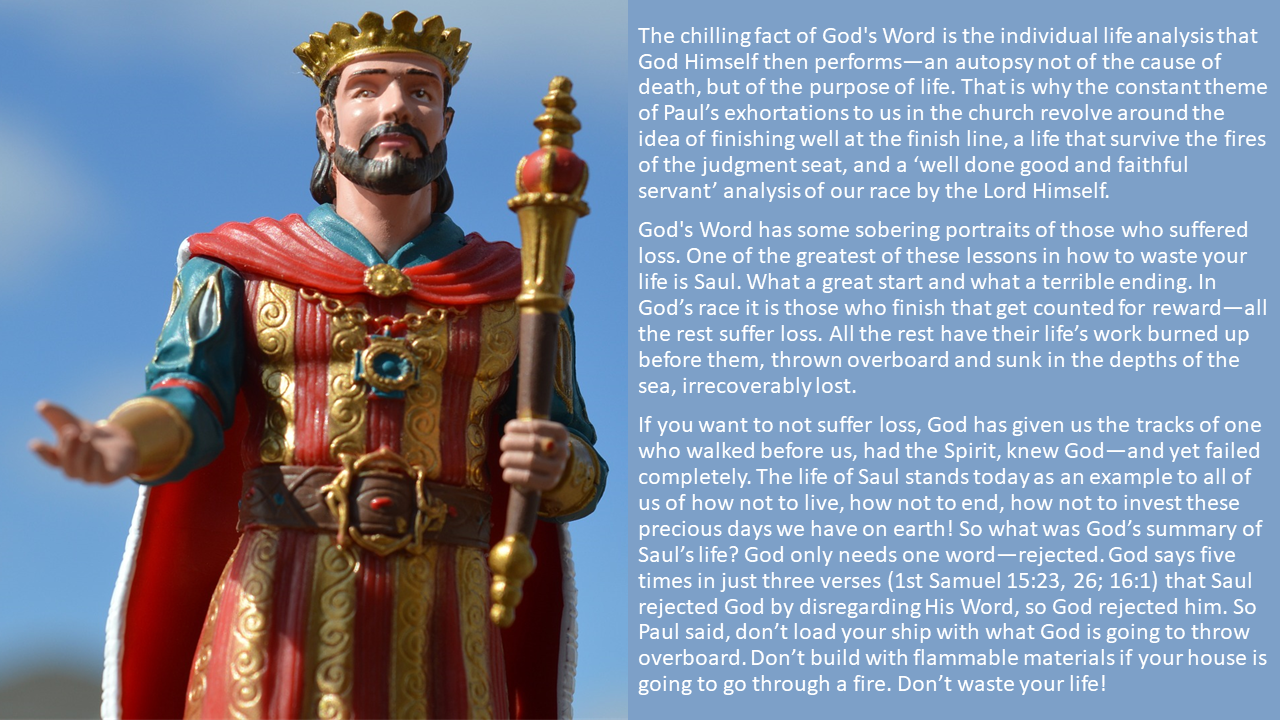
The chilling fact of God’s Word is the individual life analysis that God Himself then performs—an autopsy not of the cause of death, but of the purpose of life. That is why the constant theme of Paul’s exhortations to us in the church revolve around the idea of finishing well at the finish line, a life that survive the fires of the judgment seat, and a ‘well done good and faithful servant’ analysis of our race by the Lord Himself.
God’s Word has some sobering portraits of those who suffered loss. One of the greatest of these lessons in how to waste your life is Saul. What a great start and what a terrible ending. In God’s race it is those who finish that get counted for reward—all the rest suffer loss. All the rest have their life’s work burned up before them, thrown overboard and sunk in the depths of the sea, irrecoverably lost.
If you want to not suffer loss, God has given us the tracks of one who walked before us, had the Spirit, knew God—and yet failed completely. The life of Saul stands today as an example to all of us of how not to live, how not to end, how not to invest these precious days we have on earth!
So what was God’s summary of Saul’s life? God only needs one word—rejected. God says five times in just three verses (1st Samuel 15:23, 26; 16:1) that Saul rejected God by disregarding His Word, so God rejected him.
So Paul said, don’t load your ship with what God is going to throw overboard. Don’t build with flammable materials if your house is going to go through a fire. Don’t waste your life!
We could sum up the tragic shipwrecked life of King Saul by saying that you don’t serve God by doing what he did. Why not re-examine is life and see what made Saul the man who wasn’t after God’s heart. Or as I have come to look at Saul after sorting and sifting through all God left for us—25 ways to be sure that your life will amount to nothing!
1. Neglect God’s Leadership of your life so that you underestimate the strength of your enemy—and get completely defeated. 1st Samuel 13.1-7
King Saul faced a whole new type of enemy, he was the King—and he didn’t even know how strong his enemies were! The times since Joshua’s conquest had produced a whole new type of enemy. Fresh in from the islands of the Mediterranean, the sea peoples settled on the coasts and mixing with the ancient inhabitants became the Philistines. Saul needed God to defeat his enemies. So do we. Saul neglected God’s leadership and failed. So will we if we also neglect to allow God to lead our lives.
1 Peter 5:8 Be sober, be vigilant; because your adversary the devil walks about like a roaring lion, seeking whom he may devour. NKJV
If you want to waste your life—neglect God’s Leadership of your life so that you underestimate the strength of your enemy—and get completely defeated. 1st Samuel 13.1-7.
2. Get impatient and use your impatience as an excuse to do your own thing instead of obeying God. We can’t serve God by—Impatience. “Then he waited seven days, according to the time set by Samuel. But Samuel did not come to Gilgal; and the people were scattered from him” (1 Samuel 13:8).
Saul was impatient with God’s plan. He sought the approval of man before he sought the approval of God.
If you want to waste your life—get impatient and use your impatience as an excuse to do your own thing instead of obeying God. We can’t serve God by—Impatience.
 3. Neglect your primary responsibilities that God has entrusted to you by only taking care of your own needs. We can’t serve God by—Neglect. “So it came about, on the day of battle, that there was neither sword nor spear found in the hand of any of the people who were with Saul and Jonathan. But they were found with Saul and Jonathan his son” (1 Samuel 13:22).
Saul neglected to provide for those entrusted to his care. He made sure he had what he needed to defend himself, but not that those he cared for were armed for the battle. In the New Testament, God says such a person is worse than an infidel:
“If anyone does not provide for his own, and especially for those of his household, he has denied the faith and is worse than an unbeliever” (1 Timothy 5:8).
If you want to waste your life—neglect your primary responsibilities that God has entrusted to you by only taking care of your own needs. We can’t serve God by—Neglect.
4. Get so out of touch with the battle raging around you—that God can be doing mighty things, and you miss them completely. We can’t serve God by–Lazy indifference. “AND SAUL was sitting in the outskirts of Gibeah under a pomegranate tree which is in Migron. The people who were with him were about six hundred men. Ahijah the son of Ahitub, Ichabod’s brother, the son of Phinehas, the son of Eli, the Lord’s priest in Shiloh, was wearing an ephod. But the people did not know that Jonathan had gone” (1 Samuel 14:2-3).
Saul became lazy and indifferent; he was unaware of his son, the battle, and even the victory. He missed it all!
If you want to waste your life—get so out of touch with the battle raging around you—that God can be doing mighty things, and you miss them completely. We can’t serve God by–Lazy indifference.
5. Allow your anger and pride to rule so that you say and do things that disable, wound, and harm those around you. We can’t serve God by–Rash words. “And the men of Israel were distressed that day, for Saul had placed the people under oath, saying, ‘Cursed is the man who eats any food until evening, before I have taken vengeance on my enemies.’ So none of the people tasted food” (1 Samuel 14:24).
Saul spoke with no thought of what the implications were to his family or nation. Instead of his mouth being a fountain of blessing—he was a curse.
James 1:19-20 So then, my beloved brethren, let every man be swift to hear, slow to speak, slow to wrath; 20 for the wrath of man does not produce the righteousness of God. NKJV
Now look at James 3.
James 3:5-10 Even so the tongue is a little member and boasts great things. See how great a forest a little fire kindles! 6 And the tongue is a fire, a world of iniquity. The tongue is so set among our members that it defiles the whole body, and sets on fire the course of nature; and it is set on fire by hell. 7 For every kind of beast and bird, of reptile and creature of the sea, is tamed and has been tamed by mankind. 8 But no man can tame the tongue. It is an unruly evil, full of deadly poison. 9 With it we bless our God and Father, and with it we curse men, who have been made in the similitude of God. 10 Out of the same mouth proceed blessing and cursing. My brethren, these things ought not to be so. NKJV
If you want to waste your life—allow your anger and pride to rule so that you say and do things that disable, wound, and harm those around you. We can’t serve God by–Rash words.
6. Ignore clear and direct statements about what God wants you to do. 1 Samuel 15:1-3 Samuel also said to Saul, “The Lord sent me to anoint you king over His people, over Israel. Now therefore, heed the voice of the words of the Lord. 2 Thus says the Lord of hosts: ‘I will punish Amalek for what he did to Israel, how he ambushed him on the way when he came up from Egypt. 3 Now go and attack Amalek, and utterly destroy all that they have, and do not spare them. But kill both man and woman, infant and nursing child, ox and sheep, camel and donkey.’ ” NKJV
If you want to waste your life—just ignore clear and direct statements about what God wants you to do.
 7. Pick and choose from what God clearly tells you to do so that you offer God selective and partial obedience. 1 Samuel 15:8 He also took Agag king of the Amalekites alive, and utterly destroyed all the people with the edge of the sword. NKJV
Remember that the clearest way to declare that you love the Lord is by obedience.
John 14:21 He who has My commandments and keeps them, it is he who loves Me. And he who loves Me will be loved by My Father, and I will love him and manifest Myself to him.” NKJV
If you want to waste your life—just pick and choose from what God clearly tells you to do so that you offer God selective and partial obedience.
1Youngblood, Ronald F., General Editor; F.F. Bruce and R.K. Harrison, Consulting Editors, Nelson’s New Illustrated Bible Dictionary, (Nashville, TN: Thomas Nelson) 1997, c1995.
Slides






Check Out All The Sermons In The Series
You can find all the sermons and short clips from this series, David’s Spiritual Secret here.
Looking To Study The Bible Like Dr. Barnett?
Dr. Barnett has curated an Amazon page with a large collection of resources he uses in his study of God’s Word. You can check it out here.