
If the video above is not available, here are two other ways to view:
David’s Epitaph – Nine Words
060115AM
DSS-03
Acts 13:36
Transcript
.jpg)
I’d like to tell you, I was visiting a friend this week in their home, their new home, and I was walking around, and I saw on their wall a picture. It was a fascinating picture. It was with a telephoto lens, and I was looking at an old New England cemetery, and all of the headstones, because of the lens, looked like they were just next to each other. I was squinting and looking up close at that picture, trying to read what was written on all those beautifully profiled headstones.
.jpg)
What’s written often on headstones, in fact, gravestones, grave markers, monuments, is not just their name and their important dates, but also an epitaph. That’s not a common word in the dictionary. Epitaph is a noun. It’s an inscription on a tombstone that commemorates the person buried there in memory, celebrating their life. That’s what the dictionary says. I wonder this morning, if you hit 50 or later and it’s time for you to go, and your family goes and gets a monument, a little gravestone, a marker, what exactly would they summarize your life as? What would be your epitaph? Or even better, how about if God called into the monument company? How about if God sent an order for what to inscribe on your or my headstone? Our epitaph. What commemorated, what summarized our lives? What would God write if He were writing your epitaph? God does write epitaphs.
.jpg)
In fact, there’s one in chapter 13 of Acts. I’d like you to turn there with me. Acts 13 is God writing in nine words the entire summary of a man who lived to be at least, we believe, 70 years old. So, he lived what would be a good, full American life, 70 strong years with great accomplishments, and God reduces 70 years down to nine simple words. God writes epitaphs; He summarizes people’s lives.
This morning, in Acts chapter 13 and verse 36, let me read the nine words, the epitaph that God wrote for the life of His great servant David. For when, and here’s the epitaph, verse 36, David had served God’s purpose in his own generation, he fell asleep. Now, that is a great epitaph. David served God’s purposes for his generation. Would God write that on your marker? Will He write that on my marker? Have you thought about how God looks at your life? How God, when He summarizes what you have invested your strength, your treasures, your time, your life’s breath in, what exactly does it matter to Him that you have done? It’s fascinating to think about. If God sat down to order and write out an inscription on the monument of our lives, what would he write?
The reason that this is so important is, as we saw last week, who is it that’s going to be in Heaven? We saw in the last book of the Bible, in fact, the last chapter of the last book of the entire Bible, the 22nd chapter of Revelation, Heaven is God surrounded by and receiving the worship of His servants. Isn’t that interesting that that’s the last thing we’re called in the Bible? When it’s all over, when all the dust is cleared, when everything is settled, and whatever eschatological view you have has finally reached its end, and everything is over, and we’re finally there and everything as it shall ever be has commenced, what’s the last thing God calls us here who want to be there? He calls us His servants. That’s what matters to God: what our life is directed toward, what it is we are truly trying to do, who it is we truly serve, God or ourselves, and our own agenda.
When Paul in the New Testament and David in the Old Testament are looked at, they have something in common. Paul, in the New Testament, is the most vivid living, breathing example of a servant of God. He calls himself that all the time. Look at how he starts his epistles. Paul, a servant of God and of the Lord Jesus Christ, to the saints. That’s how he writes his letters. Paul was a servant. In fact, he calls himself a bond or bound servant. He was bound by bonds to his servitude. He couldn’t escape them.
.jpg)
In the Old Testament, God tells us that the most spoken of man in the Bible was similarly a servant. That’s David, whose life is considered most important in God’s Word because God chose to write more about him than any other single person in the whole history of the world that’s recorded in the Bible among humans. So David, the most written about man by God, was most described as God’s servant.
So, David was God-hearted in Acts 13:36. He served God’s purpose. The word served, remember I told you about that? That’s the most bound of the bond servants. It was a word, huperetes, which spoke of the most indispensable, disposable, the most life-serving servants because a huperetes served as a servant till they wore out and died, and then they killed them. They actually unbound them and threw them in the water and let them be shark food. That’s what a huperetes was. They were a lifelong paddler of Roman galley ships, and as soon as they couldn’t paddle, they had no other use. They threw them into the ocean, into the Mediterranean, and they were just done. It’s like an old battery. You’re taking an old AA out. What do you do with it? Do you set up in the mantle and think about all the great memories you had from that battery? You throw it in the trash. Unless you’re really ecology conscious, and then you put it in a hazardous material box and put it somewhere else. But most of us just throw them away because they served their purpose. That’s what a galley slave was.
I wonder, do you and I serve God’s purpose? Using the battery illustration, if I pop one out of the cupboard and stick it in, and it doesn’t work, I don’t get out the gizmo and measure it. I just throw that one away and get another one because I want one that works. Aren’t you glad were it was not for grace, we’d all be in the trash can, right? Because God pops us into a situation and we don’t work. We freeze up, clam up, don’t speak, or we revert to our flesh -and fall into sin. David was God-hearted. He served God’s purposes. He was a model of how to serve the Lord.
David was under God’s command. He did what the Lord asked him to do. He did it willingly. He did it unseen. Those psalms, if you read them carefully, David is often alone. In fact, we looked for several weeks at the loneliness, that Christ is our refuge when we’re lonely. David was all alone. He was obscure, but no matter where he was, what he was doing, he always wanted the Lord to get all the glory. David, simply stated, was God’s servant all his days. That’s why, at the end of his life, when God gets to write an epitaph, He writes those nine words. David served God’s purposes in his generation, and when he had done that, he fell asleep. It’s a great way to live life; serve to the end and then sleep in the arms of Jesus and awaken in His likeness.
What is a person’s life like when they’re committed to being God’s servant? God wants to explain that to us. So, go back with me into the Old Testament to 1 Samuel 16. So, it goes Genesis, start at the front piece where you have all the births and marriages, and then get into Genesis, Exodus, Leviticus, Numbers, Deuteronomy, Joshua, Judges, Ruth, 1 Samuel. There it is. Look at chapter 16, and we’re going to trek through this and maybe slip away a little bit.
But I want to remind you of what we’ve seen because we’re looking at what a person’s life is like when they’re committed to be God’s servant. God wants to explain that to us. If, when all the dust settles and Heaven breaks, God is surrounded by His servants, He wants us to know what they look like because we should practice now. In fact, grace teaches us to deny ungodliness and to live soberly, righteously, and godly. Grace teaches us how to be God’s servants. We should respond.
.jpg)
When we respond, what are we like? Number one. In verse 11, we realize that God uses the unchangeable features of His servants for his glory. David’s life was on God’s mind. In fact, David would later write in Psalm 139 that every little part of his life and his body and his makeup was put together by God in his mother’s womb. Before David or his mother or anybody else had anything to do with it, God was intricately building David in his mother’s womb, Psalm 139. Do you know what that means? It means the unchangeable features of our lives, how we were born, and what we look like, and how big we are, how small we are, and everything else that’s on God’s mind, and it’s part of His plan. It is part of how He’s going to glorify Himself through us. David, as God’s servant, realized God’s life was on his mind.
Secondly, in verse 12, at the beginning, David’s life was disciplined. God uses the disciplined lives of His servants for His glory. It says in verse 12, this beautiful little reminder that they sent and brought him in. Sent and brought him in from where? Brought him in from where he was supposed to be. The big question in life is not what are you doing? Are you doing what you’re supposed to do? Are you where you’re supposed to be? Are you fulfilling God’s purpose in your generation? Is He going to write that on your epitaph? Is He going to say that you pleased Him, as it says in Hebrews 11? Which, by the way, is a whole chapter of epitaphs. It’s amazing. Abel’s life still speaks, verse 2. Enoch’s life pleased God, verse 3. You go all the way through that chapter, and every single person, God summarizes their lives in just a very short little bit. David’s life was disciplined.
Look at the end of verse 12. He was available for God’s use. God uses the available lives of His servants. If you look at the end of verse 12, as we did last week, David’s heart had been crying out. I remember I showed you Psalm 132. He’d been crying out and saying, Lord, I’m your servant. Lord, I’m your servant. Lord, I’m your servant while he was taking care of those dumb, dirty, habit-ridden sheep. So, he had announced he was available. He’d put up online, posted his resume online. He had put up the notice. Do you remember the old days when people used to tack everything on the supermarket boards?
I was confessing this week. You young people, you don’t even know what I’m talking about. Message boards to you are electronic, but in the olden days, people used to take these pieces of paper like this, and they’d cut them so they had these little strips. Do you remember the little things hanging off with their phone number on it? I always used to feel such compassion for them because no one would take them, so I would take one off every one. I wanted them to feel like there was a little action on their whatever. I didn’t even check what it was. I hope none were bad, but I just pulled one off of everyone, and I’d throw them in the trash and say, yay, they’ll all feel better. Then someone told me that when they posted theirs, they’d always tear off several to look like it was a hot item, and you ought to get it before it goes. Olden days are fun.
David had posted his little sheet and said, God, I want to be Your servant. So, look at the end of verse 12. The Lord says, anoint him, Samuel. This is the one. His life was available prior to that moment. He had announced to God, I’m your servant. God says He’s the one because God’s looking for servants. God loves servants, and He uses His servants.
Verse 13. The Spirit of God anoints him. David’s life was empowered by the Lord. God uses His Holy Spirit to empower His servants for His glory. So, when His servants do what they do, people can’t figure it out, and they’ll look beyond that person, and they’ll say, surely the hand of God. That’s the whole idea of a servant. The purpose of the battery is not to be a battery; it’s to make the energy, cause the instrument to do whatever it’s supposed to do, the flashlight to work, the player to work, the remote to work. You don’t praise the battery. You rejoice in the result of what happens, and that’s what happens. God is the result. He is the resultant glory-getter when we do what we’re supposed to do.
Next, in verse 18, we find the fifth element. If you’re keeping track of these in verse 11, David’s life was on God’s mind. Verse 12, he’s disciplined. At the end, he was available. Verse 13, he was empowered. Verse 18, his life is an example. Do you remember this testimony? We went through it. This unnamed individual says, hey, I’ve seen this son of Jesse, the Bethlehemite. He doesn’t even mention his name. Isn’t that neat? I’ve seen him. The unnamed person describes an unnamed person and said he’s skillful, mighty, a man of war, prudent in speech, and handsome. But most of all, the end of verse 18, the Lord is with him. A servant of the Lord will be an example to others, even if you don’t remember their name.
Do you remember John Glass’s testimony at the missions conference a couple of years ago? John Glass, our missionary to France, is the dynamo that he is. Do you know what he said? He said he was passed in the streets of India by a nameless, faceless missionary. He doesn’t even remember what he looked like. This missionary gave John Glass the Gospel, led him to faith in Christ, and John went on his way and has become a marvelous world-class Christian and missionary statesman for the Lord and church planter, and everything else. He said, I’m going to have to wait till Heaven to find out who that servant was, because I don’t remember their name. I don’t remember what they looked like. That’s what servants are. They are an example to others, even if, look at verse 18. I’ve seen this, and he doesn’t even name him. This son of Jesse, the Bethlehemite. He’s an example of godliness to others.
God uses the actions of His servants for His glory. In verse 19, David’s life displayed true humility, and God uses humble servants for His glory. In verse 19, after all this anointing and all this you’re the next king stuff, verse 19, David, who is with the sheep. You know the neat thing? You can be the greatest servant of God, and nobody even knows it. You can be the cobbler like William Carey was. Do you remember William Carey? One of the great minds of missionaries. One of the first of the modern missionary movements in the 1700s, who went to India, he accomplished translating the Bible into so many languages, and he built work industries for the people of India to raise them out of their poverty.
He was honored near the end of his life and brought to this huge banquet by the royalty of England. He was sitting at this table, and one of the pompous, self-inebriated people who thought they were something sitting with him, looked at him and said, weren’t you a shoe repairman at one time, a shoemaker? William Carey put his head down and said, no, no, no, no. I wasn’t a shoemaker. I was merely a cobbler’s assistant to a shoemaker. Now, who was the greatest at that table? The Lord of whatever part of England this guy was from, or the humble servant? We don’t even remember who was at the table with him. William Carey has gone down in the annals of history as one of the greatest of all God’s servants. David was still with his sheep. God uses His humble servants for His glory.
Look at verse 23. David’s life ministered to others. Here’s demonized Saul, and David plays his harp. The relief that comes. God uses His servants for His glory. Never forget that. You might not know about it right away, and you might not know about it ever on this Earth, but God is using us for His glory. We minister to others, and what a joy to someday stand before Him, our Master we serve. I believe He’s going to reveal what all the faithful Sunday school teaching, the faithful leading and modeling and mentoring, the faithful serving behind the scenes, the faithful giving of your testimony or singing for the glory of God, what it all accomplished, because God uses the Spirit-empowered ministry of His servants for His glory, and it touches other lives. That’s what verse 23 is all about.
In 1 Samuel 17, verse 1, David wanted to faithfully honor God with his work. David worked hard in verse 1. The Philistines gathered their armies together to battle, and so the messenger, David, had to go. So, look down in verse 34 of that chapter. David said to Saul, your servant is used to keeping his father’s sheep. When David, the messenger, went to be a delivery boy for his dad and take food and provisions, and check on his brothers, he was still diligent, hardworking David. Even when he is going to that Goliath, momentous time, he is still, and if you read the story that goes along through here, he is so careful when he gives his testimony. He was taking care of just one little sheep we saw last time. In fact, he was willing to risk his life to take care of one lamb. He honored God with his work. He felt that whatever he did was for the Lord. He felt that even taking care of sheep, even rescuing them from a bear or a lion, one little lamb, he was doing it for the Lord, and he honored the Lord, and he risked his life for what he did.
Our hearts rise and well up with gratitude. Every time I think of all of the firemen who perished in the World Trade Center, not because they were trapped, but because they were rescuing people. We say, wow, what kind of dedication is that? The same kind of dedication you should have for your job is the answer. We should all do whatever we do. What does it say in the Bible? Heartily as unto the Lord. Whatever you do in word or deed, do all in the name of the Lord. Do it heartily as unto God, not unto men. That’s what David did. He wanted to honor God with his work.
He wanted to honor God with his habits. Back up to verse 20 of chapter 17. David Rose early in the morning. Look at these habits. He left the sheep with a keeper. He took what his dad gave him, just like his dad commanded him. He came to the camp. He had good habits. He was the model employee. He was the model son. He was the model servant. He had good habits. He cultivated good habits.
My good friend Jim Berg, whom I’ve known for 30 years now, used to always say, you got to cultivate mind over mattress. I thought, yeah, that’s a good thing, mind over mattress. Because those who never cultivate their mind over a mattress, in other words, you never learn to get up, the Bible characterizes them as a sluggard. Do you want that written on your epitaph, sluggard? No, servant of the Lord. A servant of the Lord is David. He wanted to honor God with his habits, and God is either honored or dishonored by the habits of His servants.
Look at verse 25. David wanted to honor God with his life. So, the men of Israel said, have you seen the man who’s come up? Surely, he has come up to defy Israel, and whoever kills him, the king will give great riches and won’t pay taxes. Verse 26. Then David spoke to the man who stood by him and said, what will be done to the man who kills the Philistine? And he doesn’t say and wins the lottery, gets all the money, and the no taxes. David had a whole different perspective on life.
Look at the next part of verse 26, the part I didn’t read. And takes away the reproach from Israel for who is this uncircumcised Philistine that he should defy the armies of the living God. You know what I see in that verse is that David saw clearly that God was being mocked. David cultivated a concern in his life for God. Most of us would be alleviated of a lot of stress in life if we didn’t primarily have a concern about ourselves. If we had concern about God primarily, then we would get upset at what God was upset about, and we would be concerned for God’s honor, not our own.
A lot of people spend their whole life defending their honor, their name, their agenda, their life, and David didn’t. When people came up and cussed and swore and kicked dirt and threw rocks at David, and he had these gun slingers that surrounded him, kind of like all these high-powered military types, one of them says, hey, David, how about if I just lift his head off? In other words, cut his head off and stop him from treating you that way. David said, are you kidding? What if the Lord sent him to do that? God’s in charge of my agenda. I’m not. God’s in charge of my name. I’m not. He’s in charge of defending me. I’m not. Leave him alone. God will take care of him.
Do you see why David had enough time to write all those Psalms and accomplish all the things he accomplished? He wasn’t all worked up about himself and his life. He wanted to honor God with his life, and God wants us as His servants to give our lives back to Him, and that’s what David did. David says, my life is for You, God, so how am I going to take care of, verse 26, this guy who’s defying You? This giant who’s defying You. Most times when you’ve ever looked at the David and Goliath story, most individuals who were watching the battle would’ve only seen two people, Goliath and David. Maybe off to the side, you would’ve seen the armor bearer of Goliath, but most of the stories only show two there. That’s not what David saw. David didn’t just see himself and Goliath. He saw someone else who was always with him. Because as he was running up that no man’s land toward Goliath, he said, this battle’s not mine, it’s the Lord’s. David saw someone else with him all the time, the Lord, and he wanted the Lord to be honored.
.jpg)
Let’s look at verse 36 now, of chapter 17, because I want to show you the rest of the elements of a servant’s life that God wants us to see. The next element is in verse 36 of 1 Samuel 17, and if you’re counting, it’s the 11th one. Okay? Verse 36, this is David magnifying God’s hand in his life. Remember this: God is honored when His servants remember His hand in their lives. Did you catch that? God is honored when His servants remember His hand in their lives. It gives you a whole new perspective on how to talk about life. Instead of I did this and I did that, and I’m going to do this, you can step back and say, I’m amazed to see how God who fit me together in my mother’s womb has shaped me and formed me for a specific purpose. It’s been a lifelong joy to fulfill His purposes. To know that in those climactic moments in life, I was where He wanted me to be.
See, that’s what David’s doing. Look at verse 36, your servant, he’s being interviewed by the king, has killed both lion and bear. Now, if we stop there, it would sound like all of us, this is what I’ve done. But he doesn’t stop there because he is a servant of the Lord. This uncircumcised Philistine will be like one of them, seeing that he has defied the armies of the living God. David attached everything to God. He attached even his killing the lion and the bear to this enemy of God. If God allowed him, as you’ll see in the rest of the verse, to kill the lion in the bear, it’ll be a small thing to kill this giant.
So, he continues, and he says in verse 37. Moreover, David said the Lord who delivered me from the paw of the lion and the paw of the bear. Now, we’re getting a second telling of the lion and bear story, and he is amplifying it not to show how great a marksman he was, or how fearless he was, or how he took self-defense courses and could even beat predators out in the field alone as a young adolescent. No, the Lord who delivered me, verse 37, from the paw, the lion’s, and of the paw, the bear, He. See, God is the emphasis of his stories, not himself, God, not himself. Later in life, the 115th Psalm captures this. It says this: not unto us, oh Lord, not unto us, but unto Your name be the glory.
David had a habit of magnifying God’s hand in his life. He, the middle of verse 37, God, He will deliver me from the hand of the Philistine. And Saul said to David, go, and the Lord be with you. What a great word from old Saul. By the way, we’re going to look at Saul’s life before this is all over and show you how not to serve God. King Saul from this passage is the primary example of how not to serve God. He was called and chosen and anointed and picked out and commissioned and Spirit-empowered and everything else. He had the whole package. He was just sent off as the king with everything, with God’s imprimatur. He even was, it’s Saul I’m talking about, was even empowered by the Spirit and prophesied. The Spirit of God was on him, but his life, his epitaph, is how not to serve God. We’ll see that later. David’s life: how to serve God and Saul in this moment, go and the Lord be with you.
When David was asked to talk about himself by King Saul and explain the biggest qualifications he could think of for the job of facing Goliath, what did David say? He tells the king that his greatest accomplishments came from the hand of God. Do you see the hand of God in your life? Do you talk about the hand of God in your life? Do you know how to do that? Does it make you feel uncomfortable? If it makes you feel uncomfortable, it’s like you can always tell people who haven’t done something, and they try and act like they have. They take out that new camera and say, let me take a picture. Then they go, how do you turn this on? What button turns it on? They act like they knew about the camera because all of us act like we know what’s going on.
Do you have to ask other people how to talk about the hand of God in your life, or are you practicing it? Do others hear you point out the hand of God at work in your life? Even before you talk about it, are you seeing the hand of God at work? Do you see life that way? Do you see life as God formed me and fashioned me in my mother’s womb? And He put together all the unchangeable parts and called me for His glory to accomplish what only I can accomplish. David saw that, and David told others about what God was doing in his life. We should, too, because God is honored when His servants remember His hand in their lives. God wanted to magnify His hand in David’s life.
2 Chronicles 16:9, for the eyes of the Lord run to and fro throughout the Earth, looking for one whose heart is toward God so that He can show Himself strong through them. God wants to magnify Himself through us, and all we have to do is tune in and say, I’m your servant.
.jpg)
Look at verse 45, same passage, 1 Samuel 17. I want to show you the next element, the 12th element. David wanted to honor God’s name, and God is glorified when we honor His name. God’s name is very important. People think so much of their names that they put them in places, they make them in stone, the so-and-so building, the so-and-so park. We want to remember people; we put their name on it. God has a great name, the greatest name, and He is glorified when we honor it. Verse 45, then David said to the Philistine, this is that climactic moment, one of the greatest moments in sacred history. David and Goliath. What an incredible moment this was, and we’ll revisit it later on when we talk about another element of David’s life.
But in verse 45, then David said to the Philistine, you come to me with a sword, and what a sword he had. There was none like it, the Bible says later. With a spear, what a spear. Did you know that a spear was like a weaver’s beam? That means it was about the length of a stud, a normal two-by-four stud, eight feet, normal length. It had a 25-pound spearhead on it. Most of us would have difficulty, other than the homeless in the audience, holding a stud, a two-by-four, eight-foot long. Hold it straight out in front of us like that. Attach three milk cartons full of milk to the end. That’s 25 pounds. Can you imagine an eight-foot-long spear that you hold in one hand, you wave it around, and you throw? Goliath was big. He was a big guy. No ‘roids, you know, the steroid enhancement. This guy was big with this spear.
Keep reading, and a javelin. But I come to you. Now, if I were casting this and if it were a movie, this would be David’s voice because this is how I think he was. [Speaking in a high voice] But I come to you in the name of the Lord. It’s this little guy, that’s why it made Goliath so angry. He said, am I a dead dog? What are you? A fly coming to my carcass? He’s just really cursing and carrying on. I come to you, this little boy says, in the name of the Lord of hosts, the God of the armies of Israel, whom you have defied. Verse 46, this day, the Lord will deliver you into my hand, and I will strike you, and I will take your head from you. He certainly had planned this out, hadn’t he? He wasn’t going in unprepared. David knew what he was doing. I will take your head from you, and this day I will give the carcass of the camp of the Philistines to the birds of the air and the wild beasts of the Earth. Why? Because David wanted to honor God’s name.
Look at the ending: that all the Earth may know that there is a God in Israel. If you ever want to do a neat Bible study, look at when this little phrase occurs in the Bible. It occurs at all the greatest climactic moments in Old Testament sacred history. We’re talking about the moment of the fire falling with Elijah. We’re talking about the moment of the great conquest. We’re talking about the key moments like this, that all the Earth may know. Why? Why David?
Our world has marginalized God. You know what that means? They just talk Him right out of the situation. He’s not a part of the equation anymore. The true and living God who created everything and upholds all things is slowly being erased from public life in our world. His truth is minimized. His Word is neglected. His people are ignored, and all that God asks of us is one thing: will you please magnify Me? Will you please bring up my name? Will you magnify and honor My name?
It always reminds me of when I was a little boy, one of the great Bible teachers of the day. I think he’s still around, but he was unbelievable in his prime. His name was The Walking Bible. What was his name? Jack Van Impe. He’d play the accordion. Jack Van Impe was an evangelist just starting out when I was this little shaver. He used to preach in Lansing, Michigan. I remember him telling, he memorized the whole New Testament, all 7,900 verses. He was getting on an elevator, I think it was in the Michigan National Bank Tower, the tallest building in the capital of Michigan. He got in that elevator, and he was getting all positioned when the person behind him was smoking a cigar, when smoking was okay, and everybody did it, and this guy was smoking in public. He said that blankety blank and used the name of God and cursed God’s name and stuffed the cigar back in his mouth.
Van Impe said he turned around in the elevator car and looked at him. He looked right in his eyes and said, thou shalt not take the name of the Lord thy God in vain, for whosoever shall do so, and he just quoted the whole law to this guy. He said the guy took a big suck in and took it out and coughed a little bit, and it was strangely silent in the elevator car. I’m not suggesting you smoke in elevators or call down people in elevators. I’m saying Van Impe had, at that moment, the right motivation, honoring the name of God in a world where He’s minimized, neglected, ignored, and uncared for.
Maybe it’s just simply when someone, your gang, is talking and all of a sudden, the conversation gets in the wrong direction, and God isn’t honored, and you say, I’m sorry, I can’t stand listening to that. I am a servant of the Lord, and I will not dishonor the Lord who lives within me. That works. It worked when I went to high school, Haslett High School. I remember that in the football locker room, they’d start saying, oh man. I’d say, I’m not going to stay for that one. They called me Deacon. I was in town for my 10th high school reunion. I saw one of the kids I went to school with in ’84. He said, hi, deacon. I said, you haven’t changed much. You know what? Stand up for God even if they make fun of you and honor His name. David did. David wanted to honor God, and God is glorified when we honor His name.
.jpg)
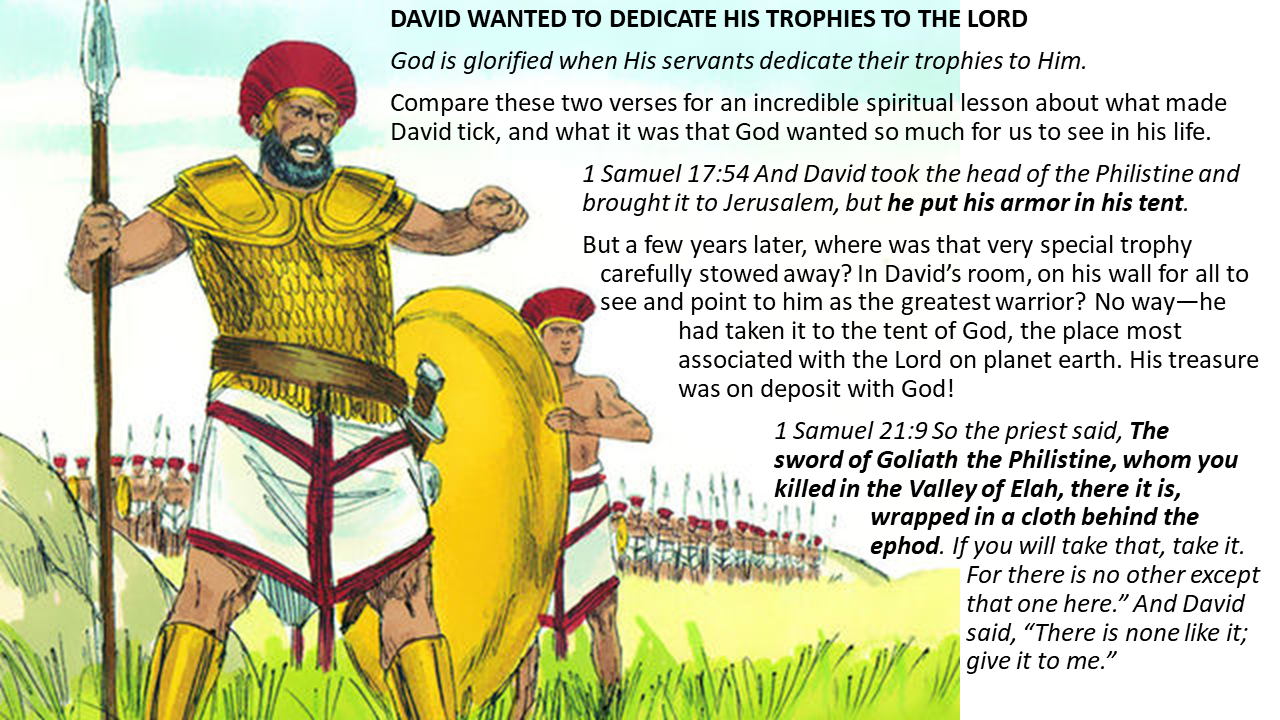
But look next at verse 54, because David wanted to dedicate his trophies to the Lord. Verse 54 is a tremendous thought, and this is what I want to leave on your mind. God is glorified when His servants dedicate their trophies to Him. Okay? Most of us don’t think about trophies. Verse 54. Remember, David said, I read to you already, I’m going to take your head and all this to Goliath. Look, he did, and David took the head of the Philistine, verse 54, and he brought it to Jerusalem, which by the way was 12 miles. The valley of Elah is eight miles from Bethlehem, 12 miles from Jerusalem. The Philistines were very close. This battle was in the backyard of the Jews, but he brought the head of the Philistine to Jerusalem. What they usually did was just put it on display to show that they won.
But look at this. This sounds like us, but he put his armor in his tent. Ha ha. He got the treasure. Who wants an old head? Ugh. That would be gross, and it would, ugh, unless you did it like the cannibals did and took the skull out and shrunk it and had it hanging, as they do in the cannibal places. But I don’t think David knew about that. So, he took the good stuff. He took the armor.
But look at this, a few years later, where was that very special trophy carefully stowed away? Have you ever asked yourself what happened to Goliath’s stuff? His armor, his sword, all the good stuff, the treasures? It wasn’t in David’s room. It wasn’t on his wall for all to see and point to as him being the greatest warrior. No way. David had taken it to the tent of God.
Turn to chapter 21 of 1 Samuel with me real quick. Look at 1 Samuel 21 in verse 9. I want to show you what David did with his trophies because he carried those trophies to the tent of God, to the place most associated with the Lord on planet Earth. His treasure was on deposit with God. Where are your treasures on deposit? Vanguard? How about the Assessor’s Office? Where are your treasures on deposit? Look where David’s were. 1 Samuel 21:9. So, the priest said, the sword of Goliath the Philistine, whom you killed in the Valley of Elah, where is it? There it is. It’s wrapped in a cloth behind the ephod. Where was David? He was in the tent of God. He was with the priest of God. He was in the place where the Tabernacle was at that moment. He was right there in the most visibly associated place for God in the whole universe at that moment. Where had he placed his trophy? He had dedicated it to God. He had brought it to the priest back when he was a little boy.
Remember, in Psalm 132, he loved the Lord’s presence. He loved to be around God. He loved to go into His presence. Wherever you love, you’ll bring your most special things, and what he loved the most was God. So, he brought to God his most special treasure. That is a very big thought that we all should think about this morning. Jesus said it this way, for where your treasure is, there your heart will be also, and where your heart is, that’s where your treasures are headed. I wonder, where are our treasures? Where are we directing them?
.jpg)
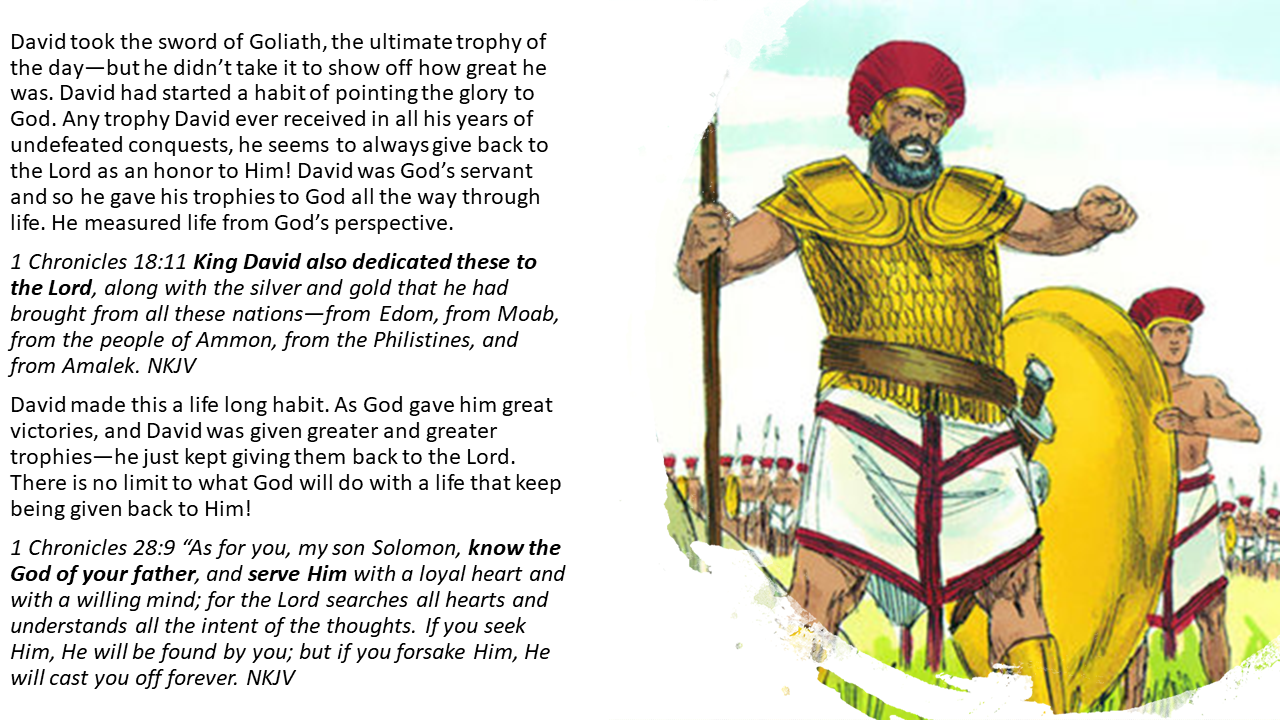
David took the sword of Goliath, the ultimate trophy of his day, but he didn’t take it to show off how great he was. David had started a habit of pointing the glory to God. Any trophy David ever received in all of his years of undefeated conquests; he seems to always give back to the Lord as an honor to his God. David was God’s servant, so David gave his trophies to his God all the way through life. He loved the Lord so much that if it was special, he gave it to the Lord. He measured life from God’s perspective.
Look at 1 Chronicles. You know, this is kind of part of the Bible we don’t go to but keep going to the right. We’re in 1 Samuel 21. Then you go to 2 Samuel, 1 Kings, 2 Kings, 1 Chronicles, chapter 18. 1 Chronicles 18. You might want to mark this. I have this all marked in my Bible. In fact, some of you wonder, what do you guys do when you go over to Israel all the time? All this kind of stuff. I distinctly remember standing on a hilltop with about 40 saints from TBC and saying, all of you turn and look right where I’m pointing. Look right there. Do you see that little smudge on the horizon? And they were all standing there with video cameras and binoculars, looking. I said, that’s the city of Nob, NOB. I said that’s where David took his treasures when he was a little boy and kept doing it his whole life. I still remember how quiet it was. We went through this whole thing we’re going through. There was a lot of reflection because all of us need to think about do we want to give our treasures and our trophies to God? The Lord says, what you give to Me, you’ll never lose. What you hold on to for all of your life, you will lose. If you hold it, you lose it. If you give it, you keep it.
Look at 1 Chronicles 18:11. David, King David also dedicated these to the Lord. He’s just getting an unbroken string of victories and conquests and tributes and conquests of great empires and kings and treasures. David also dedicated these to the Lord along with the silver and gold that he had brought from all these nations. From his campaigns in Edom, from Moab, from the people of Amman, from the Philistines, and from Amalek. Did you catch that? David made this a lifelong habit. As God gave David great victories, David was given greater and greater trophies, and so he, in a greater and greater way, gave them back to God.
Is there any limit to what God will do with your life if you just keep giving, shoveling it right back to him and saying, no, it’s you? It’s not unto us, oh Lord, not unto us, but unto your name be the glory. I don’t want to glorify myself. I don’t want to maximize myself. I want to minimize, as John the Baptist said. He must increase, and I must decrease. See, that’s the attitude David had. He said, I’m not about increasing my stuff and my honor and my trophies, it’s about you, Lord. He kept giving back to the Lord. There’s no limit to what God can do and will do with the life that keeps being given back to Him.
.jpg)
Let’s see the end. Okay? Turn over to 1 Chronicles 28:9. So, keep going to the right 28:9 because this is the father’s prayer. After this lifelong attitude, this is David talking to his son. As for you, my son Solomon, know the God of your father and serve Him. How did David serve Him?
Turn the page over to chapter 29. 1 Chronicles 29:2. I have prepared with all my might. Huh, I thought you were fighting battles with all your might, David. Oh, no. I fought those battles so I could prepare with all my might, gold for things made of gold, silver for things of silver, bronze for things of bronze, iron for things of iron, wood for things of wood, onyx stones to be set, glistening stones of various colors, all kinds of precious stones and marble slabs, and abundance. Moreover, verse 3, because I’ve set my affection on the house of my God, I have given to the house of my God over and above all I’ve prepared for the holy house, my own special treasure of gold and silver.
Obviously, what happened here is that David gave everything to the Lord, all the booty, but he had accumulated even more honors and gold and silver, maybe from his great businesses. I don’t know where he got it from, but he said, I didn’t just give the stuff everybody knew about. I gave it all. Amazing. My own special treasures.
I plugged into Excel yesterday how much all this came to, because if you look across the page, it says that he has given a lot of stuff. He had given, in verse 7, that all of the leaders are given their stuff. But David, he numbers up how much he gave, and he gave a million talents of silver and a hundred thousand talents of gold. A talent either weighs 60 or 100 pounds. David gave either 60 million pounds of silver to the Lord or 100,000,000 pounds of silver to the Lord. If you add that up at $9.17 an ounce, which was the contract in gold yesterday, and gold at $5.58 or whatever it was yesterday, the 100,000 talents or 60 million pounds of gold. Do you know how much that comes to, in modern terms? $103 billion back when dollars were worth something. David gave it all. We remember that about him.
.jpg)
Just before we go, I want you to turn. You can close your Bible. I want you to turn to hymn 378 because it’s time to go. I want to read to you the story behind this hymn, and I want you to read it with me. So, get your Bible down, get your hymn book out. Number 378. I’m going to read you this because every one of us in this room has probably heard the famous life motto of the great missionary Charles Thomas Studd. He lived and died by this motto, only one life will soon be passed, and only what’s done for Christ will last. Few of us realized he said that at the end of his life, as he lay dying on his bed, as his daughters came in to see him. He said to them, I’m sorry that I don’t have anything to give to you, but I gave it all to Jesus long ago. He was a wealthy multimillionaire. He gave it all away.
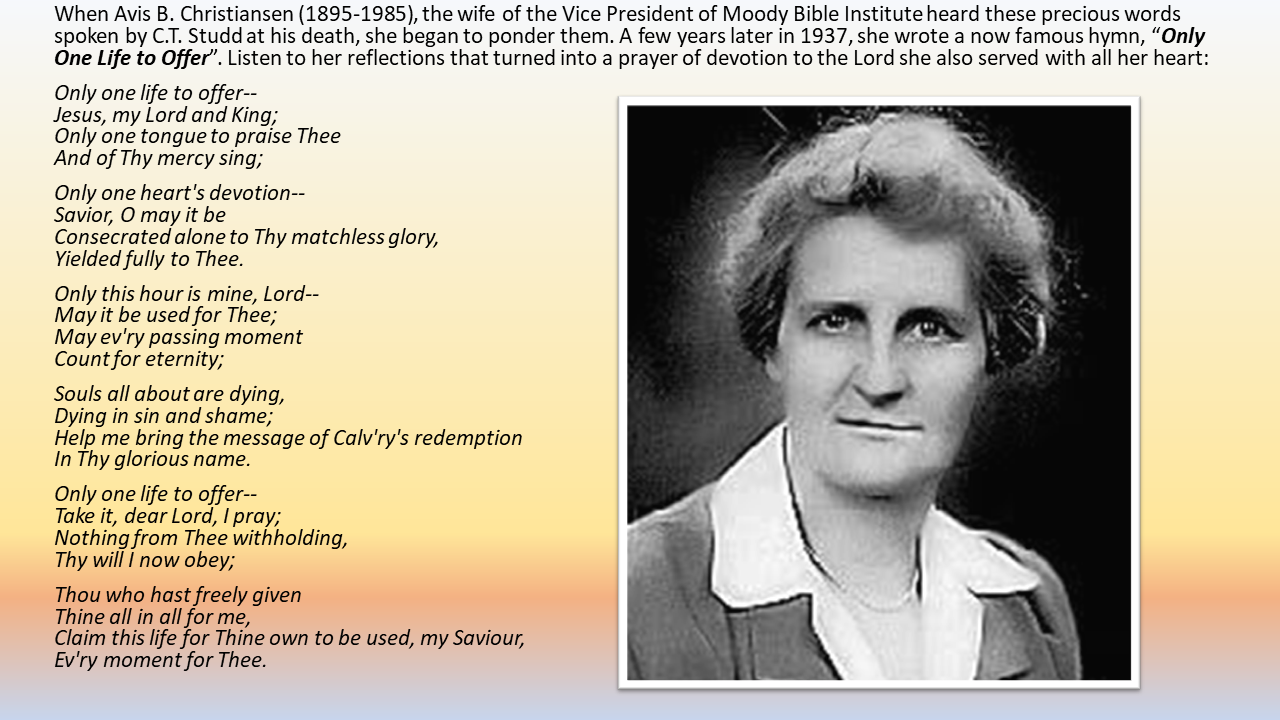
Those daughters went back to Wheaton College and shared the story of their dad’s deathbed last words. One of the people who heard their story was Avis B Christiansen. She wrote this hymn based on Studd’s testimony she heard from his daughter who had just come from the heart of Africa. God is honored when we give our trophies back to him. The greatest trophy you have is your life, that you’re even alive, that you have breath and life. God is honored when we give ourselves back to him.
Let’s stand, and let’s just say this to Him and make it our closing offering to Him. Read together, only one life to offer, Jesus, my Lord, and King. Only one tongue to praise Thee and of Thy mercy sing. Only one heart’s devotion, Savior, oh, may it be. Consecrated alone to Thy matchless glory, yielded fully to Thee. Only this hour is mine, Lord, may it be used for Thee. May every passing moment count for eternity. Souls all about our dying. Dying in sin and shame. Help me bring the message of Calvary’s redemption in Thy glorious name. Only one life to offer. Take it, dear Lord, I pray. Nothing from Thee withholding. Thy will I now obey. Thou who has freely given, Thine all in all for me. Claim this life for Thine own to be used, my Savior, every moment for Thee.
.jpg)
Let’s bow together. Father in Heaven, David’s epitaph, You wrote. Nine little words. He served You in his generation and fell asleep. May our lives so simply be summed up by You, our Master. We only have one life; may we offer it back to You to be Your servant. And all God’s people said, Amen.
Notes
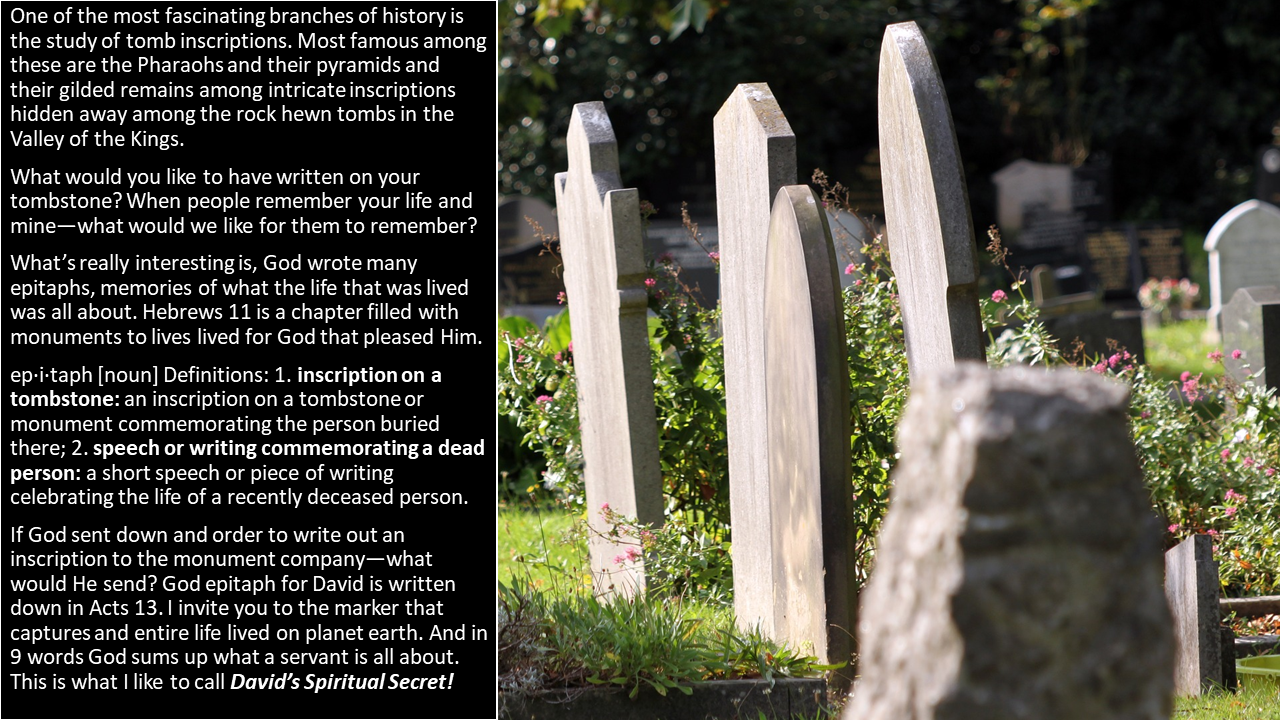
 One of the most fascinating branches of history is the study of tomb inscriptions. Most famous among these are the Pharaohs and their pyramids and their gilded remains among intricate inscriptions hidden away among the rock hewn tombs in the Valley of the Kings.
What would you like to have written on your tombstone? When people remember your life and mine—what would we like for them to remember?
What’s really interesting is, God wrote many epitaphs, memories of what the life that was lived was all about. Hebrews 11 is a chapter filled with monuments to lives lived for God that pleased Him.
ep·i·taph [noun] Definitions:
1. inscription on a tombstone: an inscription on a tombstone or monument commemorating the person buried there;
2. speech or writing commemorating a dead person: a short speech or piece of writing celebrating the life of a recently deceased person.
If God sent down and order to write out an inscription to the monument company—what would He send? God epitaph for David is written down in Acts 13. I invite you to the marker that captures and entire life lived on planet earth. And in 9 words God sums up what a servant is all about. This is what I like to call David’s Spiritual Secret!
Please open to Acts 13:36.
Acts 13:36 “For when David had served God’s purpose in his own generation, he fell asleep; he was buried with his fathers and his body decayed. NIV
Who will be in Heaven? God’s Servants.
And what does Paul in the New Testament and David in the Old Testament have in common? Both called themselves God’s servants and both looked on life as serving God, and the end of life as having finished their course of service for Him.
So, whose life is considered important to God? Well, who did God chose to write more about than any other single person in the whole history of the world? The answer is the young man we met this morning.
 David was “God-hearted” which meant he served God’s purposes. The word “served” is the verb form (hupereteo) of the word for an under rower (huperetes) that we have often studied as a model of how to serve the Lord.
David was under God’s command, he did what the Lord asked him to do, willingly unseen and obscure—always wanting the Lord to get all the glory. A simpler way to say that is—David was God’s servant all his days. No wonder Paul uses the very same concept to describe his own life and ministry.
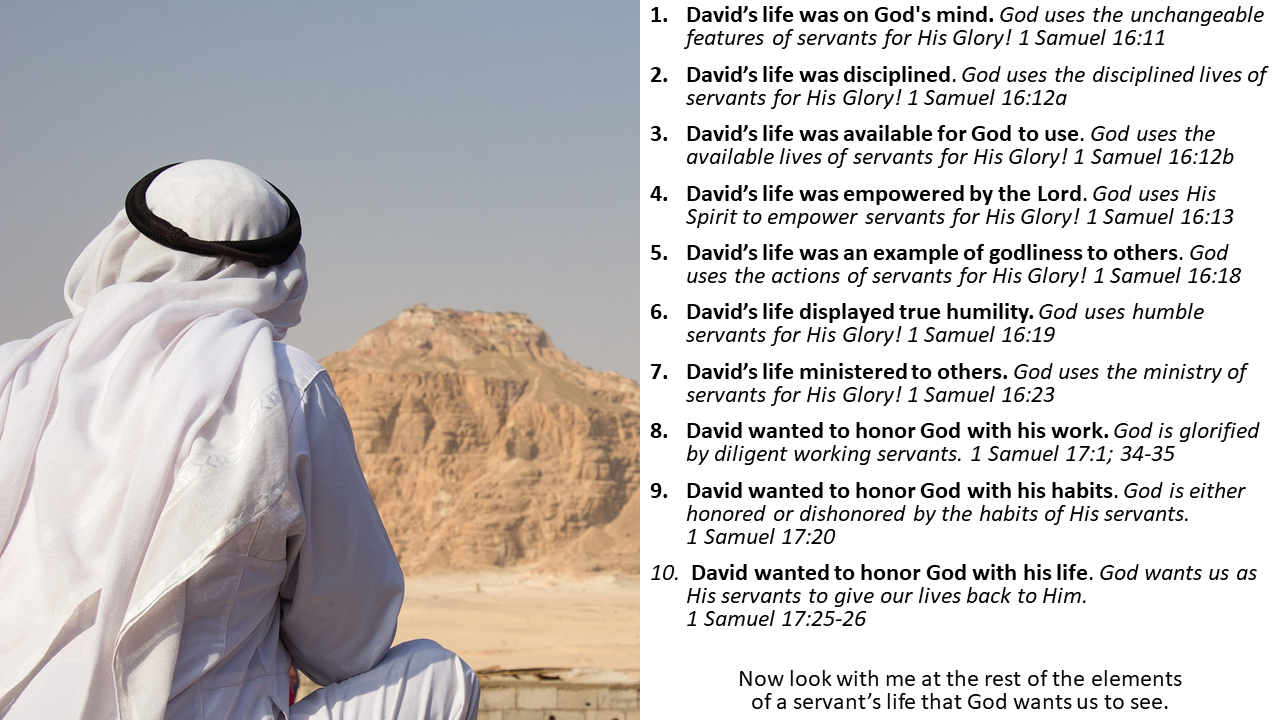
What is a person’s life like when they are committed to being God’s servant? God wants to explain that to us! First–
1. David’s life was on God’s mind. God uses the unchangeable features of servants for His Glory!1 Samuel 16:11
2. David’s life was disciplined. God uses the disciplined lives of servants for His Glory!1 Samuel 16:12a
3. David’s life was available for God to use. God uses the available lives of servants for His Glory! 1 Samuel 16:12b
4. David’s life was empowered by the Lord. God uses His Spirit to empower servants for His Glory! 1 Samuel 16:13
5. David’s life was an example of godliness to others. God uses the actions of servants for His Glory! 1 Samuel 16:18
6. David’s life displayed true humility. God uses humble servants for His Glory! 1 Samuel 16:19
7. David’s life ministered to others. God uses the ministry of servants for His Glory! 1 Samuel 16:23
8. David wanted to honor God with his work. God is glorified by diligent working servants. 1 Samuel 17:1; 34-35
9. David wanted to honor God with his habits. God is either honored or dishonored by the habits of His servants. 1 Samuel 17:20
10. David wanted to honor God with his life. God wants us as His servants to give our lives back to Him. 1 Samuel 17:25-26
Now look with me at the rest of the elements of a servant’s life that God wants us to see.
 DAVID WANTED TO MAGNIFY GOD’S HAND IN HIS LIFE God is honored when His servants remember His Hand in their lives.
1 Samuel 17:36-37 “Your servant has killed both lion and bear; and this uncircumcised Philistine will be like one of them, seeing he has defied the armies of the living God.”37 Moreover David said, “The Lord, who delivered me from the paw of the lion and from the paw of the bear, He will deliver me from the hand of this Philistine.” And Saul said to David, “Go, and the Lord be with you!”
When David is asked to talk about himself by King Saul, and explain the biggest qualifications he can think of for the job of facing Goliath—what does David say? He tells the king that his greatest accomplishments came from the Hand of God. Do you see the Hand of God in your life? Do you tell others about what God is doing in your life? We should because– God is honored when His servants remember His Hand in their lives.
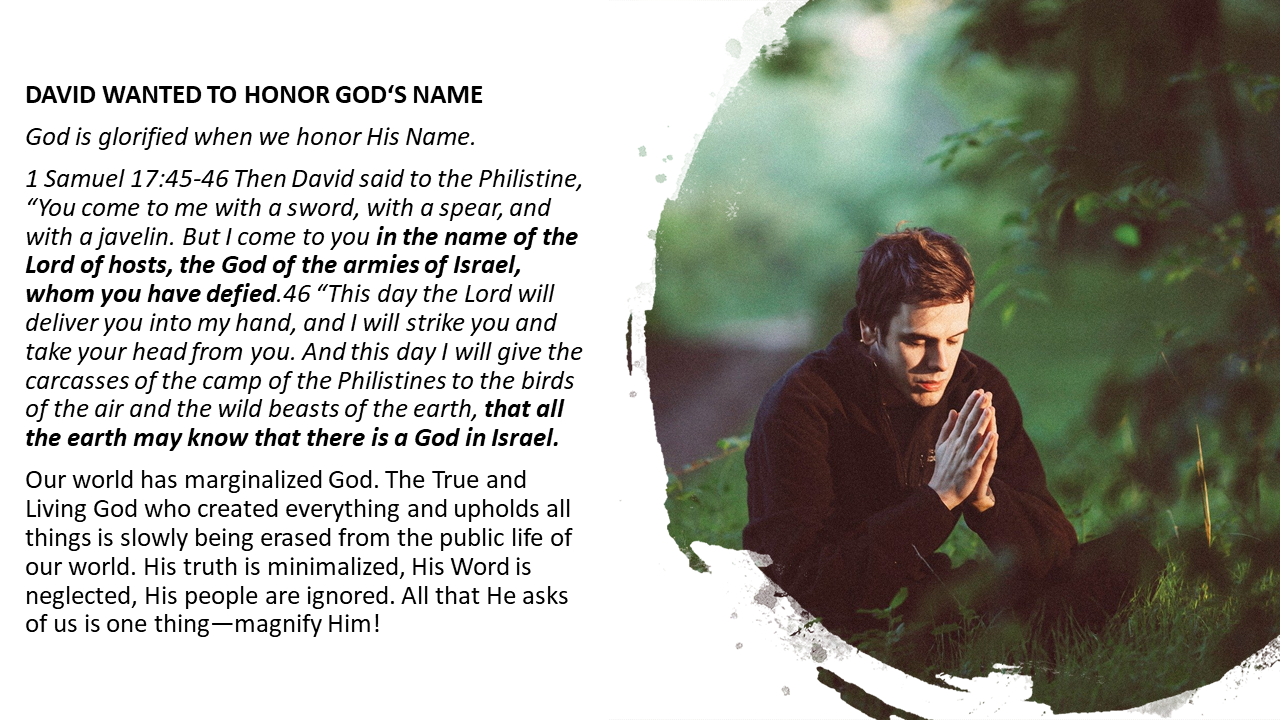
DAVID WANTED TO HONOR GOD‘S NAME
God is glorified when we honor His Name.
1 Samuel 17:45-46 Then David said to the Philistine, “You come to me with a sword, with a spear, and with a javelin. But I come to you in the name of the Lord of hosts, the God of the armies of Israel, whom you have defied.46 “This day the Lord will deliver you into my hand, and I will strike you and take your head from you. And this day I will give the carcasses of the camp of the Philistines to the birds of the air and the wild beasts of the earth, that all the earth may know that there is a God in Israel.
Our world has marginalized God. The True and Living God who created everything and upholds all things is slowly being erased from the public life of our world. His truth is minimalized, His Word is neglected, His people are ignored. All that He asks of us is one thing—magnify Him!
DAVID WANTED TO DEDICATE HIS TROPHIES TO THE LORD
God is glorified when His servants dedicate their trophies to Him.
Compare these two verses for an incredible spiritual lesson about what made David tick, and what it was that God wanted so much for us to see in his life.
1 Samuel 17:54 And David took the head of the Philistine and brought it to Jerusalem, but he put his armor in his tent.
But a few years later, where was that very special trophy carefully stowed away? In David’s room, on his wall for all to see and point to him as the greatest warrior? No way—he had taken it to the tent of God, the place most associated with the Lord on planet earth. His treasure was on deposit with God!
1 Samuel 21:9 So the priest said, “The sword of Goliath the Philistine, whom you killed in the Valley of Elah, there it is, wrapped in a cloth behind the ephod. If you will take that, take it. For there is no other except that one here.” And David said, “There is none like it; give it to me.”
David took the sword of Goliath, the ultimate trophy of the day—but he didn’t take it to show off how great he was. David had started a habit of pointing the glory to God. Any trophy David ever received in all his years of undefeated conquests, he seems to always give back to the Lord as an honor to Him! David was God’s servant and so he gave his trophies to God all the way through life. He measured life from God’s perspective.
1 Chronicles 18:11 King David also dedicated these to the Lord, along with the silver and gold that he had brought from all these nations—from Edom, from Moab, from the people of Ammon, from the Philistines, and from Amalek. NKJV
David made this a life long habit. As God gave him great victories, and David was given greater and greater trophies—he just kept giving them back to the Lord. There is no limit to what God will do with a life that keep being given back to Him!
1 Chronicles 28:9 “As for you, my son Solomon, know the God of your father, and serve Him with a loyal heart and with a willing mind; for the Lord searches all hearts and understands all the intent of the thoughts. If you seek Him, He will be found by you; but if you forsake Him, He will cast you off forever. NKJV

ONLY ONE LIFE TO OFFER
Probably every one of us in this room have heard the famous life’s motto that the great missionary Charles Thomas Studd (1860-1931) lived and died by—
“Only one life, ‘twill soon be past; and only what’s done for Christ— will last.”
However, few of us realize when it was that he said those words. It was on his deathbed with his precious family gathered around him. He had already told each of his children that he wished he had something to give to them, but he had nothing left. Then he said, “..but I gave it all to Jesus long ago.”1
This spiritual giant actually gave his children more than anyone could imagine. His children had seen their father grow year by year in the Lord. They saw his personal devotion to the Word of God. They watched him refined by constant health problems, reoccurring weakness and bouts with intense pain. They had watched his tireless devotion to the Lord that carried their frail dad to the remotest and most dangerous spots on earth—all to share the glorious Gospel of Christ. In the end, every one of his children served the Lord to their last days. They saw and followed the example of his great dedication to God.
When Avis B. Christiansen (1895-1985), the wife of the Vice President of Moody Bible Institute heard these precious words spoken by C.T. Studd at his death, she began to ponder them. A few years later in 1937, she wrote a now famous hymn, “Only One Life to Offer”. Listen to her reflections that turned into a prayer of devotion to the Lord she also served with all her heart (hymn # 378):
Only one life to offer– Jesus, my Lord and King; Only one tongue to praise Thee And of Thy mercy sing;
Only one heart’s devotion– Savior, O may it be Consecrated alone to Thy matchless glory, Yielded fully to Thee.
Only this hour is mine, Lord– May it be used for Thee; May ev’ry passing moment Count for eternity; Souls all about are dying, Dying in sin and shame; Help me bring the message of Calv’ry’s redemption In Thy glorious name.
Only one life to offer– Take it, dear Lord, I pray; Nothing from Thee withholding, Thy will I now obey; Thou who hast freely given Thine all in all for me, Claim this life for Thine own to be used, my Savior, Ev’ry moment for Thee.
Look at the end of his life, what did David do with all those treasures?
1 Chronicles 22:14 Indeed I have taken much trouble to prepare for the house of the Lord one hundred thousand talents of gold and one million talents of silver, and bronze and iron beyond measure, for it is so abundant. I have prepared timber and stone also, and you may add to them. NKJV
1 Chronicles 29:2-3 Now for the house of my God I have prepared with all my might: gold for things to be made of gold, silver for things of silver, bronze for things of bronze, iron for things of iron, wood for things of wood, onyx stones, stones to be set, glistening stones of various colors, all kinds of precious stones, and marble slabs in abundance. 3 Moreover, because I have set my affection on the house of my God, I have given to the house of my God, over and above all that I have prepared for the holy house, my own special treasure of gold and silver: NKJV
So, are you seeking God while you are young.
 You say how do I start? Here’s a quick game plan to be like David God’s servant.
1. Like David–God’s servant, MY life is on God’s mind.
2. Like David–God’s servant, MY life needs discipline.
3. Like David–God’s servant, MY life needs to be available to God for His use.
4. Like David–God’s servant, MY life needs to be empowered by the Lord.
5. Like David–God’s servant, MY life needs to be an example of godliness
6. Like David–God’s servant, MY life needs to display true humility.
7. Like David–God’s servant, MY life needs to minister to others.
8. Like David–God’s servant, I will honor God with MY work.
9. Like David–God’s servant, I will honor God with MY attitude.
10. Like David–God’s servant, I will honor God with MY habits.
11. Like David–God’s servant, I will honor God with MY life.
12. Like David–God’s servant, I will magnify God’s hand in MY life.
13. Like David–God’s servant, I will honor God’s Name with MY mouth.
14. Like David–God’s servant, I will dedicate MY life wholly to the Lord.
David’s spiritual secret was a heart to serve.
David wanted to serve the Lord.
1 Elisabeth Elliot, Passion & Purity, Fleming Revell, p. 43
Slides





Check Out All The Sermons In The Series
You can find all the sermons and short clips from this series, David’s Spiritual Secret here.
Looking To Study The Bible Like Dr. Barnett?
Dr. Barnett has curated an Amazon page with a large collection of resources he uses in his study of God’s Word. You can check it out here.