
If the video above is not available, here are two other ways to view:
Don’t Waste Your Life Like Saul
060205PM
DSS-07
1st Samuel 31
Transcript
.jpg)
Let’s open our Bibles to 1 Samuel 15. We’re actually backing up through the book of 1 Samuel. We’ve done chapter 17, chapter 16, and now we’re backing up to chapter 15. As you’re turning there, there’s a chorus that I love to sing that many of you know. It’s one of those simple ones. It’s the greatest thing in all my life is knowing You, loving You, serving You. That’s a beautiful chorus. If that’s true, and it is, and as we’ve seen over the weeks, if the inhabitants of Heaven, those who surround God in the end, when the Bible ends and when eternity is unfolded before us, are God’s servants, and they are, then the greatest thing that we truly can do in our lives, the way that we make life matter and be worthwhile, is to serve the Lord.
.jpg)
So, this morning, I would like to challenge you from God’s Word, how not to serve the Lord. The Bible is amazing. Sometimes it teaches truth positively, and sometimes it teaches truth in a negative way. This morning, I would like to show you from a negative perspective how Saul didn’t serve the Lord. In our lives, it’s a beautiful, powerful, and compelling call to our lives to not serve the Lord the way King Saul did.
Let’s look at that 15th chapter because the opposite; If serving God is the greatest thing in all the world and what we should do, the opposite of that would be the worst way to live. The greatest waste of our lives would be to live for anything but serving the Lord. To live for anything. There was a great selling book by Russell Cromwell, oh, I don’t know how many generations ago, called Acres of Diamonds. Basically, if you’ve never read the book, it was a motivational book. They use it in sales conferences, but it was about a fellow who was crossing the desert at night, and a voice came and said, reach down and pick up some rocks, and you’ll be happy and sad. So, he reached down and picked up rocks. The next morning, when he was coming out of the desert, he was lugging along with these heavy pockets, and he went like this, and he pulled them out, and they were diamonds and rubies. What was he happy about? That he picked them up. What was he sad about? Yeah, he didn’t pick up more. Why didn’t he just drag a wagon behind him?
Do you know, in a small way, that’s what this is all about? You’re going to be happy, and I’m going to be happy to the extent that we serve God, but we’re going to be sad that we didn’t do more. Saul points out to us that the greatest waste of a life is doing anything but serving God. He’s a classic example of what not to do.
.jpg)
We’ve been considering the greatest servant in the Bible. His name is David. I’ve told you over and over, his life is recorded more completely than anyone else’s. We know more about how he served the Lord than any other Biblical character. It doesn’t mean he was the greatest, but we know more about every possible way and what God thought about what he did. He is a great example to us. But God’s Word often teaches us by way of contrast. I’d like to contrast the most graphic contrast in the Bible side-by-side, the life of the greatest servant recorded in the Bible, David, with that is next to the colossal failure of Saul, the King. Those two are an incredible contrast.
1 Samuel, that we saw last time, is the record of a boy who stood all alone. That’s David and Goliath. So, that was the 17th chapter. He stood alone for God. He saw what God can do through one individual who’s completely yielded to the Lord. He did make a great, great, magnificent picture of the weakness that David was against the mightiness of Goliath and how God accomplished it. Chapter 16 is the record of David, who grew into the man after God’s own heart. David was a servant who loved and served the Lord. In that chapter, we excavated through every verse of David’s character and how he responded to his dad and his brothers and to adversity and how he sought the Lord and how he was disciplined in his life. And when he opened his mouth, he spoke about God’s hand in his life. Just a classic chapter on how to be a servant of God. Remember David’s epitaph? God wrote nine words that David served God in his generation, and that was his life in the 16th chapter.
What’s in the chapter before all that? What’s in the chapter before Goliath and the Shepherd Boy? That’s where we are this morning, the 15th chapter of 1 Samuel. 1 Samuel 15 tells us that David was chosen because of King Saul’s unwillingness to serve the Lord. Chapter 15 is God saying, that’s it, I’m fed up, I’m done. In fact, I’m grieved. I repent, God says, that I picked this guy, Saul. He is a failure. His life is a waste. Why? Because he wouldn’t serve the Lord. He wouldn’t obediently fulfill what God asked him to do. That’s a very sobering thought.
Remember that this book that we hold in our hands, the Bible, is God’s Word and it’s supernaturally engineered by God. The Spirit of God planned every word, every verse, every chapter of every book, and there is no place, no person, no event that just happened to get included. The Lord himself has master planned this book. So, as we look at it, every part of this book not only points to Christ but also teaches us how we can have our lives point to Him. That’s what serving God is all about: a choice in life of either serving ourselves or serving the One who loved us and gave Himself for us.
.jpg)
This morning, I want to challenge you on how not to serve God. That’s exactly what we see at the start of 1 Samuel 15. This chapter captures why God picked David and why God rejected Saul. If you ever want to be sure you’re on God’s team and stay there, then understand the eternal spiritual truths of this chapter. To understand them, let’s read it. So, let’s stand together for the reading of this magnificent Old Testament chapter. Stand with me. We’ll read it, and then we’ll pray.
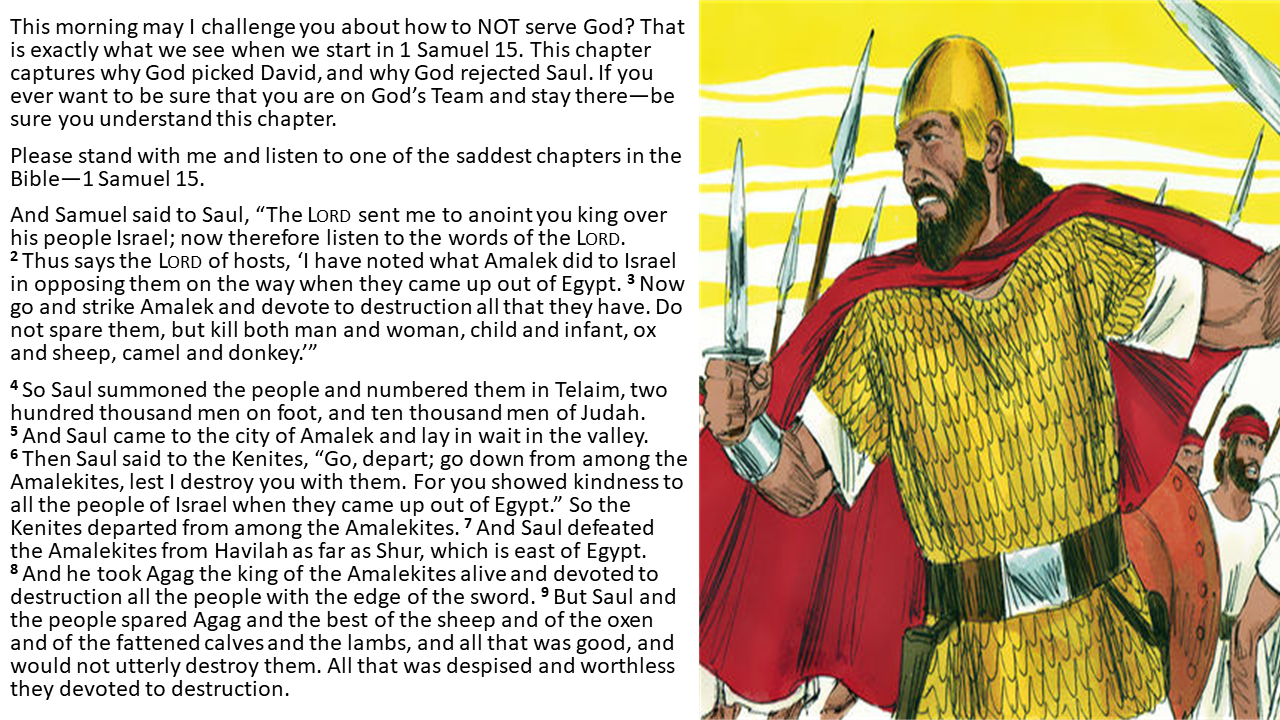
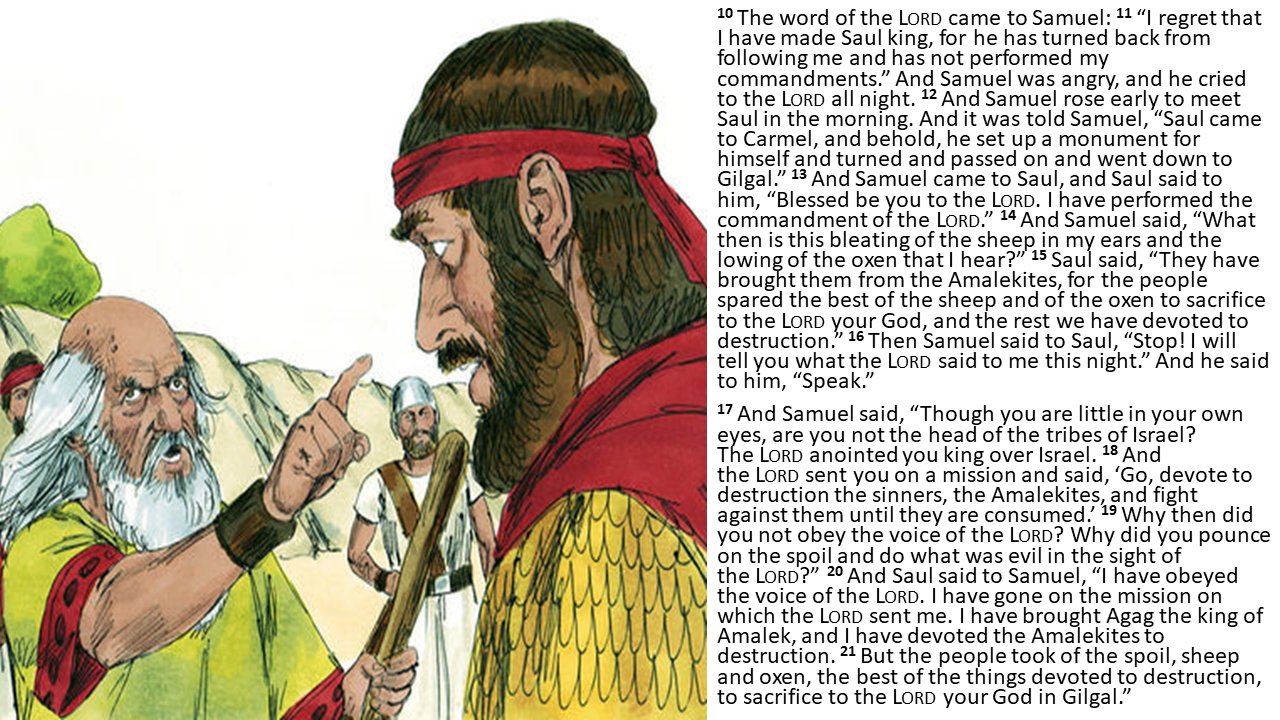
1 Samuel 15. And Samuel also said to Saul, the Lord sent me to anoint you, king over His people, over Israel. Now, therefore, heed the voice of the words of the Lord. Very clear. Okay? He’s setting him up. He says, God anointed you to be king, and here’s what he wants you to do. Verse 2, thus says the Lord of hosts. I’m telling you what God Almighty is saying. Okay, Saul, listen. I will punish Amalek for what he did to Israel, how he ambushed him on the way when he came up from Egypt. That was a historic note. You remember the whole thing. Deuteronomy 25:14-19 tells all the details. It’s also in Exodus. Okay? Verse 3. Because of that, God says, I want you, my anointed king, to do, verse 3. Go and attack Amalek. Utterly destroy all that they have. Do not spare them.
Now, in case you don’t understand, Saul, let me qualify this. But kill both man and woman, infant and nursing child, ox and sheep, camel and donkey. Now, this Hebrew word is the word ḥāram. It means being absolutely devoted to destruction for God’s purposes. That’s what they were supposed to do in Jericho. Remember what happened with Achan and all that. It was part of God’s plan because of evil, to exterminate the evil, so it would not spread. So, this was that Old Testament absolute judgment on a group of people. So, verse 4 couldn’t be clearer than that. Even the smallest child here, if I said that to them, looked at them right in the eye and said, thus says the Lord, they’d get it, total destruction. It doesn’t mean they’d agree or do it, but they would understand. So, Saul at least mentally heard this.
Verse 4. So, Saul gathered the people together and numbered them in Telaim, 200,000 foot soldiers, 10,000 men of Judah, and Saul came to the city of Amalek, and lay in wait in the valley. Again, my imagination, how do you quietly sneak up on 210,000 people? And so, they’re lying in wait in this valley. This is just amazing.
Verse 6. Then Saul said to the Kenites, go, depart, get down from among the Amalekites lest I destroy you with them. For you showed kindness to the children of Israel when they came up out of Egypt. So, the Kenites departed from among the Amalekites, and I don’t know how the Amalekites didn’t even know about that, all the whispering.
But verse 7. So, Saul, here we go. He’s going to do what God said. He attacked the Amalekites from Havilah all the way to Shur, which is east of Egypt. He took, oh, took. Now, we’re getting off the script of what God wanted. He also took. He was supposed to kill. He took. There’s the first problem right away. He took Agag, king of the Amalekites, alive and utterly destroyed all the people with the edge of the sword. But, verse 9, Saul and the people spared Agag, and the best of the sheep, and the best of the oxen, and the fatlings, and the lambs, and all that was good. In the middle of verse 9, they were unwilling to utterly destroy them. But everything despised and worthless that they destroyed.
.jpg)
Verse 10. The Word of the Lord came to Samuel, saying, I greatly regret that I have set up Saul as king for he has turned back from following Me. He has not performed My commandments, and it grieved Samuel. He cried out to the Lord all night. There’s a man really in tune with God. Whatever bothered God bothered him, and Samuel is just grieved.
Verse 12. So, when Samuel Rose early in the morning to meet Saul, he was going on a corrective mission from God. It was told Samuel, saying, oh, Saul’s not here. Saul went to Carmel, and indeed he set up a monument for himself. Saul was pretty proud of what he had accomplished, getting all this booty and loot and this trophy of Agag and getting rid of all the bad stuff. He’s setting up and having a little time of dedication of a monument to himself. He has gone down, and passed by, and gone down to Gilgal. Verse 13, Samuel went to Saul, and Saul said to him, blessed are you of the Lord. I have performed the commandment of the Lord. If you wonder what that was, it’s verse 3, utterly destroy everything, man, woman, child, nursing child, every animal, everything, destroy it all. He didn’t tell the truth. Verse 13, I have performed the commandment of the Lord.
Verse 14. It’s one of those classic moments in sacred history. But Samuel said, I can just see him. He’s going like this. He’s old. He says, what, verse 14, is the bleating of the sheep in my ears, and the lowing of the oxen, which I hear? And now, Saul goes into one of the modes he was so good at. Verse 15, Saul said they, I didn’t do that. They did that. He’s pointing, those pesky people. They have brought them, the best of the Amalekites. The people spared the best of the sheep and the oxen. They’re going to sacrifice it to the Lord. I love how the Western text puts this. The Lord your God. It isn’t just once. The New King James and King James capture this little note, the Lord your God, Samuel. He distances himself. He doesn’t say, my God, they’re sacrificing to my God. Your God. And the rest we have utterly destroyed.
Verse 16, and Samuel said to Saul, be quiet. That’s the direct approach, no beating around the bush. I will tell you what the Lord said to me last night. He said to him, Saul said to him, speak on. Samuel said, verse 17, when you were little in your own eyes, were you not head of the tribes of Israel, and did not the Lord anoint you king over Israel? Now, the Lord sent you on a mission, and He said, go and utterly destroy the sinners, the Amalekites, and fight against them until they are consumed.
I’ll just put a footnote in right here. If you ever want an interesting study, study the Amalekites. The Amalekites stand for the flesh in every way. They are an incredible Old Testament picture of what we are supposed to do. As the Scriptures say, we’re to mortify and kill and leave no ground for our flesh. The Amalekites were the constant nemesis of the Israelites. Hitler didn’t come as close to destroying the Jews as the Amalekites did through their descendant named Haman, the Agagite, Agag’s descendant. It’s very important that God wanted to destroy them, but Israel didn’t. Okay? The sinners destroy them. It’s a New Testament picture of the flesh.
But verse 18 continues, and fight against them until they are consumed. Verse 19, why then did you not obey the voice of the Lord? Why did you swoop down on the spoil and do evil in the sight of the Lord, which tells us God is watching everything we’re doing. It’s either good or evil. He watches it all, and He assesses it. Verse 20, and Saul said to Samuel, but I have obeyed the voice of the Lord. I’ve gone on the mission that the Lord sent me. I’ve brought back Agag, king of Amalek, and have utterly destroyed the Amalekites. But the people, verse 21, they took the plunder, the sheep, the oxen, the best of the things, which should have been utterly destroyed, to sacrifice to the Lord your God, he says it again, in Gilgal.
.jpg)
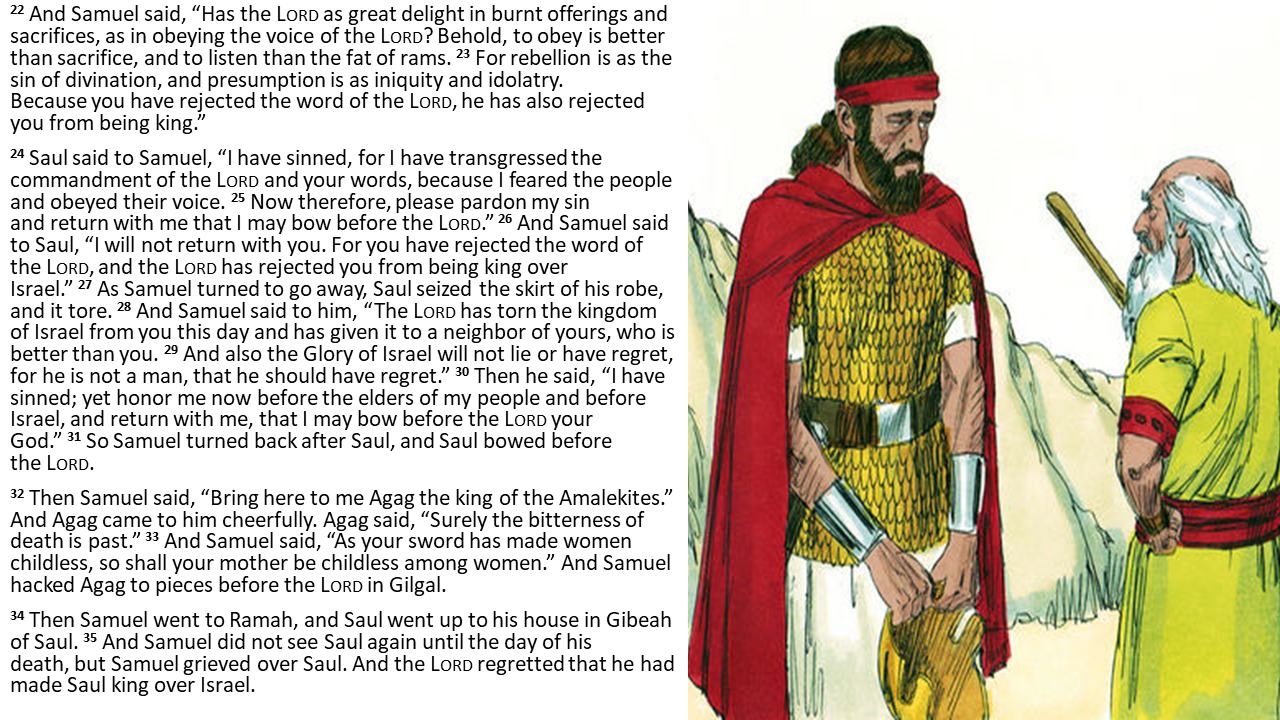
So, Samuel said, verse 22, has the Lord as great delight in burnt offerings and sacrifices as in obeying the voice of the Lord? Behold, to obey is better than sacrifice and to heed than the fat of rams, which is the ultimate sacrifice. For rebellion, verse 23, is as the sin of witchcraft. Isn’t that interesting? God says that tarot card, crystal ball reading, tea leaf astrology, and following occult practice are on the very same level in His book as rebellion. You know what rebellion is? Going against an authority instituted by God over your life and saying no. That’s rebellion. It’s one of the first sins children commit. No, they say to their parents, that’s rebellion. God says rebellion is right up there. We would be very concerned if we had witchcraft breaking out in our church, if we found them down in the youth room, sitting in the dark, looking in a crystal ball. Oh, we would just raise the roof for that. But a child glaring coldly with narrowed eyes, looking at their parents, and we say, ah, they’re a little tired. They don’t feel very good this morning. God says, rebellion is as the sin of witchcraft.
Stubbornness. Some people pride themselves on stubbornness. They say I’m a real stubborn person. You’re not going to get anything by me. Stubbornness is as iniquity and idolatry. Again, if we had a little pole downstairs and they were all bowing down to it, why, we would just clean house. But we have stubborn people. We just say they got real tenacity there. God doesn’t look at it that way. God sees things differently. Stubbornness is as iniquity and idolatry because you, Saul, have rejected the Word of the Lord. At the end of verse 23, it says, He also has rejected you from being king.
Verse 24. Then Saul said to Samuel, I’ve sinned. I’ve transgressed the commandment of the Lord and your words, because here’s another excuse, Mr. Excuse. I feared the people. I obeyed their voice. He blamed it on them and said they were more important than God. Amazing.
Look at verse 25. Now, therefore, please pardon my sin. He’s talking to Samuel. Pardon my sin and return with me that I may worship the Lord. But Samuel said to Saul, I will not return with you. For you have rejected the Word of the Lord. The Lord has rejected you from being king over Israel. Samuel turned around to go away, and Saul saw the edge of his robe and tore it, and it tore.
Verse 28. So, Samuel said to him, the Lord has torn the kingdom of Israel from you today and has given it to a neighbor of yours who is better than you. Also, verse 29, the strength of Israel, that’s one of the names and titles of God, a beautiful one, will not lie nor relent for He is not a man that he should relent. Then he said, I’ve sinned, yet honor me now, please. This guy has such a warped view. Look at this: Honor me. What a tragic thing. It’s kind of like, not so Lord. It’s one of those paradoxes. Honor me. I’ve sinned. No, honor the Lord and fall prostrate before Him, but he doesn’t do that. Honor me, please, before the elders of my people. Let me save face, he’s saying. And before Israel, I don’t want to get in trouble. And return with me, that I may worship the Lord, what? Your God. Saul had a real problem: impersonal worship. God was secondhand to him. He didn’t know Him personally. Sad.
Verse 31. So, Samuel turned back after Saul and Saul worshiped the Lord, and Samuel said, bring Agag, king of the Amalekites, to me. So, Agag came to him cautiously. Wise fella. And Agag said, surely the bitterness of death has passed. He could just see the fire in Samuel’s eyes. This old guy was fiery in his devotion to the Lord.
Verse 33, Samuel said, as your sword has made women childless, so shall your mother be childless among women. What a statement. Samuel hacked Agag in pieces before the Lord in Gilgal. You want to read a great chapter on that? MacArthur wrote a chapter called Hacking Agag to Pieces. It’s about spiritual sanctification, one of his best chapters that he ever wrote. I love it. Hacking Agag to Pieces. It says we have to ruthlessly destroy the effects of our flesh because our flesh, always, the arm of flesh, will fail us, and we cannot live except walking in the Spirit.
Samuel went to Ramah, verse 34, and Saul went up to his house in Gibeah of Saul, and Samuel went no more to see Saul until the day of his death. Nevertheless, Samuel mourned for Saul. Another indication of a great servant with a heart like God. And the Lord regretted, the second time it says that in this chapter, that He had made Saul king over Israel.
Let’s bow together. Father, one of the great chapters we all should know and heed. If the greatest thing in all of our lives is to know and love and serve You, then the greatest tragedy, the greatest waste of our lives would be not to know, not to love, and not to serve You. Help us not to waste our lives. Help us to know how not to serve You, so we will serve You. Open our minds to this. May this message be one that Your Spirit just illumines our hearts to see, because what Saul did is so easy for us to lapse into and ruin and waste our lives. We pray that You will cause us to not merely be hearers, but doers this morning. In the name of Jesus, we pray, Amen.
.jpg)
You may be seated. As you’re seated, let me just go through as far as we can go through the 15th chapter before communion this morning. I want to go back through this chapter with you and note the glaring examples that God records for us of ways to fail and waste our lives, of how not to serve the Lord.
The first one is in the first seven verses, and this is what I wrote in my Bible. If I don’t want to serve the Lord, if I want to waste my life, number one, ignore clear and direct statements about what God wants you to do. If you really want to blow it in life, ignore clear and direct statements about what God wants us to do.
Now, the Church usually gets all bent out of shape historically over little things; whether we should have foot washing or not, whether we should baptize face forward or back, once or three times, standing up under a waterfall, poured or sprinkled. That is really crucial, right? That is something that the Bible doesn’t spend a lot of time on, and that’s usually what churches divide over, and lesser things than that. But if you want to fail God, ignore the clear, direct, and hard-to-dispute commands of God. That’s what he does.
Look at those first seven verses. Saul ignored the clear and direct statements about what God wanted him to do. You couldn’t be clearer than what he said. God says, I want you to go, verse 3, and attack Amalek, utterly destroy all that they have. And in case you’re thinking it’s just their stuff, He names the people. He names every class: man, woman, infant, nursing child. Then He said they’re animals and all their other stuff. He said, I don’t want anything of Amalek left.
Here’s a little aside. Saul was from the tribe of Benjamin, right? Who was Mordecai from in the book of Esther? The tribe of Benjamin. Saul was supposed to kill Agag, the king of the Amalekites, and he didn’t.
So, 500 years later, Haman, the descendant of Agag, has a signed and sealed law of the Medes and Persians, an edict, put out to have every Jew destroyed in the kingdom of Ahasuerus, 120 provinces. It was the first time there was a death sentence on every one of God’s people, and I bet the Devil was having a party. You talk about a Super Bowl party. They had a super party. He finally was going to discredit God, Satan was, by destroying all the Jews because they’re the key to the future of God’s plan. He thought he had it down because Haman, the Agagite, had given 10,000 talents of silver, a lot of money, to destroy all the Jews in an empire that extended from the borders of China all the way through up to Europe and down into Africa. In other words, everywhere the Jews might live, it was signed. Mordecai went out and tore his clothes and paraded, you know, the story of Queen Esther and how she went to the king and how it all turned around. That’s how we have one of the Jewish holidays today, as they celebrate Purim because of the casting of lots and all that happened there. Haman, the Agagite.
So, what God did was He had an unfaithful son of Benjamin, Saul, who wouldn’t kill the Amalekites. So, then we come to another son, see how the Holy Spirit supernaturally engineers the Bible? So, in Esther, we find a faithful son of Benjamin whose name was Mordecai, who will serve God and who destroys Haman and his whole family. As far as we know, that was the end of all the Agagites. So, Mordecai is God’s good servant who served Him. Saul isn’t. So, number one, ignore the clear and direct statements of God.
Now, let me just ask you before we go on, what are some of the clear and direct statements from God about what He wants us to do? He doesn’t say how to baptize people. He does say, go into all the world and preach the Gospel to every creature. Is that pretty clear? Is that direct? Is that understandable? Mm-hmm. He said by this, all may know you’re My disciples, by what? The love you have for one another. Is that pretty clear? Is it pretty direct?
How about this one? I beseech you, therefore brethren, I beg you, Paul said, by the mercies of God that you present your body as an ongoing living sacrifice, which is your spiritual act of service. I command you, do not be conformed to this world. Don’t let the world shape your life, but be transformed by God’s Word, renewing your mind. Is that pretty clear? Is that pretty direct? You want to know how to waste your life? Ignore the clear, direct commands of God. Saul did it. His life was a colossal failure. The first seven verses, if you want to fail, what God made you to be and to do, and if you want to waste your life, just ignore the clear and direct statements about what God wants you to do.
.jpg)
Now, look at verse 8. It says, he also took Agag, the king of the Amalekites, alive and utterly destroyed all the people with the edge of the sword. Number two, want to waste your life? Pick and choose from what God clearly tells you to do and offer God selective and partial obedience. Do you see what was wrong? This Saul, he wanted to say, I obeyed the Lord. Actually, what he did was he went in as children do on their plates, and he took his fork, and he went, I don’t like peas. I don’t like broccoli. He pushed them off. Then mom says, did you eat your food? I sure did, all the parts I liked. That little caveat there, that selective and partial obedience is not obedience. Now, eating your vegetables is a small thing compared to the clear and direct statements of God.
Look what it says in verse 8. He took Agag, the king of the Amalekites, alive, and then later on, we find not just that, but all their loot. He swooped, is the way God looked at it. Swooped in on the loot, the spoil, the plunder. Pick and choose from what God clearly tells you to do so that your life only offers to God selective and partial obedience. If we were grading King Saul’s paper, we would not be so harsh on him. We’d say, wow, you destroyed the Amalekites, you just kept that old king, but that’s a good reminder of how powerful God is, and they didn’t deserve all that loot, but it’s good stuff, and why waste it, right? Isn’t that how we look at things?
We’d say Saul did it. He did it. He did what the Lord said. He killed all the Amalekites, just kept the king. He had to have kept some of his wives or something because Haman was around, so there were 500 years of descendants. Who cares about details, right? Let’s just cover the big stuff. Let’s just do the principles. Let’s just do big thoughts. Why fight over little things in the Bible? Because God is a God of detail and precision. God wants us to obey Him, and He says, either you obey me, or you don’t. There’s not this wide gray kind of squishy zone where you select and say I’m not sure about that. I don’t like that, but I like this. He, God, doesn’t like that. Saul offered God partial and selective obedience.
Keep your finger here and let me just show you one clear word from the Lord Jesus in the Gospel by John, chapter 14. John 14. Jesus is addressing His disciples. It’s at the end. He’s in His march to the cross. This is often called the legacy of Christ. It’s Him giving the greatest treasures to His disciples. It’s such a powerful part of the Scriptures. In verse 21, Jesus says something that I, the first time I found this verse when I was about nine years old, I remember marking it in my little Bible. I said, now there’s one I’m going to remember. I memorized that verse almost 50 years ago. 40 some years ago, I learned this verse. Jesus said, he that half My commandments and keepeth them, he it is that loveth Me.
You know how you show your love? By obedience. That’s a little kid’s song. Obedience is the very best way to show that I believe. Doing exactly what the Lord commands, doing it happily. Jesus said, if you have My commandments and keep them, that’s how you show that you love Me. Not if you have them and you push out the broccoli and the carrots and the stuff you don’t like, and you pick whatever is most palatable to you, and you selectively pick what you want to do. You partially obey. That’s not obedience to God. It is to us; we’ll settle for anything. It isn’t to God.
And to this man, who was in the Old Covenant, who was not indwelt by the Holy Spirit, who did not have all of the light and illumination that we have and all the resources, God held him to such a strict standard. That makes me think of what the writer of Hebrews said about how much sorer the punishment we will deserve. God says much light, much scrutiny from God. Little light, less scrutiny from God. The book of Acts, chapter 17, the Lord overlooked and winked at, kind of like He had something in His eyes, and He overlooked some of their transgressions. Now, that didn’t mean that God is not just, He just didn’t immediately respond to their error.
If you are a servant of God, called of God, indwelt by the Holy Spirit, with the image of God upon you in Christ Jesus, which we all have in Him, He expects us not to have partial and selective obedience, not to push out the parts we don’t like, but to say with my whole heart I will love You. I will serve You. I will obey You because I love You. Selective obedience doesn’t count. He who has My commandments, 21 says of chapter 14 of the Gospel by John, is he who loves Me, and he who loves Me will be loved by My Father. I will love him and manifest Myself to him.
If you ever feel like you have a wavy picture of your spiritual life, it’s kind of like the old TV sets that you’d have to fix the antennas and put a little aluminum foil on it to try and get the picture in. We still have one of those. In fact, sometimes to see stuff, we have to have the kids stand, and they hold it like this. You get to hold the antenna if we want to see the end of the world or a tsunami, or something. There’s one window, and if we hold the antenna by it, it comes in better, our three little channels we get. If your spiritual life’s fuzzy, look back at verse 21. God says, I will bring cable clarity to your life. I will manifest Myself to you. You’ll have a very clear, kind of like all those people who have cable, a really clear picture on every channel. Do you want to have a cable spiritual life? Verse 21 says, have My commandments and keep them. If God is fuzzy to you, it’s because you’re not keeping His commandments, and that means you don’t love Him. God says, selective, impartial obedience is not obedience to me. You don’t love Me if you are selective and impartial.
So, if you want to fail at what God made you to do and to be, and waste your life, just pick and choose from what God clearly tells you. I don’t mean the unclear stuff. I don’t mean you have to run around and try and pinch off every 10th leaf of your herb Garden. I’m not talking about all the disputes throughout the ages about whether we’re grace-giving, or whether you’re tithing, or whether this, or whether we’re that. I’m talking about the clear and direct statements of God. Don’t conform to the world, and be a living sacrifice, and be crucified with Christ, and yet live not you anymore, but Christ, and love one another. I’m talking about the clear stuff. You want to really fail and waste your life? Partially and selectively obey God.
Look at verse 9. Here’s another one. A third way to waste our lives and not serve God. I call this holding on to the best and nicest parts of what God hates and has asked for you to destroy and keep them for your own use. That’s 1 Samuel 15:9. Look what happens in verse 9. But Saul and the people spared Agag, and the best of the sheep, the oxen, the fatlings, the lambs, and here’s a big statement, and all that was good. Look up from your Bibles. All that was good to whom? To them. Do you see this? They were looking at life through their own eyes. They said we think it would be better to spare him as a trophy, and we think it would be better not to kill the cows. We think it’d be better to keep those fatlings for our Memorial Day cookout. We’re going to have this party, and we think the lambs we could use in the Tabernacle. We think it’s good for us.
A lot of people live their lives that way. They say to me, I think what I think is best. Instead of saying what God says, I want to be completely, lovingly, prompted by Spirit to obey. It’s amazing, look at verse 9, the first part. Look at the end of the middle because we’re going to go to the second half in a minute. And all that was good, verse 9, and were unwilling to utterly destroy them. Do you know what that means? They knew they were supposed to, but they just wouldn’t do it. They knew they were supposed to destroy everything. They just wouldn’t do it. They knew what God wanted. They just wouldn’t do it. Saul knew. He heard. God told him he just wouldn’t do it. That’s what rebellion is. I know it. I just don’t want to do it. I know what God expects. I’m not going to do it. I don’t want to. That wouldn’t be good for me. Might be good for you, won’t be good for me.
There’s a verse on that, too. Be not deceived, God is not mocked. Whatever you sow, you’ll reap if you sow the flesh. Remember the consequence engine we saw a few months ago? There is an inexorable response even in the life of a believer for disobedience. The grace of God preserves our eternal standing and our eternal destiny. The consequence engine, though, operates on Earth, and you cannot escape the consequences of wrong decisions of rebellion and of disobedience to God. That’s what chastening is. That’s what being burned up and crying and having ashes left of your life is all about.
.jpg)
Hold on to the best and nicest parts. Look what they did in verse 9. They held onto the trophy Agag, the nice sheep, the nice oxen, the nice fatlings, the nice lambs, and anything else that was good. Keep those things. Notice that God hates and has asked for you to destroy and keep them for your own use. That is what they did. Is there anything wrong with oxen? No. Anything wrong with lambs? No. They took good things that God said you may not have for My purposes at this moment. It’s kind of a legitimate desire that’s fulfilled in an illegitimate way, which could be written across the American culture right now. There’s nothing wrong with having a good job and earning money, but if you sacrifice everything to do it, it is. There’s nothing wrong with having a home; if you worship it, it is. There’s nothing wrong with athletics; bodily exercise profits a little. If you live for sports and if all you think about, then it is wrong. There is an illegitimate usage for all good things.
For a second, turn back to James chapter 4. I’m not going to go into this. We spent an entire morning on this, but look back in the New Testament, James. If you don’t know where James is, go to Revelation, back up just about 20 pages from Revelation. James in my Bible, it’s not even 20 pages. It’s only 12 pages from Revelation. But James chapter 4, very close to the end of your Bible, and I want you to think about this because Jesus told us in the New Testament what He thinks of loving what God hates. The whole Bible is about what God loves, what God hates, what serves God’s purposes, and what doesn’t. That’s what the Bible’s about. It’s a guide to how to live life empowered by the Spirit, to want to lovingly respond to God with what He loves and to flee and put to death and hate and have nothing to do with what He hates.
James 4. This is the first church in Jerusalem. This is the first pastor speaking. The first pastor of the first church was our Lord’s brother, named James. Jesus had two known brothers. He had more than that. He had four brothers and several sisters. It’s plural in the Gospel of Mark, chapter 6. So, we know he had four brothers, and we know two of them are believers. One wrote the book of Jude, the one just before Revelation. The other one wrote the book of James, which you’re in right now. James, who wrote this book, was also the first pastor of the first church of Jerusalem. In fact, the apostles came before him when they had disputes because, remember, the Jerusalem Council in Acts 15. So, he got saved, and he was a great servant of the Lord.
He is writing to the Early Church, and this is what he says in chapter 4. He says, where do fights and wars come from, verse 1? Don’t they come from your desires that war within your members? He says, you’re believers, and you’ve got these lusts. You lust and do not have, verse 2, you murder and covet and can’t obtain. Some people have trouble with that. Jesus said, if you hate your brother, it’s like murder. He said, if you long for something with such a longing, it’s covetous idolatry. This fits. You don’t have to say these are lost people. Some commentators, about half of them, say they are. It’s a position you can take. I don’t think it flows through the book very well to all of a sudden revert to lost people, but whatever. Look at verse 3. You ask and don’t receive because you ask amiss that you may spend it on your pleasures. If God doesn’t even hear the prayers of the lost. What is he talking about if this isn’t about believers?
But look at verse 4. That’s where I want to get to. Adulterers and adulteresses. Do you not know that friendship with the world is enmity with God? Whoever, therefore, wants to be a friend of the world. Loving what God hates, taking for your own use as Saul did, actually holding on to the best and nicest parts of what God hates and has asked for you and me to destroy, and keeping them for our own use. Verse 4, whoever, therefore, wants to be a friend of the world, love, and use, and selectively obey God, and pick out what we like and don’t want to give up in the lives of our old ways, and our lusts, and our flesh makes himself an enemy of God.
Do you know why Saul’s, King Saul’s, life was wasted? He made himself God’s enemy because he selectively obeyed. He didn’t get the clear message. I’m not talking about the vague stuff. He just flat out wouldn’t obey the clear, direct commands of God. He selectively kept for himself the things he thought were good in life.
Back to 1 Samuel 15 with me. If you want to fail at what God made you to do and to be and waste your life, just hold on to the best and nicest parts of what God hates, which is this world and all that’s in it. It’s going to pass away. Anything, Jesus said, if you want to save your life, lose it. If you want to lose your life, cling to it. In other words, don’t give it to Me. If you want to ruin anything, say, Lord, you can have everything but that. You just lost that as far as eternity’s concerned. It’s going to burn up. It’s going to be worthless. If you want to fail, waste your life, just hold on to the best and nicest parts of what God hates and has asked you to destroy, to mortify, to put to death, to deny, and keep them for your own use.
.jpg)
Look at the end of verse 9 of 1 Samuel 15, and this is as far as we’ll get this morning. I’ll just read it. The end of verse 9, 1 Samuel 15, but everything that was despised and worthless, that they utterly destroyed. Wasn’t that nice? In other words, anything that was really garbage, they threw away. What I wrote down is, if you don’t want to serve the Lord, only give God what you don’t want anyway, and is already worthless to you. Don’t give Him anything important; just give Him whatever you don’t want anyway.
It kind of reminds me of when I pastored in New England, we used to have this missionary house. People from the church could supply the missionary house with items for our sacrificing, God-serving missionaries. I remember as a new pastor, a young person on my tour of the facilities took me out to this missionary house, and I remember opening the cupboard. There weren’t two glasses that matched up there. There weren’t two plates that matched. I looked at the silverware, and it was the most eclectic selection I’d ever seen. There was one of every kind of pattern Oneida made. I remember opening the linen closet. There were cigarette burns. There were stained sheets. In the electric blankets, the electric coil was all ripped out.
I said, what is this? Oh, they said it’s a missionary house, everyone donates stuff. I said, what do they donate? The stuff that they couldn’t quite put into the trash because they thought it might have a little value? They said, yeah. It’s for the missionary house. I thought, you really want to serve the Lord, only give to God that which you don’t want anyway, and is worthless to you. Now, that was a tragic thing, and once they thought about it, they changed it all. They got rid of all that junk and got all new stuff. But, isn’t that how we operate sometimes? We give God the money that we couldn’t use for anything else. We give God the time that, you know, we haven’t given to work, and our hobby. You understand what I mean? If you really want to fail and waste your life, just give to God what is worthless anyway, what you want to get rid of anyway, instead of what costs you something.
That’s the context of the Lord’s Supper. Jesus says, I gave Myself to you. I died in your place. What are you going to give to Me? Let’s bow before the Lord in prayer. Why don’t you right now, in your heart, as the elders and deacons get ready at the back to serve us, just in your heart of hearts, say, Lord, I don’t want to ignore the clear and direct statements of what You want me to do. I don’t want to pick and choose from what You’ve clearly told me and only offer you selective, impartial obedience. I don’t want to hold onto the best and nicest parts of what God hates and asks me to destroy and keep them for myself. I don’t want to give You this morning what I don’t want anyway, and what’s worthless to me. I want to give You what is costly.
.jpg)
Father in Heaven, we thank You this morning that Jesus so loved us that He gave Himself for me. And in His own body, He bore my sins and became sin for me that I might become, by Your grace, the righteousness of God in Him. Lord, as we sit before You, we want to have pure hearts and clean hands. So, I pray that we would allow Your Spirit to point out some of Your clear, simple truths that we’re neglecting, some of those things we’re selectively, partially obeying You in. In the name of Jesus, we pray, Amen.
Notes
 When I read a letter or card I usually start by looking at the end to see who it is from. When I read a book I often look at the end to see whether the hero makes it alive to the end.
When I start a biographical study of a person God chose to be included in His Word I always look at the END of their life first. Why is that? Because God said that the way we finish is what counts. It is not how we start the race, but how we finish the race that really matters. That’s why Paul triumphantly said, “I have finished the course” (2nd Timothy 4:7)!
So as we look at the life of King Saul and especially at the theme of ‘how not to serve the Lord’ would you join me at the end of his life? Turn with me to how King Saul finished his life in 1st Samuel 31.
Stand, read 1st Samuel 31 and pray.
On this windswept hill, three thousand years ago the mightiest man of Israel fell wounded; King Saul with life agonizingly clinging within his tortured body — called out to a passing man and had him end his earthly suffering. That man killed King Saul and took his crown. That man was an Amalekite.
After the fierce battle all day with the Philistines — arrows from the enemies he had fought gravely wounded King Saul. His sons and heirs to the throne lay dead around him, night was falling, the enemies had retreated – and Saul was alone.
The mightiest man of Israel, head and shoulders taller than anyone else now dragged himself along trying to reach his sword fallen on the battlefield. When he had it at last he pushed himself upon it to end his dreadful pain.
As the night passed and morning dawned life still clung to Saul. The sound of the victorious Philistine warriors echoed up the hillsides, they came to abuse the wounded and strip the dead. Saul wanted to die. Handing there, impaled on his own sword, Saul looked around through the mists of death and he heard a man coming. In the gray light of dawn he appeared scavenging what he could from the dead. Then Saul cried out to him and asked for him to kill him. The young man obliged, striking down the King of Israel. Then he took the crown off Saul’s head. That man was an Amalekite. Next time we will examine why that little detail screams so loudly from God’s Word. But for tonight—Saul what is it like at the end for one who fails the Lord? What does someone who fails to serve the Lord do to their life? What exactly does a wasted life amount to?
 Saul had money, muscles, and charisma—but he didn’t have integrity, humility, and a servant’s heart. So Saul was a colossal failure.
The last hours of life were spent with a witch—his last supper with a demonic spiritist medium trying to communicate with the dead (1st Samuel 28:3-8) and his death came as he was surrounded by his dead sons and his very triumphant enemies (1st Samuel 31:2).
What happened when Saul refused to serve God and instead served himself? It led to Saul’s eternal disgrace:
Saul’s death was a Personal disgrace: While certain cultures view suicide in time of adversity as noble, God’s people regard it as always dishonorable and wrong. When Saul decided to die by his own hand (1st Samuel 31:4), he chose the lowest way out.
Saul’s death was a Family disgrace: When Saul died, he took his whole house with him. The royal father and three sons, including the popular and noble Jonathan, were killed on the same battlefield (1st Samuel 31:6). While the death of the king was tragic, the simultaneous loss of his heirs was disastrous.
Saul’s death was a National disgrace: All his life Saul had defended Israel from enemy assault. Now he lay dead at the hands of his enemies (1st Samuel 31:7). His death now signaled a Philistine advance unequaled in history and unparalleled in scope.
Saul’s death was an International disgrace: When the Philistines pinned his headless corpse to the wall of Beth Shan (1st Samuel 31:10), they made a strategic choice. Situated at the junction of the Jezreel and Jordan Valleys, Beth Shan controlled the crossroads of major highways. With Galilee and Damascus to the north, the Mediterranean to the west and Jerusalem to the south, travelers from many nations passed through this prominent city. Here is this public place; Saul’s fallen form was a silent witness to the triumph of the pagan powers. While thousands of residents whispered about it, tens of thousands of travelers trumpeted the news in every direction.
Saul’s death was a Spiritual disgrace: The greatest shame in Saul’s death was that it was God’s judgment. The end of his life was exploited as an opportunity for praise of pagan gods. The Scriptures tell us that his head was hung in Dagon’s temple as a trophy of victory (I Chronicles 10:10), and his armor was placed as a votive offering in the temple of the Ashtoreths. These five degrees of disgrace were the solemn epitaph of one who fulfilled the worst in his death because he failed to live up to the best in his life.1
Life really does come down to servanthood—who we present ourselves as servants to obey as Paul said (Romans 6:13). Or as Jesus so clearly warns us, ‘no one can serve two masters’ (Matthew 6:24).
Romans 6:12 Therefore do not let sin reign in your mortal body, that you should obey it in its lusts. 13 And do not present your members as instruments of unrighteousness to sin, but present yourselves to God as being alive from the dead, and your members as instruments of righteousness to God. 14 For sin shall not have dominion over you, for you are not under law but under grace. 15 What then? Shall we sin because we are not under law but under grace? Certainly not! 16 Do you not know that to whom you present yourselves slaves to obey, you are that one’s slaves whom you obey, whether of sin leading to death, or of obedience leading to righteousness? 17 But God be thanked that though you were slaves of sin, yet you obeyed from the heart that form of doctrine to which you were delivered. 18 And having been set free from sin, you became slaves of righteousness. 19 I speak in human terms because of the weakness of your flesh. For just as you presented your members as slaves of uncleanness, and of lawlessness leading to more lawlessness, so now present your members as slaves of righteousness for holiness. NKJV
Matthew 6:20-24 but lay up for yourselves treasures in heaven, where neither moth nor rust destroys and where thieves do not break in and steal. 21 For where your treasure is, there your heart will be also. 22 “The lamp of the body is the eye. If therefore your eye is good, your whole body will be full of light. 23 But if your eye is bad, your whole body will be full of darkness. If therefore the light that is in you is darkness, how great is that darkness! 24 “No one can serve two masters; for either he will hate the one and love the other, or else he will be loyal to the one and despise the other. You cannot serve God and mammon. 25 “Therefore I say to you, do not worry about your life, what you will eat or what you will drink; nor about your body, what you will put on. Is not life more than food and the body more than clothing? NKJV
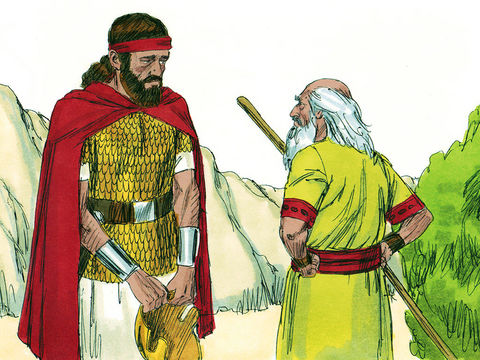 How did Saul fall so far? Back up to where we started. 1st Samuel 15 explains why Saul would have an ignominious death. Look at verse 9.
“But Saul and the people spared Agag and the best of the sheep, the oxen, the fatlings, the lambs, and all that was good, and were unwilling to utterly destroy them. But everything despised and worthless, that they utterly destroyed” (1 Samuel 15:9).
Saul used selective, self-serving obedience in place of total and God-honoring obedience.
Now go back with me through this chapter and note the glaring examples God records for us in ways to fail, waste your life. Here is how not to serve the Lord!
1. Ignore clear and direct statements about what God wants you to do. 1 Samuel 15:1-7 Samuel also said to Saul, “The Lord sent me to anoint you king over His people, over Israel. Now therefore, heed the voice of the words of the Lord. 2 Thus says the Lord of hosts: ‘I will punish Amalek for what he did to Israel, how he ambushed him on the way when he came up from Egypt. 3 Now go and attack Amalek, and utterly destroy all that they have, and do not spare them. But kill both man and woman, infant and nursing child, ox and sheep, camel and donkey.’ ” 4 So Saul gathered the people together and numbered them in Telaim, two hundred thousand foot soldiers and ten thousand men of Judah. 5 And Saul came to a city of Amalek, and lay in wait in the valley. 6 Then Saul said to the Kenites, “Go, depart, get down from among the Amalekites, lest I destroy you with them. For you showed kindness to all the children of Israel when they came up out of Egypt.” So the Kenites departed from among the Amalekites. 7 And Saul attacked the Amalekites, from Havilah all the way to Shur, which is east of Egypt. NKJV
What are some real clear and direct statements from God about what He wants us to do?
Mark 16:15 And He said to them, “Go into all the world and preach the gospel to every creature. NKJV
John 15:12 This is My commandment, that you love one another as I have loved you. NKJV
Romans 12:1-2 I beseech you therefore, brethren, by the mercies of God, that you present your bodies a living sacrifice, holy, acceptable to God, which is your reasonable service. 2 And do not be conformed to this world, but be transformed by the renewing of your mind, that you may prove what is that good and acceptable and perfect will of God. NKJV
If you want to fail what God made you to do and be and waste your life—just ignore clear and direct statements about what God wants you to do.
2. Pick and choose from what God clearly tells you to do so that you offer God selective and partial obedience. 1 Samuel 15:8 He also took Agag king of the Amalekites alive, and utterly destroyed all the people with the edge of the sword. NKJV
Remember that the clearest way to declare that you love the Lord is by obedience.
John 14:21 He who has My commandments and keeps them, it is he who loves Me. And he who loves Me will be loved by My Father, and I will love him and manifest Myself to him.” NKJV
If you want to fail what God made you to do and be and waste your life—just pick and choose from what God clearly tells you to do so that you offer God selective and partial obedience.
3. Hold on to the best and nicest parts of what God hates and has asked for you to destroy, and keep them for your own use. 1 Samuel 15:9a But Saul and the people spared Agag and the best of the sheep, the oxen, the fatlings, the lambs, and all that was good, and were unwilling to utterly destroy them…NKJV
Jesus told us what He thinks of loving what He hates— James 4:4 Adulterers and adulteresses! Do you not know that friendship with the world is enmity with God? Whoever therefore wants to be a friend of the world makes himself an enemy of God. NKJV
If you want to fail what God made you to do and be and waste your life—just Hold on to the best and nicest parts of what God hates and has asked for you to destroy, and keep them for your own use.

4. Only give God what you don’t want anyway and is worthless to you. 1 Samuel 15:9b … But everything despised and worthless, that they utterly destroyed. NKJV
Jesus told us how to live for eternal gain— Matthew 16:24-27 Then Jesus said to His disciples, “If anyone desires to come after Me, let him deny himself, and take up his cross, and follow Me. 25 For whoever desires to save his life will lose it, but whoever loses his life for My sake will find it. 26 For what profit is it to a man if he gains the whole world, and loses his own soul? Or what will a man give in exchange for his soul? 27 For the Son of Man will come in the glory of His Father with His angels, and then He will reward each according to his works. NKJV
God deserves the first, the best, the costliest of our time, treasures, and talents. If you want to fail what God made you to do and be and waste your life—just give God what you don’t want anyway and is worthless to you.
5. Honor yourself before others and remind people of your accomplishments instead of honoring the Lord. 1 Samuel 15:12 So when Samuel rose early in the morning to meet Saul, it was told Samuel, saying, “Saul went to Carmel, and indeed, he set up a monument for himself; and he has gone on around, passed by, and gone down to Gilgal.” NKJV
Jesus’ harshest criticisms were for the proud religious leaders.
Matthew 23:1-12 Then Jesus spoke to the multitudes and to His disciples, 2 saying: “The scribes and the Pharisees sit in Moses’ seat. 3 Therefore whatever they tell you to observe, that observe and do, but do not do according to their works; for they say, and do not do. 4 For they bind heavy burdens, hard to bear, and lay them on men’s shoulders; but they themselves will not move them with one of their fingers. 5 But all their works they do to be seen by men. They make their phylacteries broad and enlarge the borders of their garments. 6 They love the best places at feasts, the best seats in the synagogues, 7 greetings in the marketplaces, and to be called by men, ‘Rabbi, Rabbi.’ 8 But you, do not be called ‘Rabbi’; for One is your Teacher, the Christ, and you are all brethren. 9 Do not call anyone on earth your father; for One is your Father, He who is in heaven. 10 And do not be called teachers; for One is your Teacher, the Christ. 11 But he who is greatest among you shall be your servant. 12 And whoever exalts himself will be humbled, and he who humbles himself will be exalted. NKJV
If you want to fail what God made you to do and be and waste your life—just Honor yourself before others and remind people of your accomplishments instead of honoring the Lord.
6. Be deceptive about the true condition of your spiritual life by making false claims about your dedication to God. 1 Samuel 15:13 Then Samuel went to Saul, and Saul said to him, “Blessed are you of the Lord! I have performed the commandment of the Lord.” NKJV
Jesus honored honesty and condemned hypocrisy. Luke 18:9-14 Also He spoke this parable to some who trusted in themselves that they were righteous, and despised others: 10 “Two men went up to the temple to pray, one a Pharisee and the other a tax collector. 11 The Pharisee stood and prayed thus with himself, ‘God, I thank You that I am not like other men—extortioners, unjust, adulterers, or even as this tax collector. 12 I fast twice a week; I give tithes of all that I possess.’ 13 And the tax collector, standing afar off, would not so much as raise his eyes to heaven, but beat his breast, saying, ‘God, be merciful to me a sinner!’ 14 I tell you, this man went down to his house justified rather than the other; for everyone who exalts himself will be humbled, and he who humbles himself will be exalted.” NKJV
If you want to fail what God made you to do and be and waste your life—just be deceptive about the true condition of your spiritual life by making false claims about your dedication to God.
7. Blame others for your own personal failures. 1 Samuel 15:15a And Saul said, “They have brought them from the Amalekites; for the people spared the best of the sheep and the oxen…NKJV
If you want to fail what God made you to do and be and waste your life—just blame others for your own personal failures.
8. Experience God second hand, only through others, and not first hand and personally. 1 Samuel 15:15b “to sacrifice to the Lord your God; and the rest we have utterly destroyed.” NKJV
If you want to fail what God made you to do and be and waste your life—just Experience God second hand, only through others, and not first hand and personally.
9. Cultivate an exaggerated view of your own importance. 1 Samuel 15:17 So Samuel said, “When you were little in your own eyes, were you not head of the tribes of Israel? And did not the Lord anoint you king over Israel? NKJV
If you want to fail what God made you to do and be and waste your life—just cultivate an exaggerated view of your own importance.
10. Do your own thing even when God’s Word tells you explicitly not to. 1 Samuel 15:18 Now the Lord sent you on a mission, and said, ‘Go, and utterly destroy the sinners, the Amalekites, and fight against them until they are consumed.’ NKJV
 If you want to fail what God made you to do and be and waste your life—just Do your own thing even when God’s Word tells you explicitly not to.
The ominous warning of Saul’s life is that he had everything going for him possible. He was big, strong, blessed, gifted, chosen, empowered, and given every opportunity to serve God. But he didn’t. Saul failed because there were severe deficiencies in his character.
- God doesn’t need brains—He wants character.
- God doesn’t need brawn (huge strong muscles)—He wants integrity.
- God doesn’t need anyone’s wisdom, power, or wealth—He wants obedience.
- God doesn’t need ambitious confidence—He wants humble dependence.
Saul used selective, self-serving obedience in place of total and God-honoring obedience.
Life really does come down to servanthood—who we present ourselves as servants to obey as Paul said (Romans 6:13). Or as Jesus so clearly warns us ‘no one can serve two masters’ (Matthew 6:24).
1 Linden D. Kirby, Footprints in the Holy Land, A Devotional Discovery Guide, Discovery House Publishers, Grand Rapids, MI, p.154.
Slides


Check Out All The Sermons In The Series
You can find all the sermons and short clips from this series, David’s Spiritual Secret here.
Looking To Study The Bible Like Dr. Barnett?
Dr. Barnett has curated an Amazon page with a large collection of resources he uses in his study of God’s Word. You can check it out here.