
Jesus is the Lamb of God
NR3-25 TAB-06 WFM-38 XAS-04
010624AM
John-4
JESUS IS MY SALVATION MESSAGE SERIES PART – 4
Isaiah 53 tells us that Jesus was crushed for our sins. Have you meditated upon all that was involved in that? From the image of the olive press in ancient Israel, we understand what He endured for us.
Has Jesus Christ become your Passover Sacrifice by Faith? Have you had His shed blood applied to protect your life from God’s wrath? Have you eaten Him for your salvation? Do you rest safely in the shelter of His great salvation?
When John the Baptist stepped forward in John 1:29 and introduced Jesus as the Lamb of God, he did so as the final Old Testament prophet, the son of a priest, and as the chosen forerunner of Christ. He identified Jesus as the Passover Lamb of God, how powerful, complete and transforming is that truth. Think of the dramatic sequence God had planned just on the day of Christ’s crucifixion. On day Christ died on the Cross-for our sins, it was the fourteenth day of A’ bib, A.D. 33.
At the third hour (9:00 A.M.), Israel’s high priest tied the Passover lamb to the altar for sacrifice.
At that exact moment outside the city walls of Jerusalem, Jesus, the Lamb of God, was nailed to the cross.
For six hours, both the Passover lamb and Jesus, the Lamb of God, awaited death.
Finally, at the ninth hour (3:00 P.M.), the high priest ascended the altar in the temple and sacrificed the Passover lamb.
At that exact moment from the Cross Christ’s words thundered out over the city of Jerusalem, “It is finished!”
On Calvary’s stark mountain, God the Father, the final High Priest of all creation, placed His holy hand on the head of His only begotten Son, allowing the total sin of the world to descend upon Jesus. Barely able to lift His blood-spattered face toward heaven, Jesus shouted in triumph, “It is finished!” (John 19:30).
Transcript
Open in your Bibles with me to the Gospel by John please. As you open to the fourth Gospel, we’re looking at the pictures of Jesus Christ through the titles of Jesus Christ that are in the first chapter. Our purpose is looking at what I’ve entitled the Master’s message. The purpose of the Gospel of John; probably the most beloved, the most powerful, and also the simplest of all four of the Gospels. The singular purpose of this Gospel is stated at the end of chapter 20, and it says, this book was written that all who read it might believe that Jesus is the Christ, the Son of God, and that believing would come to life through His name.
What is His name? We saw He is the Word. We saw He is the light. We saw He is the life. Now, we’re going to see this morning that He is the Lamb of God, the fourth of seven titles that are in this first chapter. This title, I think, is probably one of the most powerful titles in the whole book because the Lamb of God begs the question, and this is what I’m asking you this morning, is Jesus Christ the Lamb of God for you? Not is He the Lamb of God? He is whether you believe it or not, but He is not for you unless you have received Him according to how He revealed Himself as the Lamb of God, who alone can take away and bear away your sin and mine.
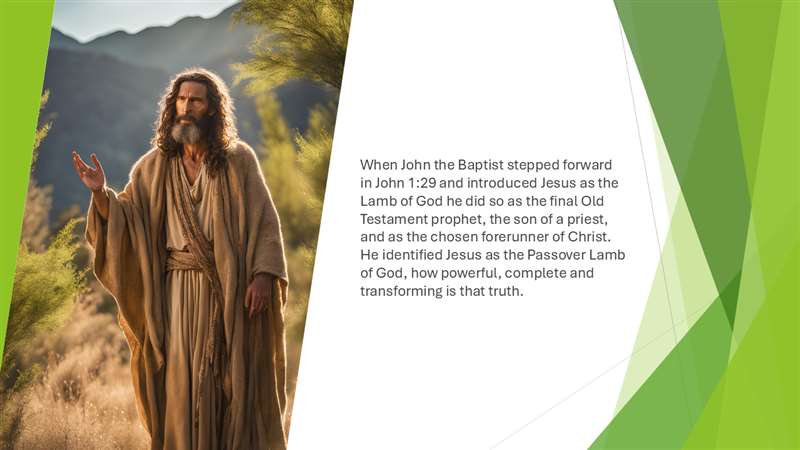
To explain that, in a moment we’re going to read verse 29 of chapter 1 of John’s Gospel which was proclaimed by John the Baptist. Think about who he was. John the Baptist was the last of the Old Testament prophets. He was the last in the succession that began actually with Enoch, the first Old Testament prophet, and concluded with John the Baptist. So, he was a prophet speaking for God. He was also the son of a priest. His father, Zechariah, was one of the successors to the Levitical priesthood who went and served inside the Temple and prior to that, the Tabernacle. John the Baptist, a prophet, the final one, the son of a priest, intimately acquainted with the sacrificial worship. He was also the chosen introducer or forerunner of Jesus Christ. He’s the one that went ahead of Christ, telling everybody that Jesus was coming. John the Baptist, whom Jesus says was the greatest man that was ever born, introduced Jesus in one way. He said, I want you to meet the Lamb of God. We’re going to see all the way through how Jesus Christ as the Lamb of God explains the entire purpose of salvation that God has laid out in His Word. It encompasses what salvation is.
Let me explain it to you this way. On the day that Jesus Christ died, we call it Good Friday some of us. It’s the day Jesus was crucified. We all know the details. We know that the Jesus was crucified at 9:00 a.m. and hung on the cross till 3:00 p.m. Remember, it was dark, and we remember that finally at the end of those six hours on the cross, as Jesus hung there, those last three hours in total darkness, He cried out, it is finished. We remember all that, but the Bible says Jesus was the Lamb, and the Bible tells us which lamb he was.
Let me share with you the background to Christ’s crucifixion to explain this. The day that Jesus was crucified, we know was the fourteenth day of the Hebrew month, Aviv. How do we know that? Because Jesus Christ was crucified on the cross at the exact same moment that the Passover lamb was offered. At the third hour at 9:00 a.m. on Passover, Israel’s high priest would take the Passover lamb that had been chosen to represent the nation. Remember, on Passover, one lamb represented the whole nation. And the high priest, dressed in his special garments, took the rope and led that little lamb at precisely 9:00 a.m. it said, according to their rules, and tied the little lamb’s rope to the great altar in the center of the Temple, and prior to that, of the Tabernacle. At 9:00 a.m. that lamb that was to represent the entire nation of Israel, walked in front of the watching people and was tied to the altar where it had been tied awaiting its death for six hours. At exactly 3:00 p.m. that priest would lead that lamb up that had stood there for six hours, and at 3:00 p.m. he would cut its throat, drain its blood, and it would die.
Now, think about it. At 9:00 a.m. as the high priest was leading in that little lamb to tie it to the altar, Jesus Christ was roughly pushed down on a cross of wood and with carpenter’s tools, His hands and His feet were nailed at the exact time the little lamb was led to the altar and tied. At 3:00 p.m. when that little lamb was led up to be slain, Jesus Christ lifts His blood-splattered head and thunders out from the cross through the darkness, it’s finished. It is finished. Three words in English, one in Greek, tetelestai. The whole work of redemption was finished, but it was exactly against the backdrop of the Passover lamb coming to the altar, waiting six hours, and after six hours at precisely twilight, which began at 3:00 p.m. the Passover lamb was slain. At precisely twilight, 3:00 p.m. Jesus died.
Isn’t it a coincidence that those events took place exactly at the same time? It’s not a coincidence, as we’ll see from our Scripture this morning, because on Calvary’s stark mountain, God the Father, the final High Priest of all creation, placed His holy hand on the head of His only begotten Son. At the same moment that the high priest on Earth placed his head or his hand on the head of the sacrificial lamb and slit its throat, God the Father placed His hand on the head of Jesus Christ and accepted His sacrifice, and when God said it was acceptable, Jesus Christ cried out it’s finished. He had suffered the weight for our sin. When the total sin of the world had descended on Jesus and He was barely able to lift His blood-splattered face toward Heaven, yet He shouted in triumph, it is finished. Jesus was the Lamb of God.
We could summarize God’s Word, and I always think of the Bible as a whole. You could summarize the whole Old Testament by one verse. Chapter 22 of Genesis verse 7 says this, where is the lamb? In fact, the whole Old Testament is caught up with, where is the lamb? All the sacrifices, the millions of animals that were slain, all the birds, and all the goats, and all the rams, and all the bulls never got rid of sin. They just painted another layer over the rest of sin. When Isaac, being led up to Mount Moriah, the same spot Jesus was crucified on, when Isaac was led up there, he asked his father, where’s the lamb, dad? And Abraham said, God will provide the lamb. The whole Old Testament is the Jewish people looking for the lamb.
You know what the Gospels are? The next four books. Jesus Christ being introduced as the Lamb. That’s our text this morning, chapter 1 verse 29. Behold the Lamb, He’s here. You know how the Bible ends? The book of Revelation finds everyone who received Jesus Christ as their Lamb to take away their sin, they’re gathered around the throne, and they’re looking at the Lamb of God who still bears in His hands, His side, His feet, and on His head the marks of His crucifixion. He has the marks of dying in our place. He is a Lamb slain it says in Revelation 5. He still shows the suffering He had for us. And it says, throughout all eternity, all of us who have received Christ as our Lamb will forever be saying worthy, worthy is the Lamb that was slain for my sin.
The people of Israel were familiar with lambs for sacrifices. They would come at Passover; each family had to bring its own lamb. During the year, the Temple and Tabernacle had two lambs a day sacrificed on the altar. But those lambs were brought by men to men, but the Lamb of God was provided by God for us. Big difference between the lambs of Jewish ceremony and the Lamb of God. The lambs of Passover could not take away sin, but the Lamb of God can take away sin. Those lambs were only for Israel. In fact, when that priest hauled that little lamb up and tied it to the altar, it was only to cover for Israel’s sin. The rest of the world, as it were, could not have any atoning grace for them through that sacrifice. But when Jesus Christ was crucified, the Scriptures say He wasn’t crucified inside the Temple, rather He was crucified outside the walls of Jerusalem. Why? because God put Him out there so the whole world could access that sacrifice. That’s why He is the Lamb of God.
Let’s read our text and then pray and ask God to deeply ingrain in our heart. Chapter 1 of John’s Gospel, verse 29. This is John the Baptist speaking. It says, the next day, John saw Jesus coming toward him and said, behold the Lamb of God, who takes away the sin of the world. Not the Jewish Passover that just covered Israel, not just the daily provision for covering the people’s sin. This is God’s Lamb provided by God for the world who has the ability to not cover sin and sweep it under the carpet, but to get rid of it forever. Look at Him, the Lamb of God. Who is Jesus? The Lamb of God.
Let’s bow together. Father in Heaven, I pray that every one of us before we leave this room this morning would answer the question, is Jesus the Lamb of God for me? Have I fulfilled what Your Word says? Jesus Christ was. He was the Passover Lamb and only for those who would obey, who would take the blood, who would apply the blood, who would hide within the shadow of the blood, who would eat the roasted lamb. Only those were saved. This morning, we have a lot of people who like to look on Passover, as it were. They love to carry around the bowl of blood. They love to see the lamb roasting, but they’ve never splattered the blood. They’ve never eaten the lamb. They are just observers; they are not partakers. Lord Jesus, You spent so much of Your ministry warning religious people that they weren’t born again. I pray this morning for all the churchgoers that are here this morning, that each one would examine whether or not Jesus Christ is their Lamb. Whether they have placed their hand on His head and said, my sins are on You, Lord Jesus. Whether or not they have knelt beneath the sprinkling of His blood for cleansing from sin and whether or not they have partaken personally of You, Lord Jesus. Oh, we thank You for Your salvation. But we thank You not just that we can know about it, but we can participate in it. And for those who have, we shall gather forever worshiping the Lamb who was slain for us, whom we partook of His great salvation. Open our hearts to this truth. May you, Lord Jesus, in a real and a very powerful way, be the Lamb who is our Lamb this morning. In Jesus’ name we pray, Amen.
We’re going to turn now to 1 Corinthians chapter 5. So, you’re in John’s Gospel, keep going to the right because I’ve mentioned the Passover so many times, and for some people, as soon as you mention anything from the Old Testament, they get a little uneasy. I want to show you what Paul says in 1 Corinthians chapter 5 in verse 7. It’s a very powerful verse. It says, therefore, 1 Corinthians 5 and verse 7, purge out the old leaven that you may be a new lump since you truly are unleavened. For indeed, look at this, Christ, our Passover was sacrificed for us. That’s a very powerful verse. It says this, that all of the eight offerings that Israel was to offer, the Levitical offerings of the book of Leviticus, all eight of them were fulfilled in Christ, but one offering portrays what Jesus Christ did for us on the cross above all others. That one was the Passover.
Have you pondered the significance of the Passover? Have you thought about why it is that Jesus was crucified at Passover? Why Jesus Christ instituted the Lord’s Supper from the Passover meal? And why the Apostle Paul told the Church that Jesus Christ, our Passover, was sacrificed for us? It didn’t say He died on the cross. It said He was sacrificed as the Passover Lamb, the Lamb of God, the Passover Lamb of God. And then he goes on in verse 8, let us keep the feast, not with old leaven, nor with the leaven of malice, but with the unleavened bread of sincerity and truth. Wonderful.
Let’s back up to Isaiah 53 and I’ll explain it real quickly. We’re going to back up through the Bible, okay? Go to Isaiah 53, back up, and then we’ll end up in Exodus chapter 12. What we’re looking at is John’s explanation of Jesus by seven titles. Jesus is the Word, the Light, the Son of God, now He’s the Lamb of God. And Jesus Christ is revealed in John’s Gospel for us to believe on for life as the Lamb of God. Paul explains to us which Lamb He is. He is the Passover Lamb.
Now, here’s why He has to be the Passover Lamb. Look at Isaiah 53 and verse 6, one of the classic verses in the Bible about Jesus Christ’s work. It says this: all we like sheep. This week I noted that there are 1 billion, 62 million sheep alive on the planet today. I’m talking about the kind that make wool suits. They count them, and they keep track of them. There are over a billion of them, but out of the billion on this planet, the fluctuation of that number, God uses sheep to portray what we are like as humans. It says this, all those billion sheep have something in common. They all are what humans are like. They’ve gone astray. They turned to their own way. The Lord says, spiritually He had to lay on Jesus Christ, our Passover Lamb, the iniquity of us all.
What does it mean to be like a sheep that goes astray? Several things. One thing, sheep are utterly helpless. I don’t know if you realize that, but you can’t get a sheep to find its way to the food on its own. It has to have a guide. There can be a pasture just outside their gate, but sheep are apparently incapable of finding pasture for themselves. They have to have a guide. In fact, I read everything I could find out about sheep this week. It’s amazing. Sheep are totally incapable of feeding themselves, cleansing themselves, defending themselves, and getting anywhere. You’ll never see a sheep doing tricks in a circus. They are untrainable, they’re totally, as the people say, they’re dumb.
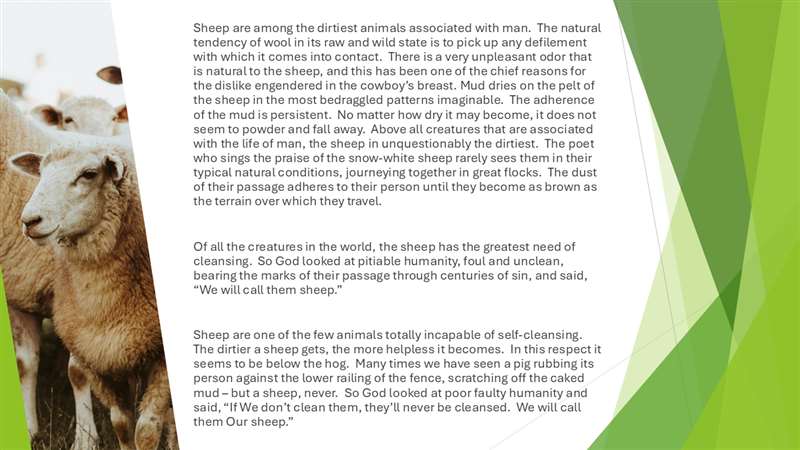
But sheep are about the dirtiest of all animals that are associated with man. The natural tendency of wool in its raw and wild state is to hold any defilement that it comes into contact with. It is a very unpleasant odor to be around the sheep in its natural condition because even its own filth clings to the sheep.
In fact, we went to visit a family this week that raises sheep. Nothing to do with this sermon, but they said, we want to show you our two sheep. This one we cleaned, and this one we didn’t. And the one looked like a walking clod of cow manure. I could tell which one they hadn’t cleaned, and the other one looked like a Q-tip. It was just all fluffy and light and I realized that the sheep can’t clean themselves even if they tried. They’re totally unable to clean themselves. The dirtier they are, the more helpless they become. In fact, I read that it weighs them down. If they get near water, they just sink in. They just go to the bottom because they’re so full of dirt and the water, just the gravity pulls them down. So, sheep, which are helpless and dirty and need cleansing, can’t cleanse themselves.
Look at Isaiah 53:6. All of us are like sheep. What does that mean? We are helpless. We can’t defend ourselves. We’re dirty. Sheep pick up any filth they get near. Doesn’t that sound like people? Sheep are totally incapable of cleansing themselves. All of us are like sheep. We’ve gone astray. We’ve turned to our own way. It doesn’t matter what sin it is, all of them have their root in this one common denominator. We want to do it our way, our own way. That’s the sin of mankind. All those iniquities the Lord has laid on Jesus, the Lamb of God.
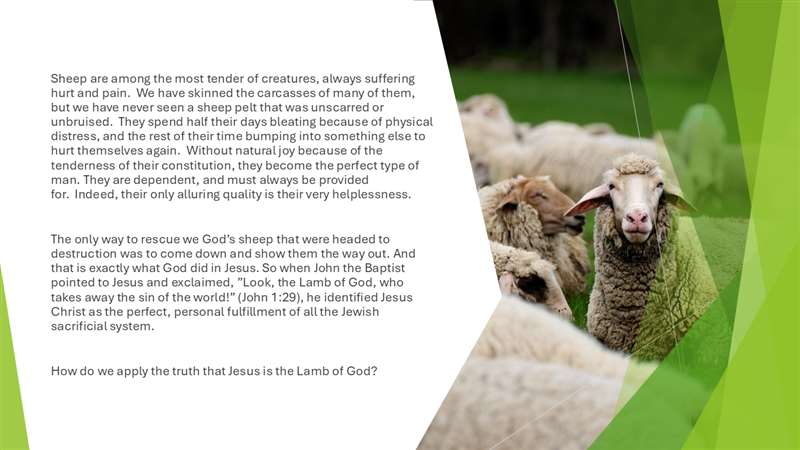
Another thing about sheep is that they’re the most tender of all creatures. They always suffer hurt and pain. In fact, this one sheep book I read, it says, every time they’ve ever skinned the carcass of any slaughtered sheep, they have never seen a sheep pelt that was unscarred or unbruised. They’ve never seen an unscarred, which means they’ve been injured, or unbruised. Every sheep that’s slaughtered when they cut away the hide and pull it away, there are big bruises on the sheep. Why? Because they’re abused? No. Because sheep are so delicate that any bump bruises them. That’s why this author says that they bleat so much. So, the only way to rescue God’s sheep who were headed to destruction was for God to come down, to show them the way out, to take all their collective sin, clean them off, and to take it Himself. That’s why it says in verse 5, He was wounded, Isaiah 53:5, for our transgressions. He was bruised for our iniquities. The chastisement for our peace was on Him, and by His stripes we’re healed. That’s why Jesus is the Lamb of God.
Now, let’s turn to Exodus chapter 12, and that’s where we’re going to end up this morning. Exodus chapter 12. I want to just sketch for you some of the facets of the Passover so that you can determine in your mind whether or not Jesus Christ is the Lamb of God for you, whether or not you have partaken in the sacrifice He made for you, whether or not He has cleansed you, whether or not He is guiding you, whether or not you have the life. Because remember, these are written that you might believe that Jesus is the Christ, the Son of God, and by believing that you’ll have life. What do you believe? You believe He is your Lamb.
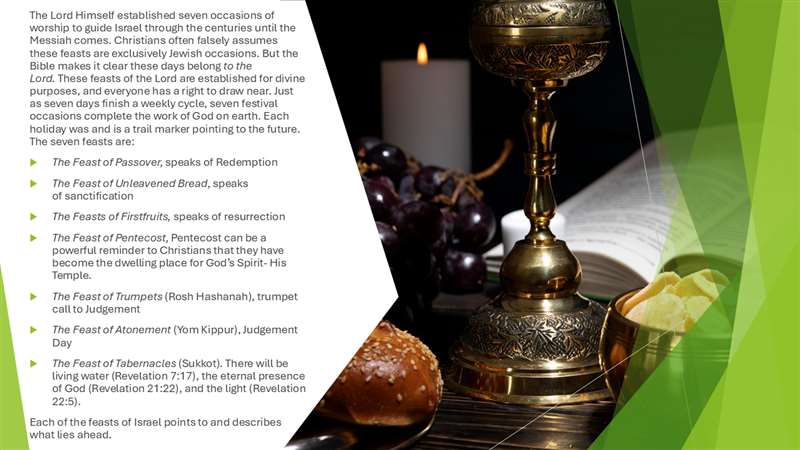
When we get to chapter 12, we get to the first of the seven specific feasts of the Lord. Now, it’s interesting, there’s one little attachment to all these feasts that fascinates me. It doesn’t say Feast of the Jews. It says, Feasts of the LORD. As we see right now, there’s a lot more than the cultural holidays that the Jews in unbelief celebrate today that the Bible’s presenting. Each one of these feasts, Passover being one of them, are of the LORD, to point to Christ. If you’ve never thought about that, and if you haven’t been here on Sunday nights, I’ll give it to you on Sunday morning.
The Passover Feast speaks of redemption. Messiah, the Passover Lamb had to be slain for sin, and He had to die in God’s plan on Passover so that when the little lamb was being led to the altar the Lamb of God was being nailed to the cross. When the little lamb had the high priest put his hand on his head and slit his throat, the Lamb of God had the weight of the sin of the world and had borne it so that He could look up into His Father’s face and say, it’s finished, Father. At the exact same moment He died, the Passover lamb died. Very significant.
And those seven Jewish feasts, which I’m going to describe, are the outline of Christ’s ministry. They’re precisely fulfilled, and they are God’s signposts that point to Christ and to the future. It’s interesting that Jesus Christ was buried at the Feast of Unleavened Bread, which speaks of sanctification. You remember when we baptize people right here, we say that they’re buried with Christ so that they come up in newness of life. It’s a picture of salvation. Jesus Christ was buried, taking our sins, and when we die with Him, our sins are with Him, and our sanctification occurs through the power of His Spirit because I am dead, and my life is hidden with Christ in God. And that’s why Jesus was put into the grave on the Feast of Unleavened Bread, which speaks of our sanctification. He was set apart; His body did not decay in the grave.
He was buried on the Feast of Unleavened Bread as the bread of life, and He rose on the third of the Jewish festivals, which is called Firstfruits, and Firstfruits always speaks of resurrection. Death cannot hold o’er foe. On the third day, Christ rose triumphantly, and it’s on the Feast of Firstfruits. When Jesus came out of the grave, He became the Firstfruits of all of us who will also rise, and death will not hold us.
Then, Jesus sent His Spirit, on Pentecost, and His followers began seeing the harvest that would occur when His Spirit came. And if you remember, 3,000 on the day of Pentecost believed, and then 5,000 later, and on and on. But at Pentecost, God was showing that though His Spirit had to depart the Temple in the book of Ezekiel because of apostasy, His Spirit came down in the day of Pentecost to inhabit the new temples, the bodies of those who are trusting in the sacrifice of the Lamb of God. Those events are the past. Those are signposts that point to events. Every time Jewish Passover comes, and by the way, if you like to relate to the Bible, look at your calendar and look for the Jewish Feast of Passover that’s on all secular calendars because they’re all politically correct, and you got to have Ramadan, and the Passover, and Christmas and all the other stuff. But look there because the Jews still follow the biblical calendar. Remember, the Roman Catholics broke from that, and they said, we will not celebrate the Jewish feasts because they’re gone, and they have no use, and they can all die. It doesn’t matter because God’s got the Church now. But if you want to understand when Christ was crucified, He was crucified on Passover. So, look in the calendar, and you’ll always be right there. Easter doesn’t have anything to do with Passover anymore.
But those are past events: Passover, Unleavened Bread, Firstfruits, and Pentecost. Those talk about things that have happened, but there are still three more Jewish feasts. There are seven. The next one is Rosh Hashanah, where there is a trumpet blast. Isn’t that interesting? What does it say the Second Coming of Christ will be? With the voice of the archangel and the trumpet of God. Rosh Hashanah is sounded with trumpets. That’s the next event. When the trumpet starts, God’s Church exits this world, and God’s judgment falls on this world. That’s a future event, and the Jewish Feast of Rosh Hashanah, in a very real way, points toward the Second Coming of Christ for His Church and the beginning of the Tribulation time.
The next of the seven feasts is Yom Kippur, the Judgment Day. Isn’t that a description of the Tribulation, the Judgment Day? And that will be completed at Christ’s return. And then the last of the Jewish celebrations, in fact the favorite one of all Jews, is called Sukkot. And what that is, we call it the Feast of Tabernacles, that’s when they have a big party. It’s the biggest time of the year, and they love it! For two weeks, they live outside in these booths, and party, and eat and all, and this is what the Jews describe Sukkot as. It is the most joyful celebration that they could ever imagine! They celebrate living water, they celebrate light, and they celebrate the presence of God. Now, let me ask you, how is Heaven described? Revelation 7:17 [Brief Loss of Audio] the place of living water. That’s also in chapter 21. Revelation 21:22, the eternal presence of God. Revelation 22:5, unending light. What is Sukkot? Living water, light, in the presence of God. What is Heaven? Rivers of living water, unbroken presence of God, and the light that never ends. Think about this, God uses the feast that portrays the greatest joy humans can know. He said, that’s what Heaven is going to be like forever. And that’s the last feast, and that’s where we’re headed.
So, Jesus, crucified on Passover, takes those who trust in His sacrifice to Heaven.
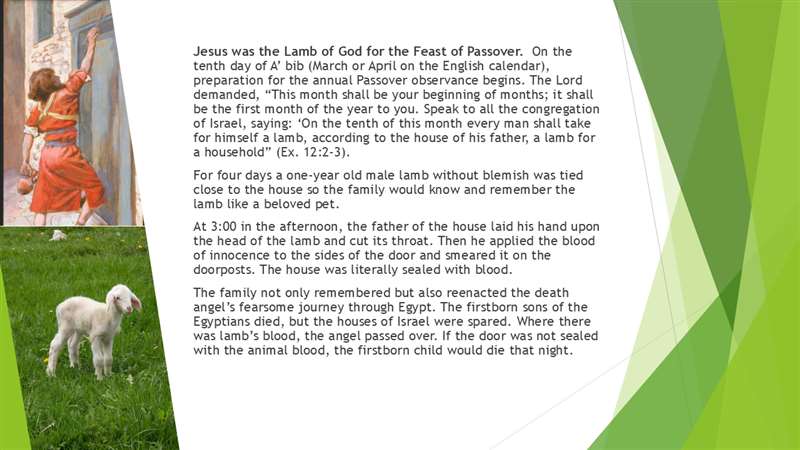
Now, let me start in chapter 12, and I’m going to, you can just mark these down. I’m going to go through them real quickly. And it says, the LORD spoke, Exodus 12 verse 1, to Moses and Aaron in the land of Egypt, and said, this month shall be your beginning of months. That’s why I said Passover is the first of the feasts of Israel, which God gave to them, which He calls the feasts of the LORD, but it was the start of their year.
And so, this month will be your beginning of months; it shall be the first month of the year to you. Passover was to start everything out. Speak to all the congregation of Israel, and say this, verse 3 of Exodus 12, on the tenth of this month every man shall take for himself a lamb. Now, let’s think about this. The sacrifice God wanted was a lamb. Okay? That’s easy, Jesus is the Lamb of God.
Secondly, it says in verse 5, look at this: your lamb shall be without blemish, a male of the first year. So, it had to be a special, spotless lamb. Had to be a male, had to be of the first year, and it had to be unblemished. Now, Jesus Christ, He was special. The only begotten of the Father, the spotless—no sin was found in Him. Do you remember at His trial as He stood before everyone? He stood before Herod. He stood before Pilate. He stood before the Sanhedrin, the ruling council. He stood before all of them, and everyone agreed, but no fault. No fault. Even people that had known Him His whole life couldn’t find one thing He’d ever done wrong. Even when He was a little boy, even when He was a young man, in youth, in teen, never did anything wrong. He was spotless. He was special.
Continuing, verse 6, it says, you shall keep it until the fourteenth day. You remember what we studied a few weeks ago on Palm Sunday? You know why Palm Sunday is Palm Sunday? Because on the tenth of the month of Aviv, the Hebrew month, which is called Nisan in the Babylonian calendar on that month, on the tenth day, the lamb was supposed to be brought into the home. On the fourteenth of the month, it was to be slain. That’s why Jews had to pick their Passover lamb on the tenth, but they did not slay it until the fourteenth. Now, look what it says, you shall keep it until the tenth [fourteenth] day. Why? So, they could start liking it. After the first service, someone ran up to me and said, you know what? That was so clear to us. They live on a farm, and they had a sweet little farm animal born. And that farm animal was with them for several days, and then somehow it fell into the watering pan face down, and it drowned. They said their kids just wept and wept. You know what the mother said? She said, it’s just like that Passover lamb. You get a little lamb that’s all cleaned up, and sweet, and young, and with the family, and they will love it like a pet. And then when it dies, they will sorrow. Jesus Christ offered Himself to the children of Israel to love. Then He was offered and slain as a Lamb that was not guilty.
Continuing it is also, it says in verse 6, at the end, you shall kill it. But specifically, when? At twilight. When does twilight begin? 3:00 p.m. When is the evening? At 6:00 p.m. So, twilight is the hours before evening. Remember, their days start at 6:00 p.m. to 6:00 p.m. And so, at sunset, 6:00 p.m. a new day started, and so before sunset from 3:00 o’clock on, that lamb was to be slain. Then it says this, look at verse 46. Turn over to 12:46. There’s something else about this lamb. In one house it shall be eaten. You shall not carry any of the flesh outside the house, nor shall you break one of its bones. Isn’t that something about Jesus? Jesus was a Lamb, a special Lamb, a spotless Lamb. He was set apart for four days. He was sacrificed, died on the cross. He was sacrificed specifically at 3:00 p.m. just like the Passover lamb, and scripturally, not one of His bones was broken. Isn’t that amazing? Jesus was our Passover Lamb.
But I want you to see what they’re supposed to do. Look at verse 7, and this is one of the most moving parts for me. Now, remember what Passover is about; some of you have to refresh your mind. The children of Israel were captive in Egypt, and they were surrounded by their enemies. Their enemies were trying to kill them by killing the firstborn and all that stuff. Moses came in as a deliverer, and God told Moses, the way you get delivered is that I will lead you out and don’t worry about the details. So, the plagues come, and then the final plague was the death angel. God says, you will not escape the angel of death unless you do, look what it says in verse 7, take some of the blood, put it on the two doorposts, and on the lintel of the house where they eat it.
Two things here. They had to fulfill the Passover requirements, which were pick a lamb, keep it for four days, put your hands—it says a little bit later—on the head of it. Confess your identification with it, slay it, collect the blood in a bowl, skin the thing, roast it, and take the blood and put it on the door post. Did you know that family could have gotten a lamb just like they were supposed to on the tenth of Aviv? And if they hadn’t killed it on the fourteenth, the death angel would’ve killed their firstborn. If they had not collected the blood, the death angel would’ve killed their firstborn on the fourteenth, on Passover night. If they had collected the blood and kept it in the bowl, the death angel would’ve killed their firstborn. Do you see? They couldn’t partially obey. They couldn’t know enough to have a lamb. They couldn’t know enough to just kill the lamb. They couldn’t know enough to just collect the blood. They had to obediently do two more things. Look at the two things they had to do in verse 7. Take some of the blood and put it on the doorpost. Number two, eat it. If they didn’t eat the roasted lamb, and if they didn’t put the blood on the doorpost, the death angel would’ve gotten them.
You know what I think? In America there are a lot of people, they’re walking around, and they’ve got the lamb, and they’ve got the blood in the bowl, and they’re walking all around. They know all the facts, but they have never personally applied the blood and hid inside the house in the protection of the sacrifice of Christ. What does that mean? It means they’ve never partaken of Jesus Christ personally. That’s why, look what it says the last of verse 7, eat it. Eat it. You have to partake. You can’t just be with the family. You can’t just watch them do it. You can’t just see what they do. You can’t just marvel at it. You’ve got to partake of it. Do you know what the blight today is? I was in the largest Christian college in the world. I was on staff there for years. You know what the biggest problem we had? Children of Christian families that had never gotten saved. They knew everything about the Lord. They knew all the verses. They won all the awards. It just never had entered them. They had not partaken of Christ. They were trying to be a Christian on their own, and they were so empty, and helpless, and frustrated because they couldn’t do it. How do they do it? They partake, verse 7. Hide beneath the shadow of the blood. In other words, say, Jesus Christ, You died from my sins, not just the world, mine, and I personally receive You. I like Charlotte Elliott’s testimony. She wrote Just As I Am. Out of my weakness, sorrow, and strife Jesus, I come. Jesus, I come. Into Thy freedom, gladness, and light, Jesus, I come to Thee. I come to You. I partake of You.
Interesting what it says here is, verse 8, they shall eat the flesh that night; roasted in fire, with unleavened bread and with bitter herbs shall they eat it. That speaks also of salvation. Did you know there’s a sorrow that comes in our salvation? We are sorry for our sin. Have you ever had a child come to you, and they did something wrong, and they go, I’m really sorry I did that. Do you think they are? No, they’re just saying it because they’re supposed to. There’s something about when we are aware of our sin, it smites our heart. That’s what the bitter herbs were about: the sorrow for their sin. Also, it doesn’t stop there. It says, verse 9, don’t eat it raw, don’t boil it, roast it.
Verse 10, you shall let none of it remain until morning. Don’t wait. What does the writer of Hebrews say? While you hear His voice, don’t harden your hearts. Today is the day of salvation. Don’t wait. Over the years of ministry, I’ve met people that say, yeah, that’s really good. I’m going to wait until I’m old and [crotchety], I’m going to have a life of fun, and just before I die, I’m going to get that. You know what the Lord says? Most likely it’ll be too late because you’ll have hardened your heart one too many times.
So, what does Jesus as our Passover Lamb mean? Number one, it means that Jesus is the only hope we have. He’s the only One who is the specific sacrificial Lamb, set apart, spotless, who was sacrificed for us. That’s number one. That’s the fact. But the Passover was not effective unless you partook of the blood that was put on the doorpost, and stayed inside of that house, and ate the lamb. This morning, are you trusting that Jesus Christ’s sacrifice has taken your sins away and have you personally received Jesus Christ? Your family could sit around the table and eat the lamb, but if you didn’t, you were not protected. You must partake of Him. There’s something about the Passover that brings salvation down to a personal interaction, relationship, a personal, intimate knowledge of the sacrifice of Christ. My question to you: is Jesus Christ the Lamb of God who was slain for you?
Jesus is the Lamb of God
IS JESUS YOUR LAMB1 OF GOD?
Isaiah 53 tells us that Jesus was crushed for our sins. Have you meditated upon all that was involved in that? From the image of the olive press in ancient Israel we understand what He endured for you and me!
Has Jesus Christ become your Passover Sacrifice by Faith? Have you had His shed blood applied to protect your life from God’s wrath? Have you eaten Him for your salvation? Do you rest safely in the shelter of His great salvation?
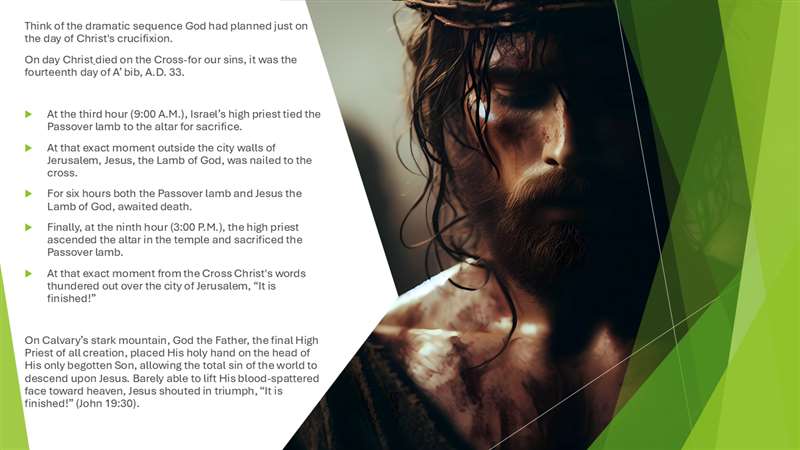
When John the Baptist stepped forward in John 1:29 and introduced Jesus as the Lamb of God he did so as the final Old Testament prophet, the son of a priest, and as the chosen forerunner of Christ. He identified Jesus as the Passover Lamb of God, how powerful, complete and transforming is that truth. Think of the dramatic sequence God had planned just on the day of Christ’s crucifixion. On day Christ[1] died on the Cross-for our sins, it was the fourteenth day of A’ bib, A.D. 33.
At the third hour (9:00 A.M.), Israel’s high priest tied the Passover lamb to the altar for sacrifice.
At that exact moment outside the city walls of Jerusalem, Jesus, the Lamb of God, was nailed to the cross.
For six hours both the Passover lamb and Jesus the Lamb of God, awaited death.
Finally, at the ninth hour (3:00 P.M.), the high priest ascended the altar in the temple and sacrificed the Passover lamb.
At that exact moment from the Cross Christ’s words thundered out over the city of Jerusalem, “It is finished!”
On Calvary’s stark mountain, God the Father, the final High Priest of all creation, placed His holy hand on the head of His only begotten Son, allowing the total sin of the world to descend upon Jesus. Barely able to lift His blood-spattered face toward heaven, Jesus shouted in triumph, “It is finished!” (John 19:30).
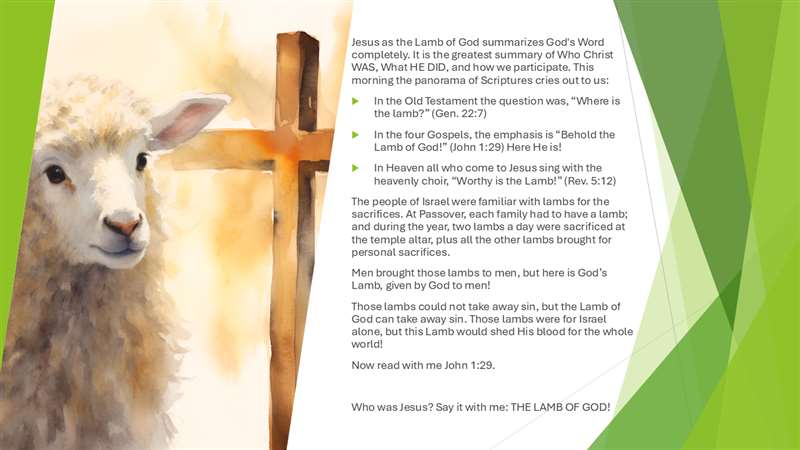
Jesus as the Lamb of God summarizes God’s Word completely. It is the greatest summary of Who Christ WAS, What HE DID, and how we participate. This morning the panorama of Scriptures cries out to us:
- In the Old Testament the question was, “Where is the lamb?” (Gen. 22:7)
- In the four Gospels, the emphasis is “Behold the Lamb of God!” (John 1:29) Here He is!
- In Heaven all who come to Jesus sing with the heavenly choir, “Worthy is the Lamb!” (Rev. 5:12)
The people of Israel were familiar with lambs for the sacrifices. At Passover, each family had to have a lamb; and during the year, two lambs a day were sacrificed at the temple altar, plus all the other lambs brought for personal sacrifices.
- Men brought those lambs to men, but here is God’s Lamb, given by God to men!
- Those lambs could not take away sin, but the Lamb of God can take away sin. Those lambs were for Israel alone, but this Lamb would shed His blood for the whole world!
Now read with me John 1:29. Who was Jesus? Say it with me: THE LAMB OF GOD! Pray
Now, please turn to I Corinthians 5:7, what Lamb is Jesus? Christ our PASSOVER!
the paschal lamb[2] and the seder: The Passover lamb stood apart in Israel’s sacrificial economy. It was like, yet unlike, the other sacrifices. Alfred Edersheim notes:
“It was neither exactly a sin offering nor a peace offering, but a combination of them both.” Israel’s paschal lamb was a kind of summary expression of all that the sacrificial system projected prophetically. Although every sacrifice and ceremony set forth a particular aspect of the Messiah’s person and ministry, it is Passover that is singled out as the unifying typical illustration: “For Christ, our Passover, is sacrificed for us.” There is a sense in which all other sacrifices were taken as grafts from Passover and rooted into the trunk of Levitical typology.
John explains jesus by the seven titles in chapter one
- In a gospel written to the whole world, John presents us with the Divine Jesus. He is the Son of God — his Divinity — the Divine nature of God is very clearly seen. We have already seen John’s incredible introduction of Jesus as the Word, the Dwelling Presence and the Glory of God. John reveals Jesus as God’s unique (“only begotten,” KJV) Son, and refers to God as His Father more than any other book of the Bible. The Old Testament refers to God as Father only 12 times, John 120 times! But there is one major theme that runs throughout John’s Gospel: Jesus Christ is the Son of God, and if you commit yourself to Him, He will give you eternal life (John 20:31). In this first chapter, John recorded[3] seven names and titles of Jesus that identify Him as eternal God.
- Jesus is The Word (John 1:1–3, 14)
- Jesus is The Light (John 1:4–13)
- Jesus is the Son of God (John 1:15–28, 49)
- Jesus is the Lamb of God (John 1:29–34) John the Baptist called Jesus “the Lamb of God,” a title he would repeat the next day (John 1:35–36). This morning as we celebrate the Lord’s Supper, the message of the Bible can be summed up in this title.
The Lord[4] Himself established seven occasions of worship to guide Israel through the centuries until the Messiah comes. Christians often falsely assumes these feasts are exclusively Jewish occasions. But the Bible makes it clear these days belong to the Lord. These feasts of the Lord are established for divine purposes, and everyone has a right to draw near. Just as seven days finish a weekly cycle, seven festival occasions complete the work of God on earth. Each holiday was and is a trail marker pointing to the future. The seven feasts are: The Feast of Passover, The Feast of Unleavened Bread, The Feasts of Firstfruits, The Feast of Pentecost, The Feast of Trumpets (Rosh Hashanah), The Feast of Atonement (Yom Kippur), The Feast of Tabernacles (Sukkot). Each of the feasts of Israel points to and describes what lies ahead.
The seven Jewish feasts also became the outline for Jesus’ ministry. It is amazing how precisely Jesus fulfilled the feasts that had been celebrated for more than 1,450 years.
- Passover speaks[5] of redemption. Messiah, the Passover Lamb, has been slain for us. He died on Passover (as God’s Lamb),
- Unleavened Bread speaks of sanctification. He was set apart. His body would not decay in the grave. He was buried on the Feast of Unleavened Bread (as the Bread of Life),
- Firstfruits speak of resurrection. Death could not hold her Foe. On the third day, Jesus rose triumphantly from the grave. He arose on the feast of First fruits (as the first fruits of those who will be raised to life),
- He sent His Spirit on Pentecost so His followers could begin “harvesting” those who would believe. Pentecost can be a powerful reminder to Christians that they have become the dwelling place for God’s Spirit- His Temple.
- Rosh Hashanah (the trumpet call to judgment).
- Yom Kippur (judgment day) in some sense will be fulfilled upon Jesus’ return, though He has already fulfilled some elements of these two feasts.
- And what comes after the final judgment? Heaven! The new Promised Land! Sukkot is the feast that celebrated the Promised Land, God’s deliverance, living water, and God’s blessing. Sukkot is a feast that will be fully realized in heaven. There will be living water (Revelation 7:17), the eternal presence of God (Revelation 21:22), and the light (Revelation 22:5). Sukkot taught the Jewish people to be joyful, in anticipation of heaven. Take the most joyful celebration that ever existed and imagine it lasting forever. That is heaven. No wonder some Jewish Christians (and some Gentile ones, too) celebrate Sukkot.
The Passover unleavened[6] bread in the New Testament is, of course, the body of our Lord. He is described as “the Bread of Life”. He was born in Bethlehem, in Hebrew “House of Bread”. He utilized bread as an image of Himself (“If a kernel of wheat fall into the ground…”). God fed the Israelites in the wilderness with manna from heaven, and He feeds the Christians in the world on the Bread of Life. The very piece of bread used by the Jews during this week if Unleavened Bread is a good picture of our Lord. Anyone who has seen the Jewish matzoh sees that it is striped (“By His stripes are we healed”), pierced (“They shall look upon me whom they’ve pierced”), and, of course, pure, without any leaven, as His body was without any sin.
The Passover ceremony of breaking and burying and then resurrecting a piece of this bread (the middle piece, as the Son in the Trinity) very obviously presents the Gospel in the midst of the modern Jewish Passover celebration. God performed this exact ceremony with the burial of Jesus, our precious piece of unleavened bread, and more importantly, He performed it on the exact day of the feast. Once again, the required feast was fulfilled in a remarkable and unmistakable way. We readily see from the Gospel that Jesus was buried at the beginning of the Feast of Unleavened Bread since His body was interred at sundown of Passover Day, the beginning of the fifteenth of Nisan, the first month. Our “kernel of wheat” was indeed placed into the ground, and at the appropriate moment. It was to rise again, of course, and again in accordance with the schedule of the feasts. One cannot permanently bury Christ or a Christian.
Jesus was the Lamb of God for the Feast of Passover. On the tenth day of A’ bib (March or April on the English calendar), preparation for the annual Passover observance begins. The Lord demanded, “This month shall be your beginning of months; it shall be the first month of the year to you. Speak to all the congregation of Israel, saying: ‘On the tenth of this month every man shall take for himself a lamb, according to the house of his father, a lamb for a household” (Ex. 12:2-3). For four days a one-year old male lamb without blemish was tied close to the house so the family would know and remember the lamb like a beloved pet. At 3:00 in the afternoon, the father of the house laid his hand upon the head of the lamb and cut its throat. Then he applied the blood of innocence to the sides of the door and smeared it on the doorposts. The house was literally sealed with blood. The family not only remembered but also reenacted the death angel’s fearsome journey through Egypt. The firstborn sons of the Egyptians died, but the houses of Israel were spared. Where there was lamb’s blood, the angel passed over. If the door was not sealed with the animal blood, the firstborn child would die that night.
Jesus was the Lamb of God at the Feast of Passover when Death Died – On the fourteenth day of A’bib, A.D. 33, at the third hour (9:00 A.M.), Israel’s high priest tied the lamb to the altar for sacrifice. At that exact moment outside the city walls of Jerusalem, Jesus, the Lamb of God, was nailed to the cross. For six hours both the lamb and Jesus awaited death. Finally, at the ninth hour (3:00 P.M.), the high priest ascended the altar in the temple and sacrificed the lamb. His words thundered out over the city of Jerusalem, “It is finished!” On Calvary’s stark mountain, God the Father, the final High Priest of all creation, placed His holy hand on the head of His only begotten Son, allowing the total sin of the world to descend upon Jesus. Barely able to lift His blood-spattered face toward heaven, Jesus shouted in triumph, “It is finished!” (John 19:30).
The paschal lamb was typical. Christ[7] is our Passover, 1 Co. 5:7.
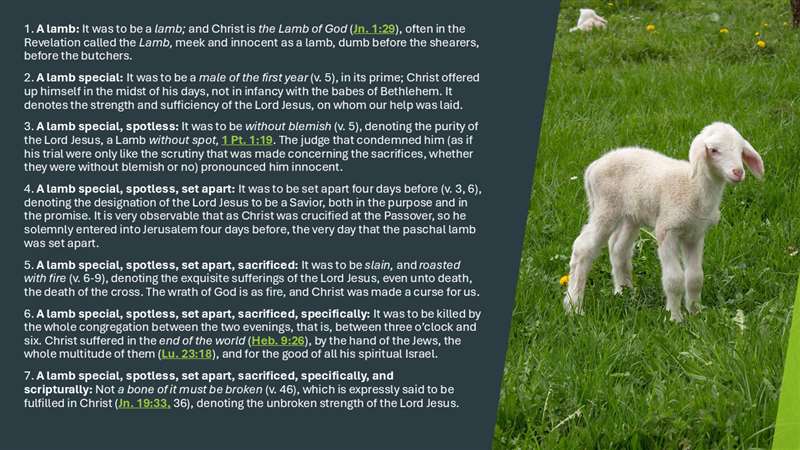
- a lamb: It was to be a lamb; and Christ is the Lamb of God (Jn. 1:29), often in the Revelation called the Lamb, meek and innocent as a lamb, dumb before the shearers, before the butchers.
- a lamb special: It was to be a male of the first year (v. 5), in its prime; Christ offered up himself in the midst of his days, not in infancy with the babes of Bethlehem. It denotes the strength and sufficiency of the Lord Jesus, on whom our help was laid.
- a lamb special, spotless: It was to be without blemish (v. 5), denoting the purity of the Lord Jesus, a Lamb without spot, 1 Pt. 1:19. The judge that condemned him (as if his trial were only like the scrutiny that was made concerning the sacrifices, whether they were without blemish or no) pronounced him innocent.
- a lamb special, spotless, set apart: It was to be set apart four days before (v. 3, 6), denoting the designation of the Lord Jesus to be a Savior, both in the purpose and in the promise. It is very observable that as Christ was crucified at the Passover, so he solemnly entered into Jerusalem four days before, the very day that the paschal lamb was set apart.
- a lamb special, spotless, set apart, sacrificed: It was to be slain,and roasted with fire (v. 6-9), denoting the exquisite sufferings of the Lord Jesus, even unto death, the death of the cross. The wrath of God is as fire, and Christ was made a curse for us.
- a lamb special, spotless, set apart, sacrificed, specifically: It was to be killed by the whole congregation between the two evenings, that is, between three o’clock and six. Christ suffered in the end of the world(Heb. 9:26), by the hand of the Jews, the whole multitude of them (Lu. 23:18), and for the good of all his spiritual Israel.
- a lamb special, spotless, set apart, sacrificed, specifically, and scripturally: Not a bone of it must be broken (v. 46), which is expressly said to be fulfilled in Christ (Jn. 19:33, 36), denoting the unbroken strength of the Lord Jesus.
The sprinkling of the blood was typical.
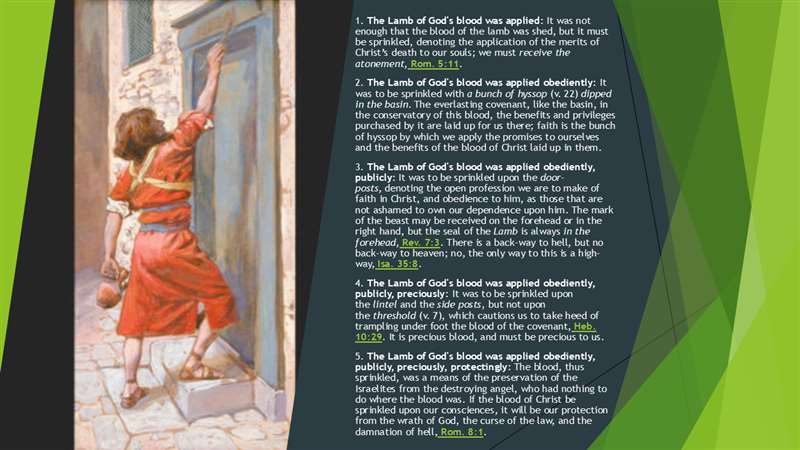
- the lamb of god’s blood was applied: It was not enough that the blood of the lamb was shed, but it must be sprinkled, denoting the application of the merits of Christ’s death to our souls; we must receive the atonement, Rom. 5:11.
- the lamb of god’s blood was applied obediently: It was to be sprinkled with a bunch of hyssop (v. 22) dipped in the basin. The everlasting covenant, like the basin, in the conservatory of this blood, the benefits and privileges purchased by it are laid up for us there; faith is the bunch of hyssop by which we apply the promises to ourselves and the benefits of the blood of Christ laid up in them.
- the lamb of god’s blood was applied obediently, publically: It was to be sprinkled upon the door-posts, denoting the open profession we are to make of faith in Christ, and obedience to him, as those that are not ashamed to own our dependence upon him. The mark of the beast may be received on the forehead or in the right hand, but the seal of the Lamb is always in the forehead, Rev. 7:3. There is a back-way to hell, but no back-way to heaven; no, the only way to this is a high-way, Isa. 35:8.
- the lamb of god’s blood was applied obediently, publicly, preciously: It was to be sprinkled upon the lintel and the side posts, but not upon the threshold (v. 7), which cautions us to take heed of trampling under foot the blood of the covenant, Heb. 10:29. It is precious blood, and must be precious to us.
- the lamb of god’s blood was applied obediently, publicly, preciously, protectingly: The blood, thus sprinkled, was a means of the preservation of the Israelites from the destroying angel, who had nothing to do where the blood was. If the blood of Christ be sprinkled upon our consciences, it will be our protection from the wrath of God, the curse of the law, and the damnation of hell, Rom. 8:1.
The solemnly eating of the lamb was typical of our gospel-duty to Christ.
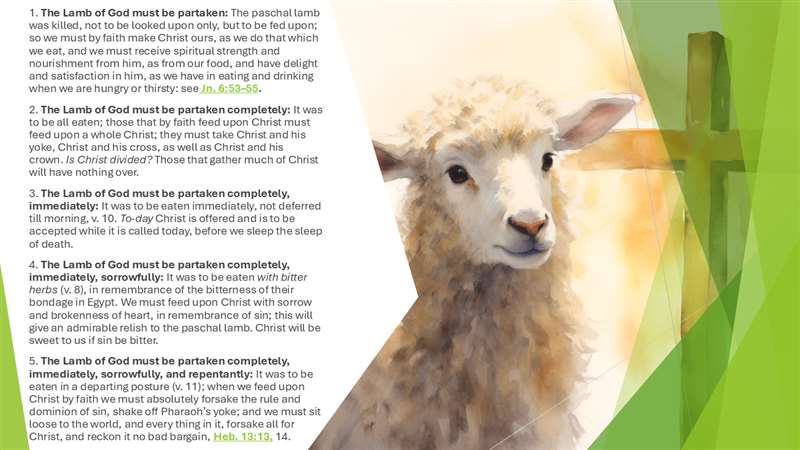
- the lamb of god must be partaken: The paschal lamb was killed, not to be looked upon only, but to be fed upon; so we must by faith make Christ ours, as we do that which we eat, and we must receive spiritual strength and nourishment from him, as from our food, and have delight and satisfaction in him, as we have in eating and drinking when we are hungry or thirsty: see Jn. 6:53–55.
- the lamb of god must be partaken completely: It was to be all eaten; those that by faith feed upon Christ must feed upon a whole Christ; they must take Christ and his yoke, Christ and his cross, as well as Christ and his crown. Is Christ divided? Those that gather much of Christ will have nothing over.
- the lamb of god must be partaken completely, immediately: It was to be eaten immediately, not deferred till morning, v. 10. To-day Christ is offered, and is to be accepted while it is called to day, before we sleep the sleep of death.
- the lamb of god must be partaken completely, immediately, sorrowfully: It was to be eaten with bitter herbs (v. 8), in remembrance of the bitterness of their bondage in Egypt. We must feed upon Christ with sorrow and brokenness of heart, in remembrance of sin; this will give an admirable relish to the paschal lamb. Christ will be sweet to us if sin be bitter.
- the lamb of god must be partaken completely, immediately, sorrowfully, and repentantly: It was to be eaten in a departing posture (v. 11); when we feed upon Christ by faith we must absolutely forsake the rule and dominion of sin, shake off Pharaoh’s yoke; and we must sit loose to the world, and every thing in it, forsake all for Christ, and reckon it no bad bargain, Heb. 13:13, 14.
The feast of unleavened bread was typical of the Christian life, 1 Co. 5:7, 8. Having received Christ Jesus the Lord,
- as our joyful worship: We must keep a feast in holy joy, continually delighting ourselves in Christ Jesus; no manner of work must be done(v. 16), no care admitted or indulged, inconsistent with, or prejudicial to, this holy joy: if true believers have not a continual feast, it is their own fault.
- as our loving ministry: It must be a feast of unleavened bread, kept in charity, without the leaven of malice, and in sincerity, without the leaven of hypocrisy. The law was very strict as to the Passover, and the Jews were so in their usages, that no leaven should be found in their houses, v. 19. All the old leaven of sin must be put far from us, with the utmost caution and abhorrence, if we would keep the feast of a holy life to the honor of Christ.
- as our constant remembrance: It was by an ordinance for ever (v. 17); as long as we live, we must continue feeding upon Christ and rejoicing in him, always making thankful mention of the great things he has done for us.
Now turn to Isaiah 53.
But[8] why does God call us His sheep? It may be, however, because sheep are the most helpless creatures known in the world of zoology. They always lose their way. In the amazing aggregation of entertainment and instruction that modern man calls the circus, we have seen almost every known animal perform, but we have never seen a trained sheep. A dog or cat, all the farm animals, and everything that can be caught in traps, may be taught to perform for the amusement of man with the apparent exception of the sheep.
Perhaps the Lord God, considering the utter helplessness of the human family, just shook His head and said, “We will call them sheep.”
- Sheep are UTTERLY HELPLESS and cannot find their way without a guide…. Though there be pasture within easy reach, the sheep is apparently incapable of finding it for itself. It must have a guide. So God, looking at stupid, lost humanity, said, “All they like sheep have gone astray.”
- Sheep are among the dirtiest animals associated with man. The natural tendency of wool in its raw and wild state is to pick up any defilement with which it comes into contact. There is a very unpleasant odor that is natural to the sheep, and this has been one of the chief reasons for the dislike engendered in the cowboy’s breast. Mud dries on the pelt of the sheep in the most bedraggled patterns imaginable. The adherence of the mud is persistent. No matter how dry it may become, it does not seem to powder and fall away. Above all creatures that are associated with the life of man, the sheep in unquestionably the dirtiest. The poet who sings the praise of the snow-white sheep rarely sees them in their typical natural conditions, journeying together in great flocks. The dust of their passage adheres to their person until they become as brown as the terrain over which they travel.
- Of all the creatures in the world, the sheep has the greatest need of cleansing. So God looked at pitiable humanity, foul and unclean, bearing the marks of their passage through centuries of sin, and said, “We will call them sheep.”
- Sheep are one of the few animals totally incapable of self-cleansing. The dirtier a sheep gets, the more helpless it becomes. In this respect it seems to be below the hog. Many times we have seen a pig rubbing its person against the lower railing of the fence, scratching off the caked mud – but a sheep, never. So God looked at poor faulty humanity and said, “If We don’t clean them, they’ll never be cleansed. We will call them Our sheep.”
- Sheep are among the most tender of creatures, always suffering hurt and pain. We have skinned the carcasses of many of them, but we have never seen a sheep pelt that was unscarred or unbruised. They spend half their days bleating because of physical distress, and the rest of their time bumping into something else to hurt themselves again. Without natural joy because of the tenderness of their constitution, they become the perfect type of man. They are dependent, and must always be provided for. Indeed, their only alluring quality is their very helplessness.
The only way to rescue we God’s sheep that were headed to destruction was to come down and show them the way out. And that is exactly what God did in Jesus. So when John the Baptist pointed to Jesus and exclaimed, ”Look, the Lamb of God, who takes away the sin of the world!” (John 1:29), he identified Jesus Christ as the perfect, personal fulfillment of all the Jewish sacrificial system.
How do we apply the truth that Jesus is the Lamb of God?
Understanding[9] Christ’s Accessibility
The meal, the work of the cross, also goes only to those “outside the camp”—those who do not subscribe to the old Jewish system. Here the preacher uses a very Hebrew argument to make his point: “The high priest carries the blood of animals into the Most Holy Place as a sin offering, but the bodies are burned outside the camp. And so Jesus also suffered outside the city gate to make the people holy through his own blood” (vv. 11, 12).
The logic goes like this: the sacrifices offered on the Jewish great Day of Atonement were a prophetic type for the sacrifice of Christ, the Lamb of God who takes away the sin of the world (John 1:29). On the Day of Atonement a bull was slain to atone for the sins of the priest and his family, and a lamb likewise was sacrificed for the sins of the rest of the people. The blood of these sacrifices was taken into the Holy of Holies, but both the carcasses were taken outside the camp and burned up (Leviticus 16:27). Therefore, those under the old sacrificial system could not partake of this great offering as a meal.
But Jesus, the ultimate atoning lamb, was sacrificed outside the camp—outside Jerusalem’s walls, on Golgotha—as an offering to God. This means two great things:
- All those who remained committed to the old Jewish system were excluded from the benefit of partaking of Christ’s atoning death. And,
- Jesus’ death outside the camp means that he is accessible to anyone in the world who will come to him. Jesus planted his cross in the world so all the world could have access. And there he remains permanently available!
There thus remains only one thing to do, and so the writer exhorts us: “Let us, then, go to him outside the camp, bearing the disgrace he bore. For here we do not have an enduring city, but we are looking for the city that is to come” (vv. 13, 14). The cities of the earth—all earthly institutions—will fall apart. Only the heavenly Zion will remain. We must go, flee to him outside the camp, and willfully embrace his “disgrace,” for such an act is worth doing a million times over! Thus Jesus Christ, who is “the same yesterday and today and forever,” becomes our constant meal—our food, our drink, our life—and we will receive from him grace upon grace upon grace. And because he is outside the camp, he will always be accessible. In fact, he is with us, in us, and coming to us! This understanding that he nourishes us and is accessible to us will help us keep on course.
[1] Sheep Numbers: World Sheep Population. 1.062 billion head.
http://melpub.wool.com/enews2.nsf/f32b26289d07c6894a25684d00086e1b/beef68d3cacbdd574a2568880009ff0a?OpenDocument
[2] Adapted from McQuaid E. , The Outpouring: Jesus in the Feasts of Israel, (Bellmawr, New Jersey: The Friends of Israel Gospel Ministry, Inc.) 1997.
[3] McQuaid E., The Outpouring: Jesus in the Feasts of Israel, (Bellmawr, New Jersey: The Friends of Israel Gospel Ministry, Inc.) 1997.
[4] Drawn from comments written by Wiersbe, Warren W., The Bible Exposition Commentary, (Wheaton, IL: Victor Books) 1997.
[5] John Hagee, Final Dawn Over Jerusalem. Nashville, TN: Thomas Nelson Publishers, 1998, p. 166-191.
[6] Kevin Howard, Marvin Rosenthal, The Feasts of the Lord. Nashville, Tennessee: Thomas Nelson, Inc., 1997, p.
[7] Zola Levitt, The Seven Feast of Israel. Dallas, Texas: Great Impressions Printing and Graphics, 1979, Pgs 5-6.
[8] This section adapted from Henry, Matthew, Matthew Henry’s Commentary on the Bible, (Peabody, MA: Hendrickson Publishers) 1997
[9] Rimmer, Science, p. 248.
[10] Hughes, R. Kent, Preaching the Word: Hebrews Vol 1&2—An Anchor for the Soul, (Westchester, IL: Crossway Books) 1998, c1993.
Check Out All The Sermons In The Series
You can find all the sermons and short clips from this series, Christ in all the Scriptures here.
Looking To Study The Bible Like Dr. Barnett?
Dr. Barnett has curated an Amazon page with a large collection of resources he uses in his study of God’s Word. You can check it out here.