
Portraits of Christ in the Tabernacle
NR3-13 TAB-10 XAS-17
ASGOTB-10 Exodus-Tab
020714PM
A STRATEGIC GRASP OF THE BIBLE-10 PORTRAITS OF CHRIST IN THE TABERNACLE
Transcript
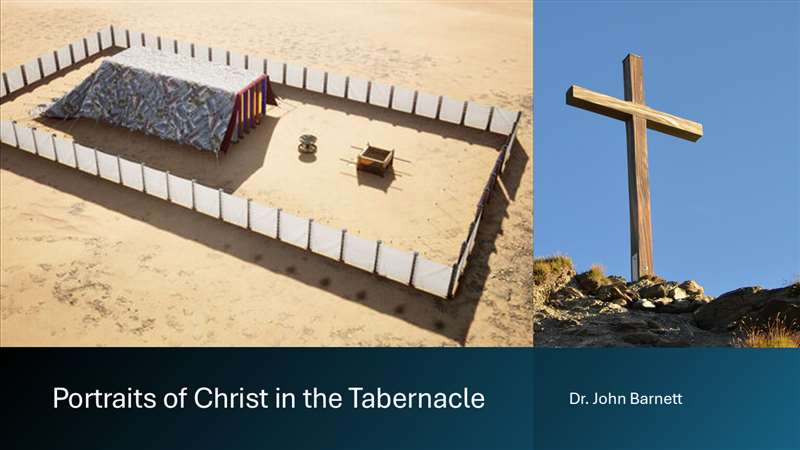
This evening, we are continuing in our look at the concept and the truth from the Bible called a strategic grasp of the Bible. And my premise is this, that to understand the Bible, the Book that you hold in your hand, you must understand that the theme of this Book is the Lord Jesus Christ. He is the theme from cover to cover. So, to get a strategic grasp of this book, it starts with understanding, and that’s why we spent so many weeks looking at Christ as a theme. But tonight, we’re going to look at portraits of Jesus Christ in the Tabernacle, and this is our tenth look at this concept. And I’m hoping to be able to get through the Tabernacle. I don’t want you to get lost in the Tabernacle but to look at portraits of Jesus Christ in the Tabernacle. There it is. Portraits of Christ in the Tabernacle.
Okay, the next one, the Tabernacle is how God portrays spiritual reality. Now, this morning I was telling you about praying for our children, and the first whole section we were talking about is praying that there’ll be reality in their spiritual lives. Now, that was a specific prayer about their salvation and about God’s Word and them hating sin. It’s interesting though, how God portrays spiritual reality to us, and I want to explain this to you. If you’ll turn with me now to the book of Hebrews, okay. Turn with me to the book of Hebrews, and we are going to look at what spiritual reality looks like starting in chapter 8 and verse 5. And I want to read these verses to you to show you how the book that most bridges and explains and ties together the Old with the New, which is the book of Hebrews, how it uses to explain Christ, and His work, and His sacrifice, and His ministry, and His supremacy. It uses, of all things, the Tabernacle. And it uses the Tabernacle, starting in chapter 8 and verse 5, and look at this verse. It says, actually verse 4. The verse starts, for if He were on Earth, He would not be a priest, since there are priests who offer the gifts according the law, who serve—now look at this description in verse 5 of what we’re studying tonight.
The Tabernacle is the copy and shadow of the heavenly things, as Moses was divinely instructed when he was about to make the Tabernacle. So, God told Moses he was making a copy and a shadow. How do you like that? Amazing. And this is what He said: for He said, see that you make all things according to the pattern shown to you on the mountain. So, when Moses was up on the mountain, God showed him a pattern.
In fact, I’ve heard it said that if you’ve ever watched the Ten Commandments movie with Charlton Heston, and it shows him, and he’s so muscular and young then, holding those two tablets of stone. Do you know what it really should have also shown? Should have shown him holding a bunch of blueprints because he came down there not only with the Ten Commandments on two stone tablets; he came down with a plan. The longest portion of any subject ever described in the Bible were the 50 chapters, the plan, that he had to write down of this wonderful Tabernacle.
We’ll look over in chapter 9 and verse 23 of the book of Hebrews, because not only was he shown the copy and shadow of heavenly things, but look at chapter 9. And chapter 9 is a very important chapter of the Bible, especially if you did not grow up in the church and got saved so young, you don’t even remember because you were so young. If you at all lived in the world, chapter 9 is very important because chapter 9 explains how the Lord regenerates, and renews, and transforms our minds from the past, and that’s in the 14th verse. So, as long as we’re there in the ninth chapter, I’ll read verse 14. It says, how much more shall the blood of Christ, Hebrews 9:14, who through the eternal Spirit offered Himself without spot to God. There’s all three persons of the triunity of God: how much more of the blood of Christ, who through the eternal Spirit offered Himself without spot to God the Father, cleanse—here’s the key—your conscience from dead works to serve the living God? Now, what they’re talking about is, the background is that all cleansing and all the work of the Old Testament sanctuary is in view, but he says that’s what Christ completely and once and for all did through the blood of the cross.
Now, look down in verse 23. Look at this: therefore, it was necessary that the copies of the things in the heavenly should be purified with these, but the heavenly things themselves with better. Again, he says that this Tabernacle we’re studying tonight is just a shadow and a copy of something that God has up in Heaven that Moses saw. Sometimes we try and get into all this, what is Heaven like, and imagining and wondering what’s going on up there, when God gave us the most complete picture of it by having them build it with engineering precise specifications. And all of that tent, and all the sockets and boards, and all the different parts of, and curtains of the Tabernacle, and the brass, and the gold, and all that, and the silver. All of those things were representations of the reality that’s in Heaven, and that’s what I want you to see: spiritual reality.
Next, we see in verse 24, look at the next verse. It says, for Christ has not entered the holy place made with hands, which are copies of the true. See, it keeps coming through this idea that the significance of the Tabernacle is that if we interpret the Tabernacle, we have to humbly follow the methods of the Holy Spirit, which are illustrated here in Hebrews. And verse 24 says this, that they are figures of the true things. So, when I talk to you about the altar of brass, that’s a figure of a true thing. When I talk to you about the laver of brass, it’s a figure of a true thing. When we talk about the elements as you walk into the holy place and you have the candlesticks or the lampstand on the right and the showbread and the altar, the golden altar right in front of you, those are shadows, and pictures, and figures of the true things. Keep reading in verse 24. Which are copies of the true, but into Heaven itself, now to appear in the presence of God for us. So, when those priests were walking around carrying the bowls of blood, and when they were sprinkling it here and pouring it there, each of those actions are figures of the true. They’re pictures of what Jesus Christ accomplished on His cross and what He ever lives to accomplish interceding for us now. Beautiful pictures.

Next, look at chapter 10 and verse 1, for the law, Hebrews 10:1, having a shadow of the good things to come. Now, all this sacrificial law, all of this, what we would call ceremonial law, all of this holy hardware, the Tabernacle. See what 10:1 says? It was a shadow of good things to come, and not the very image of the things, because they can never with these same sacrifices, which they offer continually year by year, make those who approach perfect. They were just, the earthly things were just pictures. They were just types. They were just shadows. They were just representations. So, I want you to realize that it’s very clear from what the Holy Spirit communicates in Hebrews that the Tabernacle was intended to signify spiritual realities. The Tabernacle is not the reality; it’s just a shadow. It’s just an earthly usage of earthly pieces to show the reality, which is in Heaven, and we need to see spiritual reality is reflected in this Tabernacle. And so, in the Tabernacle we see shadows, we see patterns. We see figures of heavenly or spiritual things. All of which, now here’s the bottom line, and that’s why to get a strategic grasp of this Book. If you understand this, it ties together so much that, it gets so boring at times. All of those shadows, and types, and figures, and patterns, all of them are revealed in Christ. And so, when you read about all the myriad of details with the offerings, they all signify what Jesus Christ accomplished on the cross. They all signify what He’s seeking to do in our lives, and they all point and are revealed in Christ.
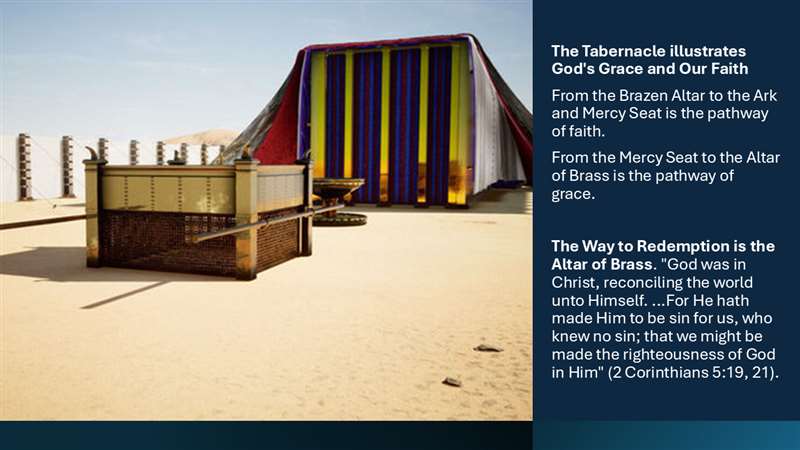
Next, let’s see this. The Tabernacle portrays two things: God’s grace; and secondly, our faith. Now, I want to talk to you about this by just giving you the big picture, an overview. So, let’s think about that. Next, what is God’s path of faith for us? The path of faith is this. Look at this, starting at the brazen altar and going toward that mercy seat. Do you see that? You say, what do you mean by that? It’s the picture of the way a sinner would approach God, and that’s what faith is all about. I, by faith, can approach God. But God says, if you’re going to approach Me, there’s only one way you can approach Me. You have to start by bumping into that brazen altar, that altar of brass. That’s that square thing with the, it looks like the tic-tac-toe board on top of it. That’s not a checkerboard; that’s an altar made of brass. And I repeat this over and over again, but whenever you read about brass in the Scriptures, when it’s associated with worship, it speaks of judgment. It speaks of fiery judgment because the brass could withstand the heat, and so a brazen altar speaks of an altar of judgment. And so, the only way we can come toward God as a sinner is by faith, and we have to start where our sins are dealt with, the altar of brass. And then we get cleansing, which is what that brass laver is all about. That’s where my sins, the judgment for my sins is applied to me, and I am cleansed. And then we can get into that holy place and commune with God, the golden lampstand, the golden table of showbread, and then that golden censer, and then we can get into the back part of that building. And the back part of the building is the place where we commune with God. But that’s what the pathway of faith is. It starts with the altar and the sacrifice in it; it ends up with God. Now, that’s the pathway of faith.
What’s the pathway of grace? Next, we see that, because in the Tabernacle we see the path of grace, and the pathway of grace goes the opposite way. It goes from where God is enthroned over the cherubim at the back of that holy tent, and it comes out over the altar of intercession or incense, passing by the illumination from that golden lampstand, by the bread of the fellowship of God, through the laver, to the altar of sacrifice. That’s grace. God comes from His holy throne and comes to Earth to sacrifice Himself. That’s what the Tabernacle’s all about, that God enthroned over the Shekinah, over the mercy seat, had to come out to Earth because everything in the back part of the tent is made of gold. Everything inside that confine had to be gold because it was divine. But when God comes to Earth, it’s to sacrifice Himself on a brass altar where He bore the punishment for our sins. So, that’s the pathway of grace from God’s throne outward to Him coming as our sacrifice.
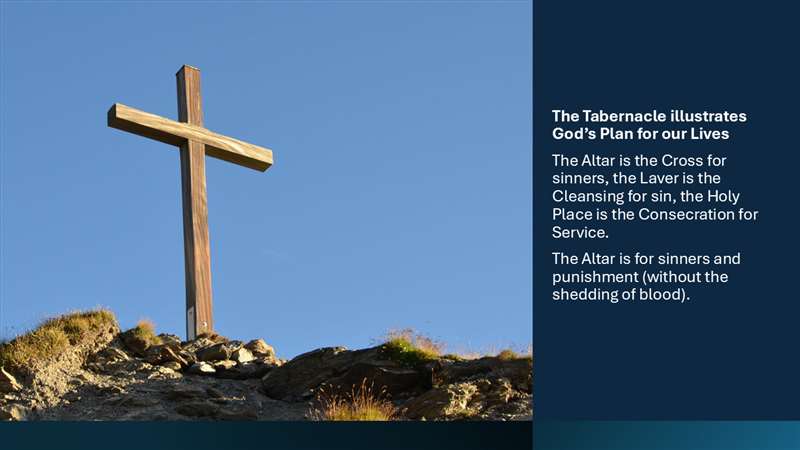
Next, we see that also the Tabernacle portrays God’s plan for our lives, and God’s plan for our lives is a very amazing concept for us to study. Next, we’ll see this, that the altar is the cross for sinners, and that’s the concept. This brazen altar, and you can look at the pieces of it. You see the four horns on each corner whenever you read, and this will help you when you’re reading through the Old Testament. Every so often, Joab grabs the horns and Adonijah grabs the horns, and they had to drag him off and kill him. The horns of the altar spoke of coming for mercy and grabbing onto those horns, and that’s where the blood was applied, showing God was mercifully going to deal with our sins. This grate here is the picture of how underneath, the coals were put there, and then the grate was where they put the sacrifice, and the sacrifice burned on top of that and became a sacrifice for our sins.
So, we see this next that the brazen altar shows the cross was for sinners. Now, what do I mean by that? Now, I want you to get this, and I’ll repeat it again, but the cross is for sinners one time. Sinners, we come to the cross, and one time the sacrifice of Christ is sufficient for us as a sinner, alienated from God. And so, you would stop on your way in and would offer on that burnt altar constantly because it wasn’t Jesus Christ; it was an animal. But this altar signifies that Jesus Christ was the sacrificial offering for our sins once and for all. So, the first concept when we look at how God has a plan for our lives, He plans for us to start in our spiritual lives at the cross, where we come as a sinner. And remember, if you want to explain the Gospel, you always have to start with a person acknowledging, realizing, and comprehending that they’re a sinner.
Someone came to me this morning, and they wanted to know how to share the Gospel with a friend of theirs. I said, you have to start by having them understand, and acknowledge, and admit, and believe, and feel the weight of the fact that they are a sinner. In fact, if you read carefully through the prophets, the Old Testament Minor Prophets, there are 12 of them. Talk about the fact that our sins are like a plague that is on us, and God talks about our sins are in His sight, just all covering us, and we are covered. It says we wear our sins like a garment. So, a person wearing that sin-stained garment can’t come to God unless it’s dealt with at this altar. So, that’s the first thing.
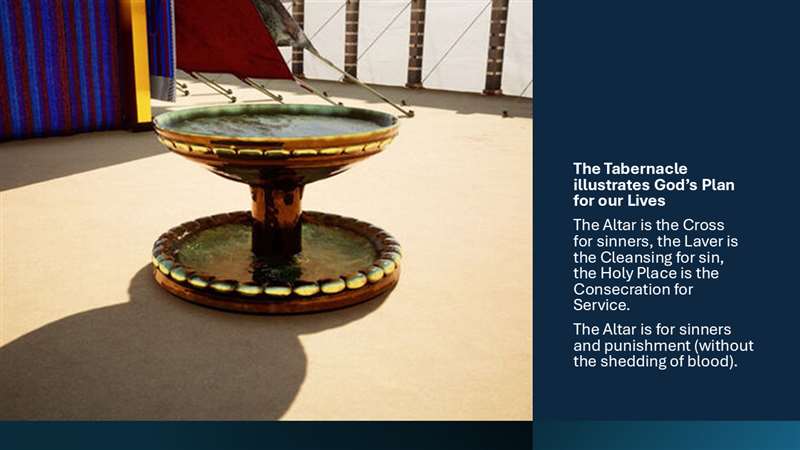
Next, we see this, that the laver, what is the laver about? If you looked at it, it was sometimes called the sea. Now, it’s fascinating, this is the only piece of furniture in the Tabernacle that doesn’t have dimensions. Isn’t that amazing? Kind of reminds us that there’s no end to the cleansing that God offers us. We can’t wear out His cleansing as believers. Everything else is, oh man, that brazen altar, the altar of brass, it was, seven and a half feet high and four, or you know, seven, four cubits, seven and a half feet high. And then it’s, I forget, three by three, something like that. But it’s very detailed. I don’t remember, and it’s not important, but it was very detailed. This thing doesn’t have any measurements, and what’s amazing is this thing shows up in Heaven. You say, where? God’s throne is set upon the sea, which is like glass. The water in here now, no longer needed for cleansing, and the water in here, by the way, speaks of the Word of God, the cleansing, the Word of God. When you get to Heaven, God’s throne is sitting on that glassy sea. God is sitting upon His Word, and He fulfills and will eternally deal with us according to His Word. So, it’s a beautiful picture.
But what is the laver all about? Next, we see this, the laver shows the cleansing for sin. And so, to come to God, you have to first come to the cross where sinners are saved, and redeemed, and regenerated, and then sin is constantly cleansed at the laver. Did you know that a priest had to come here constantly under penalty of death before he could be participating in any of the activities inside the Tabernacle? He had to run up to this thing and cleanse himself. It was a picture that before we come before God, in communion, or before we come before God to read His Word, or before we come with our list of how to pray for our children, we’ve got to come to the laver and make sure that we’re cleansed. We’re going to talk about the relationships.
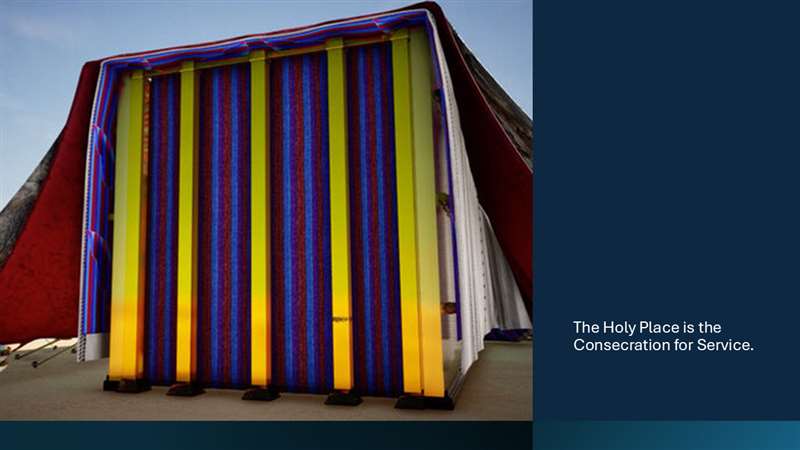
Next, the holy place. And this is a picture of the holy place. Basically, it was a big rectangular, the back is a 15-by-15-foot cube; in the front is a 30-by-15-foot cube. And it had all these curtains on it, and it’s very intricately made. And there were these tendons, and these boards, and these sockets, and fascinating stuff if you study why. And by the way, if God goes to great lengths to give you details, there is a reason for it. Think about it. If you have this long contract with lots of fine print, you ought to be careful because there’s a reason for it being there. That’s what it is in the Tabernacle.
But what’s the holy place about? Next, we see this: the holy place shows consecration for service. If you come to the brass altar of burnt offering, and that’s a picture of the cross, and you get saved, then you constantly live in this cleansing at the laver. And when that is accomplished, you can come into this holy place consecrated for service. A lot of people wonder why they don’t get anything out of the Word. That table that symbolizes that bread table, they don’t get anything out of it. It’s because they’re not cleansed at the laver. They wonder why they don’t have illumination in their life; they don’t know God’s will. That lampstand is a picture of that. It’s because they haven’t gotten cleansed at that laver. They wonder why they can’t offer any prayers that do anything, which is a picture of that golden incense altar because they haven’t stopped at the laver. The holy place shows that you have to be consecrated for service. The consecration of services, you have to be saved, and you have to be cleansed before you can serve, and you have to stay cleansed in order to serve. So, the whole Tabernacle is a living sermon.
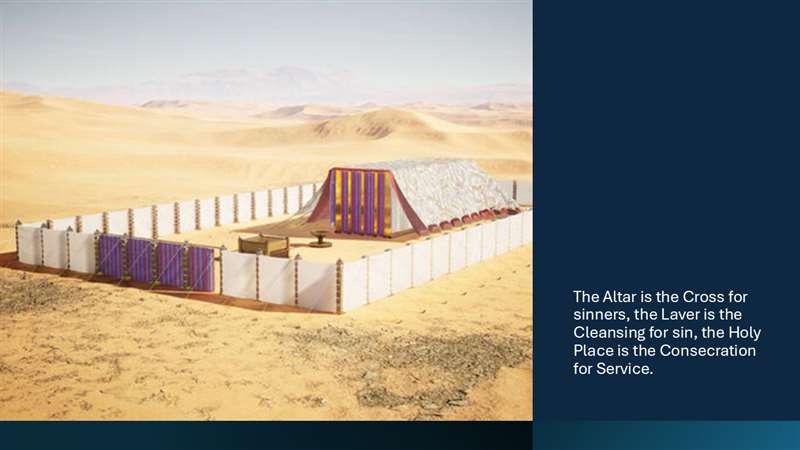
Let me show it to you again as we look at the next slide. Number one, the altar of brass is the cross for sinners. So, you come through that gate, and you’re confronted with that altar, that’s that burning thing in the front. Okay? Next you go to the laver, and that’s the cleansing for sin. Yes, once and for all our sins were taken care of on the cross, and all my sins, past, present, and future were paid for. But if we are constantly 1 John 1:9, what? Confessing our sins. That’s what the laver’s all about. We come and agree with God about our sin. We say, yes, God, I am yielding to this temptation. I am feeding that lust. I am giving way to my wrath, or my anger, or my filthy speaking, or whatever it is, impatience, whatever. Sin is sin. I have to come to the laver for cleansing. I cannot go on as a consecrated servant until I park at that laver and get cleansed, and that’s what keeping short accounts with the Lord is all about. That’s what the Christian’s bar of soap 1 John 1:9 is all about. I am agreeing with God with my sin. I’m not admitting it. There’s a big difference between admitting and confessing. Confess, two Greek words: homo, the same; logeo, to say. I say the same thing about my sins that God does. I come to the laver; I say, search me, God, cleanse me. I have failed.
And then we walk with confidence knowing that we can go to the next part, and that’s the holy place. And the holy place, I come and I’m consecrated for service. And so, I go through, and I can pray effectively. I can feed and be satisfied on the Word of God. I can be illumined and know God’s will and know in confidence that I am doing, and living, and being what He wants me to be. And I don’t have to get to the end of my life and feel like I wasted my life, and I regret it, and I wish I could live it over. No, we can walk every day illumined by the Spirit through the Word of God to be in step with God’s Spirit. So, that’s what the picture of this entire tent is all about.
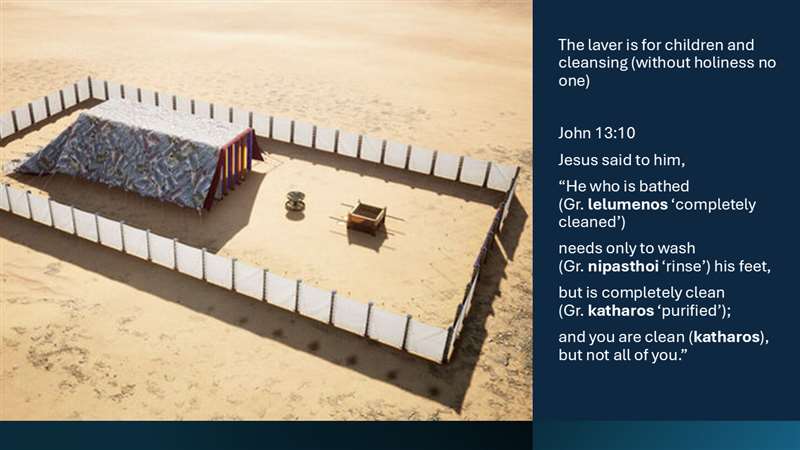
Next, we see this. Next, we see that this whole, in fact, let’s turn to John 13 and verse 10 because I want to show you this concept in the Gospel by John. Jesus differentiates between the brazen altar and the laver in John 13:10 And by the way, remember He’s talking to Jews, and He’s talking to them that knew. All this stuff was in the Temple, by the way. All this stuff, only bigger, and wider, and prettier, and more of it, but it was all there. And this is what Jesus says. He’s, and this you can zip right by. You don’t understand the Jewish nature of the New Testament unless you understand what it’s explaining, and it’s explaining to the whole culture of God’s revelation that the Jewish people got. This is what Jesus said. This is on the Last Supper night, and this is the foot washing scene, and look what Jesus says in verse 10. Simon Peter has already said, You can’t wash me, and leave me alone, and all that. And Jesus gives a very important spiritual truth, and Jesus said to him, he who is bathed needs only to wash his feet but is completely clean; and you are clean, but not all of you. And of course, that’s an allusion to Judas. But what’s He talking about? He’s talking about the fact of the cleansing. The altar is where sinners have the punishment for their sin taken care of. And that altar means that we are absolutely, all of our sins are dealt with as far as the punishment for them. But He says, look at this, but you, He says, you’ve been bathed. You only need to wash your feet. And what He’s talking about is these priests, they would offer on the altar, but then they had to come to this laver. What He’s saying is that the altar is for sinners and punishment, and it’s a once and for all thing. The altar is where, and the, it’s a picture of the cross, it’s where sin is once and for all taken care of. That’s where, in the Gospel by John chapter 13 verse 10, that’s being bathed. And the word there, bathed, is the word katharizo. It’s to be scrubbed clean. But He says, look at verse 10, it continues. He says, if you have been, this total scrubbing, you need only to, and the word is nipto. You only need to just dip your hands and clean them off because they’ve gotten dirty.
So, the next slide says this, that the laver next is for children and cleansing. You say, what do you mean by that? It’s for those who are already in the family. They’re already children of God, but they need constant cleansing. They need the, John 13 verse 10, you need to wash your feet. What was the concept? In the ancient world, you would go to the public bath. They didn’t have big baths unless you were super wealthy like the Sadducees were, and you can go through their homes in Jerusalem that have been excavated from the time of Christ. And they had 6, 8, 10, and 12,000 square foot homes, and they had indoor swimming pools, and they had all kinds of stuff. These people were loaded and wealthy, and they would take their bath at home, but everybody else went to the public bath. And so, you would totally katharizo, you would totally scrub yourself clean. But you had to walk home in your sandals, open sandals, and when you went through the dusty streets, you’d get home totally clean, except you had to nipto, you had to stop at the door and pour water and wash your feet off. You didn’t take another bath, and see, that’s what He’s telling him. He said, you don’t need to take a bath. He says, because look at Peter, he says, Lord, not my feet only, but my hands and my head! And Jesus said, you have already been bathed. You are covered by My sacrifice. I have judged your sin. Now all you need as my child is cleansing on a regular basis. We don’t need to get re-saved. We’re saved one time. We come to the cross once, but we come to the laver, that is as His children seeking cleansing often.
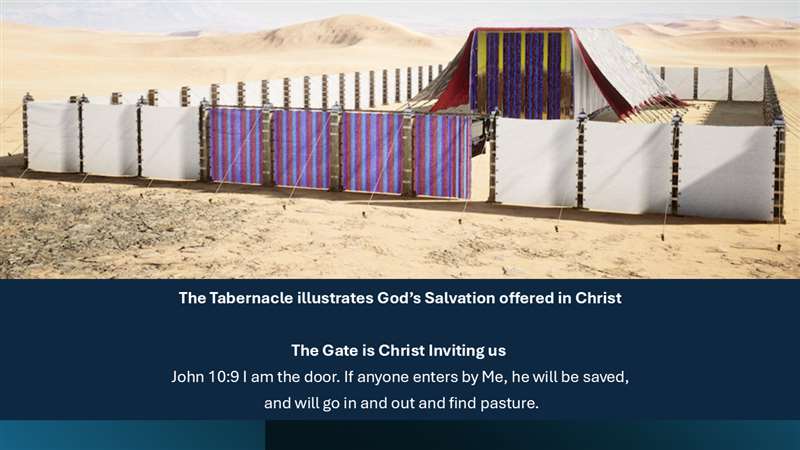
Now, next what do we see? The Tabernacle illustrates God’s salvation offered to us in Christ. What do I mean by that? Let’s go through next, I’m going to go through and explain salvation, the way the Tabernacle does. The gate, if you read at all through the Old Testament account, as we’re going to see, probably not tonight, but in the weeks ahead, looking at the construction of this thing, you see it’s very elaborate, this gate. What is the gate? Look carefully all the way around that tent, that white barrier. There’s only one doorway into that. What’s that about? Turn in your Bibles to John 10. You’re in 13; turn back to John 10 and verse 9, because the Tabernacle illustrates God’s salvation offered in Christ. And the first aspect of that salvation is Christ’s invitation. The gate is Christ inviting us to come unto Him. And when you think about that gate, you think about it is a very wide gate. In fact, that’s the widest opening in the whole Tabernacle area, that all three parts of that red color that’s circled there was openable, and it’s open for you to see, but usually that gate was down.
And what you did is you would lift up that gate, which was a curtain actually. You lift up the gate, you’d step inside, and it’d fall down behind you. Now, I want you to think about a few things. That is such a picture of salvation. There was no sound. You just silently slipped up, lifted up that little curtain, and let go of it, and you’re inside. And you know what? That’s like when people get saved. We don’t have tongues of fire over their heads anymore. We don’t have trumpets sounding. You can quietly, right where you’re sitting, come to the realization that Jesus Christ truly died in my place, that Jesus Christ is my substitute, that He poured out His blood, His life, as an atoning sacrifice, as my substitute for my sin. And you can, by faith, accept and receive that sacrifice. It’s a very quiet thing. It’s kind of like Nicodemus coming in quietly, and that tent curtain closed behind him. But the instant that occurs, you’re in. And so, that gate, look what it says in John chapter 10. In verse 9, Jesus said, I am the door. See there, that’s the doorway up there to the whole spiritual reality. I am the door. If anyone enters by Me, he will be saved and will go in and out and he’ll find pasture. He says, you are going to enter, and I’m the door, I’m the gate. Remember, in Matthew it says there’s a straight gate and a narrow gate. And if you find it, but that gate, and Jesus, Matthew 11:28 to 30, come unto Me, all you that labor and are heavy laden. Come. He says, I came seeking to save the lost. And He says, I love you so much, come to Me. Isaiah 45:22, look unto Me, all the ends of the earth, and be saved. God makes it an invitation to the world, to them to come. That’s the gate, Christ inviting us to come to Him, so that’s where it starts.
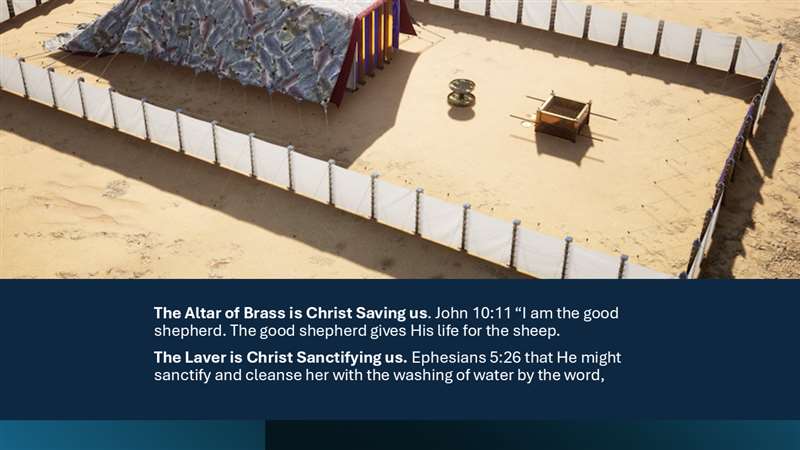
Next, look what happens. The altar is the first thing that you encounter. The altar of brass is Christ saving us. Look at John 10 and verse 11. You can track right through the Gospel by John. I am the good shepherd. And the good shepherd gives his life for the sheep. You come through the gate, and you confront the fact that there was a big price to come to Christ. That’s the salvation message. He gave Himself, John 10:11, I’m the good shepherd, and I give my life. I don’t give My hard work. I don’t give My best fruits like Cain tried to offer. I give Myself, Jesus said. I became the sacrifice. You remember the pathway of grace? God comes out to the sinner, and Jesus comes out.
And when we start, I won’t do it tonight, but I’ll just tell you, do you know what that altar was made of? It was made of acacia wood. What was acacia wood? It was a bush that grew in the desert that had a very deep root that always would go down and find the water table. Today, if you drove through there, you’d see these beautiful green bushes in the middle of wasteland. They’re acacia bushes, and they have their taproot. They are a root out of dry ground. Does that ring any bells to you? That’s Isaiah 53 and verse 2, He shall grow up before Him as a tender plant, like a root out of dry ground. That’s what that altar was made of, that root out of dry ground, acacia wood. Covered with what? It’s called the what altar? Altar of what? Brass. What does brass speak of? It speaks of judgment, so He was the Man covered with the judgment of God. The altar of brass is Christ saving us. He took on human flesh, was a root out of dry ground, as Isaiah described Him, and He bore the wrath of God for our sins. That’s why Paul said in 2 Corinthians 5. God was in Christ reconciling the world to Himself as He bore the punishment for our sins, 2 Corinthians 5 describes. So, we see in the illustration of salvation that God offers us in Christ. It started; Jesus was that gate. Then He is the altar of brass; He’s saving us.
Next, look at this. Christ is the laver sanctifying us. There are so many, but chapter 17 of John’s Gospel, and then we’ll look at what Paul said. But look at John’s Gospel chapter 17, John 17:17, sanctify them by Your truth. Your Word is truth. Now, there’s a lot of interplay here on wording. But Jesus, when He starts the Gospel by John, He’s called in the beginning was the what? The Word. Okay, and the Word became flesh and dwelt among you. And He says that we’re sanctified through the Word. But the Word is, at the end of John 17:17, what? Truth, Thy Word is truth. But John 14, Jesus said, I am the way, the what? Truth and the life. So, actually what Jesus is saying is we’re sanctified by the Word of God, but it is Christ sanctifying us because it’s the Word of Christ. And He is the Word, and He is the truth, and He is the One that sanctifies us, but He uses the Holy Spirit through the Word of God. Unbelievable how the correspondence and how everything knit together. And so, God’s illustration of salvation, the Tabernacle illustrates God’s salvation offered us in Christ. The gate is Him inviting us to come. The altar is Christ saving us, and the laver is Christ sanctifying us.
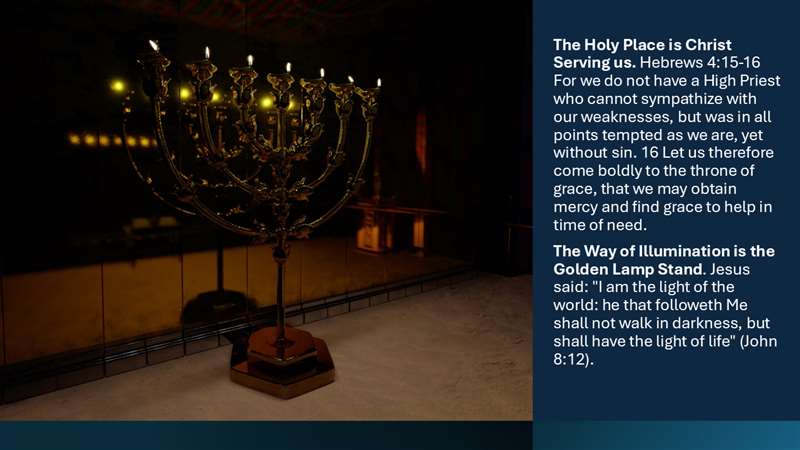
Now, next the holy place is Christ serving us. You say, what do you mean? He serves us the bread of life. He satisfies us by when we eat of Him. That’s why the Lord’s table, we keep eating that bread, reminding ourselves of what He has done. The golden lampstand. You want to know something interesting? We’re going to cover the whole golden lampstand, but I’ll tell you the secret about it. It was made of one piece of gold. See, if you buzz through Exodus, you’re missing great stuff. The lampstand was made of one piece of gold, but it was made in 66 individual pieces. Not 64, not 67. How many? Sixty-six, and the golden lampstand was filled with oil and was always burning to illumine. What object do you know of that has 66 individual parts, but it’s really one Book? The Lampstand is a picture of God’s Word, through the Holy Spirit, illuminating our lives. Thy Word is a what? A lamp to my feet and a what? A light to my path. This Book, the illumination, that’s Christ serving us. He says, you want to know what I want you to do? Get in this Book. You want to have a new mind? Get in this Book. You want to have joy and peace, and you want to have prosperity? Get into this Book! He said, this is My one piece of gold, beaten out of one piece of gold in 66 individual parts, but it’s one. There’s an organic unity in this Book because there’s one Author, there’s one theme, and there is one divine power, and that is the Lord, through His Spirit, that’s ministering to us. So, we see that the holy place is Christ serving us.
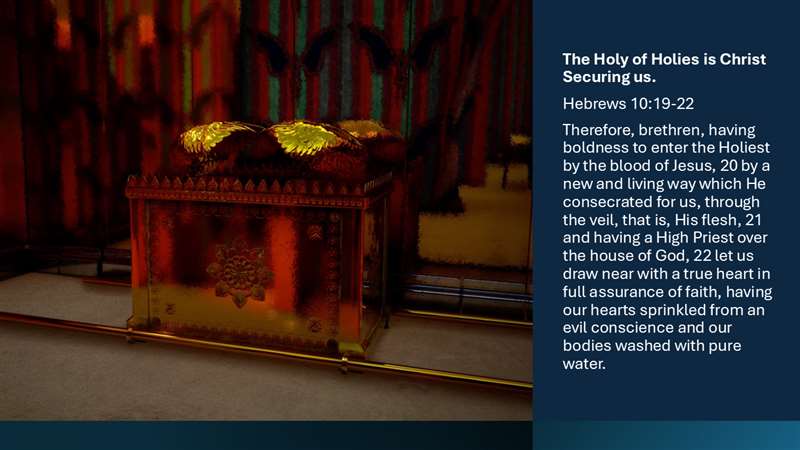
And finally, next we see that the holy of holies is Christ securing us. You say, what do you mean by that? The book of Hebrews talks about this. It says, in fact, turn with me to Hebrews chapter 10. Hebrews 10. Oh, there we go, Hebrews 10, and I’m going to start reading in verse 19. And there are many other verses in Hebrews. I’ll just draw your attention starting in verse 19. Therefore, brethren, having boldness to enter the Holiest by the blood of Jesus, by a new and living way, verse 20, which He consecrated for us, through the veil, that is, His flesh, and having a High Priest over the house of God, let us draw near with a true heart in full assurance of faith. How do we have that? Because our heart is sprinkled from an evil conscience and our bodies are washed with pure what? Water! There we are back at the laver. And He says, the way that you can be consecrated for worshiping Me and have security is stopping at that laver. It all ties together, and it’s all a beautiful picture that the spiritual reality that the Tabernacle is portraying.
Keep reading. Verse 23, let us hold fast the confession of our hope without wavering, and let us consider one another in order to stir up love and good works, and not forsake each other as we see the day approaching. What is the writer of Hebrews talk? It says, earlier in chapter 6 it says, which hope we have as an anchor of the soul, both sure and steadfast. And that anchor of the soul is Christ’s work that’s in the holy place, is in that ark of the covenant, which portrays Jesus Christ’s blood poured out once and for all on the mercy seat to take away the penalty, the power, and someday the presence of sin. That’s Jesus Christ as He offers us this great salvation.
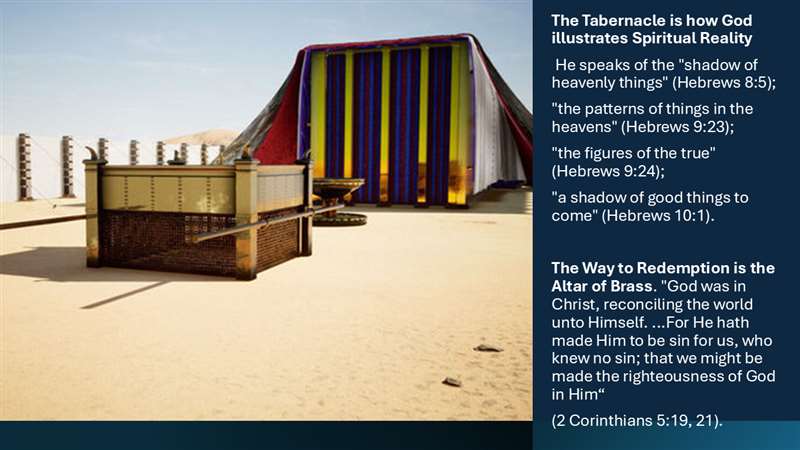
Next, we see the Tabernacle is how God portrays spiritual reality, and what we’re going to do is, and I remind you of those verses we already looked at. Hebrews 8:5, it’s a shadow. Hebrews 9:23, it’s a pattern. Hebrews 9:24, it’s a figure. Hebrews 10:1, it’s a shadow. The Tabernacle is intended by God to signify spiritual realities. What are those spiritual realities? Number one: the way of redemption is portrayed by that altar of brass. What is the way of redemption? Look at 2 Corinthians with me, and we’ll just tag little verses with everything that this beautiful picture book of the Tabernacle shows us. 2 Corinthians chapter 5, and I’ve alluded to this several times. I want to read to you two verses. The way of redemption is seen in that altar of brass, which was a picture of Christ on the cross. And it says this in 2 Corinthians 5:19, God was in Christ reconciling the world to Himself. Now look at this, for He hath made Him to be sin for us who knew no sin, that we might be made the righteousness of God in Him. So, when you came into this Tabernacle, the first thing you ran into was this big box, and that big box totally portrays the way of redemption. It had to be a spotless, innocent substitute that was slain, and put onto that contraption, and the blood was poured out.
You see the little smudges there? Did you know that the blood of the slain animal was caught in a bowl, and the priests took a little bit and put it on the four corners and then dumped all the rest of it out on the ground at the base of this altar? Now, that signifies the what? The cross! Jesus Christ’s blood was poured out, just like on the brazen altar, His blood was poured out at the base. Did you know, all the way through if you read Exodus and Leviticus, it keeps saying, ad infinitum, ad nauseam, and catch the blood and pour it at the base of the altar, and catch the blood and poured at the base of the altar, and slay a bullock and skin it and flay it and catch the blood and pour it at the base of the altar. What was that pouring at the base of the altar? To show the sacrificial life pouring out of Jesus Christ.
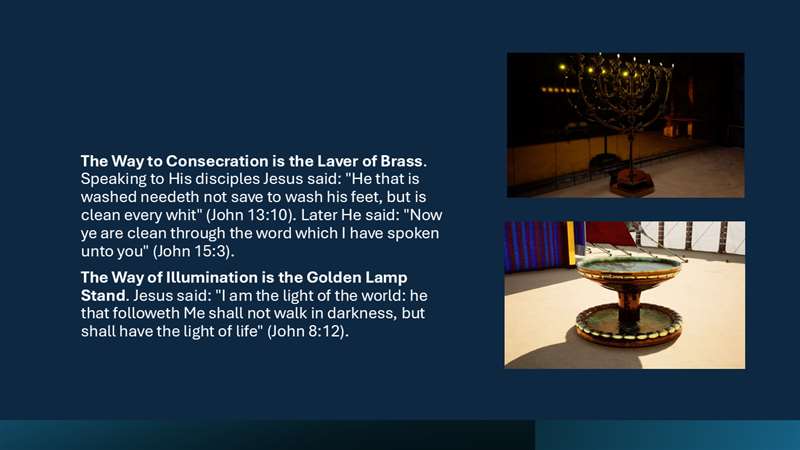
Next, we see that the way of consecration is the laver of brass. And what is that? Look back at John 15 and verse 3. We already saw John 13:10, that we are cleansed, but we need to have this little ongoing cleansing. Once and for all our sins are dealt with, but we need to come as children and keep our hands clean for the meal. But look at John 15 and verse 3, and this is what Jesus says, and we spent a long time studying abiding in Christ. But this little truth, you are already clean because of the word which I’ve spoken to you. And that is the fact that we are already clean through the sacrifice of Christ once and for all. But now back to John 13 and verse 10, we must, as Jesus said, we don’t need to wash anything but our feet. And so, the way of consecration is regularly coming to that laver of brass.
Next, we see this: the way of illumination is the golden lampstand. How do we keep illumined into what God wants for us? And look back at John 8 and verse 12. This is what, and by the way, Jesus claimed to be every one of these articles of furniture. What they represented, Jesus in His ministry claimed to be. That’s what bothered the Jews so much. Remember what He claimed to be about this in John 8 and verse 12? When we studied it, in fact, Jesus was standing next to those giant menorahs. That’s what the Jews call these lampstands, this same thing that’s in Revelation, by the way, the seven churches, the seven lampstands and all that. Same thing. Looked just like this. And actually, they were just candle holders. They were holding little oil lamps on the ends. They had wicks in them and big bowls full of olive oil. But Jesus said, I, He stood next to one of these in the Temple that was 30 or 40 feet high, and He says, I am, John 8:12. Look at this. He says, I am the light of the world. He who follows Me will not walk in darkness but will have the light of life. And He says, if you want the way of illumination, He says, I am your light, and I will illuminate you through this Book.
See, that’s the tragedy of what’s going on in Christendom today. I believe that the charismatic—most of them—people around us are born-again believers, but they’re in the dark because they’re not going by the illumination of the Word of God. They’re going by their own illumination, which is all these feelings. Jesus didn’t say, I’ll lead you by feelings. He said, I’ll lead you by what? My Word, I will illumine My will for you through My Word. And He says, without this, people perish when they don’t have the revelation of God, when they’re looking for their own revelation. So, what we see is, if you want the way of illumination, it’s the golden lampstand, which Jesus said is Me, which comes through us knowing His Word, because His Word is truth and His Word will be the light for our path.
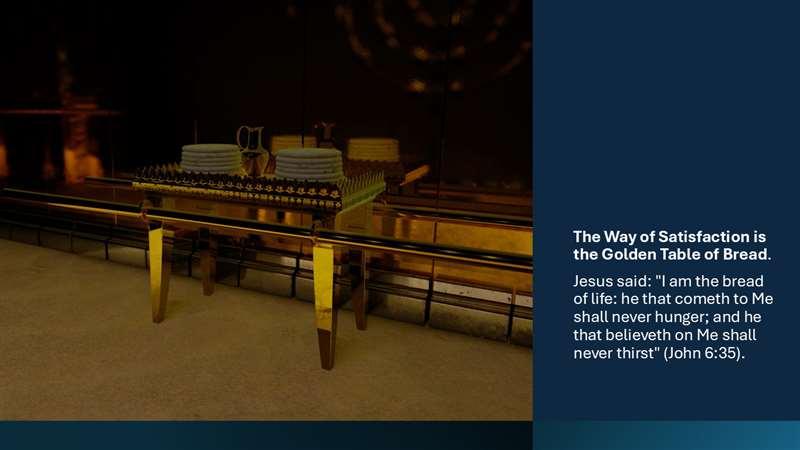
The next aspect of what the Lord is showing us is that the way of satisfaction. You want to be satisfied in your life. It’s portrayed in this golden table of bread. And for us to look at, Jesus said this in John 6 and verse 35, and I’m sure you know where I’m headed with this. Jesus claimed in John 6:35, He said, I am the bread of life. If you come to Me, you’ll never hunger. You’ll be satisfied. If you believe in Me, you’ll never thirst. You’ll be satisfied. And so, He said the way of satisfaction is coming regularly and feeding of Him. You mean we have to go to this table? No, the table represents, the table is just a shadow, and a pattern, and a picture of Jesus Christ. He said, I had to make this golden table to show them that I am your source of satisfaction. Talked to someone recently and they said, I was trusting in the wrong thing. I was trusting in what I did rather than in Christ. The Tabernacle is a picture for us to realize we don’t trust in the type, the shadow, the portrait; we trust in who it portrays, Jesus Christ. And if you are unsatisfied in your life, you are not trusting in Christ. He said, all who come to Me will never hunger, will never thirst, will never be dry, will never be empty. If we are, it’s because we haven’t been cape and cleansed at that altar, so we can’t eat at this table.
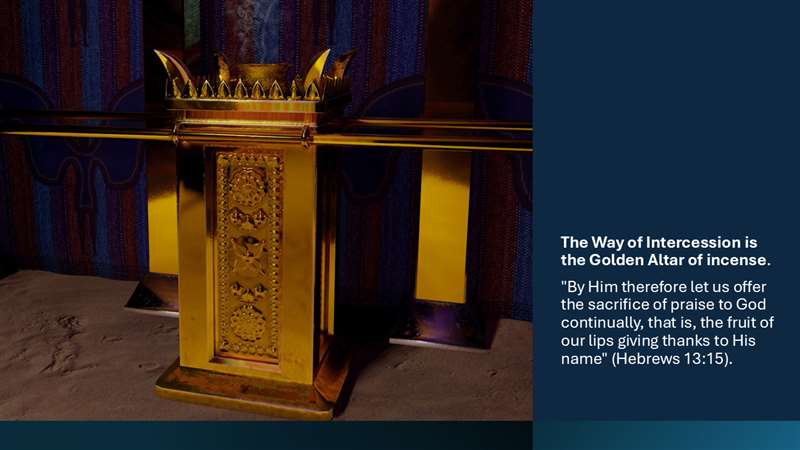
Next, we see that the wave of intercession is the golden altar of incense. I could spend a whole night talking about this altar, but I will tell you this. It’s interesting, it moves around. In the Tabernacle, it’s in front of the veil. When you get the book of Revelation, it’s on the other side of the veil; it’s right in front of the mercy seat. You say, what do you mean by that? This thing was lit by coals from that brass altar, and so the only way your and my prayers can be lit is by the sacrificial work of Christ on our behalf. And that’s why that famous statement by Jimmy Draper, or one of those great Southern Baptist preachers [Bailey Smith], when he said, God won’t hear the prayers of Jews. Remember it made such a stir about 10 years ago? You know what he was saying? Your prayers cannot rise before God unless they are ignited by the sacrifice of Christ. Now, in a general sense, yes, God who is omniscient and omnipresent hears everything. But the prayers are not effective if you’re not saved, is what that Southern Baptist guy was saying. That’s what the way of intercession on this golden altar of incense is all about. It’s a picture of prayer. It’s a picture of a continual offering to God.
But what is the basis of that? The coal that lit that incense on that little golden altar there, that coal had to be carried from the front altar of brass. So, the only way that you could ignite prayers is through. And that’s why we pray in whose name? Jesus’ name. What does Jesus signify? The sacrificial offering for our sins. That’s why we pray in Jesus’ name. It’s not, you don’t have to, you don’t have to add that on as a kind of a little postscript, just mindlessly. When you say, Jesus, you’re talking about the person, the work, the character, the finished work of Jesus Christ, our sacrifice. That’s what ignites our prayer.
In the book of John, Jesus constantly talks about abiding in Him but look at Hebrews 13:15. We’ll turn back there to get a verse for this intercession, and it talks about, and we could go to Revelation 8 and many other places. But Hebrews 13:15 says this, therefore by Him—that’s Jesus Christ—let us continually offer the sacrifice of praise to God, the fruit of our lips, giving thanks to His name. This constant rising fragrant offering of our prayers of thanksgiving and our prayers of worship. And commingled with that, remember, the model of prayer is adoration of God, confession of sins, thanksgiving, then the supplications. Sometimes we’re so quick shooting off all of our supplications, and intercessions, and all that, we forget to adore Him, and stop and get cleaned up and wash, and then thank Him for the washing, and then present to Him the petitions. That’s all embodied in this altar of incense.
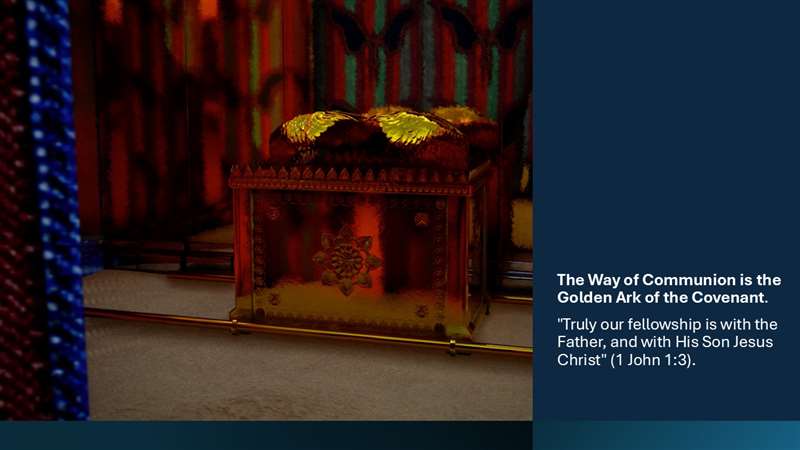
Next, we see finally, the way of communion is the golden ark of the covenant. And what that’s talking about is, and if you want to turn to 1 John 1:3. This ark, and when we get to it, I’ll tell you that when the veil was rent in the Temple, it wasn’t the opening gate to the Tabernacle [Temple]. God didn’t say anybody, you don’t have to come through Christ now; I’m just going to knock the gate down. And it wasn’t the way into the holy place. It was the curtain that separated the holy place from the holy of holies. That’s what was rent in the Temple when Jesus died, that veil that kept people from direct communion with God. Only the high priest could commune with God. Now look what we have in the New Testament, 1 John 1:3, this side of the cross. Hallelujah, what a blessing! That which we have seen and heard we declare to you, that you may have fellowship with us; and truly our fellowship is with the Father. The way of communion is through the golden ark of the covenant. God says, I have given you a new heart and a new spirit, and you can commune with Me. In fact, I love you so much that I’m going to live within you, and you are going to become My temple, and there’s no veil separating you anymore, and you can come boldly unto My throne. And I’m going to be like your Abba, your Papa, your Daddy, and you can come boldly to Me. You have to come My way. You have to come cleanse. You have to come through the offering of Christ, but you can come boldly anytime you want before Me. What does all this say?

Next, we see that the Tabernacle is God’s portrait of Christ. And by the way, there’s a nice artist’s rendition. You see all the 81 square miles of tents around it, and all night long that pillar of fire illumined the whole desert so they could see to do things you have to do at night. And then that cloud cover, probably 81square mile cover of cloud, was a canopy all day long that kept them from the 130-degree Fahrenheit Sinai Desert, and it shadowed them. But all that reminds us that the Tabernacle is God’s portrait of Christ.
Let’s get some quick overview of what we’re going to do next time. We’re going to get, when we come together next time, some faith lessons from the altar of brass. What are they? I already gave you a clue. Next, we see this once, the acacia wood. We’re going to study that. That is an amazing study. Next, we see that the tallest piece of furniture, the priority of the cross, the brazen altar speaks of that. Next, we’ll see, when we come together next time, the first object you see. In fact, God parked that brazen altar right in the doorway! In fact, the next slide shows that. When you walked in, you bumped into it. You had to see that thing and all the blood splattered there to remind you that there’s no way to God under Heaven except through the sacrificial, substitutionary death of Jesus Christ shedding His blood. That’s the only way to get to God. So, every time they walked in the Tabernacle or the Temple, they had to be reminded that Jesus Christ sacrificed Himself. Next, we see that the ashes, remember they burned the sacrifice completely. Jesus Christ said, it’s finished, and it reminds us of His finished work. And next, the blood poured at the base reminds us that He poured out His blood, and they even pierced His side, and we’re going to study the implications of that. Next, we see that the fire pans and censers, I already told you about this, that the only way you could have the altar of incense, which typifies prayer and signifies prayer, is by having coals from the always-burning fire on that altar. And so, we, our whole basis that we can intercede, and pray, and adore, and even talk to God is because of the sacrifice of Christ.
And finally, one last thing, the flesh hooks. You say, what are you talking about? Did you know they had these huge, they look like meat hooks they have nowadays, and they would take those things that are pointed and sharp, and they just whap them into that animal part, and then they’d throw it up onto the altar up there, and they would actually put sides of beef up there. It reminds us of how cruelly Christ our Lamb was treated, as it were, with flesh hooks as they took carpenter’s tools, the meek and mild Carpenter of Nazareth, and they took carpenter’s tools and cruelly crucified Him, hands and feet. And they cruelly pressed down those razor-sharp thorns, and they cruelly cut open His back in the scourging, and they cruelly stuck the spear. The flesh hooks remind us of the horrors of crucifixion. Every time they would take those animals, and they’d stab them with that flesh hook and throw it up on that altar, it was a graphic reminder of Christ, who the prophet said was pierced through, flesh hooked, for our iniquities. What a picture we see in this Tabernacle and what a beautiful picture! It’s a beautiful portrait that God gave us of Jesus Christ.
Let’s bow together and thank Him for the beautiful shadow of the reality that we find in Christ. O Father, tonight, if nothing else, I pray that Your servants who have sought to understand and learn more about You through Your Word would realize that everything starts at the cross, and everything is contingent after the cross to coming to the cleansing of the laver, of keeping ourselves on short accounts with You. Confessing, agreeing with You about our sin, seeking and receiving by faith the constant cleansing so we can be consecrated to boldly come before You. And tonight, if anyone here is not getting anything out of Your Word, it’s because they haven’t stopped at the laver on their way to the table of showbread. And if they’re not really feeling like they understand Your will and Your direction for their life, it’s because they haven’t stopped at the laver before they stand before the golden lampstand. And if their prayers seem empty and cold and lifeless, it’s because they haven’t stopped at the laver, and they haven’t gotten cleansed before they come to that golden altar of incense to offer their prayers to You. And if those prayers are to be effective, they have to be ignited by an overwhelming sense that You gave Yourself for us on that cross, and the coals from that altar are what ignite our prayers. And so may we, with the love of Christ compelling us, be earnest in prayer, praying for spiritual reality in our own lives, in the lives of those we love, and praying for personal integrity in our own lives and the lives of those we love. We love You, Lord. Thank You for this beautiful picture You gave us in your Tabernacle. May we not get all caught up with the shadow, but the reality which we find in You, Lord Jesus. In Your precious name we pray, amen. And God bless you as you go tonight.
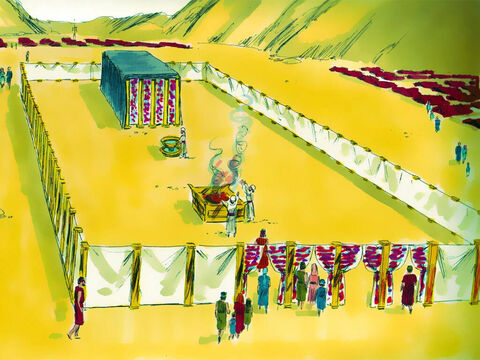
Portraits of Christ in the Tabernacle – The Tabernacle is how God illustrates Spiritual Reality
THE SIGNIFICANCE OF THE TABERNACLE In seeking to interpret the Tabernacle, we must not dogmatize but humbly follow the method of the Holy Spirit as illustrated in the Epistle to the Hebrews. Referring there to the Tabernacle and the priesthood,
o He speaks of the “shadow of heavenly things” (Hebrews 8:5);
o “the patterns of things in the heavens” (Hebrews 9:23); o “the figures of the true” (Hebrews 9:24);
o “a shadow of good things to come” (Hebrews 10:1).
Thus it is clear that the Tabernacle was intended to signify spiritual realities. In other words, in the Tabernacle we see shadows, patterns, and figures of heavenly or spiritual things that are revealed in Christ.
The Tabernacle illustrates God’s Grace and Our Faith
From the Brazen Altar to the Ark and Mercy Seat is the pathway of faith.
From the Mercy Seat to the Altar of Brass is the pathway of grace.
The Tabernacle illustrates God’s Plan for our Lives
The Altar is the Cross for sinners, the Laver is the Cleansing for sin, the Holy Place is the Consecration for Service.
The Altar is for sinners and punishment (without the shedding of blood).
The laver is for children and cleansing (without holiness no one) John 13:10 Jesus said to him, “He who is bathed (Gr. lelumenos ‘completely cleaned’) needs only to wash (Gr. nipasthoi ‘rinse’) his feet, but is completely clean (Gr. katharos ‘purified’); and you are clean (katharos), but not all of you.”
The Tabernacle illustrates God’s Salvation offered in Christ
- The Gate is Christ Inviting us John 10:9 I am the door. If anyone enters by Me, he will be saved, and will go in and out and find pasture.
- The Altar of Brass is Christ Saving us. John 10:11 “I am the good shepherd. The good shepherd gives His life for the sheep.
- The Laver is Christ Sanctifying us. Ephesians 5:26 that He might sanctify and cleanse her with the washing of water by the word,
- The Holy Place is Christ Serving us. Hebrews 4:15-16 For we do not have a High Priest who cannot sympathize with our weaknesses, but was in all points tempted as we are, yet without sin. 16 Let us therefore come boldly to the throne of grace, that we may obtain mercy and find grace to help in time of need.
- The Holy of Holies is Christ Securing us. Hebrews 10:19-22 Therefore, brethren, having boldness to enter the Holiest by the blood of Jesus, 20 by a new and living way which He consecrated for us, through the veil, that is, His flesh, 21 and having a High Priest over the house of God, 22 let us draw near with a true heart in full assurance of faith, having our hearts sprinkled from an evil conscience and our bodies washed with pure water.
The Tabernacle is how God illustrates Spiritual Reality
THE SIGNIFICANCE OF THE TABERNACLE In seeking to interpret the Tabernacle, we must not dogmatize but humbly follow the method of the Holy Spirit as illustrated in the Epistle to the Hebrews. Referring there to the Tabernacle and the priesthood,
- He speaks of the “shadow of heavenly things” (Hebrews 8:5);
- “the patterns of things in the heavens” (Hebrews 9:23);
- “the figures of the true” (Hebrews 9:24);
- “a shadow of good things to come” (Hebrews 10:1).
Thus it is clear that the Tabernacle was intended to signify spiritual realities. In other words, in the Tabernacle we see shadows, patterns, and figures of heavenly or spiritual things that are revealed in Christ. This may be gathered from the significance of:
- The Way to Redemption is the Altar of Brass. “God was in Christ, reconciling the world unto Himself. …For He hath made Him to be sin for us, who knew no sin; that we might be made the righteousness of God in Him” (2 Corinthians 5:19, 21).
- The Way to Consecration is the Laver of Brass. Speaking to His disciples Jesus said: “He that is washed needeth not save to wash his feet, but is clean every whit” (John 13:10). Later He said: “Now ye are clean through the word which I have spoken unto you” (John 15:3).
- The Way of Illumination is the Golden Lamp Stand. Jesus said: “I am the light of the world: he that followeth Me shall not walk in darkness, but shall have the light of life” (John 8:12).
- The Way of Satisfaction is the Golden Table of Bread. Jesus said: “I am the bread of life: he that cometh to Me shall never hunger; and he that believeth on Me shall never thirst” (John 6:35).
- The Way of Intercession is the Golden Altar of incense. “By Him therefore let us offer the sacrifice of praise to God continually, that is, the fruit of our lips giving thanks to His name” (Hebrews 13:15).
- The Way of Communion is the Golden Ark of the Covenant. “Truly our fellowship is with the Father, and with His Son Jesus Christ” (1 John 1:3).
The Tabernacle is God’s Portrait of Jesus
The Tabernacle is God’s photo journal documenting salvation. It is not an after thought, it is His premeditated explanation of what Jesus would do perfectly on the Cross. The Tabernacle is the clearest portrait of Christ and His redemption to be found in any part of the Old Testament. While God only uses one verse to record Creation (Genesis 1:1), and two chapters (Genesis 1-2) to explain it, He takes 15 chapters (Exodus 25-40) to explain the construction of the Tabernacle and 27 more to describe it in action (Leviticus). This task was so important that God did not depend on the ingenuity of craftsmen to follow a blueprint, He actually came into them through His Spirit (Exodus 31:1-6) and guided each step of their work.
Before God sent a Person named Jesus Christ, He sent a picture called the Tabernacle.
The Tabernacle is a photo album of the most detailed explanation of salvation in the Old Testament. The Tabernacle is the ABCs of Christian Doctrine, it is a systematic Theology that Paul actually uses in Romans to explain salvation. In the Old Testament the Tabernacle is the dwelling place of God. In the New Testament the Church becomes the dwelling place of God.
Walk again with me through Exodus 37-38.. The courtyard of the Tabernacle was one hundred fifty feet long and seventy-five feet wide. As we walk around it on a Scriptural Tour, we can find that every object we see in some way points to Christ. And also His great I AM declarations are featured in this sacred place.
The furnishings of the tabernacle reveal what God’s presence in our lives has provided. Each of the furnishings speaks clearly of a ministry of God through which the believer is protected from himself and enabled to become all God intends. All the pieces of furniture also picture Christ. Everything in the outer courtyard was connected with salvation and the cleansing of sins. Jesus accomplished His sacrificial work on earth, outside God’s heavenly presence. The outer court was accessible to all the people, just as Christ is accessible to all who will come to Him. But in His heavenly sanctuary He is shut off from the world, temporarily even from His own people.
- THE BRONZE ALTAR. exodus 38:1-7 The bronze altar is a perfect picture of Jesus Christ, who Himself was a sacrifice for sin. Jesus reflected this when He declared I AM the Good Shepherd who gives MY LIFE for my sheep (John 10.11). So Jesus our Lamb offered Himself for us.
- The first article of furniture in the outer court was the bronze altar. It was made of acacia wood sheathed with bronze.
- Isaiah 53:2 For He shall grow up before Him as a tender plant, And as a root out of dry ground. He has no form or comeliness; And when we see Him, There is no beauty that we should desire Him.
- The root out of dry ground is most likely a reference to the acacia, which is a desert bush with an exceptionally deep root that goes down to a source of water. Acacia was also ship building tough wood. This wood covered bronze means Jesus covered by God’s judgment.
Check Out All The Sermons In The Series
You can find all the sermons and short clips from this series, Christ in all the Scriptures here.
Looking To Study The Bible Like Dr. Barnett?
Dr. Barnett has curated an Amazon page with a large collection of resources he uses in his study of God’s Word. You can check it out here.