
NR3-21 TAB-13
980315PM
God is a Terrible God. Have you pondered that lately? When Jonathan Edwards did, he wrote out his thoughts into a message and upon reading it the people listening grabbed the backs of the pews fearful of the fires of His wrath.
Look with me at some Scriptures:
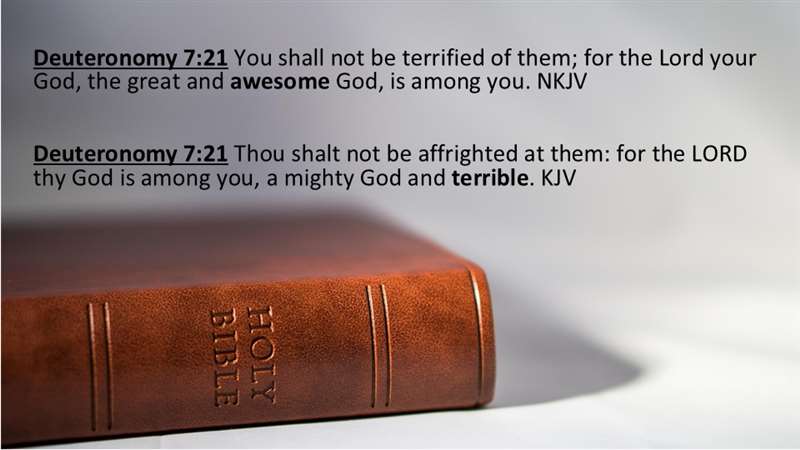
Deuteronomy 7:21 You shall not be terrified of them; for the Lord your God, the great and awesome God, is among you. NKJV
Deuteronomy 10:17 For the LORD your God is God of gods, and Lord of lords, a great God, a mighty, and a terrible, which regardeth not persons, nor taketh reward: KJV
Judges 13:6 Then the woman came and told her husband, saying, A man of God came unto me, and his countenance was like the countenance of an angel of God, very terrible: but I asked him not whence he was, neither told he me his name: KJV
Nehemiah 1:5 And said, I beseech thee, O LORD God of heaven, the great and terrible God, that keepeth covenant and mercy for them that love him and observe his commandments: KJV
Transcript
So, let’s open our Bibles to Exodus, and we’re going to start in chapter 7 this evening. And as we do so, I’d like to introduce you to a concept tonight that you might not have thought about for a while. In fact, all of us, the old timers that still use the King James Bible, or at least have memorized from it have a little different view of some of the Scriptures I’m going to share tonight because one of the great names of God in the Old Testament is that God is terrible. Now, in English, I was mentioning this to my children, they said, terrible? What did you say? Are you sure you mean terrible? And I said, yes. In your Bibles, all the New King James onward Bibles, they’ve changed terrible with the word awesome. But for me, I see kids getting off rides at Disney World, and they’re going, oh, awesome ride. And I think, that doesn’t fit with God. God is an awesome on the side of fearful, terrible, causing people to quake and shake, and that’s what we’re going to see tonight. And so, if you wonder where we’re going tonight, it’s looking at the fearful, awesome, holy, reverential wrath of the God we serve. And what that should drive us to is to think how incredible it is that Jesus loves us and isn’t pouring out His wrath.
Let me show you what I mean. God is a terrible God. Have you pondered that lately? When Jonathan Edwards did, he wrote out his thoughts into a message, and upon reading it, the people listening grabbed the back of the pews in front of them, fearful of falling into the fires of God’s wrath. In Exodus chapter 7, we find God unleashing His terrible wrath upon the people who had not listened to His messenger’s warning. In verse 14, we saw last week, the first plague, and it says in verse 17 of chapter 7, by this you shall know that I am the LORD. The purpose of the plagues were to point people to God, to acknowledge Him, to see Him in His terrible holiness, and to cause the people of Egypt to turn and to cause the children of Israel to turn in reverential awe of God. It turned the Egyptians away. It brought the Israelites out, but they soon lost their fervor for the LORD.
But with your finger right here, turn two books over to Deuteronomy 7. We’re in Exodus 7; turn two books to the right. It goes Exodus, Leviticus, Numbers, actually three. Deuteronomy chapter 7, seventh chapter of a different book. Verse 21 says, in the New King James, 7:21, you shall not be terrified of them; for the LORD your God, the great and awesome God, is among you. Listen to King James. Thou shalt not be affrighted at them: for the LORD thy God is among you, a mighty God. And what? Terrible. The word is yare’, which comes from the same word as yara, which is the same word as glory. And also, it is tied with another word for holiness, ka?ô?, which means heaviness. And the frightening fearfulness yara with the ka?ô? heaviness of God makes a gloriously awesome God. But literally, it means frighteningly terrible. And when people came into contact with God, it scared them. And we’re going to see that in just a moment. Look at Deuteronomy 10, keep going to the right. Same idea. Deuteronomy 10 and verse 17, For the LORD your God is God of gods, and Lord of lords, a great God, a mighty, and—King James—a terrible—or awesome, as the modern translations would put it— which regardeth not persons, nor taketh reward. Now, what happens when people came in the presence of God and got a little glimpse of Him?
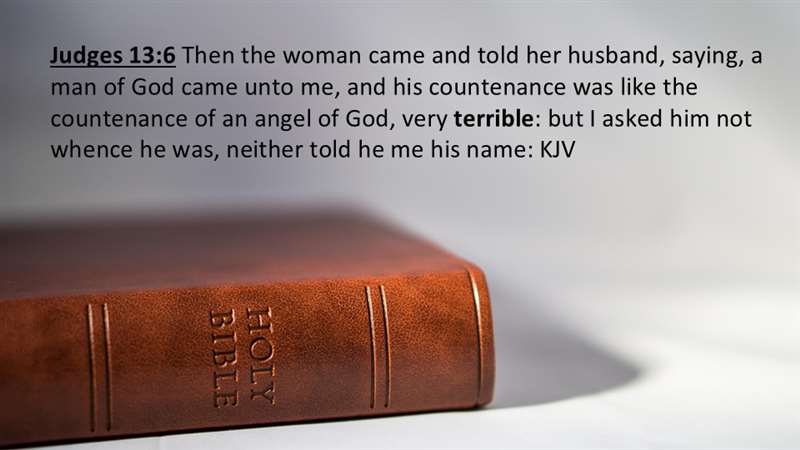
A couple books over to the right, Judges chapter 13. Look at what happened when Samson’s parents got a little view of the pre-incarnate Christ. It says in Judges 13 and verse 6. And by the way, these people had a proper response, so that’s why they didn’t experience the wrath of God. The Egyptians didn’t have a proper response, and we’re going to see tonight that God increasingly devastated them because they wouldn’t acknowledge Him. And the idea is that the best way to worship God is acknowledge who He is tonight. But look at Judges 13:6, and the woman came and told her husband, saying, a Man of God came to me, and His countenance was like the countenance of an angel of God. What? Very terrible. Now we wouldn’t think that was a compliment to us, and that’s because terrible doesn’t wash well into English because it’s such a big Hebrew word. But it means awesome on the side of not being exciting but awesome on the side of being overwhelmingly, dreadfully holy and different from us. And so, she said, He’s very terrible: but I asked Him not from whence He was, neither told me His name. And then verse 8, Manoah prayed to the LORD, and said, O my Lord, please let the Man of God whom You sent come to us again and teach us what we shall do for the child who will be born. And that’s every parent’s prayer, right? When you find out you’re going to have children, you say, God, teach us what You want us to do.
Keep going to Nehemiah. Judges, Ruth, 1 and 2 Samuel, 1 and 2 Kings, Chronicles, Ezra, Nehemiah, there we go. Nehemiah chapter 1 because this theme, and we could just go all the way through the Bible and find this, but this theme is repeated over and over again. Nehemiah 1:5, Nehemiah said, I beseech Thee, O LORD God of Heaven, the great and what? Terrible—or awesome—God. What’s great and terribly awesome about Him? You keep your covenant and mercy on those that love You and observe His commandments. But on those that don’t, His wrath rests upon them.
Chapter 4 of Nehemiah, same idea. Nehemiah was taken up with this concept of God. Nehemiah 4 :14, and I looked, and I rose up, and said to the nobles, to the rulers, to the rest of the people, be not afraid of them—all the adversaries—remember the LORD. And what are we to remember about the LORD? Which is great and terrible, and fight for your brethren, your sons, and your daughters, and your wives, and your houses. Terrible! Not bad, not mean, not awful. Terribly powerful and frighteningly so.
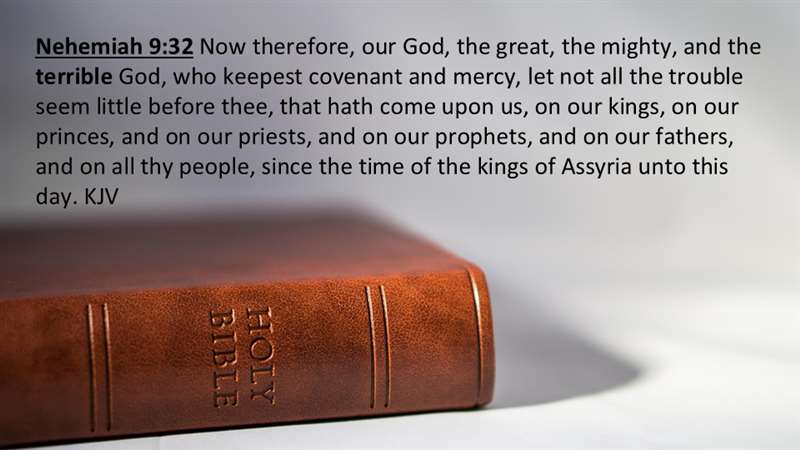
Look at chapter 9. Nehemiah records the longest prayer in the Bible prayed by Ezra and the Levites. Nehemiah 9:32, now therefore, our God, the great, the mighty, and the terrible God, who keepest covenant and mercy, let not all the trouble seem little before Thee. You’re so terribly awesome and big. This isn’t, don’t let it be little before You, that has come on us, and on our king, and our princes, and our priests, and on our prophets, and on our fathers, and on all Thy people, since the time of the kings of Assyria to this day. What he’s beseeching is, God, You are so, so removed, and Your awesome holy terribleness, can You look on this little deal with us, the needs of Your people? Amazing.
Now to the Psalms, it’s a big theme in the Psalms. I’ll only show a couple. So, it goes Ezra, Nehemiah, Esther, Job, Psalms. There we go. Right in the middle of your Bible, if you’re lost. Forty-seventh Psalm will be the first one we’re going to look at. We’ll only look at three tonight, 47 it says this, for the LORD most high is terrible—King James Authorized Version—He is a great King over all the Earth. Now you get a little glimpse. And remember, the best way to interpret the Bible is with the Bible, and the best way to get a commentary on the Bible, before you look at what men have to say, look what God has to say about the passage. And so, if you’re tracking this word to do a word study on what this terrible means, there are little keys, and right here is one of them. The LORD is terrible because He’s most high. That means He’s over all, and He is the King over all the Earth. He is, He transcends. He’s bigger than the Earth and literally, if you think about it, says, the Earth is His footstool. Next time you go home and kick off your shoes and put your feet up, imagine the planet Earth there. And God is so much bigger that He can just put His feet on the Earth. That’s the concept of being terrible. He is beyond our comprehension.
Psalm 68 verse 35 has another instance of this word. In the thirty-fifth verse of the sixty-eighth Psalm, O God—listen—Thou art terrible out of Thy holy places: the God of Israel is He that giveth strength and power to His people. Blessed be God. Now, there’s no feeling that God is bad. It’s just that He is terribly removed from us, and He is terribly awesome, and He causes reverential awe. And here’s the last one, Psalm 99. If you want to turn there, it pulls it all together, and it’s wonderful. It says this, let them praise Thy great and terrible—or terribly awesome—name. Why? What makes God terribly awesome? It is holy.
Now, we’re going to see what happens when hardened hearts confront a holy God, and it’s an awful thing. The poet once wrote, in fact, Joseph Addison Alexander was his name. He wrote a very famous poem that was popular in the nineteenth century. This is what it says. Listen to it about this coming together of a holy God and hardened, impenitent hearts. When those two hit, it’s amazing what happens. There is a time—Addison Alexander says—we know not when, a point—we know not where, that marks the destiny of men to glory or despair; There is a line, by us unseen, that crosses every path, The hidden boundary between God’s patience and His wrath. To pass that limit is to die, to die as if by stealth; it does not quench the beaming eye or pale the glow of health; The conscience may be still at ease, the spirit light and gay; That which is pleasing, still may please, and care may be thrust away. But on that forehead God has set indelibly a mark. And this is, Addison Alexander knew the Bible well enough to knew to know that in Ezekiel, before God destroyed the city of Jerusalem, the Angel of the LORD came with a blotter and a pen, and it says He kept getting ink on his pen. And he made a mark on every one of those in Jerusalem, they couldn’t see it, but he marked all those that feared His name. And when the Babylonians came through and slaughtered, they didn’t slaughter the ones He’d marked because he marked the ones that feared His name, and no one could touch them. He uses the reverse idea when says, on their forehead God has set indelibly a mark, unseen by men, for men, as yet, are blind and in the dark. Oh, where is that mysterious bourn by which our path is crossed, that beyond which God Himself hath sworn that He who goes is lost? How far may we go in sin? How long will God forbear? Where does hope end, and where begin that confines [of] despair? An answer from the skies is sent, ye that from God depart, while it is said today repent, and harden not your heart.
Tonight, the message of Exodus 7 through 11 is don’t harden your hearts, and God shows what happens when we do. Tonight, and you can be turning back to Exodus 7. Tonight, we’re going to meet the God who is the God who sent a fiery sword, and those cherubim holding that fiery sword that blocked Adam and Eve returned to the Garden of Eden after their sinning. And it says in the last verse of the third chapter that God sent cherubim, that’s several cherubs, to come and to hold their fiery swords so that the fallen humans couldn’t return. That’s the holiness of God. God is a God who cataclysmically destroyed all the people and animals that breathed and buried them on this planet under thousands of feet of strata, while their souls were awaiting the final day of judgment. Now, think about that. God destroyed not, it was not a local flood in Iran in the time of Noah. It was a cataclysmic global drowning of hundreds of millions of people. That’s what God’s holiness demands without the righteous intervention of a substitute, Jesus Christ.
In fact, Peter said it this way in 2 Peter 2, for if God spared not the angels that sinned, but cast them down to Hell, tartaroo, and delivered them into chains of darkness, waiting for judgment. 2 Peter 2:5, and He spared not the old world. That’s what God calls the world before the flood, the pre-flood world, the old world. But He saved Noah the eighth person, a preacher of righteousness, bringing in the flood upon the world of the ungodly. That’s what the holiness of God does. He drowns people and buries them under mud. God is a God who melted the city of Sodom and every inhabitant in it with fire out of Heaven. God is a God who poured liquid burning sulfur onto Gomorrah and incinerated every living creature, man, woman, and child, in that city. That is the Holy God of the Bible. Who saw their hardened and impenitent hearts as they and their sins ascended before His face. And he said, enough, in Genesis 19. Says In 2 Peter 2:6, He turned the cities of Sodom and Gomorrah into ashes condemning them with an overthrow, making them an example to those that should after live in an ungodly way. Now, what He did is He instantly incinerated them and now they’re awaiting in the Lake of pre-Hell Fire, which is Hades. They’re awaiting the judgment of God, but they experienced His judgment while they were here. Now, right now, most people in this world don’t experience His judgment. That’s why God leaves us these reminders.
Let’s meet this great and terribly awesome God as He faces off with the impenitent hearts of Egypt and destroys their gods systematically. We already saw last time the plague of the blood in the Nile, and we saw that God says, I did that, in verses 14 to 25, He did that to show that only He controls the afterlife. I hope you remember that. Every time someone mockingly goes to the grave, they die laughing in their sin. God says, don’t let that worry you. I control the gate into eternity and let them just bust through it laughing. They won’t laugh when they land on the other side. God says, I control the afterlife. I’m the Spirit of creation. I made all things. I watch over and protect My people securely. And I want the whole world, as we saw last week, to know that I rule.
Now, chapter 8 verse 1. Let’s look at the second plague, the plague of frogs. The plague described as this. Now, imagine waking up, and we don’t have time to read all 15 of the verses, but let me distill it down into a paragraph. Like a blanket of filth, the slimy, wet monstrosities of innumerable frogs covered the land of Egypt until the inhabitants sickened at the continued squashing crunch of the ghastly pavement they were forced to walk upon. If a man’s feet slipped in the greasy mass of their crushed bodies, he fell into an indescribably offensive mass of rotting frogs. Can you imagine, have you ever smelled blood from hamburger in your trash can before the garbage truck gets? The smell of blood, dead blood, it’s horrible! Can you imagine carpeting Egypt with frogs that died and then the smell rose up? Amazing. If he sought water to cleanse himself, the water was solid with frogs, so he got no cleansing there. The frogs were called Kerer and represented the fruitfulness or fertility. The annual floods of the Nile, which renewed the farmland, caused him to make the goddess Heqet, embodied as a frog, the wife of the great Nun the great pantheon of the Egyptian gods, harming any frog or killing a frog was a capital offense in Egypt. Boy, we’ve come a long way, haven’t we? We’re starting to do that in America. Frogs are on the list; next they’ll be endangered before you know it. But back then, if you endangered a frog, or if you stepped on one or killed it or did anything to it, a child, it was a capital offense because they worship, that frog was a representation of one of their three prime gods, the frog god. And if you look at any Egyptian mythological junk that they sell at all, you have the frog-headed god. God says, you worship frogs? I’ll give you frogs. And so, He covered every square inch of the land thick with frogs. And to feel them crunching beneath your feet and to smell your feared god rotting in heaps was the second plague. God says, I did this because I want you to know that your gods are false and dead, and I’m the true and powerful God. And this was a death blow to the closed system of their worship.
Someone asked me tonight, they said, is there anything in Egyptian history about all this happening? Are you kidding? Do you think they would record this? Did you know that Egypt was run, not by the Pharaoh, but by the priests? It was lucrative. There were thousands of priests. In fact, if you go to the ruins of Luxor, the temple of Amun-Re, the great temple, there are miles of walls, and pools, and gardens. It’s just, they can’t even excavate it. The part they’ve excavated, the pillars are 70 feet tall. You feel like you’re in the redwoods when you stand there. It was all buried in sand. When you’re there, you think about the fact that they had acres of lakes for the priest to wash themselves with their continued… There were so many priests, they had to have just acres of lakes for the ritual washing. Those people ran the whole country. Remember I told you last week, they carried the gods out every morning and set them on their pedestals, and then they picked them up, and bundled them up, and put them away at night. And so, God says, I want you to know that I’m the true and powerful God and these gods aren’t, and I’m concerned that you know that I’m the Creator. And so, He says, I’m going to knock out the frog god.
Look at chapter 8 verse 16, because here’s the third plague coming. It is real brief that there’s only 16 to 19 that mentions it, but this is what it’s all about. This was an unannounced plague. If you’re studying them, most of them are announced. Moses says, tomorrow the locust will come. It will be dark. The firstborn will die. He didn’t say anything. When Pharaoh, in verse 15, hardened his heart, God says, here comes another one. Stretch out your rod, verse 16, and strike the dust of the land so that it might become lice throughout all the land of Egypt. Can you imagine that? I’ve never had lice, but just the sound of them just can’t stop crawling on you and biting you sounds awful, and burrowing and whatever they do. This is an unannounced plague. Josephus tells us that they were lice, but in the Talmud, but it’s not in the Hebrew text. And so, that’s why there’s a little mark by mine where it says lice, and if you look in the middle, they say it could be gnats, it could be flies, it could be fleas, sand flies, it could have been mosquitoes. In fact, Meyer, a great Hebrew scholar, took it to be the scarab beetle. The word is a general word for a pesky bug. So, just think, it could have been earwigs. Do we have those in Oklahoma? Earwigs? No? Those are awful too. But it was just a creepy bug.
But the group that was hit the most were the priests because they were constantly shaving and purifying themselves, and whenever they came in contact with creeping bugs, they were unclean. And so, God just basically through this plague, knocked out all the priestly class. Why is that? Because the priests of Egypt were supposed to make people holy by all their stuff, and God made them unclean to show He’s the only One that can make anyone holy, and so He attacked the holy makers to show there’s only one way to the holiness of God. And it’s not through all the cleansings and holy rigamarole of the priests; it’s only through the true and living God. And so, he made the dust turn into creeping bugs, and it covered the people of Egypt.
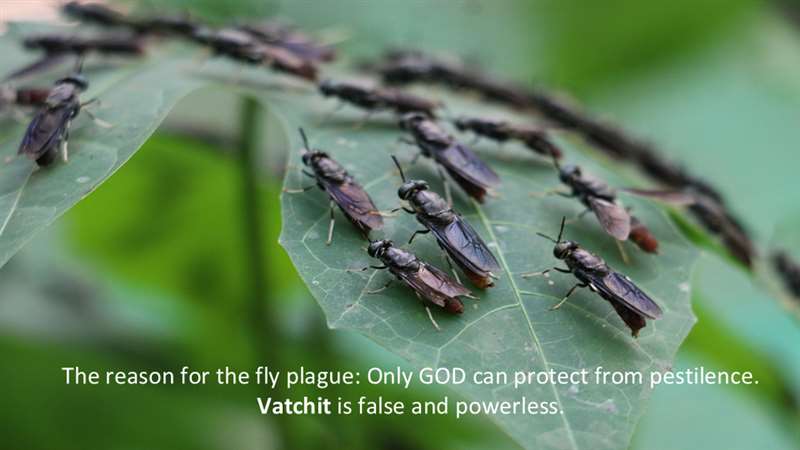
The next one starts quickly in chapter 9 verse 1. This is the fifth plague. I mean in verse 20 is the flies, and the flies I’ll go through even quicker because there’s very little known about that. All we know is there was blood-sucking flies, and that’s because there was a fly goddess called Uatchit that they worshiped. And so, God says, you worship the flies? We’ll have the flies bite you, and so He did. But what’s interesting is it says they were not, look at verse 22, I will set apart in the land of Goshen, that no flies—no blood-sucking flies—are going to go there. And I thought that was amazing. Have you ever tried to keep flies out without screens? Even if you have screens, they seem, you know how in the wintertime they come out of nowhere? I think they’re hiding in there somewhere. And when it gets warm, they come out, and they’re all crawling around in there, and you have to sweep them out. Do you know what God said? He says, no flies are going to cross this invisible perimeter around the land of Goshen. He said, do you know why? Because, He says, everybody else is going to have these huge blood-sucking holes from these flies biting them. And the Israelites are going to come walking out in their field, they’re going to look at those people, and they’re going to be knocking the flies off, and they’re just going to be walking, they don’t have any flies on. And you know what? Uatchit, the fly god was a god of protection. These people wear little medals around their neck to make them safe, and they have them on their dashboard so they’ll help them drive. Those people had little flies, and that was supposed to protect them. And God says, you think the fly will protect you? I’ll have the flies bite you, but I’m going to protect. The living and true God, the only One that can really protect you is going to have an invisible fence, and the flies aren’t going to be able to go through it, and they’re not going to even go into Goshen, and they’re not going to bite one single Israelite.
Now, if you were living in Egypt and you were an Egyptian back then and you saw your river, the bloodstream of your god, turn to blood, wouldn’t it have gotten your attention? And all of a sudden, the frog god, that all your life, you’re told if you step on one, it’ll kill you and the prime god will kill you, and all of a sudden, the land was blanketed with a carpet of slimy dead frogs. Wouldn’t that have shattered your view of that? And then all of a sudden, if the ground became crawling with bugs up you, biting you, and they were representative of the god that was supposed to be a protective god. And then all of a sudden, these flies came in biting you, that was your one, you had a little fly around your neck for protection. Wouldn’t that have gotten your attention? Got mine the first time. I can’t believe it.

Look at Chapter 9, fifth plague. They get worse, by the way, you can brush flies off but look at this one. This one is amazing. The cattle plague, seven verses is all, but what’s amazing, several things. Only the Egyptian cows were killed. Again, God differentiates between His people and the hard-hearted ones. And it says, the LORD said to Moses, go tell Pharaoh, thus says the LORD: let My people go, that they may serve Me. Which is interesting. God wants us not to just know Him but to serve Him. If you refuse to let them go, verse 2, and still hold them, behold, the hand of the LORD will be on the cattle in the field, on the horses, the donkeys, the camels, on the oxen, and on the sheep, a very severe pestilence. And the LORD will make a difference between the livestock of Israel and the livestock of Egypt. So, nothing shall die of all that belongs to the children of Israel. Wow. Verse 6, so the LORD did this thing, and all the livestock of Egypt died; but of the livestock of the children of Israel, not one died.
You say, so what? Like India today, Egypt back then worshiped the cow. If you know anything about Egyptian mythology, Hathor, the big cow with the big horns and the crown in its head was one of their prime gods. In fact, in November of 1856, which was a long time ago, a French archeologist named by the name of Mariette, found an underground avenue. He was digging around. French were, after Napoleon found the Rosetta Stone in 1804, they just ascended and started using the Rosetta Stone to read the hieroglyphics, and they found all those tombs, and they found where they were. And so, he found a tomb, and he was so excited. He started excavating a tunnel underground carved into rock that was 1,120 feet long. He couldn’t believe it! It had never been excavated, and he started pulling the sand out as fast as he could, and all of a sudden, these giant 10-foot-high and about 8-foot-wide doors started appearing, sealed. He just had gold. He could imagine what he was going to find, and he found this 1,120-foot-long avenue. He found it lined 32 doors on each side. There were 64 huge burial chambers, all sealed. He started opening the seals and found sarcophagi, and that’s a big word for a stone coffin. And these sarcophagi were 12 feet long, 9 feet high, and 6 feet wide. Each room had this 12-foot-long, 9-feet-high, and 6-foot-wide stone, solid granite polished box in it, sealed. Can you imagine the visions of treasure that this guy had? So, he finally got a crew in to take the first lid off, and he started taking this lid off, and each sarcophagus was made of red and black granite. Each one weighed 60 tons, these boxes, big thick lids. They finally got one off, and they looked inside. Guess what was inside the first one? A cow, mummified cow just there, mummified cow! He couldn’t believe it, and they were all cow gods, Hathor cows, the goddess of love and beauty, depicted with bulls’ horns and the sun disk on her head that was worshiped in Heliopolis, and it was the sacred bull of sun worship. And what had happened was he found out that this bull that they kept out in front of their temple, they always had one in this pen, and they fed it, and they worshiped it and everything. And whenever it would die, they would embalm it, and they’d put it in a sarcophagus, 60 ton one, by the way, and put this lid on and make it a mummy. And they put it in there and then the next one they put out, and they’d worship that one. When it died, they put it in. They had generations of bulls in there.
Can you imagine coming one day and having this old man from the desert come and look your king in the face and say, the God of Heaven is going to kill all the cows. Can you imagine what everybody looked at right away? The bull in the pen that they were all worshiping that day. And boom, died just like that. Why did God do stuff like that? Because God says, I want you to know that the god behind the bull is only an impotent demon. I want you to know that the sun god is nothing. I want you to know that your cow god, the goddess of love and beauty, is powerless in the face of the ugliness of death that no one has power over but God, the true and living God. By the way, it says in Genesis 47 that. Pharaoh had the biggest flocks in all of Egypt. So, do you know who got the biggest message? Pharaoh! All of his livestock died, and when he looked over the fence one day, all of his cows were there bloated and rotting, and there were peacefully grazing on the other side of the fence all the Israelites’ cattle.
Don’t you think he got the message? Don’t you think that would’ve communicated? Didn’t communicate. If you looked at what it says in verse 12, but the LORD hardened the heart of Pharaoh; and he did not heed them, just as the LORD has spoken. Verse 7, it says, the heart of Pharaoh was hardened, and verse 35 of chapter 9, the heart of Pharaoh was hardened. We’re going to go through all these plagues, and it’s just going to sound like a repeat, because every time God showed His hand, Pharaoh hardened his heart.
Verses 8 through 17 is the boil plague. It was unannounced, and this one was targeted at the lion headed goddess called Sekhmet, who was the regulator of epidemics and diseases. And if you didn’t want to get a plague back then, you had a Sekhmet god, S-E-K-H-M-E-T. But this god, that basically had a lion for the head of this god and an animal’s body, was the main god of the magicians of Pharaoh’s court. Now, keep your finger here and show. We don’t know very many people that lived in Egypt 3,500 years ago, but we do know the names. In 2 Timothy chapter 3, I want to read to you something really interesting. God tells us the names of the head of the Egyptian magicians’ corps that confronted and opposed the true God. Look what it says in 2 Timothy 3. I’ll just read it to you. Verse 8, now as, 2 Timothy 3:8, as Jannes and Jambres withstood Moses. God tells us the names of two individuals that lived 3,500 years ago. Why? Because those two people looked the God of the universe straight in the face, saw His, just hard to regard the unmistakable finger of God just squashing Egypt. And these hard-hearted magicians told Pharaoh, and withstood Moses, and said, don’t give in to him. It’s going to ruin our royal religion. Don’t give in to him. And Pharaoh led the nation of Egypt into utter destruction because he was unwilling to listen to God, but he listened to Jannes and Jambres who resisted the truth: men of corrupt minds, with no desire for the faith of God.
The boil plague goes on. That’s verses 8 through 17. And what’s interesting, if you notice in this one that it says in verse 10 of chapter 9 of Exodus that the magicians could not stand before Moses because of the boils. This is humorous to me. Here’s this old man, we saw him last week, this old man in his sheepy clothes, and he’s got his staff and his big brother walking with him, and they walk in. They say, Moses said he was shy, so he would lick his lips a little bit, and he’d say, we’re going to all have boils today. God said so. Stood there and all of a sudden, the magicians started dropping. They couldn’t even stand up. They had boils on the bottom of their feet. They had boils everywhere. They fell down. Moses said, see? And off he went. And the whole nation of Israel [Egypt] was covered with these boils. And in spite of that, look at verse 12, hard hearts.
The seventh plague, hail. The LORD said to Moses, rise early in the morning, stand before Pharaoh, and say to him, the LORD God of the Hebrews: let my people go, that they may serve Me, for at this time I will send all My plagues to your very heart, and on your servants and on your people, so that you may know there is no one like Me in all the Earth. And if I had stretched out My hand and struck you and your people with pestilence, then you would have been cut off from the Earth. But indeed, for this purpose I have raised you up, that I may show My power in you, that My name may be declared in all the Earth. Now look at this. Tomorrow, verse 18, about this time I will cause a very heavy hail to rain down, such has not been in Egypt since the foundation till now. Now, see what the LORD does is He gives him an opportunity to respond. Verse 19, send now, gather your livestock and all that you have in the field, for the hail will come down on every man and every animal which is found in the field and is not brought home; they shall die.
Now look at verse 20. Here’s the first crack. He who feared the Word of the LORD among the servants of Pharaoh made his servants and his livestock flee to the houses. But he who did not regard the Word of the LORD left his servants and his livestock in the field. And the LORD said to Moses, stretch your hand toward Heaven, there may be hail in all the land of Egypt—on man, on beast, on every herb of the field, throughout the land. And Moses stretched out his rod toward Heaven; and the LORD sent thunder and hail, and fire darted to the ground. And the LORD rained hail on the land of Egypt. And there was hail, and fire mingled with the hail, so very heavy that there was not one like it in all the land of Egypt since it became a nation. And the hail struck throughout the whole land of Egypt, all that was in the field. Look at verse 26, only in the land of Goshen, where the children of Israel were, there was no hail.
Now, another time God, remember, sent down hail in chapter 10 of [Joshua] at Gibeon, that battle? And it says that the hail squashed and crushed the soldiers, the Canaanites, and it said more people died from the hail than got killed with the sword. Did you know it’s coming again in the time of the Revelation, the Great Tribulation? In the Great Tribulation, 100-pound hailstones. Did you know that if you throw a small object off of a high building, a small object can kill someone at the bottom. That’s why you’re not supposed to do that. And even a bullet shot up in the air, if it comes back down just the gravity will kill someone if it hits them. Can you imagine what will happen with 100-pound gigantic hailstones? Can you imagine what will happen to this Earth when that’s coming?
The hail plague was to remind them as they looked out at their blackened and desolate fields, it was a tragic testimony of the impotence of their deities of and stone. The Egyptians had a goddess of the sky and weather named Nut. And you know what? That God couldn’t protect them from the Creator. Isis and Seth were supposedly responsible, but they were seen to be not able to protect the crops because the true God of Heaven and Earth came.
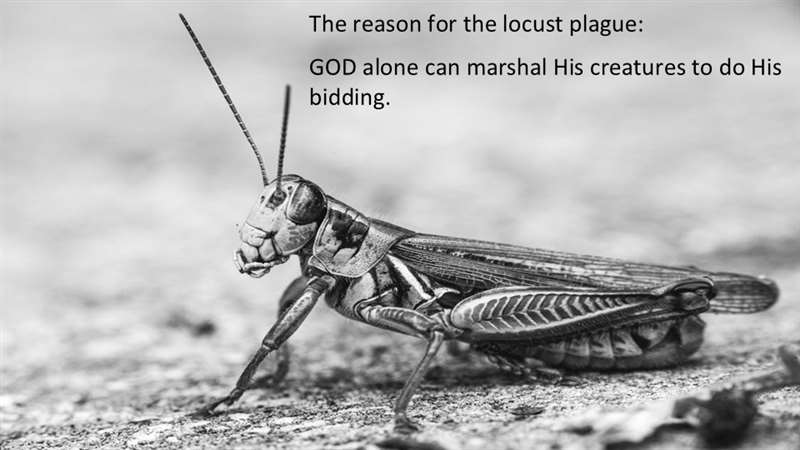
Real quickly, this next one, the eighth plague in chapter 10 is astounding. Most of us have never thought about locusts. You hear the sound of them out there and the rubbing their feet together, making noises in the trees, and you love to watch them hop when you’re a little kid, and you catch them and scare the girls with them at the bus stop. But you don’t think about what happened here. And sometimes we miss the tenth chapter, and I love this. Go to Pharaoh and tell him, in verse 2, in the hearing of his sons and daughters, what I’m going to do. And thus says the LORD, verse 3, don’t refuse to listen. And then he says, verse 4, behold God says, I am going to bring locusts into your territory. So, you say, so what? Just pray, right? Can you imagine them? So what? Let me read to you what locusts can do. The locust is perhaps nature’s most awesome example of the collective destructive power of a species. One adult locust weighs a maximum of two grams, yet its combined destructive force can lead thousands of people in famine. For years, the locust plagues were much feared in ancient Egypt, so much so that the peasants were in the habit of praying to the locust god. They knew about this. They were afraid of locusts. Satan likes to keep superstitious people enslaved to his demonic hordes and evil powers.
But listen, 1927, the people who had long accused the Bible of hyperbole changed their mind. In 1926 and ’27, small swarms of the African migratory locusts were spotted in an area 50 miles long and 120 miles wide in the plains of the River Niger, near Timbuktu in Western Africa. The next year, those swarms crossed over into Senegal and Sierra Leone. By 1930, all of West Africa was flailing at the pest with everything movable, but the locusts didn’t seem to notice. The swarms reached Khartoum, more than 2,000 miles east of Timbuktu. Then they turned south and spread across Ethiopia, Kenya, the Belgian Congo, and by 1932, they struck the lush farmland of Angola and Rhodesia. Before the plague finally spluttered out 14 years after it began, it had affected a five million square mile area of Africa and had destroyed the crops in an area nearly double the size of the United States. You can read about it in the National Geographic. They aren’t prone to proving the Bible, but they do with that article. A locust is capable of eating its own weight every day. One square mile of a swarm of locusts will contain 1 to 200 million of the creatures. It’s usual, however, that the plagues of locusts occupy an area of not one square mile but of 400 square miles when they swarm. God says, you want to know something? Chapter 10 verses 1 through 20. He says, I can tell locusts where to go. Can you? I can marshal their hosts, and they obey My command. That’s the God that Moses was representing.
Two more plagues. The ninth plague, and then the tenth is the most important. Chapter 10 verse 21 gives us the ninth plague, the plague of darkness. The darkness was like in the deepest cave. If you’ve ever been in one, you could feel the darkness. All the Egyptians immediately knew that the source of light was extinguished, and for how long no one knew. But look what it says in verse 21. The LORD said, stretch out your hand over Egypt. Look at the end of 21 of chapter 10, the darkness which could be felt. Moses stretched his hand toward Heaven; there was a thick darkness over all the land of Egypt for three days. They did not see one another; nor did anyone rise from his place for three days. This petrified them. Can you imagine? Just instant blackness! You didn’t know if you went blind. You didn’t know, you could feel, it’s just like you’re buried in ink, and everyone just froze. But all the children, look at verse 23, but all the children of Israel had light in their dwellings. That means it was pitch black outside, but inside God supernaturally made light for them, so they didn’t go through this darkness. Did you know what part of Hell is? In suffering, it says in Jude, in suffering the blackness of darkness and the vengeance of eternal fire, amazing combination. The hopelessness of the blackness of darkness and the fearsomeness of eternal fire that continuously burns and never consumes. These people felt the blackness.
Why? Because at the heart of all Egyptian religion, the greatest god of all was Amun-Re, or Ra, the sun god. The largest of all the ancient temples with a hundred miles of walls and gardens was Luxor, the temple of the sun god. This God had a wife, Mut, and son, Khonsu, and all were sacred and were worshiped. And God says, I am light. In fact, it says in 1 John 1:5, this is the message we’ve heard from Him and we declare to you, that God is light and in Him is no darkness at all. And God says, if you’re going to worship the sun and think that’s a source of light, I’m going to turn it out, and you’ll know I’m the true and living God. Powerless were those legions of priests that overflowed the largest of all the ancient temples; powerless were the stone and metal and wooden gods and goddesses who controlled the sky. God alone gives the true light, and He alone can guide individuals to the Way, the Truth, and the Life, but they didn’t listen.
The last plague and where we’re going to end tonight is the death of the firstborn. Look at chapter 11, and LORD said to Moses, I will bring one more plague on Pharaoh and on Egypt. Afterward he will let you go from here. When he lets you go, he will surely drive you out of here altogether. And thus, begins that final plague. Nothing we can imagine can come close to what happened on the Passover night in Egypt. I want you to think about it for a moment. Life was going on in Egypt. The pest, Moses, had caused some problems, but nothing that couldn’t be forgotten. From cradle to stall, all the firstborn known only to God went to bed on the night of Passover as they had gone to bed all the other nights of their lives. But on that night, God had planned something that was final, dark, and fearful. It was an unspeakable plague to even imagine. A supernatural messenger of doom who would hunt and kill the firstborn is just beyond words. That anyone could pick out the firstborn of man and livestock in the unlit blackness of an Egyptian night is imperceivable, and to know that it was tonight, that it was going to happen, it must have been beyond words to express because God said to these people, tonight, the death angel will personally come and strike the firstborn of man and of beast. But whoever will heed the call to put blood on the doorpost over the top and down the sides will be spared. And so, that night, an unavoidable plague hit where there was no place that the death angel would not visit. Each family would be noticed. Each would be examined from the poorest to the richest, from the huts of the farming peasants to the ivory halls of the palaces. All would see the dark shadow of the death angel cross their path, looking to see if there was blood, and if not, death would come.
It was an unstoppable plague. There was no power on Earth then or now that could have stopped that stalking death. Nothing could deflect his sword of death. It was unexpected. Life had been moving along as expected. Business was as usual. Yet that old fanatic was still crying about judgment. But the people said, we live in a real world, not some God we can’t see who can judge us. Remember how the gods of Egypt were put to bed every night in their temples by the priest, they awakened every morning and fed, and set up by the priest? There was a final dark plague to fear.
Why did God do that? Why did He do that? Why did He kill all those innocents? To show that no one’s really innocent, to show we’re all infected with a plague of sin, to show that God will keep His Word, but more than that to tell us that only the blood of God’s sacrifice can keep His hand of wrath abated. Only those who trust and obey Him would be safe. Egypt was powerful, it was pampered, it was proud, and on that very night, the death angel would make an unforgettable visit. I hope we never miss the lessons of the Passover because it reminds me of something worse than being killed by the death angel. Reminds me of the dark, unavoidable, inescapable plague of Hell and of eternal judgment. God’s offer was salvation. He gave the ones who would listen the only solution to avert the death, the disaster of the death angel’s sword. His plan was substitution. He detailed a simple act of taking an innocent, spotless lamb that would die in place of the family members. And if you would let that lamb signify your guilt, and let that innocent lamb die in your place, and that substitute to be a picture of the coming Lamb of God, you’d be spared. God’s method was sprinkling of blood. It was the dark sprinkle of blood on the doorposts staining the wood that provided protection. God’s promise was sufficient. It included deliverance from death, provision of all needs for life, the hope of a Land of Promise flowing with milk and honey. All this with a personal guide to assure safe arrival.
So, what does the LORD want us to remember from these plagues tonight? Yes, the gods of Egypt are impotent. Yes, they were lifeless. Yes, they were false. Yes, they were not true or living. But more than that, He wants us to know that there’s an unspeakable dark plague for us to fear. There’s an unavoidable appointment with death for all. There’s an unstoppable wrath of God, and it’s going to come unexpectedly on all of us, except for those who will obey God and hide beneath the shadow of shed blood, not our works, but the sinless, spotless Lamb of God who poured out His blood so that the wrath of God might pass over us.
I wonder tonight if you’ve thought about the unspeakable, unavoidable, unstoppable, unexpected plague of death. To me it sounds just like death, and Hell, and the wrath of God facing the unrepentant sinners. What’s God’s offer? Salvation. He said, you don’t have to have that happen to you. What is God’s plan? Substitution. Look at the substitute and trust Him. What is God’s method? The sprinkling of blood. What is His promise? It’s that I will provide a sufficient sacrifice as a free gift. I wonder tonight, Don started out, I didn’t even know he was going to do that. He says, do you know when you were saved? Let me ask it to you in a different way. Do you know for sure that the more powerful death angel, the death angel of Hell, are you sure when he comes knocking at your door, whenever God says, your life and my life is over, are you sure He’s going to see the sprinkled blood of Christ covering you? Your parents’ blood won’t cover you. Your wife’s blood won’t cover you. Your husband’s blood won’t cover you. Your grandparents’ blood won’t cover you. Your youth leader’s blood won’t. Your elder’s blood won’t cover you. You have to personally be sprinkled with the blood of Christ, the substituted Lamb in your place. Are you sure that you have that? Are you sure that His blood has cleansed you from all your sins? Do you know that’s what salvation is all about?
Let’s bow before our Lord. We’re going to sing, in just a second, a hymn of assurance. But before that, let’s bow before the Lord. Oh, great, awesome, terrible God, You’ve shown in Egypt how dreadful is Your wrath upon impenitent and hardened hearts. By Your grace, for Your glory, may there be none in this room tonight, but all soft, willing, yielded hearts. Lord Jesus, I pray that tonight if there is anyone here who is not sure that they have been sprinkled by the blood of Jesus Christ, may they right now, where they’re sitting, just quietly ask for the Lamb, You Lord Jesus, who died in their place, to sprinkle them from all their iniquity, cleanse them, and purge them from all their sin. Thank You that tonight, the blood of Jesus Christ cleanses me, and all of us who have asked, from all our unrighteousness, and we are saved from Your wrath, O God. But if anyone has not yet trusted in Christ’s sacrifice, may they believe that Jesus died for our sins according to the Gospel. And that He was buried, and that He rose again on the third day, and that He offers the remission, the forgiveness, the cleansing, the taking away of sins that target Your wrath upon us. And in the quietness of this moment, all of us have our heads bowed before the Lord and our hearts bowed before Him. You can in your heart, call out to Jesus and you can say, Lamb of God, take away my sin, forgive me, cleanse me. I turn to You from my sins. O Lord Jesus, I pray You’d hear the cries of any who are going to face the unspeakable death plague of Hell, that You would save them from that tonight. And may they know that they are Yours and You are theirs. Tonight, I am His and He is mine. The hope of everyone trusting in the substitutionary atonement of Jesus Christ, in whose name we pray, amen.
God is a Terrible God. Have you pondered that lately? When Jonathan Edwards did, he wrote out his thoughts into a message and upon reading it the people listening grabbed the backs of the pews fearful of the fires of His wrath.
Look with me at some Scriptures:
Deuteronomy 7:21 You shall not be terrified of them; for the Lord your God, the great and awesome God, is among you. NKJV
Deuteronomy 10:17 For the LORD your God is God of gods, and Lord of lords, a great God, a mighty, and a terrible, which regardeth not persons, nor taketh reward: KJV
Judges 13:6 Then the woman came and told her husband, saying, A man of God came unto me, and his countenance was like the countenance of an angel of God, very terrible: but I asked him not whence he was, neither told he me his name: KJV
Nehemiah 1:5 And said, I beseech thee, O LORD God of heaven, the great and terrible God, that keepeth covenant and mercy for them that love him and observe his commandments: KJV
Transcript
So, let’s open our Bibles to Exodus, and we’re going to start in chapter 7 this evening. And as we do so, I’d like to introduce you to a concept tonight that you might not have thought about for a while. In fact, all of us, the old timers that still use the King James Bible, or at least have memorized from it have a little different view of some of the Scriptures I’m going to share tonight because one of the great names of God in the Old Testament is that God is terrible. Now, in English, I was mentioning this to my children, they said, terrible? What did you say? Are you sure you mean terrible? And I said, yes. In your Bibles, all the New King James onward Bibles, they’ve changed terrible with the word awesome. But for me, I see kids getting off rides at Disney World, and they’re going, oh, awesome ride. And I think, that doesn’t fit with God. God is an awesome on the side of fearful, terrible, causing people to quake and shake, and that’s what we’re going to see tonight. And so, if you wonder where we’re going tonight, it’s looking at the fearful, awesome, holy, reverential wrath of the God we serve. And what that should drive us to is to think how incredible it is that Jesus loves us and isn’t pouring out His wrath.
Let me show you what I mean. God is a terrible God. Have you pondered that lately? When Jonathan Edwards did, he wrote out his thoughts into a message, and upon reading it, the people listening grabbed the back of the pews in front of them, fearful of falling into the fires of God’s wrath. In Exodus chapter 7, we find God unleashing His terrible wrath upon the people who had not listened to His messenger’s warning. In verse 14, we saw last week, the first plague, and it says in verse 17 of chapter 7, by this you shall know that I am the LORD. The purpose of the plagues were to point people to God, to acknowledge Him, to see Him in His terrible holiness, and to cause the people of Egypt to turn and to cause the children of Israel to turn in reverential awe of God. It turned the Egyptians away. It brought the Israelites out, but they soon lost their fervor for the LORD.
But with your finger right here, turn two books over to Deuteronomy 7. We’re in Exodus 7; turn two books to the right. It goes Exodus, Leviticus, Numbers, actually three. Deuteronomy chapter 7, seventh chapter of a different book. Verse 21 says, in the New King James, 7:21, you shall not be terrified of them; for the LORD your God, the great and awesome God, is among you. Listen to King James. Thou shalt not be affrighted at them: for the LORD thy God is among you, a mighty God. And what? Terrible. The word is yare’, which comes from the same word as yara, which is the same word as glory. And also, it is tied with another word for holiness, ka?ô?, which means heaviness. And the frightening fearfulness yara with the ka?ô? heaviness of God makes a gloriously awesome God. But literally, it means frighteningly terrible. And when people came into contact with God, it scared them. And we’re going to see that in just a moment. Look at Deuteronomy 10, keep going to the right. Same idea. Deuteronomy 10 and verse 17, For the LORD your God is God of gods, and Lord of lords, a great God, a mighty, and—King James—a terrible—or awesome, as the modern translations would put it— which regardeth not persons, nor taketh reward. Now, what happens when people came in the presence of God and got a little glimpse of Him?
A couple books over to the right, Judges chapter 13. Look at what happened when Samson’s parents got a little view of the pre-incarnate Christ. It says in Judges 13 and verse 6. And by the way, these people had a proper response, so that’s why they didn’t experience the wrath of God. The Egyptians didn’t have a proper response, and we’re going to see tonight that God increasingly devastated them because they wouldn’t acknowledge Him. And the idea is that the best way to worship God is acknowledge who He is tonight. But look at Judges 13:6, and the woman came and told her husband, saying, a Man of God came to me, and His countenance was like the countenance of an angel of God. What? Very terrible. Now we wouldn’t think that was a compliment to us, and that’s because terrible doesn’t wash well into English because it’s such a big Hebrew word. But it means awesome on the side of not being exciting but awesome on the side of being overwhelmingly, dreadfully holy and different from us. And so, she said, He’s very terrible: but I asked Him not from whence He was, neither told me His name. And then verse 8, Manoah prayed to the LORD, and said, O my Lord, please let the Man of God whom You sent come to us again and teach us what we shall do for the child who will be born. And that’s every parent’s prayer, right? When you find out you’re going to have children, you say, God, teach us what You want us to do.
Keep going to Nehemiah. Judges, Ruth, 1 and 2 Samuel, 1 and 2 Kings, Chronicles, Ezra, Nehemiah, there we go. Nehemiah chapter 1 because this theme, and we could just go all the way through the Bible and find this, but this theme is repeated over and over again. Nehemiah 1:5, Nehemiah said, I beseech Thee, O LORD God of Heaven, the great and what? Terrible—or awesome—God. What’s great and terribly awesome about Him? You keep your covenant and mercy on those that love You and observe His commandments. But on those that don’t, His wrath rests upon them.
Chapter 4 of Nehemiah, same idea. Nehemiah was taken up with this concept of God. Nehemiah 4 :14, and I looked, and I rose up, and said to the nobles, to the rulers, to the rest of the people, be not afraid of them—all the adversaries—remember the LORD. And what are we to remember about the LORD? Which is great and terrible, and fight for your brethren, your sons, and your daughters, and your wives, and your houses. Terrible! Not bad, not mean, not awful. Terribly powerful and frighteningly so.
Look at chapter 9. Nehemiah records the longest prayer in the Bible prayed by Ezra and the Levites. Nehemiah 9:32, now therefore, our God, the great, the mighty, and the terrible God, who keepest covenant and mercy, let not all the trouble seem little before Thee. You’re so terribly awesome and big. This isn’t, don’t let it be little before You, that has come on us, and on our king, and our princes, and our priests, and on our prophets, and on our fathers, and on all Thy people, since the time of the kings of Assyria to this day. What he’s beseeching is, God, You are so, so removed, and Your awesome holy terribleness, can You look on this little deal with us, the needs of Your people? Amazing.
Now to the Psalms, it’s a big theme in the Psalms. I’ll only show a couple. So, it goes Ezra, Nehemiah, Esther, Job, Psalms. There we go. Right in the middle of your Bible, if you’re lost. Forty-seventh Psalm will be the first one we’re going to look at. We’ll only look at three tonight, 47 it says this, for the LORD most high is terrible—King James Authorized Version—He is a great King over all the Earth. Now you get a little glimpse. And remember, the best way to interpret the Bible is with the Bible, and the best way to get a commentary on the Bible, before you look at what men have to say, look what God has to say about the passage. And so, if you’re tracking this word to do a word study on what this terrible means, there are little keys, and right here is one of them. The LORD is terrible because He’s most high. That means He’s over all, and He is the King over all the Earth. He is, He transcends. He’s bigger than the Earth and literally, if you think about it, says, the Earth is His footstool. Next time you go home and kick off your shoes and put your feet up, imagine the planet Earth there. And God is so much bigger that He can just put His feet on the Earth. That’s the concept of being terrible. He is beyond our comprehension.
Psalm 68 verse 35 has another instance of this word. In the thirty-fifth verse of the sixty-eighth Psalm, O God—listen—Thou art terrible out of Thy holy places: the God of Israel is He that giveth strength and power to His people. Blessed be God. Now, there’s no feeling that God is bad. It’s just that He is terribly removed from us, and He is terribly awesome, and He causes reverential awe. And here’s the last one, Psalm 99. If you want to turn there, it pulls it all together, and it’s wonderful. It says this, let them praise Thy great and terrible—or terribly awesome—name. Why? What makes God terribly awesome? It is holy.
Now, we’re going to see what happens when hardened hearts confront a holy God, and it’s an awful thing. The poet once wrote, in fact, Joseph Addison Alexander was his name. He wrote a very famous poem that was popular in the nineteenth century. This is what it says. Listen to it about this coming together of a holy God and hardened, impenitent hearts. When those two hit, it’s amazing what happens. There is a time—Addison Alexander says—we know not when, a point—we know not where, that marks the destiny of men to glory or despair; There is a line, by us unseen, that crosses every path, The hidden boundary between God’s patience and His wrath. To pass that limit is to die, to die as if by stealth; it does not quench the beaming eye or pale the glow of health; The conscience may be still at ease, the spirit light and gay; That which is pleasing, still may please, and care may be thrust away. But on that forehead God has set indelibly a mark. And this is, Addison Alexander knew the Bible well enough to knew to know that in Ezekiel, before God destroyed the city of Jerusalem, the Angel of the LORD came with a blotter and a pen, and it says He kept getting ink on his pen. And he made a mark on every one of those in Jerusalem, they couldn’t see it, but he marked all those that feared His name. And when the Babylonians came through and slaughtered, they didn’t slaughter the ones He’d marked because he marked the ones that feared His name, and no one could touch them. He uses the reverse idea when says, on their forehead God has set indelibly a mark, unseen by men, for men, as yet, are blind and in the dark. Oh, where is that mysterious bourn by which our path is crossed, that beyond which God Himself hath sworn that He who goes is lost? How far may we go in sin? How long will God forbear? Where does hope end, and where begin that confines [of] despair? An answer from the skies is sent, ye that from God depart, while it is said today repent, and harden not your heart.
Tonight, the message of Exodus 7 through 11 is don’t harden your hearts, and God shows what happens when we do. Tonight, and you can be turning back to Exodus 7. Tonight, we’re going to meet the God who is the God who sent a fiery sword, and those cherubim holding that fiery sword that blocked Adam and Eve returned to the Garden of Eden after their sinning. And it says in the last verse of the third chapter that God sent cherubim, that’s several cherubs, to come and to hold their fiery swords so that the fallen humans couldn’t return. That’s the holiness of God. God is a God who cataclysmically destroyed all the people and animals that breathed and buried them on this planet under thousands of feet of strata, while their souls were awaiting the final day of judgment. Now, think about that. God destroyed not, it was not a local flood in Iran in the time of Noah. It was a cataclysmic global drowning of hundreds of millions of people. That’s what God’s holiness demands without the righteous intervention of a substitute, Jesus Christ.
In fact, Peter said it this way in 2 Peter 2, for if God spared not the angels that sinned, but cast them down to Hell, tartaroo, and delivered them into chains of darkness, waiting for judgment. 2 Peter 2:5, and He spared not the old world. That’s what God calls the world before the flood, the pre-flood world, the old world. But He saved Noah the eighth person, a preacher of righteousness, bringing in the flood upon the world of the ungodly. That’s what the holiness of God does. He drowns people and buries them under mud. God is a God who melted the city of Sodom and every inhabitant in it with fire out of Heaven. God is a God who poured liquid burning sulfur onto Gomorrah and incinerated every living creature, man, woman, and child, in that city. That is the Holy God of the Bible. Who saw their hardened and impenitent hearts as they and their sins ascended before His face. And he said, enough, in Genesis 19. Says In 2 Peter 2:6, He turned the cities of Sodom and Gomorrah into ashes condemning them with an overthrow, making them an example to those that should after live in an ungodly way. Now, what He did is He instantly incinerated them and now they’re awaiting in the Lake of pre-Hell Fire, which is Hades. They’re awaiting the judgment of God, but they experienced His judgment while they were here. Now, right now, most people in this world don’t experience His judgment. That’s why God leaves us these reminders.
Let’s meet this great and terribly awesome God as He faces off with the impenitent hearts of Egypt and destroys their gods systematically. We already saw last time the plague of the blood in the Nile, and we saw that God says, I did that, in verses 14 to 25, He did that to show that only He controls the afterlife. I hope you remember that. Every time someone mockingly goes to the grave, they die laughing in their sin. God says, don’t let that worry you. I control the gate into eternity and let them just bust through it laughing. They won’t laugh when they land on the other side. God says, I control the afterlife. I’m the Spirit of creation. I made all things. I watch over and protect My people securely. And I want the whole world, as we saw last week, to know that I rule.
Now, chapter 8 verse 1. Let’s look at the second plague, the plague of frogs. The plague described as this. Now, imagine waking up, and we don’t have time to read all 15 of the verses, but let me distill it down into a paragraph. Like a blanket of filth, the slimy, wet monstrosities of innumerable frogs covered the land of Egypt until the inhabitants sickened at the continued squashing crunch of the ghastly pavement they were forced to walk upon. If a man’s feet slipped in the greasy mass of their crushed bodies, he fell into an indescribably offensive mass of rotting frogs. Can you imagine, have you ever smelled blood from hamburger in your trash can before the garbage truck gets? The smell of blood, dead blood, it’s horrible! Can you imagine carpeting Egypt with frogs that died and then the smell rose up? Amazing. If he sought water to cleanse himself, the water was solid with frogs, so he got no cleansing there. The frogs were called Kerer and represented the fruitfulness or fertility. The annual floods of the Nile, which renewed the farmland, caused him to make the goddess Heqet, embodied as a frog, the wife of the great Nun the great pantheon of the Egyptian gods, harming any frog or killing a frog was a capital offense in Egypt. Boy, we’ve come a long way, haven’t we? We’re starting to do that in America. Frogs are on the list; next they’ll be endangered before you know it. But back then, if you endangered a frog, or if you stepped on one or killed it or did anything to it, a child, it was a capital offense because they worship, that frog was a representation of one of their three prime gods, the frog god. And if you look at any Egyptian mythological junk that they sell at all, you have the frog-headed god. God says, you worship frogs? I’ll give you frogs. And so, He covered every square inch of the land thick with frogs. And to feel them crunching beneath your feet and to smell your feared god rotting in heaps was the second plague. God says, I did this because I want you to know that your gods are false and dead, and I’m the true and powerful God. And this was a death blow to the closed system of their worship.
Someone asked me tonight, they said, is there anything in Egyptian history about all this happening? Are you kidding? Do you think they would record this? Did you know that Egypt was run, not by the Pharaoh, but by the priests? It was lucrative. There were thousands of priests. In fact, if you go to the ruins of Luxor, the temple of Amun-Re, the great temple, there are miles of walls, and pools, and gardens. It’s just, they can’t even excavate it. The part they’ve excavated, the pillars are 70 feet tall. You feel like you’re in the redwoods when you stand there. It was all buried in sand. When you’re there, you think about the fact that they had acres of lakes for the priest to wash themselves with their continued… There were so many priests, they had to have just acres of lakes for the ritual washing. Those people ran the whole country. Remember I told you last week, they carried the gods out every morning and set them on their pedestals, and then they picked them up, and bundled them up, and put them away at night. And so, God says, I want you to know that I’m the true and powerful God and these gods aren’t, and I’m concerned that you know that I’m the Creator. And so, He says, I’m going to knock out the frog god.
Look at chapter 8 verse 16, because here’s the third plague coming. It is real brief that there’s only 16 to 19 that mentions it, but this is what it’s all about. This was an unannounced plague. If you’re studying them, most of them are announced. Moses says, tomorrow the locust will come. It will be dark. The firstborn will die. He didn’t say anything. When Pharaoh, in verse 15, hardened his heart, God says, here comes another one. Stretch out your rod, verse 16, and strike the dust of the land so that it might become lice throughout all the land of Egypt. Can you imagine that? I’ve never had lice, but just the sound of them just can’t stop crawling on you and biting you sounds awful, and burrowing and whatever they do. This is an unannounced plague. Josephus tells us that they were lice, but in the Talmud, but it’s not in the Hebrew text. And so, that’s why there’s a little mark by mine where it says lice, and if you look in the middle, they say it could be gnats, it could be flies, it could be fleas, sand flies, it could have been mosquitoes. In fact, Meyer, a great Hebrew scholar, took it to be the scarab beetle. The word is a general word for a pesky bug. So, just think, it could have been earwigs. Do we have those in Oklahoma? Earwigs? No? Those are awful too. But it was just a creepy bug.
But the group that was hit the most were the priests because they were constantly shaving and purifying themselves, and whenever they came in contact with creeping bugs, they were unclean. And so, God just basically through this plague, knocked out all the priestly class. Why is that? Because the priests of Egypt were supposed to make people holy by all their stuff, and God made them unclean to show He’s the only One that can make anyone holy, and so He attacked the holy makers to show there’s only one way to the holiness of God. And it’s not through all the cleansings and holy rigamarole of the priests; it’s only through the true and living God. And so, he made the dust turn into creeping bugs, and it covered the people of Egypt.
The next one starts quickly in chapter 9 verse 1. This is the fifth plague. I mean in verse 20 is the flies, and the flies I’ll go through even quicker because there’s very little known about that. All we know is there was blood-sucking flies, and that’s because there was a fly goddess called Uatchit that they worshiped. And so, God says, you worship the flies? We’ll have the flies bite you, and so He did. But what’s interesting is it says they were not, look at verse 22, I will set apart in the land of Goshen, that no flies—no blood-sucking flies—are going to go there. And I thought that was amazing. Have you ever tried to keep flies out without screens? Even if you have screens, they seem, you know how in the wintertime they come out of nowhere? I think they’re hiding in there somewhere. And when it gets warm, they come out, and they’re all crawling around in there, and you have to sweep them out. Do you know what God said? He says, no flies are going to cross this invisible perimeter around the land of Goshen. He said, do you know why? Because, He says, everybody else is going to have these huge blood-sucking holes from these flies biting them. And the Israelites are going to come walking out in their field, they’re going to look at those people, and they’re going to be knocking the flies off, and they’re just going to be walking, they don’t have any flies on. And you know what? Uatchit, the fly god was a god of protection. These people wear little medals around their neck to make them safe, and they have them on their dashboard so they’ll help them drive. Those people had little flies, and that was supposed to protect them. And God says, you think the fly will protect you? I’ll have the flies bite you, but I’m going to protect. The living and true God, the only One that can really protect you is going to have an invisible fence, and the flies aren’t going to be able to go through it, and they’re not going to even go into Goshen, and they’re not going to bite one single Israelite.
Now, if you were living in Egypt and you were an Egyptian back then and you saw your river, the bloodstream of your god, turn to blood, wouldn’t it have gotten your attention? And all of a sudden, the frog god, that all your life, you’re told if you step on one, it’ll kill you and the prime god will kill you, and all of a sudden, the land was blanketed with a carpet of slimy dead frogs. Wouldn’t that have shattered your view of that? And then all of a sudden, if the ground became crawling with bugs up you, biting you, and they were representative of the god that was supposed to be a protective god. And then all of a sudden, these flies came in biting you, that was your one, you had a little fly around your neck for protection. Wouldn’t that have gotten your attention? Got mine the first time. I can’t believe it.
Look at Chapter 9, fifth plague. They get worse, by the way, you can brush flies off but look at this one. This one is amazing. The cattle plague, seven verses is all, but what’s amazing, several things. Only the Egyptian cows were killed. Again, God differentiates between His people and the hard-hearted ones. And it says, the LORD said to Moses, go tell Pharaoh, thus says the LORD: let My people go, that they may serve Me. Which is interesting. God wants us not to just know Him but to serve Him. If you refuse to let them go, verse 2, and still hold them, behold, the hand of the LORD will be on the cattle in the field, on the horses, the donkeys, the camels, on the oxen, and on the sheep, a very severe pestilence. And the LORD will make a difference between the livestock of Israel and the livestock of Egypt. So, nothing shall die of all that belongs to the children of Israel. Wow. Verse 6, so the LORD did this thing, and all the livestock of Egypt died; but of the livestock of the children of Israel, not one died.
You say, so what? Like India today, Egypt back then worshiped the cow. If you know anything about Egyptian mythology, Hathor, the big cow with the big horns and the crown in its head was one of their prime gods. In fact, in November of 1856, which was a long time ago, a French archeologist named by the name of Mariette, found an underground avenue. He was digging around. French were, after Napoleon found the Rosetta Stone in 1804, they just ascended and started using the Rosetta Stone to read the hieroglyphics, and they found all those tombs, and they found where they were. And so, he found a tomb, and he was so excited. He started excavating a tunnel underground carved into rock that was 1,120 feet long. He couldn’t believe it! It had never been excavated, and he started pulling the sand out as fast as he could, and all of a sudden, these giant 10-foot-high and about 8-foot-wide doors started appearing, sealed. He just had gold. He could imagine what he was going to find, and he found this 1,120-foot-long avenue. He found it lined 32 doors on each side. There were 64 huge burial chambers, all sealed. He started opening the seals and found sarcophagi, and that’s a big word for a stone coffin. And these sarcophagi were 12 feet long, 9 feet high, and 6 feet wide. Each room had this 12-foot-long, 9-feet-high, and 6-foot-wide stone, solid granite polished box in it, sealed. Can you imagine the visions of treasure that this guy had? So, he finally got a crew in to take the first lid off, and he started taking this lid off, and each sarcophagus was made of red and black granite. Each one weighed 60 tons, these boxes, big thick lids. They finally got one off, and they looked inside. Guess what was inside the first one? A cow, mummified cow just there, mummified cow! He couldn’t believe it, and they were all cow gods, Hathor cows, the goddess of love and beauty, depicted with bulls’ horns and the sun disk on her head that was worshiped in Heliopolis, and it was the sacred bull of sun worship. And what had happened was he found out that this bull that they kept out in front of their temple, they always had one in this pen, and they fed it, and they worshiped it and everything. And whenever it would die, they would embalm it, and they’d put it in a sarcophagus, 60 ton one, by the way, and put this lid on and make it a mummy. And they put it in there and then the next one they put out, and they’d worship that one. When it died, they put it in. They had generations of bulls in there.
Can you imagine coming one day and having this old man from the desert come and look your king in the face and say, the God of Heaven is going to kill all the cows. Can you imagine what everybody looked at right away? The bull in the pen that they were all worshiping that day. And boom, died just like that. Why did God do stuff like that? Because God says, I want you to know that the god behind the bull is only an impotent demon. I want you to know that the sun god is nothing. I want you to know that your cow god, the goddess of love and beauty, is powerless in the face of the ugliness of death that no one has power over but God, the true and living God. By the way, it says in Genesis 47 that. Pharaoh had the biggest flocks in all of Egypt. So, do you know who got the biggest message? Pharaoh! All of his livestock died, and when he looked over the fence one day, all of his cows were there bloated and rotting, and there were peacefully grazing on the other side of the fence all the Israelites’ cattle.
Don’t you think he got the message? Don’t you think that would’ve communicated? Didn’t communicate. If you looked at what it says in verse 12, but the LORD hardened the heart of Pharaoh; and he did not heed them, just as the LORD has spoken. Verse 7, it says, the heart of Pharaoh was hardened, and verse 35 of chapter 9, the heart of Pharaoh was hardened. We’re going to go through all these plagues, and it’s just going to sound like a repeat, because every time God showed His hand, Pharaoh hardened his heart.
Verses 8 through 17 is the boil plague. It was unannounced, and this one was targeted at the lion headed goddess called Sekhmet, who was the regulator of epidemics and diseases. And if you didn’t want to get a plague back then, you had a Sekhmet god, S-E-K-H-M-E-T. But this god, that basically had a lion for the head of this god and an animal’s body, was the main god of the magicians of Pharaoh’s court. Now, keep your finger here and show. We don’t know very many people that lived in Egypt 3,500 years ago, but we do know the names. In 2 Timothy chapter 3, I want to read to you something really interesting. God tells us the names of the head of the Egyptian magicians’ corps that confronted and opposed the true God. Look what it says in 2 Timothy 3. I’ll just read it to you. Verse 8, now as, 2 Timothy 3:8, as Jannes and Jambres withstood Moses. God tells us the names of two individuals that lived 3,500 years ago. Why? Because those two people looked the God of the universe straight in the face, saw His, just hard to regard the unmistakable finger of God just squashing Egypt. And these hard-hearted magicians told Pharaoh, and withstood Moses, and said, don’t give in to him. It’s going to ruin our royal religion. Don’t give in to him. And Pharaoh led the nation of Egypt into utter destruction because he was unwilling to listen to God, but he listened to Jannes and Jambres who resisted the truth: men of corrupt minds, with no desire for the faith of God.
The boil plague goes on. That’s verses 8 through 17. And what’s interesting, if you notice in this one that it says in verse 10 of chapter 9 of Exodus that the magicians could not stand before Moses because of the boils. This is humorous to me. Here’s this old man, we saw him last week, this old man in his sheepy clothes, and he’s got his staff and his big brother walking with him, and they walk in. They say, Moses said he was shy, so he would lick his lips a little bit, and he’d say, we’re going to all have boils today. God said so. Stood there and all of a sudden, the magicians started dropping. They couldn’t even stand up. They had boils on the bottom of their feet. They had boils everywhere. They fell down. Moses said, see? And off he went. And the whole nation of Israel [Egypt] was covered with these boils. And in spite of that, look at verse 12, hard hearts.
The seventh plague, hail. The LORD said to Moses, rise early in the morning, stand before Pharaoh, and say to him, the LORD God of the Hebrews: let my people go, that they may serve Me, for at this time I will send all My plagues to your very heart, and on your servants and on your people, so that you may know there is no one like Me in all the Earth. And if I had stretched out My hand and struck you and your people with pestilence, then you would have been cut off from the Earth. But indeed, for this purpose I have raised you up, that I may show My power in you, that My name may be declared in all the Earth. Now look at this. Tomorrow, verse 18, about this time I will cause a very heavy hail to rain down, such has not been in Egypt since the foundation till now. Now, see what the LORD does is He gives him an opportunity to respond. Verse 19, send now, gather your livestock and all that you have in the field, for the hail will come down on every man and every animal which is found in the field and is not brought home; they shall die.
Now look at verse 20. Here’s the first crack. He who feared the Word of the LORD among the servants of Pharaoh made his servants and his livestock flee to the houses. But he who did not regard the Word of the LORD left his servants and his livestock in the field. And the LORD said to Moses, stretch your hand toward Heaven, there may be hail in all the land of Egypt—on man, on beast, on every herb of the field, throughout the land. And Moses stretched out his rod toward Heaven; and the LORD sent thunder and hail, and fire darted to the ground. And the LORD rained hail on the land of Egypt. And there was hail, and fire mingled with the hail, so very heavy that there was not one like it in all the land of Egypt since it became a nation. And the hail struck throughout the whole land of Egypt, all that was in the field. Look at verse 26, only in the land of Goshen, where the children of Israel were, there was no hail.
Now, another time God, remember, sent down hail in chapter 10 of [Joshua] at Gibeon, that battle? And it says that the hail squashed and crushed the soldiers, the Canaanites, and it said more people died from the hail than got killed with the sword. Did you know it’s coming again in the time of the Revelation, the Great Tribulation? In the Great Tribulation, 100-pound hailstones. Did you know that if you throw a small object off of a high building, a small object can kill someone at the bottom. That’s why you’re not supposed to do that. And even a bullet shot up in the air, if it comes back down just the gravity will kill someone if it hits them. Can you imagine what will happen with 100-pound gigantic hailstones? Can you imagine what will happen to this Earth when that’s coming?
The hail plague was to remind them as they looked out at their blackened and desolate fields, it was a tragic testimony of the impotence of their deities of and stone. The Egyptians had a goddess of the sky and weather named Nut. And you know what? That God couldn’t protect them from the Creator. Isis and Seth were supposedly responsible, but they were seen to be not able to protect the crops because the true God of Heaven and Earth came.
Real quickly, this next one, the eighth plague in chapter 10 is astounding. Most of us have never thought about locusts. You hear the sound of them out there and the rubbing their feet together, making noises in the trees, and you love to watch them hop when you’re a little kid, and you catch them and scare the girls with them at the bus stop. But you don’t think about what happened here. And sometimes we miss the tenth chapter, and I love this. Go to Pharaoh and tell him, in verse 2, in the hearing of his sons and daughters, what I’m going to do. And thus says the LORD, verse 3, don’t refuse to listen. And then he says, verse 4, behold God says, I am going to bring locusts into your territory. So, you say, so what? Just pray, right? Can you imagine them? So what? Let me read to you what locusts can do. The locust is perhaps nature’s most awesome example of the collective destructive power of a species. One adult locust weighs a maximum of two grams, yet its combined destructive force can lead thousands of people in famine. For years, the locust plagues were much feared in ancient Egypt, so much so that the peasants were in the habit of praying to the locust god. They knew about this. They were afraid of locusts. Satan likes to keep superstitious people enslaved to his demonic hordes and evil powers.
But listen, 1927, the people who had long accused the Bible of hyperbole changed their mind. In 1926 and ’27, small swarms of the African migratory locusts were spotted in an area 50 miles long and 120 miles wide in the plains of the River Niger, near Timbuktu in Western Africa. The next year, those swarms crossed over into Senegal and Sierra Leone. By 1930, all of West Africa was flailing at the pest with everything movable, but the locusts didn’t seem to notice. The swarms reached Khartoum, more than 2,000 miles east of Timbuktu. Then they turned south and spread across Ethiopia, Kenya, the Belgian Congo, and by 1932, they struck the lush farmland of Angola and Rhodesia. Before the plague finally spluttered out 14 years after it began, it had affected a five million square mile area of Africa and had destroyed the crops in an area nearly double the size of the United States. You can read about it in the National Geographic. They aren’t prone to proving the Bible, but they do with that article. A locust is capable of eating its own weight every day. One square mile of a swarm of locusts will contain 1 to 200 million of the creatures. It’s usual, however, that the plagues of locusts occupy an area of not one square mile but of 400 square miles when they swarm. God says, you want to know something? Chapter 10 verses 1 through 20. He says, I can tell locusts where to go. Can you? I can marshal their hosts, and they obey My command. That’s the God that Moses was representing.
Two more plagues. The ninth plague, and then the tenth is the most important. Chapter 10 verse 21 gives us the ninth plague, the plague of darkness. The darkness was like in the deepest cave. If you’ve ever been in one, you could feel the darkness. All the Egyptians immediately knew that the source of light was extinguished, and for how long no one knew. But look what it says in verse 21. The LORD said, stretch out your hand over Egypt. Look at the end of 21 of chapter 10, the darkness which could be felt. Moses stretched his hand toward Heaven; there was a thick darkness over all the land of Egypt for three days. They did not see one another; nor did anyone rise from his place for three days. This petrified them. Can you imagine? Just instant blackness! You didn’t know if you went blind. You didn’t know, you could feel, it’s just like you’re buried in ink, and everyone just froze. But all the children, look at verse 23, but all the children of Israel had light in their dwellings. That means it was pitch black outside, but inside God supernaturally made light for them, so they didn’t go through this darkness. Did you know what part of Hell is? In suffering, it says in Jude, in suffering the blackness of darkness and the vengeance of eternal fire, amazing combination. The hopelessness of the blackness of darkness and the fearsomeness of eternal fire that continuously burns and never consumes. These people felt the blackness.
Why? Because at the heart of all Egyptian religion, the greatest god of all was Amun-Re, or Ra, the sun god. The largest of all the ancient temples with a hundred miles of walls and gardens was Luxor, the temple of the sun god. This God had a wife, Mut, and son, Khonsu, and all were sacred and were worshiped. And God says, I am light. In fact, it says in 1 John 1:5, this is the message we’ve heard from Him and we declare to you, that God is light and in Him is no darkness at all. And God says, if you’re going to worship the sun and think that’s a source of light, I’m going to turn it out, and you’ll know I’m the true and living God. Powerless were those legions of priests that overflowed the largest of all the ancient temples; powerless were the stone and metal and wooden gods and goddesses who controlled the sky. God alone gives the true light, and He alone can guide individuals to the Way, the Truth, and the Life, but they didn’t listen.
The last plague and where we’re going to end tonight is the death of the firstborn. Look at chapter 11, and LORD said to Moses, I will bring one more plague on Pharaoh and on Egypt. Afterward he will let you go from here. When he lets you go, he will surely drive you out of here altogether. And thus, begins that final plague. Nothing we can imagine can come close to what happened on the Passover night in Egypt. I want you to think about it for a moment. Life was going on in Egypt. The pest, Moses, had caused some problems, but nothing that couldn’t be forgotten. From cradle to stall, all the firstborn known only to God went to bed on the night of Passover as they had gone to bed all the other nights of their lives. But on that night, God had planned something that was final, dark, and fearful. It was an unspeakable plague to even imagine. A supernatural messenger of doom who would hunt and kill the firstborn is just beyond words. That anyone could pick out the firstborn of man and livestock in the unlit blackness of an Egyptian night is imperceivable, and to know that it was tonight, that it was going to happen, it must have been beyond words to express because God said to these people, tonight, the death angel will personally come and strike the firstborn of man and of beast. But whoever will heed the call to put blood on the doorpost over the top and down the sides will be spared. And so, that night, an unavoidable plague hit where there was no place that the death angel would not visit. Each family would be noticed. Each would be examined from the poorest to the richest, from the huts of the farming peasants to the ivory halls of the palaces. All would see the dark shadow of the death angel cross their path, looking to see if there was blood, and if not, death would come.
It was an unstoppable plague. There was no power on Earth then or now that could have stopped that stalking death. Nothing could deflect his sword of death. It was unexpected. Life had been moving along as expected. Business was as usual. Yet that old fanatic was still crying about judgment. But the people said, we live in a real world, not some God we can’t see who can judge us. Remember how the gods of Egypt were put to bed every night in their temples by the priest, they awakened every morning and fed, and set up by the priest? There was a final dark plague to fear.
Why did God do that? Why did He do that? Why did He kill all those innocents? To show that no one’s really innocent, to show we’re all infected with a plague of sin, to show that God will keep His Word, but more than that to tell us that only the blood of God’s sacrifice can keep His hand of wrath abated. Only those who trust and obey Him would be safe. Egypt was powerful, it was pampered, it was proud, and on that very night, the death angel would make an unforgettable visit. I hope we never miss the lessons of the Passover because it reminds me of something worse than being killed by the death angel. Reminds me of the dark, unavoidable, inescapable plague of Hell and of eternal judgment. God’s offer was salvation. He gave the ones who would listen the only solution to avert the death, the disaster of the death angel’s sword. His plan was substitution. He detailed a simple act of taking an innocent, spotless lamb that would die in place of the family members. And if you would let that lamb signify your guilt, and let that innocent lamb die in your place, and that substitute to be a picture of the coming Lamb of God, you’d be spared. God’s method was sprinkling of blood. It was the dark sprinkle of blood on the doorposts staining the wood that provided protection. God’s promise was sufficient. It included deliverance from death, provision of all needs for life, the hope of a Land of Promise flowing with milk and honey. All this with a personal guide to assure safe arrival.
So, what does the LORD want us to remember from these plagues tonight? Yes, the gods of Egypt are impotent. Yes, they were lifeless. Yes, they were false. Yes, they were not true or living. But more than that, He wants us to know that there’s an unspeakable dark plague for us to fear. There’s an unavoidable appointment with death for all. There’s an unstoppable wrath of God, and it’s going to come unexpectedly on all of us, except for those who will obey God and hide beneath the shadow of shed blood, not our works, but the sinless, spotless Lamb of God who poured out His blood so that the wrath of God might pass over us.
I wonder tonight if you’ve thought about the unspeakable, unavoidable, unstoppable, unexpected plague of death. To me it sounds just like death, and Hell, and the wrath of God facing the unrepentant sinners. What’s God’s offer? Salvation. He said, you don’t have to have that happen to you. What is God’s plan? Substitution. Look at the substitute and trust Him. What is God’s method? The sprinkling of blood. What is His promise? It’s that I will provide a sufficient sacrifice as a free gift. I wonder tonight, Don started out, I didn’t even know he was going to do that. He says, do you know when you were saved? Let me ask it to you in a different way. Do you know for sure that the more powerful death angel, the death angel of Hell, are you sure when he comes knocking at your door, whenever God says, your life and my life is over, are you sure He’s going to see the sprinkled blood of Christ covering you? Your parents’ blood won’t cover you. Your wife’s blood won’t cover you. Your husband’s blood won’t cover you. Your grandparents’ blood won’t cover you. Your youth leader’s blood won’t. Your elder’s blood won’t cover you. You have to personally be sprinkled with the blood of Christ, the substituted Lamb in your place. Are you sure that you have that? Are you sure that His blood has cleansed you from all your sins? Do you know that’s what salvation is all about?
Let’s bow before our Lord. We’re going to sing, in just a second, a hymn of assurance. But before that, let’s bow before the Lord. Oh, great, awesome, terrible God, You’ve shown in Egypt how dreadful is Your wrath upon impenitent and hardened hearts. By Your grace, for Your glory, may there be none in this room tonight, but all soft, willing, yielded hearts. Lord Jesus, I pray that tonight if there is anyone here who is not sure that they have been sprinkled by the blood of Jesus Christ, may they right now, where they’re sitting, just quietly ask for the Lamb, You Lord Jesus, who died in their place, to sprinkle them from all their iniquity, cleanse them, and purge them from all their sin. Thank You that tonight, the blood of Jesus Christ cleanses me, and all of us who have asked, from all our unrighteousness, and we are saved from Your wrath, O God. But if anyone has not yet trusted in Christ’s sacrifice, may they believe that Jesus died for our sins according to the Gospel. And that He was buried, and that He rose again on the third day, and that He offers the remission, the forgiveness, the cleansing, the taking away of sins that target Your wrath upon us. And in the quietness of this moment, all of us have our heads bowed before the Lord and our hearts bowed before Him. You can in your heart, call out to Jesus and you can say, Lamb of God, take away my sin, forgive me, cleanse me. I turn to You from my sins. O Lord Jesus, I pray You’d hear the cries of any who are going to face the unspeakable death plague of Hell, that You would save them from that tonight. And may they know that they are Yours and You are theirs. Tonight, I am His and He is mine. The hope of everyone trusting in the substitutionary atonement of Jesus Christ, in whose name we pray, amen.
God is a Terrible God. Have you pondered that lately? When Jonathan Edwards did, he wrote out his thoughts into a message and upon reading it the people listening grabbed the backs of the pews fearful of the fires of His wrath. Look with me at some Scriptures:
Deuteronomy 7:21 “You shall not be terrified of them; for the Lord your God, the great and awesome God, is among you. NKJV
Deuteronomy 7:21Thou shalt not be affrighted at them: for the LORD thy God is among you, a mighty God and terrible. KJV
Deuteronomy 10:17 For the LORD your God is God of gods, and Lord of lords, a great God, a mighty, and a terrible, which regardeth not persons, nor taketh reward: KJV
Judges 13:6 Then the woman came and told her husband, saying, A man of God came unto me, and his countenance was like the countenance of an angel of God, very terrible: but I asked him not whence he was, neither told he me his name: KJV
Nehemiah 1:5 And said, I beseech thee, O LORD God of heaven, the great and terrible God, that keepeth covenant and mercy for them that love him and observe his commandments: KJV
Nehemiah 4:14 And I looked, and rose up, and said unto the nobles, and to the rulers, and to the rest of the people, Be not ye afraid of them: remember the Lord, which is great and terrible, and fight for your brethren, your sons, and your daughters, your wives, and your houses. KJV
Nehemiah 9:32 Now therefore, our God, the great, the mighty, and the terrible God, who keepest covenant and mercy, let not all the trouble seem little before thee, that hath come upon us, on our kings, on our princes, and on our priests, and on our prophets, and on our fathers, and on all thy people, since the time of the kings of Assyria unto this day. KJV
Psalm 47:2 For the LORD most high is terrible; he is a great King over all the earth. KJV
Psalm 68:35 O God, thou art terrible out of thy holy places: the God of Israel is he that giveth strength and power unto his people. Blessed be God. KJV
Psalm 99:3 Let them praise thy great and terrible name; for it is holy. KJV
Psalm 99:3 Let them praise Your great and awesome name-He is holy. NKJV
Psalm 99:3 Let them praise Thy great and awesome name; Holy is He. NASB
Joseph Addison Alexander. Let me leave- their awful warning- with you, as the application of this discourse:
There is a time, we know not when,
A point we know not where,
That marks the destiny of men
To glory or despair.
There is a line, by us unseen,
That crosses every path;
The hidden boundary between
God’s patience and his wrath.
To pass that limit, is to die, to die as if by stealth;
It does not quench the beaming eye,
Or pale the glow of health.
The conscience may be still at ease,
The spirits light and gay;
That which is pleasing, still may please, And care be thrust away.
But on that forehead God has set,
Indelibly, a mark,
Unseen by men: for men as yet
Are blind, and in the dark-
Oh, where is this mysterious boume
By which our path is crossed?
Beyond which God himself hath sworn
That he who goes is lost.
How far may we go on in sin?
How long will God forbear?
Where does hope end, and where begin the confines of despair?
“An answer from the skies is sent ‘Ye that from God depart,
While it is said to-day, repent,
And harden not your heart.’
God is the God who sent fiery sword bearing cherubim to block the way to His Tree Genesis 3:24 So he drove out the man; and he placed at the east of the garden of Eden Cherubims, and a flaming sword which turned every way, to keep the way of the tree of life. KJV
God is the God who cataclysmically destroyed all people and animals that breathed and buried them under thousands of feet of strata while their souls await the final judgment day!
2 Peter 2:4-5 For if God spared not the angels that sinned, but cast them down to hell, and delivered them into chains of darkness, to be reserved unto judgment; 5 And spared not the old world, but saved Noah the eighth person, a preacher of righteousness, bringing in the flood upon the world of the ungodly;
God is the God who melted the city and every inhabitant of Sodom with fire out of heaven and poured liquid sulfur onto Gomorrah incinerating every living thing. 2 Peter 2:6 And turning the cities of Sodom and Gomorrah into ashes condemned them with an overthrow, making them an ensample unto those that after should live ungodly; KJV
Now meet this Great and Terribly awesome God face off and destroy the false gods of Egypt!
God reveals his way of salvation. Divine Redemption Has Jesus As Its Perfect Redeemer. God Shows The Way Out. . .Of Bondage Into Freedom. (Exodus 1-18). God Is Showing He Is Powerful.
- God KNOWS and UNDERSTANDS THE Bitterness of Life (1)
- God PROVIDES A Deliverer (Exodus 2) Christ was like Moses in His life. Christ is superior to Moses.
- God sends HIS SERVANTS (Exodus 3-6)
- God DEFEATS HIS ENEMIES (Exodus 7-11)
In each of the ten plagues, The Lord showed the gods of Egypt were all impotent. Remember the Ten plagues? Lets examine the PLAGUES in the light of the worship of all the Egyptian gods. The captors of the captive Jews were proud of their false worship and GOD is about to humble them.
1. NILE PLAGUE [7:14-25] =
1.1 THE PLAGUE DESCRIBED: When God allowed Moses to turn the Nile to blood it was a catastrophe of greatest magnitude. This is because the Nile was so vital to Egyptian life. It was guarded by the feared god, Khnum at its sources. It was inhabited by the spirit of HAPI , and was the bloodstream of the most revered of all the gods – OSIRUS , god of the underworld. Also those who worshiped the NEITH the goddess of war would have noticed her inability to protect her children the lates [large fish] of the Nile which died in the plague. HATHOR protected a smaller fish the chromis, which also died.
1.2 THE REASON WHY: This plague was an unmistakable message. It was to drive a wooden stake into the very heart of the worship of Egypt. Simply stated, God is powerful and you are impotent.
- only God controls the after life so OSIRUS was hit. God is very concerned that mankind knows the true JUDGE OF DESTINY.
- God is the spirit of creation so HAPI was hit.
- only God came watch over and protect people securely so NEITH was hit. GOD wants all to know He alone is the ROCK OF SECURITY.
- most of all: that all the world would know God rules!
Joshua 4:24 “that all the peoples of the earth may know the hand of the Lord, that it is mighty, that you may fear the Lord your God forever.”
1 Samuel 17:46 “This day the Lord will deliver you into my hand, and I will strike you and take your head from you. And this day I will give the carcasses of the camp of the Philistines to the birds of the air and the wild beasts of the earth, that all the earth may know that there is a God in Israel.
1 Kings 18:37 “Hear me, O Lord, hear me, that this people may know that You are the Lord God, and that You have turned their hearts back to You again.”
2 Kings 19:19 “Now therefore, O Lord our God, I pray, save us from his hand, that all the kingdoms of the earth may know that You are the Lord God, You alone.”
2 Chronicles 6:33 “then hear from heaven Your dwelling place, and do according to all for which the foreigner calls to You, that all peoples of the earth may know Your name and fear You, as do Your people Israel, and that they may know that this temple which I have built is called by Your name.
Daniel 4:17 ‘This decision is by the decree of the watchers, And the sentence by the word of the holy ones, In order that the living may know That the Most High rules in the kingdom of men, Gives it to whomever He will, And sets over it the lowest of men.’
FROG PLAGUE [8:1-15] =
THE PLAGUE DESCRIBED: Like a blanket of filth, the slimy wet monstrosities covered the land until men sickened at the continued squashing crunch of the ghastly pavement they were forced to walk upon. If a mans feet slipped on the greasy mass of their crushed bodies, he fell into an indescribably offensive mass of putrid uncleanness, and when he sought water to cleanse himself, the water was solid with frogs, so he got no cleansing there. (6) The frogs were called krur and represented fruitfulness or fertility. The annual flood of the Nile which renewed the farmland caused them to make the goddess HEQT , embodied as a frog, the wife of the great Khnum . The harming or death of a frog was a capital offense. It was punishable by death in that time, to have every square inch of the land thick with frogs. To feel them crunching beneath your feet. To smell your feared gods rotting in heaps.
THE REASON WHY: God was true and powerful, their gods were not. All this was a deathblow to the closed system of their worship. God is very concerned that all know the CREATOR. HEQT was hit to show who really created Egypt.
GNAT/LICE PLAGUE [8:16-19] =
THE PLAGUE DESCRIBED:
This one was unannounced. Josephus said they were lice in Talmud but it’s not in the Hebrew text. The LXX and Vulgate carry the translations – “gnats” (Hyatt) Other translations could possibly be: sand flies, fleas, or mosquitoes (Cole), although Meyer took them to be the Scarabeus beetles emblem of sun and abiding life of soul. The most hit group was the priests because of their shaving and purification became unclean. They controlled to a large degree the hearts and minds of the people. Ichneuman fly was the manifestation of the god Vatchit. So, again the gods are crushed.
THE REASON WHY: GOD alone is holy. No priests are or could make anyone holy!
FLY PLAGUE [8:20-32] =
THE PLAGUE DESCRIBED: These were blood sucking, caused blindness, that were abhorred. They were related to VATCHIT, the god of flies. They were not in Goshen, which is a miracle.
THE REASON WHY: Only GOD can protect from pestilence. VATCHIT is false and powerless.
CATTLE PLAGUE [9:1-7] =
THE PLAGUE DESCRIBED:
Only the Egyptian cows were killed. They were significant to their worship [Davis, p. 121-22]. The god PTAH was sacred to the APIS bull, which was central to Egyptian worship. On November 13, 1856 Mariette found an underground avenue 1,120 feet long with 64 huge burial chambers. Each containing sarcophagi that were 12 feet long, 9 feet high and 6 feet wide. They were made of red and black granite and weighed over 60 tons each. HATHOR the goddess of love and beauty was depicted with bulls horns and a sun disk. The worship at Heliopolis used the sacred bull in Sun worship.
THE REASON WHY: PTAH was hit to show the god behind that bull was only an impotent demon. MNEVIS was hit to show that even the union of the sun god and the sacred APIS bull was powerless to keep the sacred bull on display at the Heliopolis alive! HATHOR the goddess of love and beauty was powerless in the ugliness of death. This plague was devastating to Pharaoh who had vast herds of cattle [Gen. 47:6, 17] The economy was so dependent on oxen for plowing and carts, cattle for milk and worship. Camels, donkeys and horses for transportation.
BOIL PLAGUE [9:8-17] =
THE PLAGUE DESCRIBED:
Like the 3rd plague this one was unannounced. the Lion-headed goddess SEKHMET was the regulator of epidemics and diseases.
The magicians of Pharaoh’s court were so skilled in the arts of the occult, their names are still on record 2 Timothy 3:8 Now as Jannes and Jambres withstood Moses, so do these also resist the truth: men of corrupt minds, reprobate concerning the faith. (KJV) All of Egypt believed that SERAPSIS was the god of healing and IMHOTEP the god of Medicine.
THE REASON WHY: SEKHMET was hit to prove he could not regulate epidemics and diseases. The magicians of Pharaoh’s court, Jannes and Jambres, found that when they withstood Moses his god was REAL!SERAPSIS was hit to demonstrate that only GOD is the One who is the god of healing.IMHOTEP was hit to declare who was really the god of Medicine.
HAIL PLAGUE [9:18-35] =THE PLAGUE DESCRIBED:
This plague occurred in late January or early February. The Egyptians of course, had a goddess of the sky and weather named NUT.
Two other gods watched over agriculture. They were named ISIS and SETH.
THE REASON WHY: The blackened and desolate fields were a tragic testimony of the impotence their deities of wood and stone. The Egyptians had a goddess of the sky and weather named NUT who could not protect them from the CREATOR. ISIS and SETH were not really responsible for the crops, they were as all else, under the TRUE GOD OF HEAVEN AND EARTH!
LOCUST PLAGUE [10:1-20] = THE PLAGUE DESCRIBED:
The locust is perhaps nature’s most awesome example of the collective destructive power of a species. An adult locust weighs a maximum of two grams, and yet its combined destructive force can leave thousands of people in famine for years.
The locust plagues were very much feared in ancient Egypt. So much so that the peasants were in the habit of praying to the locust god. [Satan likes to keep superstitious peoples enslaved to his demonic hordes evil powers.] No one who has ever seen the locust at work accuses the Bible of hyperbole. In 1926 and 1927, small swarms of the African migratory locusts were spotted in an area 50 by 120 miles on the plains of the river Niger near Timbuktu. The next year swarms invaded Senegal and Sierra Leone. By 1930 the whole of West Africa was flailing away at the pests with everything movable. But the locusts didn’t seem to notice; swarms reached Khartoum, more than 2,000 miles to the east of Timbuktu, then turned south, spreading across Ethiopia, Kenya, the Belgian Congo, and in 1932, striking into the lush farm land of Angola and Rhodesia. Before the plague finally sputtered out fourteen years after it began, it affected five-million square miles of Africa, an area nearly double the size of the United States (7) . A locust is capable of eating its own weight daily. One square mile of a swarm will normally contain from 100,000,000 to 200,000,000 of the creatures. It is unusual, however, for such plagues to occupy an area of only one square mile. Swarms covering more than 400 square miles have been recorded.
THE REASON WHY: GOD alone can marshals his creatures to do His bidding.
DARKNESS PLAGUE [10:21-29]
THE PLAGUE DESCRIBED:
The darkness like in the deepest cave could be felt. All of Egypt instantly knew that the source of light was extinguished and for how long, no one knew. Only Israel had light in their dwelling places.
The heart of all Egyptian religion was the worship of the sun god, RA. The largest of all the ancient temples with over 100 miles of walls and gardens, was the Luxor Temple of AMUN RA the Sun god. This god had a wife MUT and son KHONS all were sacred and of the highest degree of worship. HATHOR was the goddess who controlled the sky. HORUS was the son of RA. ISIS and OSIRUS completed the sacred pantheon.
THE REASON WHY: GOD, who is light, struck the heart of all Egyptian religion- the worship of the sun god, RA. 1 John 1:5 This is the message which we have heard from Him and declare to you, that God is light and in Him is no darkness at all. NKJV
Powerless were the legions of priests that overflowed the largest of all the ancient temples with miles of walls and gardens, was the Luxor Temple of AMUN RA the Sun god. RA and wife MUT and son KHONS all were sacred and of the highest degree of worship. None rose to defend their titles. HATHOR was the goddess who controlled the sky. HORUS was the son of RA. None could undo what GOD had done.
ISIS and OSIRUS who watched over the afterlife were watching in darkness.
- GOD alone gives the true light to guide individuals to the way, truth and life. John 14:6 Jesus said to him, “I am the way, the truth, and the life. No one comes to the Father except through Me. NKJV
DEATH OF FIRSTBORN PLAGUE [11:1-12:32]
THE PLAGUE DESCRIBED: Nothing we can imagine can come close to what happened on Passover Night. Life was going on in Egypt. The pest Moses had caused some problems but, nothing that couldn’t be forgotten. From cradle to stall, all the firstborn, known only to God, were struck. The wail and moans must have been indescribably chilling.
THE REASON WHY:Only the blood of God’s Sacrifice can keep His hand of wrath abetted. Only those who trust and obey would be safe. Egypt was powerful, pampered and proud. And on that very night, the Death Angel would make an unforgettable visit. There are some powerful lessons built into the Passover. We must not miss them. What is it about the Passover we must remember? Two main areas are presented in the Bible, God’s Word.
THERE WAS A FINAL, DARK PLAGUE TO FEAR:
- It was UNSPEAKABLE – to even imagine a supernatural messenger of doom was to hunt and kill the first born, was beyond words. That anyone could pick out the first born of man and livestock in the unlit blackness of an Egyptian night, is inconceivable. And to know it was tonight, was beyond words to express.
- It was UNAVOIDABLE – there was no place he would not visit. Each family would be noticed and examined from poorest to the richest. From the huts of farming peasants to the ivory halls of palaces, all would see the dark shadow of the Death Angel.
- It was UNSTOPPABLE – there was no power on earth then or now that could have stopped that stalking death. Nothing to deflect his sword of death.
- It was UNEXPECTED – life was moving along as expected. Business as usual. Yes, that old fanatic was still crying judgment. But, we live in a real world, not some God we can’t see who can judge us. Remember that the god’s of Egypt were put to bed each night in their temples by the priest. Awakened each day, fed, clothed and put on display…
Sounds just like Hell and the wrath of God facing unrepentant sinners today. Remember that Jesus says!
THERE WAS A FULL SALVATION TO SEEK:
- God’s offer was Salvation – He gave those who would listen the only solution to avert the disaster of the Death Angel’s sword.
- God’s plan was Substitution – He detailed a simple act of taking an innocent, spotless lamb to die in the place of the family members.
- God’s method was the Sprinkling of Blood – in the dark, a sprinkle of blood on the doorposts was all it took to find protection.
- God’s promise was Sufficient – it included deliverance from death, provision of all needs for life, and the hope of a land of promise flowing with milk and honey. All this with a personal guide to assure safe arrival!
So what does the Lord want us to remember tonight? THE PASSOVER. And what does that teach us? About our REDEMPTION.
THERE IS A FINAL, DARK PLAGUE TO FEAR:
- It was UNSPEAKABLE –
- It was UNAVOIDABLE –
- It was UNSTOPPABLE –
- It was UNEXPECTED –
Sounds just like Hell and the wrath of God facing unrepentant sinners today. Remember that Jesus says!
THERE IS A FULL SALVATION TO SEEK:
- God’s offer was Salvation –
- God’s plan was Substitution –
- God’s method was the Sprinkling of Blood –
- God’s promise was Sufficient –
Sounds like simply receiving the gift of God in Christ!
# 490 I am His
God REDEEMS HIS PEOPLE (Exodus 12-14)
- THE PASSOVER picture (Exodus 12)(8) Exodus 12 gives us the thrilling story of the Passover, the clearest Old Testament picture of our individual salvation through faith in the shed blood of our Lord Jesus Christ. In this chapter is the basis for calling Christ the Lamb of God, Christ our Passover, and the many tender references to His crucifixion as the death of our own Passover Lamb. For even Christ our Passover is sacrificed for us (I Corinthians 5:7. God said that the first-born in all Egypt should die. It would have fallen on the Hebrews, too, had they not killed the paschal lamb and been protected by its blood of redemption (Exodus 12:12,13).
What was the message of the Passover? It is found in Exodus 12:7 & 13.
- SPECIFIC: Only those who obeyed the Lord’s specific instructions would be spared.
- SACRIFICIAL: Put the BLOOD of an innocent, spotless lamb that was poured out, caught in a bowl and applied.
- SUBSTITUTIONARY: Paint it on the door posts as the reminder that a lamb was identifies with that family and it was slain. This was true of all the homes that wish to be spared the horrors of God’s wrath.
- SUFFICIENT: All that hid behind the shadow of that bloody sacrifice were protected from God’s wrath. The bloody cross of Calvary casts a narrow shadow in today’s sinful world. All who step by faith into that place of refuge are eternally saved from God’s wrath upon sin. And, they can begin to enjoy His abundant life forever.
- DOUBT: Way of Wilderness (13)
- DELIVERANCE: Salvation of the Lord (14) As always, it was not the covenant that saved, nor the sacrifices, nor the ceremonies. Not even big events were able to save them like the Passover, Red Sea event or Sinai. It was only by personal faith mixed with obedience (as most clearly shown in the brazen serpent incident). As the atonement was sufficient for all (they all came out of Egypt) it was only efficient or effective for those whose personally took the truth by faith (seemingly a precious few)!
Look at Ex. 12:38 (the same group as Neh. 13:3) who wanted a Savior without a Lord. This brings up a whole concept that troubles some people. It is called – LORDSHIP. I was once called in before a council at DTS to “defend Lordship”. I asked them to base our discussions on just the Bible, no issues or personalities. I shared the following 12 verses and they said they had no further questions.
Luke 14:33 “So likewise, whoever of you does not forsake all that he has cannot be My disciple. NKJV
John 17:3 “And this is eternal life, that they may know You, the only true God, and Jesus Christ whom You have sent. NKJV
Acts 5:32 “And we are His witnesses to these things, and so also is the Holy Spirit whom God has given to those who obey Him.” NKJV
Acts 11:18 When they heard these things they became silent; and they glorified God, saying, “Then God has also granted to the Gentiles repentance to life.” NKJV
Acts 20:32 “So now, brethren, I commend you to God and to the word of His grace, which is able to build you up and give you an inheritance among all those who are sanctified. NKJV
Acts 26:20 “but declared first to those in Damascus and in Jerusalem, and throughout all the region of Judea, and then to the Gentiles, that they should repent, turn to God, and do works befitting repentance. NKJV
Colossians 1:23 if indeed you continue in the faith, grounded and steadfast, and are not moved away from the hope of the gospel which you heard, which was preached to every creature under heaven, of which I, Paul, became a minister. NKJV
2 Thessalonians 1:8 in flaming fire taking vengeance on those who do not know God, and on those who do not obey the gospel of our Lord Jesus Christ. NKJV
Hebrews 12:9 Furthermore, we have had human fathers who corrected us, and we paid them respect. Shall we not much more readily be in subjection to the Father of spirits and live? NKJV
James 1:21 Therefore lay aside all filthiness and overflow of wickedness, and receive with meekness the implanted word, which is able to save your souls. NKJV
1 Peter 1:2 elect according to the foreknowledge of God the Father, in sanctification of the Spirit, for obedience and sprinkling of the blood of Jesus Christ: Grace to you and peace be multiplied. NKJV
1 John 2:17 And the world is passing away, and the lust of it; but he who does the will of God abides forever. NKJV
Note what the writer of Hebrews says about those who saw but never experienced God’s salvation. Hebrews 3:7-19 Therefore, as the Holy Spirit says: “Today, if you will hear His voice, 8 Do not harden your hearts as in the rebellion, In the day of trial in the wilderness, 9 Where your fathers tested Me, tried Me, And saw My works forty years. 10 Therefore I was angry with that generation, And said, ‘They always go astray in their heart, And they have not known My ways.’ 11 So I swore in My wrath, ‘They shall not enter My rest.’ ” 12 Beware, brethren, lest there be in any of you an evil heart of unbelief in departing from the living God;13 but exhort one another daily, while it is called “Today,” lest any of you be hardened through the deceitfulness of sin.14 For we have become partakers of Christ if we hold the beginning of our confidence steadfast to the end,15 while it is said: “Today, if you will hear His voice, Do not harden your hearts as in the rebellion.” 16 For who, having heard, rebelled? Indeed, was it not all who came out of Egypt, led by Moses?17 Now with whom was He angry forty years? Was it not with those who sinned, whose corpses fell in the wilderness?18 And to whom did He swear that they would not enter His rest, but to those who did not obey? 19 So we see that they could not enter in because of unbelief. NKJV
God PREPARES the WAY (Ex. 15 – 18)
Mighty God of moses : Twofold Song (Rev. 15:1-4; Exod.15:1-21) LESSON:The Christian life is not an easy road, but a hard and narrow one.
Marah : Wells of Bitterness (15:22-26) LESSON : Only Jesus can make bitter days sweet through His Cross.
Mannah (16) Jesus Bread of Life (John 6:48-51) LESSON : Manna is a type of Christ as well as a picture of our daily need of the Word! Note the elements of the Israelites gathering manna:
- Personal effort – gather by work
- Private obedience – not leave, won’t keep
- Priority discipline – melts
- Provision rest – not on the Sabbath; Three truths we can grow by:
- God provides – perfect supply
- God expects – must involve
- God knows – can’t hide lack
Rephidim (17:1-7) LESSON : Jesus Water of Life (John 4:13-14; I Cor. 10:4who was smitten for us)
Amalek: (17:8-16) Deuteronomy 25:17-18 “Remember what Amalek did to you on the way as you were coming out of Egypt,18 “how he met you on the way and attacked your rear ranks, all the stragglers at your rear, when you were tired and weary; and he did not fear God. NKJV LESSON : Amalekites (the grandson of Esau) are a picture of the flesh and is our mortal enemy. Only Christ gives us the victory
Jethro: LESSON : portrays the wisdom from above (spirit led shared ministry) that triumphs over earthly wisdom (weariness of self-empowered service for God). (18)
_____________________________________________________________________________________
- Mears, What the Bible is all about, p. 36-37.
- John Davis, Moses and the God’s of Egypt , p. 873. Davis, p. 109.4. Davis, pp. 128-130.5. Mears, What the Bible is all about, p. 36-37.6. Davis, p. 109.7. Davis, pp. 128-130.
8. Mears, What the Bible is all about, p. 36-37.
9. A.M. Hodgkins, CHRIST IN ALL THE SCRIPTURES, p. 20-23.