
If the video above is not available, here are two other ways to view:
Saul – How NOT to Serve God
060205AM
DSS-06
1st Samuel 15
Transcript
.jpg)
Let’s open to 1 Samuel 31, the last chapter of 1 Samuel. As you’re turning there, usually when I get a card or a letter, I look at the end of it to see who it’s from. In fact, that’s a habit Bonnie and I have. We only have a half an inch left of our tenth anniversary about two-foot stack. We literally got hundreds and hundreds and hundreds of everything from cards and letters and notes to all the little twisted up things the kids did and tied, and glued, and taped together. And as we were going through reading those, it just is always, I flip it over and I say, this is who it’s from, and then I start reading them. And so, that’s just something I usually do.
.jpg)
When I read a book, sometimes if, especially if it’s a series of historical novels that I like, I always look at the end to see if the one I like is still alive, and then I’ll read the book because I don’t want to have anything bad happen to the heroes. So, those are just habits.
But whenever, every time I do a scriptural biography, a study through Scripture of an individual, I always start with the end of their life because to God, it’s not how you start, it’s how you end. Whether or not we finish well, that’s what matters. In fact, the Apostle Paul, you know this, at the end of his life, triumphantly in 2 Timothy 4:7 said, I fought the good fight and I have finished the course that the Lord had laid out for him. There is something about how we finish. So, as we look at the life of King Saul and especially the theme how not to serve the Lord, 1 Samuel 31 gives us how King Saul finished, and it’s very ominous. And if God measures how we do by how we finish, he didn’t do well. And that’s what we’ll see in 1 Samuel 31.
.jpg)
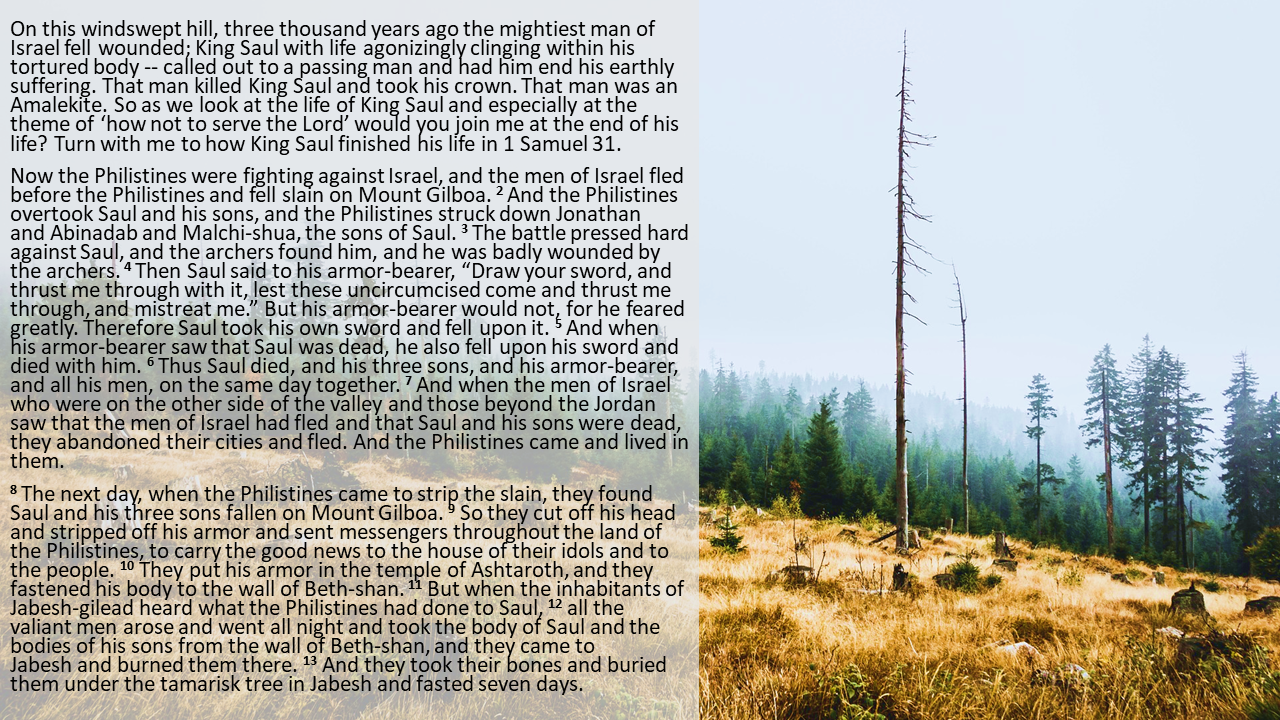
What we’re going to read about is on the wind-swept hill of Mount Gilboa 3,000 years ago, the mightiest man of Israel fell wounded. King Saul, with his life agonizingly clinging within his tortured body, called out to a passing man and had him end his earthly suffering. That man killed King Saul and took his crown, and that man was an Amalekite. Isn’t it fascinating that the people that Saul was supposed to utterly destroy at the beginning of his kingship, that one of those that he spared was the one that did him in after he tried to commit suicide, and so miserably failed? Isn’t it amazing the way God put the Bible together to show us that if we don’t do what God asks us to do, it’s going to come around? And we should not be deceived, God’s not mocked, what we sow. He didn’t extinguish and exterminate and get rid of the Amalekites. That we’ll reap what we sowed, and he was killed by an Amalekite. Amazing.
Let’s read about that, 1 Samuel 31, and I’d like to read the whole chapter together with you. Let’s stand up and you follow along with me please, and let’s listen to the tragic ending of this man that God asked to serve Him. Now the Philistines fought against Israel; and the men of Israel fled from before the Philistines, and fell slain on Mount Gilboa. Then the Philistines followed hard after Saul and his sons. And the Philistines killed Jonathan, Abinadab, and Malchishua, Saul’s sons. Our sin often harms those near us. Did you ever think about that? Saul’s sons got killed because they were with their dad who was under God’s judgment, and God’s going to wipe him out, and they were there in the proximity. Our sins often harm those close around us. Verse 3, the battle became more fierce against Saul. And the archers hit him, and he was severely wounded by the archers. Then Saul said to his armorbearer, draw your sword, thrust me through with it, lest these uncircumcised men come and thrust me through and abuse me. But his armorbearer would not, for he was greatly afraid. Paralyzed. Therefore Saul took a sword and fell on it. And when his armorbearer saw that he was dead, he also fell on his sword, and died with him. So Saul, and his three sons, and armorbearer, and all his men died together that same day.
And when the men of Israel who were on the other side of the valley, and those who were on the other side of the Jordan, saw that the men of Israel had fled and that Saul and his sons were dead, they forsook the cities and fled; and the Philistines came and dwelt in them. So, Saul accomplished the utter overthrow of most of Israel by his own sin and by his own fall because the Philistines just came in and occupied because everybody ran away scared. So, he not only harmed those near him, he harmed everybody else by his sin. Verse 8, so it happened the next day, when the Philistines came to strip the slain, that they found Saul and his three sons fallen on Mount Gilboa. And they cut off his head and stripped off his armor, and sent word throughout the land of the Philistines, to proclaim it in the temple of their idols and among the people. Then they put his armor in the temple of the Ashtoreths, and they fastened his body to the wall of Beth She’an. That’s a very significant statement we’ll look at later. Verse 11, now when the inhabitants of Jabesh Gilead heard what the Philistines had done to Saul, all the valiant men arose and traveled all night, and took the body of Saul and the bodies of his sons from the wall of Beth She’an; and they came to Jabesh and burned them there. Then they took their bones and buried them under the tamarisk tree at Jabesh, and fasted seven days. And of course, in 2 Samuel 1 is the story about the Amalekite, but we won’t read that tonight.
Let’s bow together for a word of prayer. Father, I pray that we would learn in this little time we have how important it is that we serve You in life, and that we finish the course and that we end well. And we know that we have a very great blessing because You have promised that You are able to keep us from falling, and You are able to present us faultless before Your presence with exceeding great joy because You’re the only wise God and to You alone belong glory, and majesty, and dominion, and power. But as the Apostle Paul translated that into everyday life, he said, I beat under my body lest I should get disqualified. We can not finish well. We can fail if we do not deal with our flesh. If we don’t fear that which can destroy all the good that You have done in and through us, by letting that flesh loose, growing, and defiling and despoiling our lives. So, I pray we learn a lesson from King Saul and from the promises of Your Word and make choices that we don’t want to serve You the way he did. We want to serve You and finish well. Teach us that tonight. In the name of Jesus we pray, amen.
.jpg)
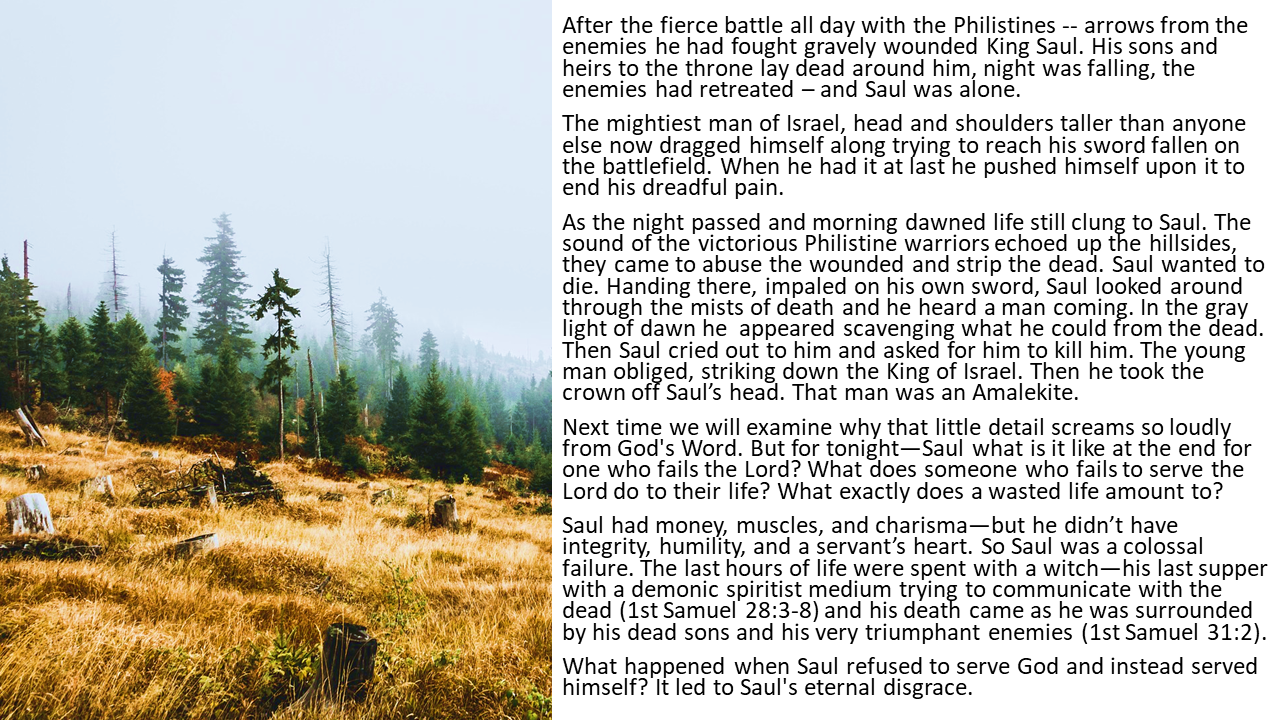
You may be seated. As you’re seated, after the fierce battle all day with the Philistines in this chapter that we just read, the thirty-first chapter, with the arrows from the enemy flying all around, Saul was gravely wounded, is what the text tells us. And his sons, the heirs to the throne, were dead around him, and night was falling. The enemies had retreated, and Saul was all alone, and that’s when this discourse with his armorbearer took place. The mightiest man of Israel, head and shoulders taller than anyone else, was now dragging himself along, trying to reach his sword, trying to get to his sword, fallen somewhere on the battlefield. When he had last had it, he pushed himself upon it. Seeking to end his dreadful pain as the night passed and the morning dawned. Life still was clinging to Saul. That’s what 2 Samuel 1 tells us. The sound of the victorious Philistine warriors echoed up the hillsides. They were coming to abuse the wounded and to strip the dead. That’s what Saul so greatly feared. That’s why he had tried to get his armorbearer to kill him. That’s why he fell on his sword. He didn’t want to face them. Saul wanted to die, and hanging there impaled on his own sword, Saul looked around through the midst of death and heard someone coming. In the gray light of dawn, he appeared scavenging what he could from the dead. So, as that man got closer, Saul cried out to him and asked for him if he would end Saul’s life. The young man obliged, the young man struck down the king of Israel and then he took the crown off Saul’s head, and that man was Amalekite. The significance of what happened at the end of Saul’s life is so big that we can’t cover it tonight.
I still want to look at his life, not at his death, but that little detail that an Amalekite killed him just screams from the Bible. It screams a warning to us so loudly from God’s Word, but for tonight, Saul tells us what it’s like to end our lives not having served the Lord, the bitterness that comes of that. Saul tells us what it’s like at the end of life for one who has failed the Lord, someone who fails to serve the Lord with their life, someone who wastes their life as he did. Saul had money. If you know anything about the earlier stories, when God chose him, Saul had money. He was from a very prosperous family in Benjamin. He had muscles. It said that he was a mighty man. He was one of those that the others would’ve longed to have had his brawn and muscles. He had charisma. He was one who could move people to do things, great exploits. He had it all. He had money, and muscles, and charisma, but what he didn’t have was integrity, humility, and a servant’s heart. And you can have it all as far as in the physical side, but if you don’t have the vital ingredients on the spiritual side, then like Saul, you’ll be a colossal failure because the flesh doesn’t accomplish anything that pleases God. The flesh displeases God; the flesh is set contrary to Him. So, Saul was a colossal failure the last hours of his life.
If you want to turn back to chapter 28 for a moment and just look at it. His last hours of 1 Samuel 28 were spent with a demonic spiritist medium, a witch trying to communicate with the dead. That’s verses 3 through 8 of chapter 28. That was his last supper. I always think it’s significant where the last supper of Saul was. It was at the table of a witch, of an enemy of God, of an occultic, demonic tool of Satan. That was where his last supper was. It’s amazing where little choices we make earlier in life lead us at the end. And then in chapter 31, as we saw, he was surrounded by his dead sons and his very triumphant enemies as he died. So, what happened when Saul refused to serve God and instead served himself?
Look at verse 4 of chapter 31 right there of 1 Samuel because there are some interesting insights we can make about the tragic end of someone who doesn’t serve the Lord. And before we look at what Saul’s life teaches us, I want you just to think about his ending. Look at the ending as a lesson because when Saul refused to serve God and instead served himself, it led to incredible levels of disgrace. It isn’t just himself that he impacted. See, our lives don’t just merely revolve around ourselves. There are others in orbit around us. And so, the acts of one individual can affect a marriage and a family, and can affect a community, and can affect a ministry and a church, and affect even a national level of testimony depending on how well known the person is. We all affect others, and so Saul affected others.
.jpg)
Saul’s death, first of all, was a personal disgrace. Verse 4 reminds us of that. While certain cultures in the ancient world viewed suicide as a noble thing, like the harikari, and the noble death of the warrior, and the other things that still permeate some cultures we have today. God’s people have always regarded suicide as dishonorable and wrong. And so, when Saul decided to die by his own hand, as verse 4 says, he chose the lowest way out, he made the lowest choice he could make. Saul’s death was a personal disgrace to him.
Look at verse 6 because Saul’s death was also a family disgrace. Verse 6 reminds us when Saul died, he took his whole house with him. The royal father and three sons, including the popular and noble Jonathan, were killed in the same battlefield. While the death of the king was tragic, the simultaneous loss of all the heirs to the throne was nothing less than disastrous for the nation of Israel. So, it was a family disgrace. He wiped out his family by his ignominious choices. Verse 7 tells us that Saul’s death was also a national disgrace. All his life, Saul had defended Israel from enemy assault. Now he laid dead at the hands of his enemies, and as verse 7 tells us, his death signaled a Philistine advance that was unequal in history and unparalleled in scope. Never had the Philistines overrun Israel like they did at his death. So, his bad choice to not serve the Lord was a personal disgrace, and a family disgrace, and a national disgrace.
.jpg)
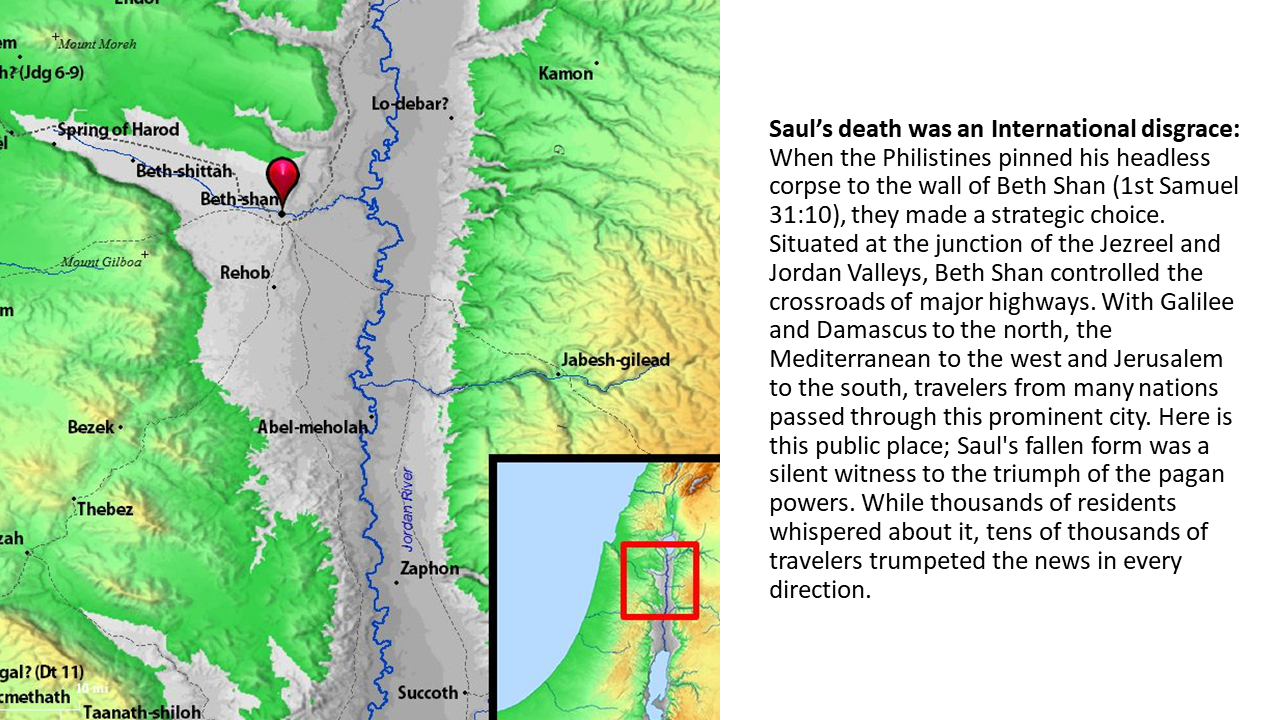
But verse 10 tells us it became an international disgrace. A lot of us, we just read the words; we don’t see the bigger picture. And so, for just a moment, I want you to step back and think what happened. And I said, remember I said that they pinned up his body on the wall of a city called Beth She’an? That city’s still there today. In fact, it’s the most excavated city in all of Israel. It’s the largest archeological area, an arena, of Israel. Today, they call it the Disneyland of Israel. Let me tell you about this city because when the Philistines pinned the headless corpse of King Saul to the wall of this city in verse 10, they made a very strategic choice. Why is that? Because of the proximity of the city to the rest of the world. The ancient world revolved around these great roads. Roads stretched from China and India all the way across the trackless deserts, and would come down across the, what’s called Fertile Crescent. And they came down around the Sea of Galilee because they followed the Jordan Rift, and they came to the crossroads of the ancient world back then. And right in the center of the crossroads between the way of the kings and the way of the sea was this city that’s in verse 10, Beth She’an. Situated at the junction of the Jezreel and Jordan Valleys, Beth She’an controlled the crossroads of two major highways with Galilee and Damascus to the north, with the Mediterranean to the west, and Jerusalem to the south, and Egypt beyond that. Travelers from many nations would pass through this prominent city. In fact, one of the temples there that we go and stand at I show the people because it’s the best way to see the Roman world without ever going anywhere. But in Israel there are 50- and 60-foot-tall columns. It is just, they’re fallen down, but if you can just imagine how massive the entrance to the city was, these huge temples. That’s in the Roman times, but there was obviously a large temple there from the time of the Philistines. And there, as people passed through this prominent city in this public place, Saul’s fallen form was a silent witness that the pagan powers had triumphed. They had triumphed over this religious, theocratic, God-worshiping people that had picked a king to lead them, and the pagan powers and their evil gods had triumphed over this man who represented the true and living God, while thousands of residents whispered about it. Tens of thousands of travelers trumpeted the news of what had happened in the ignominious end of Saul. Everywhere they went, because his body, his headless corpse, was up on the walls at the crossroads showing who had won.
.jpg)
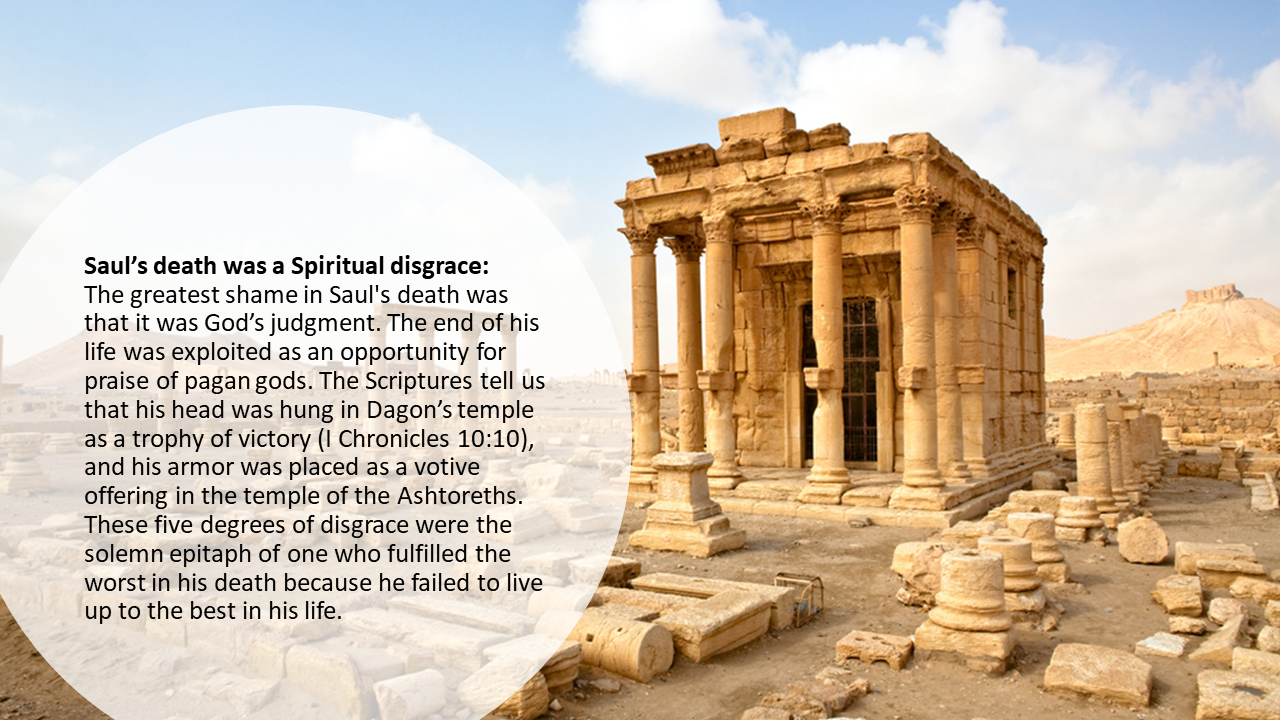
There’s one last level of disgrace, a personal disgrace, a family disgrace, a national disgrace, and an international disgrace, but the worst one is what 1 Chronicles tells us. And you know what God says about this? He said this was a tragic spiritual disgrace. The greatest shame of Saul’s death was that it was God’s judgment. He had to be killed by God. David, we don’t even know that David was ever even wounded in battle. We know that God never lost a single one of his troops in the conquest of Canaan under Joshua. There were no casualties except when the children of Israel were disobedient in the conquest of Ai because of Achan’s sin. There was never a casualty in the army when God was leading it. That’s an amazing, no casualties! They just won, and they just overcame their enemies. But this was God’s judgment. The end of Saul’s life was exploited as an opportunity for praise to pagan gods. You notice it says in the text we read that they told it, they announced his death in their temples. Why was that? Because they were announcing that their gods, the Ashtoreths, that the false gods of the pagans of those Philistines had triumphed. The Scriptures tell us his head was hung in Dagon’s Temple as a trophy of victory. That’s 1 Chronicles 10:10. His armor was placed as a votive offering in the temple of the Ashtoreths. Those vile gods of these pagan people and these levels of disgrace were the solemn epitaph of one who would not serve God. Now, Saul is a monumental figure, but he is an example to us, and as Paul said in 1 Corinthians 10, these are examples to us lest we also fall. Let no man thinketh that he stands, and when you do think that, take heed lest you fall. A sober warning. The epitaph of Saul is one who failed the worst in his death because he failed to live up to the best in his life. Life really does come down to servanthood. Life is measured by who we present ourselves as servants to obey.
.jpg)
For just a moment, look at Romans 6 with me because Paul effectively communicates this in Romans chapter 6, talking about the end of those who decide who is going to be their master and to whom they’re going to present themselves. I want to start in verse 12 and just read down lightly through this because we could go for a long time. There’s so many significant events, especially starting in the eleventh verse. The first imperative in the book of Romans comes in the eleventh verse, but we’re starting in the twelfth verse. But I think it’s amazing that the Apostle Paul starts making commands based on everything he said about salvation in chapter 5. Verse 11 of chapter 6 starts in the imperative mode, and it continues. But look at verse 12, therefore, of Romans 6 and verse 12, do not let sin reign in your mortal body. He’s saying, say no to sin. By the way, that is something we have the opportunity to do, and we have the responsibility to do, and we do not just pray that the Lord will deliver us. We have to say no to sin. We do not conquer sin, and flesh, and lust in our life by just prayer, memorize a few more verses and pray. It has to be an act of the will, a conscious saying no to sin. He says in verse 12, therefore do not—you have to make a choice—do not let sin reign in your mortal body, that you should obey in its lusts. Verse 13, and do not present your members as instruments of unrighteousness to sin. Stop the pattern. Stop the continuous yielding up of yourself. But here’s the positive. Verse 13, present yourselves to God as being alive from the dead, your members as instruments of righteousness to God. For sin shall not have dominion over you, for you are not under the law but under grace. Deny your old master. You don’t have to succumb to that anymore. And so, we can be slaves to God. That’s what this is all about.
What then? Shall we sin because we’re not under law but under grace? Certainly not! Verse 16, do you not know that to whom you present yourselves slaves to obey, you are that one’s slaves whom you obey, whether sin leading to death, or obedience leading to righteousness? We’re supposed to enlist with God as His servants and just say, I want to present, verse 16, myself to You. Verse 17, but God be thanked though you were the slaves of sin, yet you obeyed from the heart that form of doctrine to which you were delivered. And having been set free, verse 18, from sin, you became slaves—bondservants—of righteousness. See that’s, who are we going to serve? Are we going to serve God as a bondslave to Him and as a bondslave to righteousness? Are we going to serve ourself and our former passions? That’s the choice laid before us. Verse 19, I speak in human terms because of the weakness of your flesh. For just as you presented your members as slaves of uncleanness, and of lawlessness leading to more lawlessness, so now present—that’s the fifth imperative in a row—your members as slaves of righteousness for holiness. So, an imperative means a response is required and demanded of us, and so our response is that life really comes down to servanthood. Who we present ourselves as servants to obey, as Paul says in Romans 6, is going to determine what the outcome of our life and what is going to endure.
.jpg)
Now, back up to Matthew chapter 6 because Jesus says the same thing, Matthew 6. As we back up toward 1 Samuel, go to Matthew 6, first book of the New Testament, sixth chapter, Sermon on the Mount. This is what Jesus says in Matthew 6 and verse 20. His context is not the yielding of our members to pleasure, but the whole idea of what we’re going to live for. Are we going to live for the moment? Are we going to live for treasures? Are we going to live for this Earth? Are we going to live for Him? Verse 20 of Matthew 6, but lay up for yourselves treasures in Heaven. Live for eternity! Live for the Lord. Don’t live for the here and now. Where neither moth or rust corrupts, where thieves do not break in and steal. For where your treasure is, your heart will be. Verse 22, the lamp of the body is the eye. If therefore your eye is good—if you’re focused on what you’re supposed to—your whole body will be full of light. But if, verse 23, but if your eye is bad—if you’re not focusing on what you’re supposed to and on the Lord—your whole body will be full of darkness. If therefore the light that is in you is darkness, how great is that darkness! And Saul is an example. Now here’s the key. Verse 24, no one can serve two masters; for either he will hate the one and love the other, or else he will be loyal to the one and despise the other. You cannot serve God and this world, or mammon, or the all the material things and pleasures and pursuits of this life, the lusts of this world. Verse 25, therefore I say to you, don’t worry about your life, what you eat, what you drink; or about your body, what you put on. Is not life more than food and the body more than clothing? That’s why James says in the first epistle to the first church in Jerusalem, he says, a double-minded man is unstable in all his ways. Jesus said, you can’t have two masters. You can’t say, I’ll on Sunday serve the Lord and the rest of the week I’ll serve myself. Or I’ll serve the Lord in these areas; I’ll be selective like Saul was, and the rest of these areas I’ll serve what I want. A double-minded person is unstable. Jesus says you can’t serve two masters.
.jpg)
Let’s go back to 1 Samuel now, and let’s go to the fifteenth chapter, 1 Samuel 15, where we were this morning, and I want to continue with the life of Saul because there’s so many, many lessons here, verse 9. How did Saul fall so far? We saw his ending. We saw the ignominious attempted suicide, the lingering life, and then the death at the hand of an Amalekite. How did he fall so far to have a national, and in international, and a family disgrace, and a personal disgrace, and be disgraceful to God? How did he fall so far? It starts in verse 9, where we saw this morning with his selective obedience.
I remember reading the news reports, I think it was from Wisconsin, about Jeffrey Dahmer. Do you remember that cannibal serial killer who killed, and dismembered, and put in his freezer the bodies of people that he murdered? Do you know when they examined his life and started peeling back the layers? He started out with little things. Little things. He was addicted to violent gaming, and he was addicted to pornography, and then he got violent pornography, and then he got violent everything, and then he started doing all that. But it started out so small. But little choices have very great consequences. But Saul, verse 9, and the people spared Agag. Saul used selective, self-serving obedience in place of total and God-honoring obedience; and selective and self-serving obedience is not obedience at all. God-honoring obedience is what? Is a true obedience.
.jpg)
Now, I want to go back through this chapter and note with you more examples we saw in verses 1 through 7 that if you want to fail in life and not serve God. Verses 1 through 7, I have written in my Bible ignore clear and direct statements about what God wants you to do. My, one of my heroes I talk about often is C. T. Studd, and C. T. Studd had a simple Bible study method. He had a Bible, and he had one of those pencils that was blue at one end and red at the other. You’ve probably seen those in the old days. They used to have these pencils colored blue and red. I remember I used to have an old teacher that always kept one in his pocket and he’d pull it out, and the red was for correcting papers, and the blue was for putting the smileys on when you did well. And I remember that. C. T. Studd had one of those kind of pencils, and he went through his entire Bible and would read it, and he would put down a blue check by everything that was a clear and direct response that God desired from us of obedience, and he would put a check by all those in his Bible. And then his devotional time was a prayerful, looking at all those clear statements of God. And when he came to the point that he was willing to say, God, that’s what I want to do and be, he put another check by it. And that confirmatory check, he put the red check to see what God wanted and the blue check to say, yes, that’s what I’m going to do. That’s a very simple way of Bible study, but it’s very, very servant oriented. I want to serve what You say. Your wish, God, is my command. So, if you don’t want to serve God, and if you want to fail and waste your life, ignore clear and direct statements.
Number two, we saw in verse 8, pick and choose what God clearly tells you to do so that you offer God selective, impartial obedience, and that’s what he does. And then in verse 9, hold onto the best and nicest parts of what God hates and wants you to destroy in your life, and keep them to serve you. And that’s what Romans 6 is all about. It’s that selective saying I’m going to not do any of the big sins, but there’s a few little ones that they’ve become good friends in my life. And those are the things that are our undoing because that selective saying no to sin comes back because we underestimate the power of our enemy. And if you want to fail, hold on to the best and nicest parts of what God hates and has asked you to destroy and keep them for your own use.
We ended this morning at the end of verse 9. Everything despised and worthless, utterly destroyed. Only give to God what you don’t want anyway and what’s worthless. That’s a sure way to fail in life. Give Him your worst time. Give Him when you don’t have any, when you’re dead tired, just give that to God. When you’re totally, just at the end of yourself, give that time to God instead of your clearest time, instead of your best time, instead of your most focused time. And that’s why so often it’s hard to get something out of the Word.
.jpg)
But look now at verse 12; I want to show you another one. Because it says in verse 12, another element of how we can fail to serve the Lord. And that fifth element is honor yourself before others and remind people of your accomplishments instead of honoring the Lord. When you get the platform, start getting in the limelight, start talking about everything about yourself. That’s what Saul did. Look what it says in verse 12, when Samuel rose early in the morning to meet Saul, it was told him. See, the other people knew what Saul was doing. They said, Saul went to Carmel, and indeed, he set up a monument for himself. That’s just such a sad verse. Saul was actually proud of what he did with Agag, and God was grieved. Saul thought he was great, and God saw through that and saw the disobedience.
Jesus’ harshest criticisms were for the proud religious leaders. A woman taken in adultery, Jesus said, I don’t condemn you. A religious person that had stuffed shirts of pride for their accomplishments, Christ excoriated them. In fact, His most pointed denunciations are in the Scriptures in Matthew 23, and this is what Jesus said. Jesus spoke to the multitudes and to His disciples, and He said, the scribes and Pharisees sit in Moses’ seat. Therefore whatever they tell you to observe, that observe and do, but do not be doing according to their works; for they say, and do not do. He said, watch out for them. They’re hypocrites. Don’t be like them. They brag about themselves, but they’re nothing. They don’t do that. And then He goes on and on, and Jesus’ harshest criticisms were for those who honored themselves before others.
There’s a common denominator among the greatest people recorded in the Bible. When Daniel got hauled in before the king and it was said to him that he wanted, the king wanted Daniel to tell him his dream, but he couldn’t remember what his dream was. The others had said there’s no human being on Earth that can do that, but Daniel could. But when Daniel got in front of the king, you know what he said? He said, it’s not me, king. It’s the Lord that’s going to reveal this. Daniel could have gone with the flow because he did have the God-given ability, and he could have claimed the credit for himself. No, God would’ve disciplined him for that and would not have blessed him, but he could have done that. We do have choices whether we’re going to use what God does in our life for our own benefit or for God’s glory, and Saul honored himself before others. He reminded people of his accomplishments instead of honoring the Lord. If you want to fail in life, if you want to really waste your life for what God made you to do, honor yourself in front of others and remind people of your accomplishments instead of honoring the Lord. That’s what he did.
Look at verse 13. Here’s another element that’s so tragic in his life. Then Samuel went to Saul, and he said to him. Saul said to him, blessed are you of the LORD! I have performed the commandment of the LORD. Here’s the next way to really be a failure: be deceptive about the true condition of your spiritual life by making false claims about your dedication to the Lord. That can happen in songs! Remember I said this morning, no perjury? Did you know we can sing, all to Jesus I surrender, all to Him I freely give, but yet, in the back of our mind we say, no, I can’t do that. I can’t do that. I can’t do that. I can’t do that, yet we give the appearance of total dedication. That’s all we have here. All Saul’s doing is just doing the party line. He said, blessed are you of the LORD. You’re a great leader, Samuel, and I’ve done just what God wanted me to do. But a lot of our friends don’t have Samuel’s gift of knowing exactly what’s going on in our life. And so, it just goes right by, and no one but the Lord and ourselves know that there’s deception going on. If you really want to fail and you want to waste your life, just be deceptive about the true condition of your spiritual life by making false claims about your dedication to God. You know what would really help is having someone in your life that asks you hard questions that you honestly answer. That’s really the step to spiritual growth. That’s what the Church is supposed to have. We are supposed to be iron that sharpens one another. We are supposed to be those who speak the truth in love to one another.
I know some people think they have the gift of criticism. There’s some people that can criticize everything. That’s not what I’m talking about. I’m not talking about criticism. That’s not a gift. That’s a fault and a sin. I am talking about those who speak the truth in love, that address spiritual deficiencies in our life with a Scripture, and with love, and with humility, considering themselves, as Galatians says, lest they also be at fault and will come alongside and say, watch out! I can see it looks like a pattern in your life, and the Scriptures say this, and in my own life, that’s something that I’m very much aware and I don’t want to happen. And I pray that you heed, and that’s an admonition from the Lord. And Saul wouldn’t take admonitions. He was deceptive. And if you want to fail, be deceptive about your true spiritual condition and make false claims about your dedication to the Lord.
.jpg)
Look at verse 15, just the first part. Here’s another way to be sure that you’re going to fail and not amount to anything for God: blame others for your personal failures. Blame others. It says in verse 15 at the beginning, and Saul said, they’ve brought them from the Amalekites; for the people spared the best of the sheep and the oxen. They did it. Who is king, by the way? Who is leading this? Who set up the monument? Who said that they had just followed the will of the Lord? Saul was responsible, but Saul blamed others for his own personal failures. And if you want to fail to be all that God wants you to be, and if you want to waste your life, just blame others for your own personal failures. Just hide behind that screen of blame. Not my fault, it’s their fault. Never confess. Just admit things and blame someone else, and you’ll be a real life wasted.
The end of verse 15 has another one. He said that these people spared the best of the sheep and the oxen—now watch the end of verse 15 of 1 Samuel 15—to sacrifice to the LORD—and as I said this morning, the Western text picks this up so clearly—your God. Three times in this passage he says that. Three times Saul distances himself from God and looks at God in a secondhand way, a detached mode of looking at God. If you want to fail to be all that God wants you to be and waste your life, experience God secondhand only through others and not firsthand and personally. Just experience God through books, through tapes, through television shows, through videos. Experience God through concerts, experience God through singing and through music. Just don’t experience Him personally for yourself. Always use someone else. Never be still and know Him personally, and you’ll waste your life because you’ll only experience God second hand. And I’m not saying that you can’t worship God with music. I’m not saying that you aren’t benefited. I have thousands of books that I consult constantly, but those are all secondary to the primary needing, and knowing, and experiencing, and communing with God Himself in His Word. Saul experienced God secondhand. It wasn’t my God, it wasn’t my Lord, it was yours. And he held God at an arm’s length, and he only experienced Him through others, and he didn’t experience God firsthand, and he didn’t know God personally, and he was a colossal failure.
Look at verse 17. Here’s another element that is just so vivid in the text. This is directly from the Lord, an analysis that God made. And it says in verse 17, so Samuel said, when you were little in your own eyes, were you not head of the tribes of Israel? And did not the LORD anoint you king over Israel? He’s saying, don’t you remember why all this began? Don’t you remember why God picked you? In the past, Saul was a great man. He was a great man. He not only had muscles, and money, and charisma; he was humble. He was a humble man, and even old, wicked Ahab, centuries later, one of the wickedest kings, God blessed him because he humbled himself. God will even bless wicked, horrible things, people, if they will just humble themselves repentantly. You want to know how to really fail? Cultivate an exaggerated view of your own importance. Saul was big in his own eyes, and if you’re big in your own eyes, then you start getting impatient, and you start getting rash, and you start getting pushy, and you start getting proud and start doing all the stuff we’re going to see comes out in his life, as we go through this. So, if you really want to fail, cultivate an exaggerated view of your own importance. Be big in your own eyes. God says, that’s a sure, that is a sure way to fail. Cultivate this proud view of yourself.
Here’s one last one before we go. Look at verse 18. Another way to fail, the tenth one, is do your own thing, even when God’s Word tells you explicitly not to. That’s what we call direct disobedience. Verse 18, now the LORD sent you on a mission, and said, go, and utterly destroy the sinners, the Amalekites, and fight against them until they are consumed. And if you really want to fail, do your own thing, even when God tells you explicitly not to do that. If you really want to fail, directly disobey God because God says, I’m not deceived. What you sow, you’re going to reap. And if you sow the flesh, and if you directly disobey Me, you will from your flesh reap corruption. Now, when we study the Amalekites, it’s going to be an amazing little study in itself. But what I told you earlier, chapter 1 of 2 Samuel says that Saul was slain by the sword of an Amalekite. He reaped what he sowed right here. The LORD said, go, verse 18, utterly destroy the Amalekites. If he would’ve done that, then God would not have rejected him is the lesson of this. God says, I rejected you because you wouldn’t obey Me. Now, we’re not going to talk about what ifs, conditional-ism. What? What if? What? We know what happened, and we know God’s plan. But Saul was given a choice, and he didn’t make it.
You want to really waste your life? Do your own thing, even when God’s Word explicitly tells you not to cultivate an exaggerated view of your own importance, experience God only secondhand through others and not firsthand, and personally blame everyone else for your own failure, and be deceptive about the true condition of your spiritual life by making false claims about your dedication to God. And that’s what Saul did, and Saul was a personal disgrace. The God who called him and gifted him. He chose the low way out. Saul was a family disgrace because those near us are harmed by our sins. He was a national disgrace; it caused the defeat of God’s people. He was an international disgrace. Thousands of people that were coming down that main crossroads looked up and they went, what’s that? What’s that headless corpse up there on the wall of that temple? And they went, oh, that’s the king of the people of the LORD, the great God of Israel. That’s their king. And the people mocked. But most of all, he was a spiritual failure because God told him what to do and he chose not to. And I hope that in our lives that we will, as Paul said, choose to present ourselves as servants of the Lord.
.jpg)
Let’s bow for a word of prayer before we go tonight. Father in Heaven, I thank You for the clarity of Your Word, even when it’s so difficult, even when it’s so grievous. There is a lesson for us, and that is don’t waste our lives by anything less than being Your servants, and that we must, You command us, to present our bodies as Your instruments for righteousness’ sake. And if in any way we haven’t done that, I pray we wouldn’t selectively and partially obey. But tonight, anew and afresh say, I surrender to You, Lord, every part of me. I will hate what You hate. Even though my flesh cries out and longs for that, I will say no to sin because I want to be Your servant. I pray that would be the desire of our hearts as Your servants tonight. In the name of Jesus we pray, amen.
.jpg)
Just before we go, I want to turn to my favorite hymn. I just can’t leave on a note like this. And I, we don’t have to sing it because it’s too late, but it’s, if I remember the numbers, it’s 372. Yep, I know that one by heart. And this hymn book has never been opened. It’s one of those stiff ones. Look at that. How do you like that? Open your hymn books. Okay, 372, and let’s stand, get the blood going. And just before you go, we have two minutes. This is what it’s all about. That’s why I love this hymn. Remember, this is the meditation of Thomas Obadiah Chisholm, the pastor, and this is what he wanted to do, and this just reduces it down to what it’s all about. Let’s just read the first, the third, and the last, and we can do that in two minutes. Okay? Living for Jesus, a life that is true, striving to please Him in all that I do; yielding allegiance, glad-hearted and free, this is the pathway of blessing for me. Third stanza: living for Jesus, wherever I am, doing each duty in His holy name; willing to suffer affliction and loss, deeming each trial a part of my cross. Last stanza, and then we’ll do the chorus, living for Jesus through Earth’s little while, my dearest treasure, the light of His smile; seeking the lost ones He died to redeem, bringing the weary to find rest in Him. And here’s the commitment prayer, and as we read this, make it your prayer from your heart, agree with it in your heart. And don’t perjure yourself tonight; tell the truth to the Lord. O Jesus, Lord and Savior, I give myself to Thee, for Thou, in Thine atonement, didst give Thyself for me; I own no other master, my heart shall be Thy throne; my life I give, henceforth to live, O Christ, for Thee alone. Let’s serve the Lord. God bless you as you go.
NOTES
There is a chorus we often sing, “The greatest thing in all my life—is loving You, knowing You, serving You…”.

Those are precious words, if they are true, and they are. And if the Bible ends with those who know, love and serve the Lord doing so forever—and it does. Then the most important element in our life is that knowing, loving, and serving the Lord!
So we could say the greatest way we could invest our lives and live them well would be serving God.
But then the opposite would also be true. The worst way to live, and the greatest waste of a life would be to live for anything but serving the Lord!
We have been considering the greatest servant in the Bible named David. His life is recorded more completely than any other—so we know more about how he served the Lord than any of Biblical character.
God’s Word often teaches us by mean of contrasts. This morning I’d like you to join me looking at one of the sharpest in the Bible—the comparison of David and Saul. It is also one of the most sobering.
Side by side in God’s Word is the amazing record God left us of the life of David who served God all his days—and the equally amazing record of Saul who didn’t serve God all his days. This proximity of ‘how to serve’ and ‘how not to serve’ is very insightful.
I Samuel 17 is the record of the boy who stood all alone for God and saw the reality of what God can do through a person who is completely His—David had a heart to stand.
1st Samuel 16 is the record of the boy who would grow into the man after God’s own heart—David was a servant who loved and served God. But what happens in the chapter before all that? What precipitated the anointing of David by Samuel?
1st Samuel 15 tells us that David was chosen because of King Saul’s unwillingness to serve the Lord. Remember that this book the Bible is God’s Word—and is also supernaturally engineered by God. The Spirit of God planned every word, every verse, and every chapter of every book. There is no place, person or event that just happened to get included. The lord has master planned this book, engineering it to point to Christ in every way possible.
This morning may I challenge you about how to NOT serve God? That is exactly what we see when we start in 1st Samuel 15. This chapter captures why God picked David, and why God rejected Saul. If you ever want to be sure that you are on God’s Team and stay there—be sure you understand this chapter.
Please stand with me and listen to one of the saddest chapters in the Bible—First Samuel 15.
 Now go back with me through this chapter and note the glaring examples God records for us in ways to fail, waste your life. Here is how not to serve the Lord!
1. Ignore clear and direct statements about what God wants you to do. 1 Samuel 15:1-7 Samuel also said to Saul, “The Lord sent me to anoint you king over His people, over Israel. Now therefore, heed the voice of the words of the Lord. 2 Thus says the Lord of hosts: ‘I will punish Amalek for what he did to Israel, how he ambushed him on the way when he came up from Egypt. 3 Now go and attack Amalek, and utterly destroy all that they have, and do not spare them. But kill both man and woman, infant and nursing child, ox and sheep, camel and donkey.’ ” 4 So Saul gathered the people together and numbered them in Telaim, two hundred thousand foot soldiers and ten thousand men of Judah. 5 And Saul came to a city of Amalek, and lay in wait in the valley. 6 Then Saul said to the Kenites, “Go, depart, get down from among the Amalekites, lest I destroy you with them. For you showed kindness to all the children of Israel when they came up out of Egypt.” So the Kenites departed from among the Amalekites. 7 And Saul attacked the Amalekites, from Havilah all the way to Shur, which is east of Egypt. NKJV
What are some real clear and direct statements from God about what He wants us to do?
- Mark 16:15 And He said to them, “Go into all the world and preach the gospel to every creature. NKJV
- John 15:12 This is My commandment, that you love one another as I have loved you. NKJV
- Romans 12:1-2 I beseech you therefore, brethren, by the mercies of God, that you present your bodies a living sacrifice, holy, acceptable to God, which is your reasonable service. 2 And do not be conformed to this world, but be transformed by the renewing of your mind, that you may prove what is that good and acceptable and perfect will of God. NKJV
If you want to fail what God made you to do and be and waste your life—just ignore clear and direct statements about what God wants you to do.
2. Pick and choose from what God clearly tells you to do so that you offer God selective and partial obedience. 1 Samuel 15:8 He also took Agag king of the Amalekites alive, and utterly destroyed all the people with the edge of the sword. NKJV
Remember that the clearest way to declare that you love the Lord is by obedience.
John 14:21 He who has My commandments and keeps them, it is he who loves Me. And he who loves Me will be loved by My Father, and I will love him and manifest Myself to him.” NKJV
If you want to fail what God made you to do and be and waste your life—just pick and choose from what God clearly tells you to do so that you offer God selective and partial obedience.

3. Hold on to the best and nicest parts of what God hates and has asked for you to destroy, and keep them for your own use. 1 Samuel 15:9a But Saul and the people spared Agag and the best of the sheep, the oxen, the fatlings, the lambs, and all that was good, and were unwilling to utterly destroy them…NKJV
Jesus told us what He thinks of loving what He hates— James 4:4 Adulterers and adulteresses! Do you not know that friendship with the world is enmity with God? Whoever therefore wants to be a friend of the world makes himself an enemy of God. NKJV
If you want to fail what God made you to do and be and waste your life—just Hold on to the best and nicest parts of what God hates and has asked for you to destroy, and keep them for your own use.
4. Only give God what you don’t want anyway and is worthless to you. 1 Samuel 15:9b … But everything despised and worthless, that they utterly destroyed. NKJV
Jesus told us how to live for eternal gain— Matthew 16:24-27 Then Jesus said to His disciples, “If anyone desires to come after Me, let him deny himself, and take up his cross, and follow Me. 25 For whoever desires to save his life will lose it, but whoever loses his life for My sake will find it. 26 For what profit is it to a man if he gains the whole world, and loses his own soul? Or what will a man give in exchange for his soul? 27 For the Son of Man will come in the glory of His Father with His angels, and then He will reward each according to his works. NKJV
God deserves the first, the best, the costliest of our time, treasures, and talents. If you want to fail what God made you to do and be and waste your life—just give God what you don’t want anyway and is worthless to you.
5. Honor yourself before others and remind people of your accomplishments instead of honoring the Lord. 1 Samuel 15:12 So when Samuel rose early in the morning to meet Saul, it was told Samuel, saying, “Saul went to Carmel, and indeed, he set up a monument for himself; and he has gone on around, passed by, and gone down to Gilgal.” NKJV
Jesus’ harshest criticisms were for the proud religious leaders.
Matthew 23:1-12 Then Jesus spoke to the multitudes and to His disciples, 2 saying: “The scribes and the Pharisees sit in Moses’ seat. 3 Therefore whatever they tell you to observe, that observe and do, but do not do according to their works; for they say, and do not do. 4 For they bind heavy burdens, hard to bear, and lay them on men’s shoulders; but they themselves will not move them with one of their fingers. 5 But all their works they do to be seen by men. They make their phylacteries broad and enlarge the borders of their garments. 6 They love the best places at feasts, the best seats in the synagogues, 7 greetings in the marketplaces, and to be called by men, ‘Rabbi, Rabbi.’ 8 But you, do not be called ‘Rabbi’; for One is your Teacher, the Christ, and you are all brethren. 9 Do not call anyone on earth your father; for One is your Father, He who is in heaven. 10 And do not be called teachers; for One is your Teacher, the Christ. 11 But he who is greatest among you shall be your servant. 12 And whoever exalts himself will be humbled, and he who humbles himself will be exalted. NKJV
If you want to fail what God made you to do and be and waste your life—just Honor yourself before others and remind people of your accomplishments instead of honoring the Lord.
6. Be deceptive about the true condition of your spiritual life by making false claims about your dedication to God. 1 Samuel 15:13 Then Samuel went to Saul, and Saul said to him, “Blessed are you of the Lord! I have performed the commandment of the Lord.” NKJV
Jesus honored honesty and condemned hypocrisy. Luke 18:9-14 Also He spoke this parable to some who trusted in themselves that they were righteous, and despised others: 10 “Two men went up to the temple to pray, one a Pharisee and the other a tax collector. 11 The Pharisee stood and prayed thus with himself, ‘God, I thank You that I am not like other men—extortioners, unjust, adulterers, or even as this tax collector. 12 I fast twice a week; I give tithes of all that I possess.’ 13 And the tax collector, standing afar off, would not so much as raise his eyes to heaven, but beat his breast, saying, ‘God, be merciful to me a sinner!’ 14 I tell you, this man went down to his house justified rather than the other; for everyone who exalts himself will be humbled, and he who humbles himself will be exalted.” NKJV
If you want to fail what God made you to do and be and waste your life—just Be deceptive about the true condition of your spiritual life by making false claims about your dedication to God.
7. Blame others for your own personal failures. 1 Samuel 15:15a And Saul said, “They have brought them from the Amalekites; for the people spared the best of the sheep and the oxen…NKJV
If you want to fail what God made you to do and be and waste your life—just Blame others for your own personal failures.

The ominous warning of Saul’s life is that he had everything going for him possible. He was big, strong, blessed, gifted, chosen, empowered, and given every opportunity to serve God. But he didn’t. Saul failed because there were severe deficiencies in his character.
- God doesn’t need brains—He wants character.
- God doesn’t need brawn (huge strong muscles)—He wants integrity.
- God doesn’t need anyone’s wisdom, power, or wealth—He wants obedience.
- God doesn’t need ambitious confidence—He wants humble dependence.
Saul had money, muscles, and charisma—but he didn’t have integrity, humility, and a servant’s heart. So Saul was a colossal failure. Why not look at Saul’s ending as we begin our lesson in How NOT to serve the Lord this morning? Turn with me to 1st Samuel 31. Look at Saul’s end—his last supper with a witch (1st Samuel 28:3-8) and his death surrounded by his dead sons (1st Samuel 31:2).
Slides



Check Out All The Sermons In The Series
You can find all the sermons and short clips from this series, David’s Spiritual Secret here.
Looking To Study The Bible Like Dr. Barnett?
Dr. Barnett has curated an Amazon page with a large collection of resources he uses in his study of God’s Word. You can check it out here.