If the video above is not available, here are two other ways to view:
DYG-18 WFL-31
031012AM
Suffering Affliction: Focusing on Our Master Teacher DYG: Message Eighteen
- Saul had driven him from his country, the Philistines had driven him from their camp, the Amalekites had plundered his city, his wives were taken prisoners, and now, to complete his woe, his own familiar friends, in whom he trusted, whom he had sheltered, and who did eat of his bread, instead of sympathizing with him and offering him any relief, lifted up the heel against him and threatened to stone him.
- It is the duty and interest of all good people, whatever happens, to encourage themselves in God as their Lord and their God, assuring themselves that he can and will bring light out of darkness, peace out of trouble, and good out of evil, to all that love him and are the called according to his purpose, Rom. 8:28. It was David’s practice, and he had the comfort of it, What time I am afraid I will trust in thee. When he was at his wits’ end he was not at his faith’s end.
Transcript
.jpg)
Let’s open to the 30th chapter of 1 Samuel. We’re going to be reading there momentarily, the first six verses. 1 Samuel chapter 30.
.jpg)
As we turn there, there are a few things in life that hurt us as much as problems in the lives of those that we’re close to. People close to us, our family and our friends almost hurt us more than our own personal problems and pains. To see them and to see their trials and their hurts. And for most people, we invest heavily in our family and our friends, and thus our wife, our husband, our children, our close friends have become the precious treasures of our lives. And what God wants to teach us is that when we go through the affliction of suffering with those closest to us, God allows us in those times to test His promises.
So, what happens when we lose someone near us? What happens when a child is swept away lamentably and unexpectedly and tragically, or a marriage ends horribly, or a wife is taken tragically, or a husband is gone unexpectedly, or even friends are ripped out of our lives and we didn’t even sometimes know why. Those become the times of deepest woes. And those afflictions are sometimes the afflictions that we can say overwhelm us like a flood. And those are the sorrows that make our world crash down around us. And those are the problems that plague us so much that we don’t think we can take another wave of affliction.
.jpg)
This morning one of the classic passages, being completely overwhelmed with grief and sorrow and pain is before us. It’s 1 Samuel 30 in the first six verses. And in this passage, we find David losing everything precious to him in life. His family and his friends in one moment are gone. And we learn the secret by the time we get to the 6th verse. A secret that we can lay hold on in our lives. How David, in the midst of his deepest woe and grief, strengthens himself in the Lord. Let’s read about that 1 Samuel 30, the first six verses. Let’s read about that.
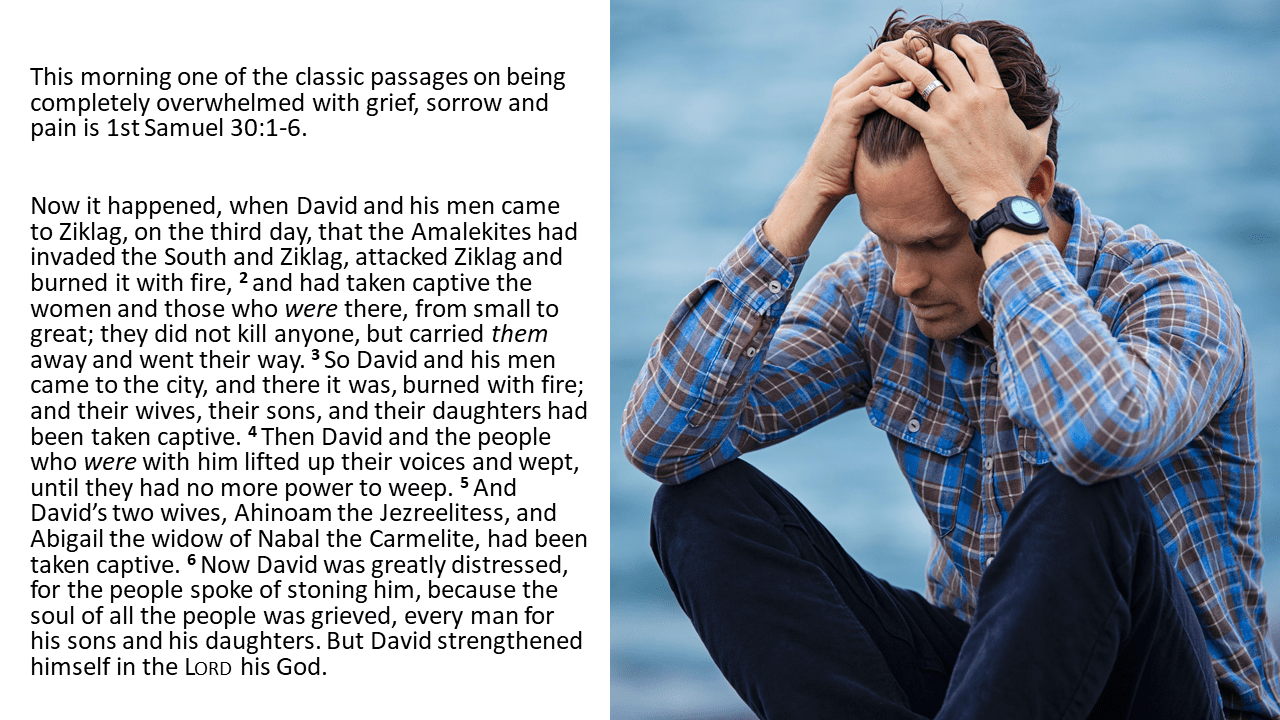
Now, it happened when David and his men came to Ziklag on the third day that the Amalekites had invaded the south and Ziklag, attacked Ziklag, and burned it with fire. So, as they came up over the hilltop, they just saw the smoke and the ruins of their city. First thought, is everyone dead? Is my wife dead? Are my children dead? I already can tell I’ve lost everything on this planet, but are they dead? So, you can just feel the feeling. Verse 2, and had taken captive the women and those who were there from small to great, and they did not kill anyone, but carried them away and went on their way. Now, that’s a nice note. That’s God telling us. But David didn’t know at that moment that no one was dead.
So David, verse 3, and his men came to the city and there it was burned with fire, and their wives and their sons and their daughters had been taken captive. And David and the people who were with him, verse 4, lifted up their voices and wept until they had no more power to weep. Literally, the Hebrew says, no more tears. They cried out everything they had. And David’s two wives, Ahinoam the Jezreelitess, and Abigail the widow of Nabal the Carmelite had been taken captive. Now, David was greatly distressed for the people spoke of stoning him because the soul of all the people was grieved every man for his sons and daughters.
Now, here’s the key. But David strengthened himself in the Lord his God. The answer to affliction is test the promises of God. Reach out to the God who promised I’ll never leave you or forsake you. That I can be more than all you’ll ever need. I am the God who is enough, and to reach out and find that to be true as David did.
.jpg)
Let’s bow before the Lord and ask Him to teach us that. Father in Heaven teach us this morning, more than in a mental way, more than another fact, another truth that we can tuck away in the pages of our Bible. Write upon our hearts the reality that blessing is in affliction and that afflictions produce blessings. And those blessings are, that we can test Your promises. We can lay hold on You, hearing Your voice, feeling Your presence, knowing Your guiding hand more clearly than at any other time in our life when we’re afflicted. And I pray that we would learn lessons from this man after Your own heart who strengthened and encouraged and found what he needed from You and You alone. You are the only true comforter. Teach us how to grab hold of that truth. In the name of Jesus we pray, amen.
I want you to think about what’s going on. We’re looking at the seven times affliction is mentioned in the 119th psalm. We’ll go back there in just a moment. We’re looking at them systematically, and I call them each a blessing. And each blessing of affliction is that God does something in our life. He pushes us closer into His Word. He gets us back on the path. He helps us understand His faithfulness. We’re looking at all these.
The blessing of affliction that we’re going to see this morning is that affliction gives us the opportunity to take the theory and to take the supposed reality that we’ve always heard all of our life, that God is able to comfort and to keep us through times, and we can test that. We actually get to try it out.
.jpg)
This week I was looking at the trial runs of America’s hottest new item in our defense arsenal, as if we need any more. But the FA 22, the Raptor it’s called, and they finally have produced those things, and that’s the newest jet fighter. And it has more engine and more stealth and everything than anything has ever had before. But they rolled the first one out of the top secret production line. And they said this week, it was interesting, they had a workman, an engineer, sitting on a stool inside this $120 million super stealth warplane and his job was to, for the first time, fully engage its huge engines. And they had to tie that thing down. They had a 20 foot deep anchored cement pylon it was on, and they had cables all around that thing. And that guy sat in there and he pulled that throttle back and cut loose those engines and let them just burn at full speed. And I was thinking about that as that thing was just sitting there and it was just rattling and it wanted to take off but it was held down that man was experiencing the power of that cable to hold down that massive war plane. That’s what God wants us to experience in affliction. Everything is just rattling and ready to fall apart. And He says, but I want you to find an anchor for your soul. That’s a blessing. You can test my promises through affliction.
.jpg)
How did David do that? The key, look at the last phrase of verse 6, and I want you to let this get riveted in your mind because I’ve had 84 hours to think about this, okay? And it’s going to be hard to get it into one hour of what I thought. But what David says, look at the end of verse 6. It says, David strengthened himself in the Lord his God. Now, first of all, what’s the background? Think about several things.
.jpg)
The first thing that happened is David was in this position, because Saul had thrown him out of his country. Saul was hounding David, his father-in-law, trying to kill him, and he got driven right out of his country. Number two, the Philistines threw him out of their town. He had found temporary refuge, he probably shouldn’t have gone there, but he found temporary refuge with the Philistines, they had thrown him out. Now, the Amalekites have destroyed his whole possession. On top of that, his own friends these 600 men that he had raised up personally, that he had led, that he had cultured and cultivated and trained in warfare. Now they, in verse 6, are ready to kill him.
So, everything… His country is gone. His city is gone. His own people are forsaking him. He is at the bottom. Very, very hard time. What does he do? The end of verse 6, it says, David strengthened himself in the Lord his God. Now, I don’t know about you but the 21st century world we live in we have more available information than anybody’s ever had in the history of the world. In fact, Sundays New York Times, it’s this big, has more information in one newspaper than an 18th century person could find on the whole plant. There is more information, more separate items of information in that one New York Times than the average 18th century person could ever encounter in their whole life. And that’s one newspaper. We are overloaded with information. And there’s another piece, David strengthened himself.
The question is, how do you do that? How does it go from being an abstract truth out there that we’ve heard, down to a reality in our life. For me, I like to practice, and one of the ways I study the Bible is, and people ask me all the time, what’s your favorite commentary in the Bible? That’s a… especially…, I just spoke at a pastor’s conference last month in Michigan. All the pastors clustered up afterwards and said, what’s your favorite commentary? And I said, my favorite commentary on the Bible is the Bible. And the first thing I do before I go into all the other books, and I have thousands of books, literally thousands of books. Before I go into my thousands of books, I always love to see whether this book has commented on that passage itself, because the reformers called it analogia scriptura, the analogy of the scripture, the way that the Bible explains the Bible.
.jpg)
So, does the Bible explain this? The answer is immensely yes. But one way that the Bible explains David’s strengthening himself is the word that the Holy Spirit used. Remember, we believe in the verbal plenary inspiration of the Bible. Verbal means we believe every word of God was chosen by God. God inspired every word of this book. He breathed out through His Holy Spirit, and so we believe every word is important. What is the word? Look again at the bottom of verse 6 or the last line, David strengthened himself. The people that have counted the words, they’ve numbered, that happens to be word number 2388, for those of you that like to know the details. Do you know where else that word occurs? That would be a fascinating study to know what David did, and I think it applies it well.
.jpg)
Keep your finger here and go over with me to 1 Kings. You’re in 1 Samuel, go the right. 2 Samuel. And the next book is called 1 Kings. 1 Kings chapter 1 and let me show you because the idea of this word means to grab onto and hold onto something. It means to really grab it and hold on. You might say, the old English expression holding on for dear life. That’s really what this word means. Look at 1 Kings 1:50. Here’s a usage of this word that’s very graphic. Now, Adonijah, that was one of the older sons of King David, was afraid of Solomon, that’s the son of promise that God told and instructed him to give the throne to. So, older brother is afraid of younger brother who’s become king, and he arose and went, and here’s the word that we’re looking at. Took hold of the horns of the altar. That’s the word when David was at the bottom of his grief and he strengthened himself in the Lord, the word literally means he laid hold of the Lord. He grabbed onto.
Now here’s the picture, look at this. Adonijah comes and he knows he is going to be executed. He knows he’s done a capital offense, and he runs into the tent of the tabernacle and runs up to the square altar. And there were protruding from the four corners, these little, handles coming out of this thing. They called it the horns of the altar. And he went up and grabbed onto those things and said, I’m going to hold on for dear life, don’t kill me. Now, do you see a picture of what David did when he was struggling?
Now keep going to the second chapter 1 Kings 2:28. It’s another usage of this word. And it says, then news came to Joab, for Joab had defected to Adonijah though he had not defected to Absalom. So, Joab fled to the tabernacle of the Lord. 1 kings 2:28. And there’s our word, and took hold of the horns of the altar. So, when you read in the Bible about someone laying hold of the horns of the altar, that’s the word, it’s the idea of grasping and holding on, listen, for dear life.
Now, think about what you know about the Lord. The Lord says, you’ll seek Me and you’ll find Me when you seek for Me, what? With all your heart. Do you know why David, when he had lost his wives and children and every possession he had on Earth and everybody else around him was ready to kill and murder and do horrible things; do you know why David could, right on that spot with the smoke of everything dear to him rising around him and their ashes all around; do you know why he could look up and strengthen himself in the Lord? Because David is one who reached out and got ahold of the Lord. He didn’t talk about it. He didn’t think about it. He did it. He sought the Lord with all of his heart. And that’s what the Lord says is a secret for finding comfort.
Now, keep going to 2 Kings. You’re in 1 Kings. Keep going to the right all the way through those chapters of 1 Kings and go to 2 Kings, chapter 4. Because those first two guys were bad guys anyway. Joab and Adonijah. So, that’s not a really good, that’s a graphic illustration, it’s not a pretty one. But look at this one, this is a touching illustration. Same word. 2 Kings 4:27. And as I read it, see if you can pick the word out. Okay? You all be doing a little analogia scriptura with me. Now, when she came up. Now, who is this? This is a Shunammite woman. Remember, this is a woman who used to watch Elisha come by. And she’d loved watching him come by, the man of God. And so, she said, man of God, I want to build a room for you up on my house so that you have a place to stay. And so, she did that. And then he was staying there and he says, hey, can I help you? She said, yeah, you can help me. My husband and I have never been able to have children. Could you pray for us? And so, he prayed and God bless them and they had a child. Can you imagine how special that little boy was? That was their son of promise and their son of blessing from the Lord. And so, this little boy was just the center of their lives. And one day that little boy was out in the field watching his dad and all of a sudden got sick, faint, and died. Okay. That’s the setting for this 27th verse.
So, this woman knows that there’s one person that can rescue her son from death, and she sends for him and finds out where he is and goes rushing up. And now verse 27. And when she came to the man of God at the hill. Now here comes the word, she caught him. You catch that same word as laying hold on the horns of the altar. She catches him. And I’ll tell you what she was pleading for the life of her son. Now, is that a picture of seeking the Lord or not? She took hold of him by the feet and Gehazi came near to push her away, but the man of God said, let her alone, her souls in deep distress. And the Lord is hidden from me and hasn’t told me. And then you know the good news he does. He goes in and raise the boy from the dead, but can you feel the páthos, the emotion, the feeling of this woman as she seeks out for Elisha.
And finally, she finds him and she will want nothing less than his personal intervention. And she grabs him by the feet and says; I’m not going to let go of you until you help me. Now, that’s the type of seeking God wants from us when we go into affliction. Not maybe, maybe the Lord will help me out. I don’t know. But I’m going to make it myself. No, no, no. Grab the horns of the altar. Grab the feet of the prophet.
.jpg)
Now, just for interesting… keep going to the right and I’m going to throw this in, go to Nehemiah. It goes 1 and 2 Kings, 1 and 2 Chronicles, Ezra, Nehemiah. This is just fascinating to me, and I’ll just share it only because it’s significant. This word that is used for strengthening or holding on, taking hold, and catching, and grabbing is also most used in the Bible in the book of Nehemiah. And it’s fascinating. It says, look in Nehemiah 3 in verse 4, and I’ll point out where it is. It’s 34 times in a row. In this chapter it says, next to him, this is Nehemiah 3 in verse 4. And next to them, Meremoth the son of Urijah, the son of Koz, and there’s the word, same word; made repairs.
Now, if you know the background to this, here’s the children of Israel and they’ve returned to the land. They’re living in Jerusalem and they’re surrounded by all the enemies of God. And the enemies of God are sniping on them and they’re in a very insecure situation. They’re fearful for their life. And so, Nehemiah says, God has sent me to help you, and we’re going to build this wall. And I’ll tell you what, they, with their whole heart started moving those stones up and putting that wall up to protect them from their enemies on the outside.
And 34 times it says, repaired, repaired, repaired, repaired, repaired, repaired. Same word. What it means is you can’t build a wall by just saying, oh, I hope the wall gets built and I hope it goes. And boy, who’s going to do it? What you have to do is, get in there and do it. And those people were sweating and pushing and picking up those giant rocks. You can still see them by the way. Part of Nehemiah’s wall is still in Jerusalem. When you come around Mount Zion and look out the left window of the bus, as you’re rounding that corner right down there, you can still see the courses of… we’re talking about pulpit size rocks. These people really were serious about what they were doing. And so, that means that they really were building with fervor.
In chapter 4. It’s the same word, in verse 16 where they were holding their spear while they were building. In Nehemiah 4:16 it says from that time, that half the servants worked at construction, the other half held their spears. If your enemies were out there ready to attack you, would you kind of lean your weapon up against the wall and be drinking your coffee? No, you’d be holding it and watching, trying to protect the workers. And that’s the idea of a totally in gear, a totally engaged, a wholeheartedness. That’s what you need if you’re going to hold on for dear life to an altar, if you’re going to hold on for pleading for the life of your son like Gehazi didn’t understand with a Shunammite woman, and that’s what you do when you’re building a wall to protect your family, and that’s what you do when you’re hold your weapon.
.jpg)
And that’s, if you turn back to 1 Samuel 30, what David was doing. Now, I want you to think about that. 1 Samuel Chapter 30, verse 6 tells us something. If we’re drowned by sorrow, if we are overwhelmed by grief, then it’s time to reach out and grab hold of the Lord. It’s time for us to grab hold like one, who alone, can save our beloved child or like the horns of the altar. And that’s what the man after God’s own heart did. And that’s how we should respond. In verse 6, but David with his whole heart reached out and grabbed hold of God and said, You’re the only one that can help me. You’re the only one. I’m going to test Your promises. You said that if we seek You, we’d find You. I’m seeking. You said that You would be our refuge. I’m wanting the refuge. You said that You would help us. I’m wanting the help. That’s what God is glorified through, when we with our whole heart seek Him.
So, whenever we feel drowned by sorrow. Whenever we feel overwhelmed by grief, we should be careful because we’re on sacred ground as believers. We are at a place where God’s voice is most clearly heard. It’s a place where God’s presence is most closely felt. And it’s a place where God’s guidance is most powerfully given. That’s what Affliction does.
.jpg)
Now turn to the middle of your Bible to the 119th psalm. 119th psalm. And that’s the promise, the sixth blessing of affliction. Psalm 119:107 says this, I’m afflicted very much. Revive me, oh Lord, according to Your Word. And what we looked at is we’re afflicted. That means we’re physically afflicted. That’s the word that’s used. We’re afflicted very much. We saw the global flood of Noah and the plagues of Moses. And he says, I’m afflicted very much, revive me. Remember that was the same word that God used for when He rescued Rahab. And what he says is, revive me according to Your Word. And that’s, God’s Word is the voice to guide us through life. So, affliction allows us to experientially test God’s promises. How do we do that?
.jpg)
How do we lay, hold on God. The Bible gives us a pattern. And I’d like to complete that. And we’re going to go back to Psalm 71 and you don’t have to turn to any more places. You all, I’ve heard all your pages turning. Go back to Psalm 71 and park there. You won’t leave, okay, the rest of the morning. And for the next few minutes, let me show you how David at the end of his life testifies of testing God’s promises. He says, you remember me in Ziklag when I lost everything? Do you remember me in the ashes of all of my dreams and my family? Do you remember what I did, how I reached out to God? At the end of his life he wrote the 71st psalm and he said, this is how I was revived. This is how I made it through my problems. This is how God came to my rescue.
In verse 1 he said, I tested God’s promises because I fled to the Lord instead of living in confusion. He says, in You I put my trust. I’m fleeing to You. I don’t want to be confused. In verse 2, we saw he tested God’s promise by crying to the Lord when troubles came. He didn’t just go through them alone, he cried out to the Lord. And that’s what verse 2 says. Incline Your ear and save me. Kind of like Peter when he was sinking. He didn’t just sink. He looked at the Lord and said, help! You see, God is glorified to help us.
Third verse, we test God’s promises. And David said, I tested God’s promises by running into God’s refuge. God is offering us, He’s standing at the door with His arms out saying, are you having problems? Come on to Me. Come on to Me. Come on to Me. That’s the idea. And we don’t sometimes. And he says, I want you to. And that’s what verse 3 says. Be my strong refuge to which I may resort continually. God wants us to keep running to Him and finding refuge.
Verse 4, David said, I tested God’s promises by asking for God’s help before becoming bitter. He said, deliver me from these unrighteous people. I don’t want to get embittered and all defiled by that, I want to flee to You and I want You to deliver me. That’s the fourth verse.
.jpg)
And we saw the fifth verse; we test God’s promises by remembering His faithfulness in the past. He says, You are… verse 5… my hope. Hope is something you’re hoping and looking forward, and expecting, and wanting. You don’t quite have it, and you’re looking forward to it. And he says you should hope based on, look at the end of verse 5, You are my trust for my youth. Look at God’s track record. And that’s why, regularly, one of the things we do in our home is we tell the accounts of God’s faithfulness in the past in our lives.
I have told the story of how I am from a troubled home and saw all the unhappiness in my home. I started praying as a little boy. I’ve told my kids so many times that I started praying for your mother long before I ever knew anything about her. I prayed from when I was nine years old on. And I remember when I got to college, I used to walk at night and say, Lord, the only mistake I don’t want to make on my own, and the only decision I don’t want to make without Your help will be the choice of who I marry. And I want Your help and I don’t want to be unhappy. And I’ve told them that story so many times, how I met their mother. And many other things. And that’s what David is saying. Show God’s faithfulness in the past.
In verse 6, he said, I trust and test God’s promises by praising God for having a plan for my life. Verse 6. You are the one who took me out of my mother’s womb. You are the one that knows the plan because You’re the one that made me. In the 7th verse, we test God’s promises by letting our life testify of the Lord. And we saw that. He says, many people look at my life.
Verse 8. We tested God’s promises by praising God so much no time was left for complaints. There are two kinds of people in the world. There are the ones Thomas Hardy called, those that find the manure pile in every meadow. You can be in a 50 acre field and have it full of green grass and flowers and butterflies, and they’ll walk over and they’ll go; look, manure. There’s 50 acres of grass! Manure. They’re the kind of people that all they see is manure piles in every meadow. And he says, I’m not going to be a manure pile person. He says, I’m going to be this; my mouth, verse 8, is so full of Your praise that I don’t have time to be pointing out all the manure piles around me… All the problems and criticizing everything. That’s how he learned to lay hold of God.
Verse 9, David learned he could trust God the end of life. He tested God’s promise by saying, don’t cast me off an old age. He said, when my strength fails, I’m trusting in You to the end. And he poured out his prayers in verse 10 through 12, especially verse 12. Oh God, don’t be far from me. Make haste he says, I’m going to, I’m going to trust in You by prayer as much as I trust in the rescue squad.
.jpg)
Just a couple more and you can go through the rest of the 71st psalm. Look at verse 13. I love this one. David said, I’ve found God faithful. I’ve tested His promises because I learned, and look what it says in verse 14, but I will hope continually and praise You yet more. He says, I’ve learned to never give up. I’m going to hope continually. I’m not going to give up. I’m going to keep hoping in You, no matter how many… verse 13. He talked about the confound, the ones who are adversaries in my life. Let them be covered with reproach. He says, I’ve got all kinds of problems, but I’m never going to give up, I’m not going to quit. He says, I’m going to hope. Verse 14 says, continually. And I’m going to praise you more and more and more. Every time that You deliver me, I’m going to praise You more and more. He says, basically, if we put it in 21st century jargon, I’m going to never give up even when I’m alone, neglected, sick, ignored, rejected, maligned, forgotten by everybody in the world. I’m going to remember You haven’t forgotten me. And remember, you and God make a majority. And so, you don’t have to have anybody else. And that’s the concept of this testing the promises of God.
Verse 15, and I love this one, of Psalm 71. David said I tested God’s promises because I found a way to bring God into the conversation. Now look at the 15th verse. He said, my mouth will tell of Your righteousness and Your salvation. He says, my mouth is going to talk about Your salvation. Let me ask you this, when is the last time you brought God into the conversation? Did you know we’re supposed to do that?
Last week I was standing with my children, our whole family, and I just had the littler ones. And we were down at the dock where the fishing boats were unloading and they were unloading the tuna that they’d gotten 112 miles out, they told us, into the Atlantic. And they were showing us the big tuna tails that they chop off and keep record of, and it was a big time. And I was listening to them. And the one man said, I’ve lived on the boat for 13 years. I said, oh, do you go to church? He says, no. The church is the ocean and I worship God at my boat. And I thought, Hmm. And the kids were looking at that and I thought… he was really one of the crusties, old salts. In fact, there were three of them on that boat. In fact, it was really, I didn’t notice how bad it was, they were so vial that there was just pornography, just all over. But I was showing the kids the tuna tails and I kept having them… I said, line up over here so I can take your picture. And I said, turn around. They wouldn’t turn around. I couldn’t figure out why. And they kept going [no], and it’s because they wouldn’t look at all that trash there. And so, Bonnie went through and threw it all away. And I was thankful for that.
But after we got up to the edge of the boat, I looked at those men and I was thinking in my heart, they don’t know the Lord. And verse 15 says, my mouth should bring up the Lord. And so, I said you ever heard of the perfect storm? Have you ever thought about being 112 miles out into the ocean in a boat with the storms? And I said, are you ready to meet the Lord? And at that moment, it was so precious, my buddies, the little guys wanted to give them tracts. And I opened my wallet and I kept sharing the Gospel and I pulled out three little tracts. And one by one those boys walked up to each of those three crusty fishermen and handed them a Gospel tract. And then daddy stood and explained to Gospel to them. And I thought about that, I thought, we could have talked about the ocean, the water, their pretty boat, and how much their tuna was and what life was like on the boat. But look what verse 15 says, He, God says, that we test God’s promises by finding a way to bring God into the conversation.
Now, why am I saying that? Because we need to practice that. You need to be able to talk about the Lord. If you’re not any good at witnessing, why don’t you just talk about the Lord, what you found in the Bible? When I was a youth pastor, I used to make my high school students. One a time I would say, your turn. Stand up. Tell us what you learned in the Bible. Open the Bible to the last place you read and tell us something you learned. If you talk about glass eyed teenagers, they’d go [blank]. But you know what? After about the fifth time you ask them, finally they started looking for stuff and they got excited and they would stand up and say, this is what I found in God’s Word. Did you know that there are men in leading families that never stand up and bring God into the conversation? They don’t say, I read the Bible. They don’t say, this is what God’s teaching me. And God wants us to do that. He wants us to bring Him into the conversation.
.jpg)
Look at verse 16. We test God’s promises by humbly depending on Him. Verse 16. I can’t do it myself. I can’t bring You up, I’m too afraid. But I will go, look at verse 16, in the strength of the Lord God. That’s how I will make mention of Your righteousness and Yours only. Apart from the Lord’s strength, we do not have hope. We do not have any peace as we’re going through physical problems, we don’t have comfort when we lose everything, and we certainly can’t bring Him into conversations without His strength. And that’s why the 16th verse says, we humbly depend on the Lord. I go in His strength; I make mention of His righteousness. And that’s what we should do. And you know what? If you ask for that, if you just put up your antenna and say Lord, I want to speak for You, He’ll bring you opportunities. It happens. I can testify to that. People will go out of their way to bring up things. That is an opportunity for you to introduce the message of the Lord.
I was paying tolls this week. We drove 4,200 miles. I helped pay for the interstate system, $122 in tolls. You think Oklahoma’s tolls are high? I paid $27 at one stop. It’s just unbelievable. I think they’re soaking the Westerners or something, I don’t know. But here I was parked at the toll booth and it was raining and I opened my window and leaned out. And that man was sizing me up to see how much he could charge me. And he went like this. He went [looked the car over]. And then he started again at the front of the car and he went and he said, I’ll be $12. And I said, okay. And he said, how are you doing? And I said, wonderful. And remember, I was in my wallet getting out the $12 and you know what I hide in my wallet? Tracts. So, I pulled one out, he couldn’t see it.
And at that moment he looked up at me from his toll booth and he said, I’d be wonderful too if life was treating me as well as you. What was that? That was him asking a question, how can you be wonderful? Why are you wonderful? What’s going on in your life? And I said to him… I said, here’s your $12. And I said, and I have a present for you. You know what? Both of his earrings raised right up like that. They have the weirdest people working in the toll booth. But this guy was really hungry and he looked up at me and he leaned out of his toll booth and he said, what’s the present? And I opened up and had one of those… you see them out in the racks, the door and it’s like, have you made an appointment in Heaven?
And I leaned out in the rain, out the toll thing, and I went like this. And I said, see those verses? And he was looking, trying to see them. And I said, you can look those up in the Bible. And then I said, and that tells how someone came and died in your place and paid the price for your sin and you can have a wonderful life too. And he looked at me and he took that tract and he said, thank you. You know what that is. That is just saying, Lord, in Your strength, I don’t know who to talk to but will You open the door for me to speak for You? Will You let me be sensitive to when You do that so I can, look at verse 16, go in Your strength and make mention of Your righteousness all day long. That’s what He left us here to do.
.jpg)
So, what does David say? He said one day I came home and everything that was dear to me on the Earth was burning. My wife was gone. My children were gone. My home was destroyed. My friends were turning against me. And I was at the bottom of life. And I reached out and clung to the Lord for dear life. And I held onto Him like the Shunammite woman held onto Elisha’s feet. And I said, Lord, You are the one who promised to help me. And that’s a blessing of affliction. When we are afflicted, we get to grab onto the Lord. You get to choose to do that this week or not. Go in your own strength, or reach out and grab the Lord. I hope you’ll choose to grab Him. Let’s bow before Him.
.jpg)
Father in Heaven, we thank You for these blessings of affliction. Especially 119:107. I’m afflicted very much, revive me according to Your Word. We believe Your Word. We hear it testified in the life of David as he strengthened himself by grabbing onto You. Help us to grab hold of You this week, this day, this moment, and go in Your strength. And Lord, for any who are here this morning, and I know every week that there are some who come and they come looking and seeking and searching, but they haven’t found. I pray that they would realize that the answer is a person, it’s you Lord Jesus. A substitute. You took their place. And that they would find You as savior, as the one that they can cry out to, as all of us who know You have and say, Lord Jesus, forgive me of my sins. Be merciful to me. Cleanse me. Forgive me. And Lord, then as we turn to You from our sin and to Your salvation we find life. And life everlasting. Anyone who doesn’t know You, I pray that You would draw and tug and convict and quicken in their heart, moving them to salvation. And for us who do? May we say, Lord, according to Your Word revive me. We thank you in the name of Jesus. And for Your glory, amen.
Few things in life hurt as much as problems with those who are close to us in life.
Most people invest most heavily in their family and friends; thus our wife, husband, children, and close friends become the precious treasures of life.
So what happens when we lose them? What happens when a child is swept away lamentably, a marriage ends horribly, a wife is taken tragically, a husband is gone unexpectedly, or friends are ripped from us unknowingly?
Those are times of deepest woes. Those are the afflictions that we can say overwhelm us like a flood. Those are the sorrows that can make our world crash down all around us. Those are the problems that can plague us so that we feel like we cannot make it through another wave of trouble.
This morning one of the classic passages on being completely overwhelmed with grief, sorrow and pain is 1st Samuel 30.1-6
Now for a moment look closely at the 6th verse. If it isn’t marked, underlined, or highlighted – then do it now. This is the essence of God’s recovery program for those who are hurting!
1 Samuel 30:6 Now David was greatly distressed, for the people spoke of stoning him, because the soul of all the people was grieved, every man for his sons and his daughters. But David strengthened himself in the Lord his God.
The key is the last phrase. This idea of “strengthened”. The question we need to ask is how did David do that? What is the key when we are struggling?
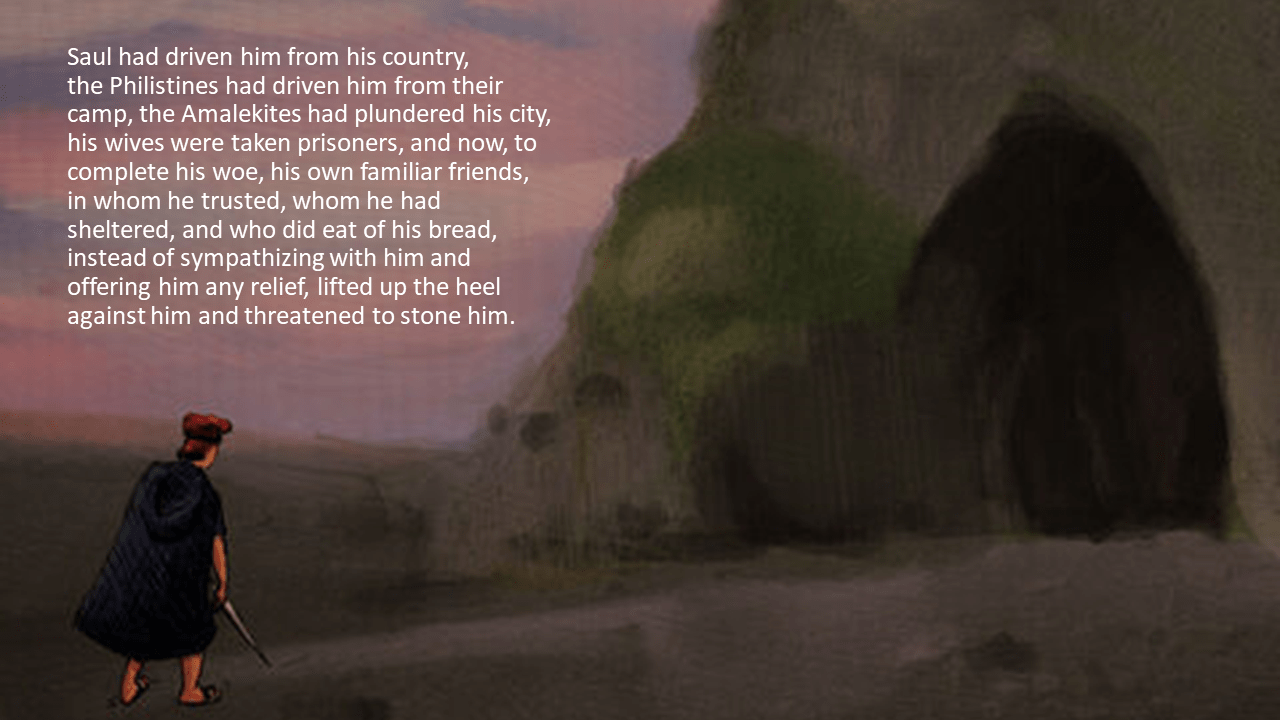
This was a sore trial to the man after God’s own heart, and could not but go very near him. o Saul had driven him from his country, the Philistines had driven him from their camp, the Amalekites had plundered his city, his wives were taken prisoners, and now, to complete his woe, his own familiar friends, in whom he trusted, whom he had sheltered, and who did eat of his bread, instead of sympathizing with him and offering him any relief, lifted up the heel against him and threatened to stone him. o It is the duty and interest of all good people, whatever happens, to encourage themselves in God as their Lord and their God, assuring themselves that he can and will bring light out of darkness, peace out of trouble, and good out of evil, to all that love him and are the called according to his purpose, Rom. 8:28. It was David’s practice, and he had the comfort of it, What time I am afraid I will trust in thee. When he was at his wits’ end he was not at his faith’s end.1
Friend, there are times in our lives when the circumstances will not produce any joy or happiness. There are times when we find ourselves in dark places, like David. We look about, and the situation looks hopeless. What should we do? Be discouraged? Give up? Say we are through? Friend, if we are children of God, we will encourage ourselves in the Lord. We will turn to Him at times like this. Sometimes the Lord puts us in such a spot so we will turn to Him. He wants to make Himself real to us. It was during times like these that David wrote some of his most helpful psalms. When troubles come, you can thumb your way through the Psalms and find where David is encouraging himself in the Lord. Several times he says, “The LORD is good … Let the redeemed of the LORD say so.” David found this to be true.2
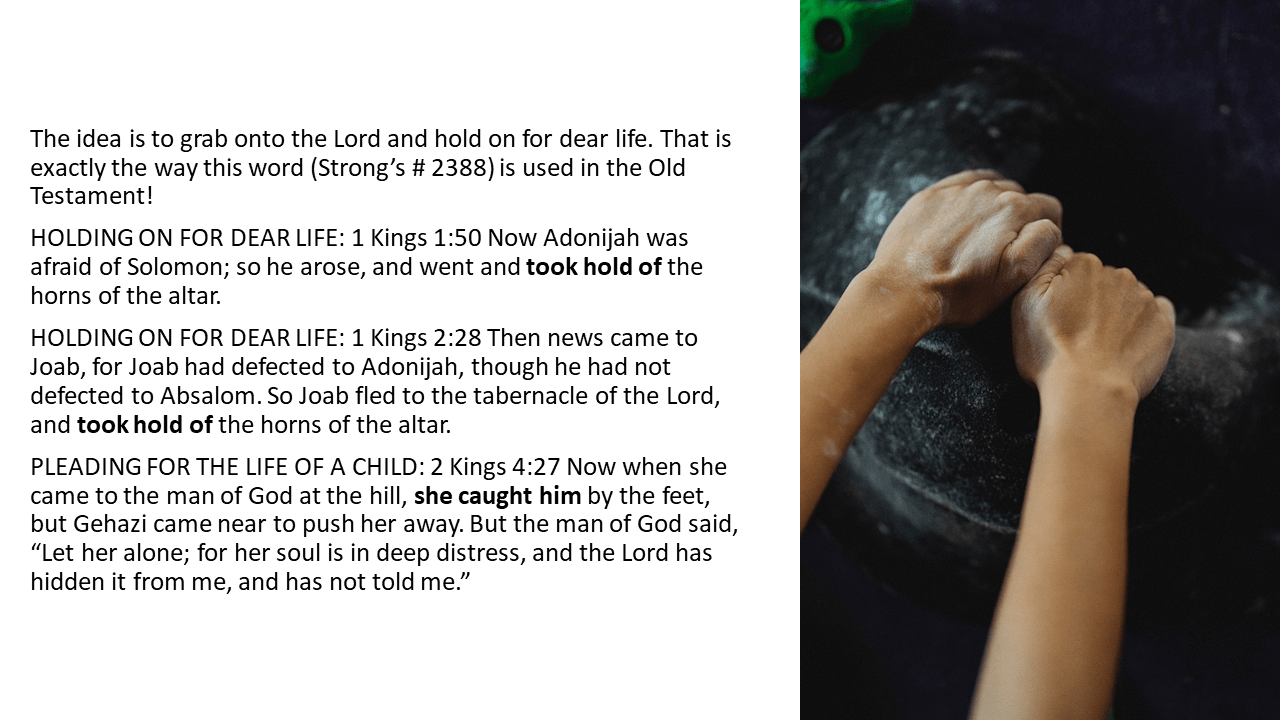
The idea is to grab onto the Lord and hold on for dear life. That is exactly the way this word (Strong’s # 2388) is used in the Old Testament!
o HOLDING ON FOR DEAR LIFE: 1 Kings 1:50 Now Adonijah was afraid of Solomon; so he arose, and went and took hold of the horns of the altar. o HOLDING ON FOR DEAR LIFE: 1 Kings 2:28 Then news came to Joab, for Joab had defected to Adonijah, though he had not defected to Absalom. So Joab fled to the tabernacle of the Lord, and took hold of the horns of the altar. o PLEADING FOR THE LIFE OF A CHILD: 2 Kings 4:27 Now when she came to the man of God at the hill, she caught him by the feet, but Gehazi came near to push her away. But the man of God said, “Let her alone; for her soul is in deep distress, and the Lord has hidden it from me, and has not told me.”
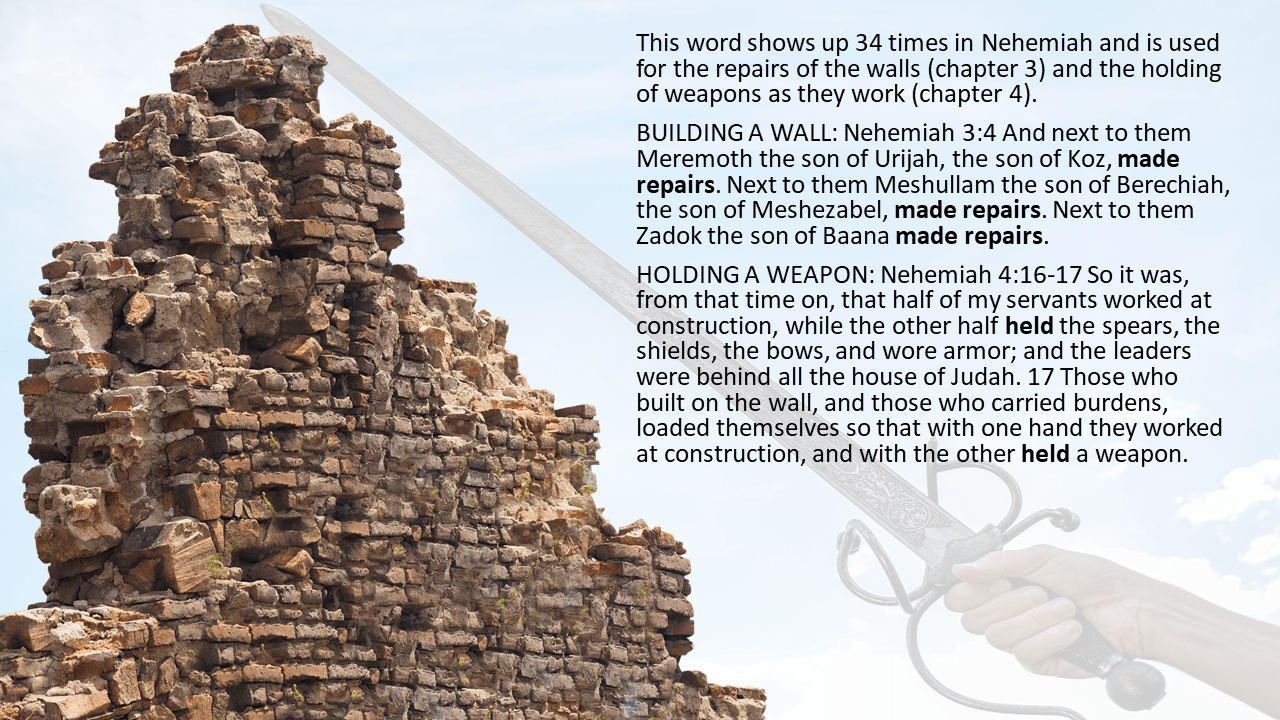
This word shows up 34 times in Nehemiah and is used for the repairs of the walls (chapter 3) and the holding of weapons as they work (chapter 4). o BUILDING A WALL: Nehemiah 3:4 And next to them Meremoth the son of Urijah, the son of Koz, made repairs. Next to them Meshullam the son of Berechiah, the son of Meshezabel, made repairs. Next to them Zadok the son of Baana made repairs. o HOLDING A WEAPON: Nehemiah 4:16-17 So it was, from that time on, that half of my servants worked at construction, while the other half held the spears, the shields, the bows, and wore armor; and the leaders were behind all the house of Judah. 17 Those who built on the wall, and those who carried burdens, loaded themselves so that with one hand they worked at construction, and with the other held a weapon.
Ever feel drowned by sorrow? Ever feel overwhelmed by grief? Then reach out and grab the Lord by faith like you would do if it was the horn of the altar, like it is the feet of the only One who can save your beloved child, or like it was the wall that alone can stand between you and your enemies, or like the only weapon you have to stay alive when attacked. That is the way the man after God’s heart did it – and that is how we should respond!
So whenever we feel drowned by sorrow, whenever we feel overwhelmed by grief — be careful – we are on sacred ground as a believer. o We are at a place when God’s Voice is heard most clearly, o We are at a place where God’s Presence is felt most closely, o We are at a place where God’s Guidance is given most powerfully.
And that is the message of our text this morning. Open with me to the 6th Blessing of Affliction. It is found in Psalm 119.107:
I am afflicted very much; Revive me, O Lord, according to Your word.
The 6th blessing of Affliction is seen in Psalm 119 as: AFFLICTION FORCES US TO TEST HIS PROMISES.
Listen to the expanded message of Psalm 119:107 – o I am afflicted (remember the usage of this Hebrew word # 6031 implies an affliction that affects us in a physical way); o Very3 much (remember this is the same word used to describe the extent of the waters of the Global Flood of Noah and the Ten Plagues of Moses upon Egypt); o Revive4 (remember that this is the same word as the one that describes God’s deliverance of Rahab out from the complete destruction of Jericho) o Me, O Lord, according to YOUR WORD (remember this is that synonym for the Bible that describes God’s Word as the Divine Voice that guides us through life [Strong’s #1697]).
Afflictions allow us to experientially test God’s promises. Affliction is a blessing.
Trials refine us, pain opens our eyes to the realities of life, and sorrow tunes us in to what really matters. And on and on through life it goes. Traumatic and painful experiences actually help us be more aware and apart of the world around us.
This morning we find that when troubles come, and we experience affliction it forces us to test the Promises of God. Remember that this is the 6th point in our discovery in Psalm 119 — of the Seven Blessings of Affliction.
AFFLICTION can be used by God to bless our lives. Have you marked the pathway of His blessing that He has laid out in His Word? Here is what the Lord has told us. Affliction can be a blessing if it — 1. PUSHES US INTO GOD’S WORD: Psalm 119:50 2. PULLS US BACK ONTO HIS PATH: Psalm 119:67 3. CHISELS GOD’S PLAN INTO OUR LIFE: Psalm 119:71 4. TEACHES US THAT GOD IS FAITHFUL: Psalm 119:75 3 The word for “very much” is an adverb. It is the same Hebrew word used of the way the waters of the Flood covering the earth (Genesis 7.18-19) and of the way the plagues covered Egypt (Exodus 9.3 on cattle; Exodus 9.18 the hail; Exodus 10.14 the locusts). Do you feel like troubles are raining down like the Flood of Noah? Do you feel drowned by your pain and problems? Then affliction can force you to test the promises of the Lord who wants to revive you by listening to the Lord’s Voice in His Word – guiding, leading, rescuing, and comforting! Are your life’s pains like the plagues sometimes? Another one coming and you haven’t even recovered from the last one? Then affliction can force you to test the promises of the Lord who wants to revive you by listening to the Lord’s Voice in His Word – guiding, leading, rescuing, and comforting! 4 The word for “revive” is actually ‘save my life’ and is the same Hebrew word as used for the rescue of Rahab from Jericho as the walls crumbled and everyone else was destroyed and she and her family alone were rescued (Joshua 2.13; 6.17, 25). Do you ever feel like you are not going to survive what you are going through? The pain, the hurt, the crumbling of everything you have held onto? Then you feel like Rahab did when the city of Jericho was destroyed – and God rescued her, spared her, revived her as Psalm 119 says. And that is what He allows afflictions to do in our lives (tear things down) so He can allow us to test His promises (revive us, rescue us, spare us)! Then affliction can force you to test the promises of the Lord who wants to revive you by listening to the Lord’s Voice in His Word – guiding, leading, rescuing, and comforting!
5. KEEPS US FOCUSED ON OUR TEACHER: Psalm 119:92 6. FORCES US TO TEST HIS PROMISES: Psalm 119:107 7. BRINGS GOD TO OUR DOORSTEP: Psalm 119:153
Lessons on Ending Well by Making the Right Choices Now from Psalm 71:1-24
1. Test God’s Promises by fleeing to the Lord instead of living in confusion. Psalm 71:1 In thee, O LORD, do I put my trust: let me never be put to confusion. 2. Test God’s Promises by crying to the Lord before giving up to troubles. Psalm 71:2 Deliver me in Your righteousness, and cause me to escape; Incline Your ear to me, and save me. 3. Test God’s Promises by running into God’s Refuge – thus trusting God’s Word more than his fears. Psalm 71:3 Be my strong refuge, To which I may resort continually; You have given the commandment to save me, For You are my rock and my fortress. 4. Test God’s Promises by asking for God’s help before becoming bitter. Psalm 71:4 Deliver me, O my God, out of the hand of the wicked, Out of the hand of the unrighteous and cruel man. 5. Test God’s Promises by remembering His faithfulness. Psalm 71:5 For You are my hope, O Lord God; You are my trust from my youth. 6. Test God’s Promises by praising God for His plan for your life. Psalm 71:6 By You I have been upheld from birth; You are He who took me out of my mother’s womb. My praise shall be continually of You. 7. Test God’s Promises by allowing my life to testify for the Lord. Psalm 71:7 I have become as a wonder to many, But You are my strong refuge. 8. Test God’s Promises by praising God so much — no time was left for complaints. Psalm 71:8 Let my mouth be filled with Your praise And with Your glory all the day. 9. David had learned he could trust God to the end of life. Psalm 71:9 Do not cast me off in the time of old age; Do not forsake me when my strength fails. 10. Test God’s Promises by taking your fears to God in prayer (“do thy friends despise, forsake thee? Take it to the Lord in prayer. In His arms He’ll tend and shield thee – thou shalt find a solace there!) Psalm 71:10 For my enemies speak against me; And those who lie in wait for my life take counsel together, 11 Saying, “God has forsaken him; Pursue and take him, for there is none to deliver him.” 12 O God, do not be far from me; O my God, make haste to help me!” In a modern sense David trusted God as much as in 911!
That’s as far as we got last time. Now the rest of the Psalm:
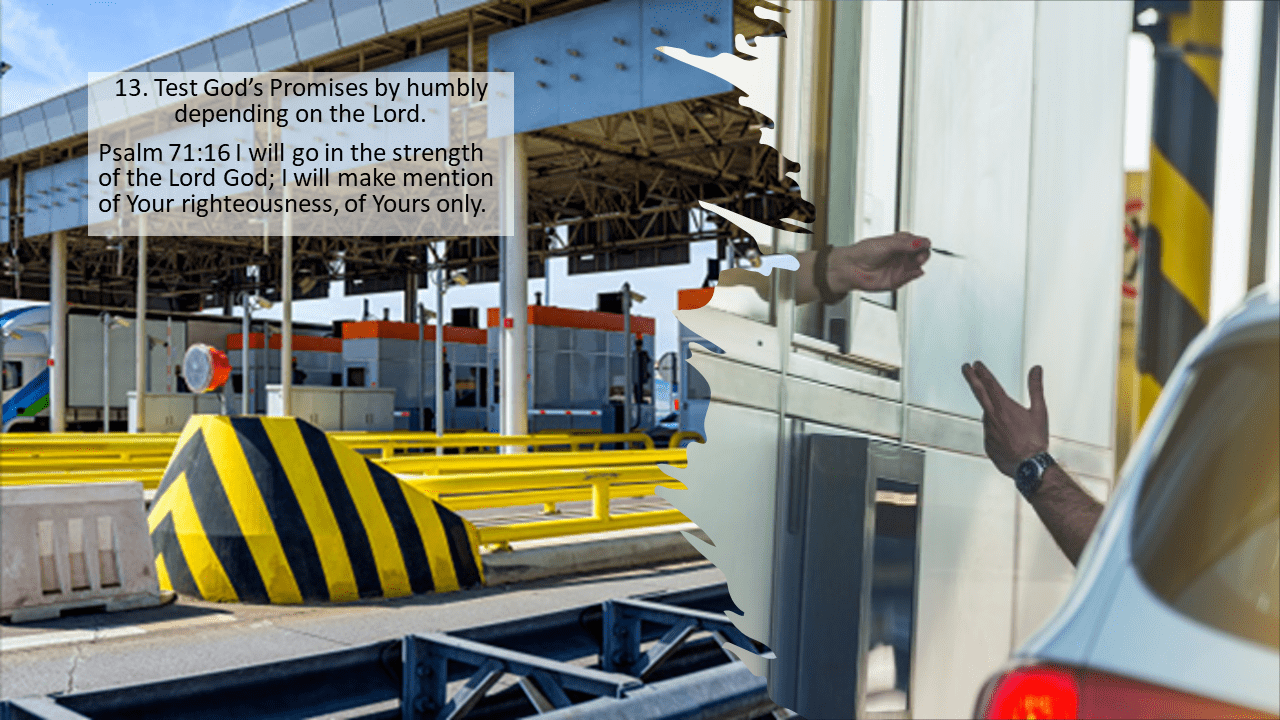
11. Test God’s Promises by learning to never give up – even when alone, neglected, sick, ignored, rejected, maligned, and forgotten by everyone in the world —– EXCEPT GOD! Psalm 71:13 Let them be confounded and consumed Who are adversaries of my life; Let them be covered with reproach and dishonor Who seek my hurt. 14 But I will hope continually, And will praise You yet more and more. 12. Test God’s Promises by finding ways to bring God into the conversation. Psalm 71:15 My mouth shall tell of Your righteousness And Your salvation all the day, For I do not know their limits. (When is the last time you brought up the subject of the things of God – into a conversation?) 13. Test God’s Promises by humbly depending on the Lord. Psalm 71:16 I will go in the strength of the Lord God; I will make mention of Your righteousness, of Yours only. 14. Test God’s Promises by making a life long commitment to the Lord! Psalm 71:17 O God, You have taught me from my youth; And to this day I declare Your wondrous works. 15. Test God’s Promises by serving God even when you get out of season, past your prime, and old and gray – by finding young people to invest your life into. Psalm 71:18 Now also when I am old and gray headed, O God, do not forsake me, Until I declare Your strength to this generation, Your power to everyone who is to come. (Just like Bill Eddy!) 16. Test God’s Promises by seeking to never stop experiencing God daily. Psalm 71:19 Also Your righteousness, O God, is very high, You who have done great things; O God, who is like You? (Just like Howard Smith) 17. Test God’s Promises by seeing affliction as a blessing. Psalm 71:20 You, who have shown me great and severe troubles, Shall revive me again, And bring me up again from the depths of the earth. (Just like Ezra, Job, Joni Erikson Tada, Phillip Yancey, and many sweet saints suffering this morning!) 18. Test God’s Promises by allowing the Lord be in charge of your life. Psalm 71:21 You shall increase my greatness, And comfort me on every side. 19. Test God’s Promises by breaking from the crowd and stay involved in personal worship. Psalm 71:22 Also with the lute I will praise You— And Your faithfulness, O my God! To You I will sing with the harp, O Holy One of Israel. 20. Test God’s Promises by staying enthusiastic for the Lord. Psalm 71:23 My lips shall greatly rejoice when I sing to You, And my soul, which You have redeemed. 21. Test God’s Promises by allowing God invade all of your life. Psalm 71:24 My tongue also shall talk (hagah = meditate) of Your righteousness all the day long; For they are confounded, For they are brought to shame Who seek my hurt
1 Henry, Matthew, Matthew Henry’s Commentary on the Bible, (Peabody, MA: Hendrickson Publishers) 1997.
2 McGee, J. Vernon, Thru the Bible with J. Vernon McGee, (Nashville: Thomas Nelson Publishers) 2000, c1981.