
GHS-11 KGD-03 MMG-27 NR6-40 NR7-33 TAB-23 WWJ-54
040627AM
The Good Heart – Accepts the Word
Mark 4:20
Transcript
Let’s open our Bibles to the fourth chapter of the Gospel by Mark. Fourth chapter of the Gospel by Mark. This morning we’re looking at, continuing to look at, the good heart. We’re looking at one truth and that is, that the good heart accepts the Word. The concept that Jesus is presenting is you can identify those who are the good soil, the good hearts. Those who have received Him, because they’re characterized by accepting the Word. Now the 20th verse, which we’re going to read in just a moment, contains that beautiful line that says, they accept it, that’s the Word, and bear fruit. The Word accepted means to welcome for myself. It’s not just accepting that it’s out there, it’s the idea of welcoming it for myself. So, the good hearts are those who take God’s word, and they don’t just in a general sense acknowledge it’s out there, but they personally accept it for myself and welcome it into their life.
There’s a whole generation that has come up that doesn’t even really know about communism and about how evil and how hard it was. Just for a moment, I want you to think about the power of accepting something into your life because I want to talk about how communism even began. Historically, and if you read the history books, communism rapidly conquered much of the world because of the total dedication of only a few. Now in 1903, a man by the name of Vladimir Lenin began communism with just a handful of followers. Just a few years later, in the year 1917, Lenin toppled the largest nation on Earth, the Soviet USSR/ Russia. With just 40,000 followers. He had gone from a handful in 1903 to 40,000 dedicated followers. And in 1917, he utterly overthrew the largest country on Earth with that handful who had multiplied into 40,000. Communism triumphed. And by the year 1950, communism controlled over 62 percent of all people on this planet. Almost two thirds of all the inhabitants of Earth were under the iron fist of communist rule.
Now, how did… from 1917 to 1950… how did that happen so quickly? Let me just share with you the testimony of one, because communism triumphed largely because of the complete devotion of its followers. Their dedication was typified by an actual letter written by a young communist. This is an actual letter that’s been preserved, that was written by a young man breaking off his engagement with a young lady. And he wrote this letter, and she brought it to her pastor. And that pastor eventually mailed it to Billy Graham, and he read this at a crusade a number of years back, and I want to read it to you. This is what that communist wrote, and this captures the dedication of welcoming into the life and receiving the philosophy of communism. This is what he said.
There is one thing which I am dead earnest about, and that is my communist cause. It is my life, my business, my religion, my hobby, my sweetheart, my wife, my mistress, my bread, and my meat. I work at it in the daytime, I dream of it at night. Its hold on me grows, not lessens. And as time goes on, I cannot carry on a conversation without relating it to this force that drives and guides my life.
Now, this is how he’s going to break up with this girl. He’s saying, I don’t have room anymore in my life for you because of communism.
He said, I evaluate people. I evaluate looks, and ideas, and actions according to how they affect my cause, which is the communist state. And by their attitude toward it, I measure them. I’ve already been in jail because of my ideals. And if necessary, I’m ready to go before a firing squad.
Now, that’s dedication. A man utterly dedicated to a cause. But just step back and think about what I just read to you. A dedication to a cause of communism. Now, without divine help, without God’s grace, without the Spirit’s power, or even Christ’s love, look at how intense humans can be devoted to things. Now, let me ask you, can you imagine what the God of the universe can do with a heart completely devoted in that way to Him? And that’s what Mark 4:20 is, Jesus’ invitation. He’s asking us to welcome and to accept into our lives, His word, as this young communist accepted that philosophy.
If God were to get a hold of our heart and life to the extent that this young communist did, what would it look like? What would we be like if we were totally drawn to deeply devote ourselves to Jesus?
At the same time that Lenin, in 1917, had devoted himself to master all these who were following him, the same year God got a hold of someone else in an equally powerful way. In fact, they wrote their testimony out at the same time the Bolshevik Revolution broke out.
A young man in the United States was gripped in his heart and wrote this testimony, same year, 1917. The words of this hymn were written when the author was unable to finish his career he was studying to do. This man was weak and sickly. He found himself in 1917 unemployed. He was trying to make ends meet, selling things he had door to door. He would go from door to door and knock, and offer what he had for sale, trying to earn enough money to buy food. This hymn was his testimony of how he made it through life when it seemed like everything was going against him. When it seemed like the world was crumbling around him. And he wrote those words in 1917, and what’s amazing to me is that they reflect the same degree of devotion, only prompted by grace and encompassed by the love of Jesus Christ.
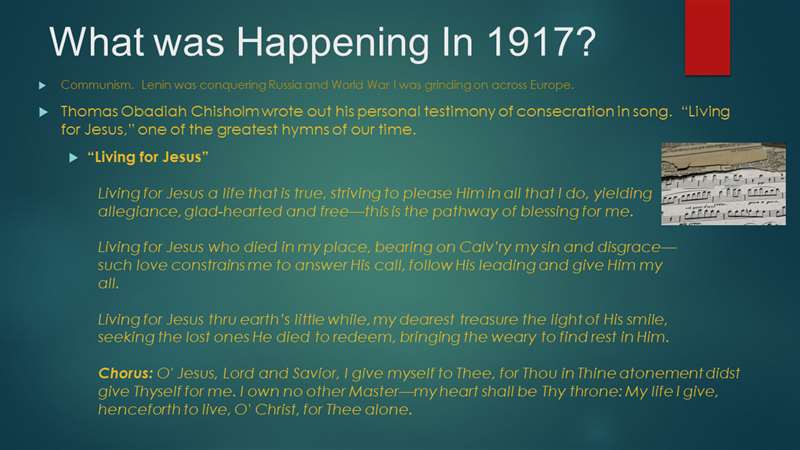
What was happening as he wrote these words in 1917? Lenin was conquering Russia. World War I was grinding on across Europe. There were hundreds of miles of trenches oozing with millions of fighting men in a river of death, gas warfare, and plagues. That’s what the world looked like in 1917. Now, look at the words written in some of the darkest hours of human history. And from those times come one of the greatest hymns of our time. And I’m going to just read these four stanzas.
Living for Jesus, a life that is true. Striving to please Him in all that I do. It parallels the young communist letter to his fiancée. He said, this governs everything I do. This man says, Jesus is the one I strive to please in all that I do. Yielding allegiance. Not under the iron fist of communism, but glad hearted and free. This is the pathway of blessing for me. Stanza 2, Living for Jesus who died in my place. Bearing on Calvary my sin and disgrace. Such love constrains me to answer His call. Follow His leading, and look at this, give Him my all. Third stanza, Living for Jesus through Earth’s little while. Oh, I skipped the third wherever I am. Let me go to the fourth. Living for Jesus through Earth’s little while. My dearest treasure, the light of His smile. Seeking the lost ones He died to redeem. Bringing the weary to find rest in Him.
And then look at the chorus, it’s one of the clearest statements of personal dedication. It’s one of the clearest declarations of personal consecration. In fact, as I read these words, think about, have you ever literally said these words to the Lord. Have you ever literally, from your heart, offered yourself in this way to the Lord? This is a profound statement. O Jesus, Lord and Savior, I give myself to Thee. For Thou in Thine atonement didst give Thyself for me. I own no other master. My heart shall be Thy throne. My life I give henceforth to live, O Christ, for Thee alone.
Now, as you’re thinking of those words, let me ask you a couple questions. Who wrote these words? Was this some great 1st century saint? No. It was an unemployed man who was too weak and sick to do what he had studied his whole life to do. He had to leave full time vocational ministry. He actually had been a pastor, and because of the hard times, the church could no longer support him. Because he was sick, he couldn’t get a laboring job, and so he went door to door. And so, this man who had to leave the ministry and became a door-to-door salesman just to stay alive. What was his name? It’s in the bottom left corner. Thomas O. Chisholm. This man who was born in a log cabin in Franklin, Kentucky, in 1866, never went to high school or advanced training. He only was able to teach in the little one room schoolhouse that he grew up in and was trained in. And that was his first job. He studied intently and became a circuit preaching Methodist minister in the hills of Kentucky. But yet, because of his sickness, and his weak body, and poor health, and limited finances, he was unable to do much.
And while he kept himself alive selling stuff, he would primarily stay indoors reading God’s Word. And from God’s Word he would write poetry that expressed his devotion to Christ. This is one from the darkest time of his life, and this is what came out of him. At age 51, he wrote his personal testimony of consecration in song. This poem was his prayer, a consecration hymn, and through his words, a pathway has been made through which thousands and even millions in the last 87 years have consecrated their lives to Jesus Christ. Living for Jesus was published the same year he wrote it, 1917. And Mr. Chisholm went on to conclude a long and fruitful ministry, dying in 1960.
But let me ask you, how do we cultivate this level of devotion? This level that says, I give myself to Thee. How do we do that? Look at Mark chapter 4 and verse 20, because the way we develop this level of dedication to Christ is what Jesus calls in our text this morning, accepting the Word. Accepting the Word, welcoming it into our hearts and lives as His Word, and His way, and we make it our own. Let’s listen to Jesus as He speaks to us. Mark 4 and verse 20. Listen to Jesus as He speaks.
But those are the ones sown on good ground who hear the Word, accept it, and bear fruit. Some thirtyfold, some sixty, and some a hundred.
Emphasis right in the middle of the verse, accept. Paradechomai is the Greek word. From the Greek dictionary, literally it means, welcome for themself. I wonder, have you welcomed God’s Word for yourself? Let’s ask Him to help us to do that as we bow in prayer.
Father in Heaven teach us that good hearts accept Your word. Let us listen to Your voice as we follow You through scripture, as we see what those who welcome Your word look like and perhaps a new and afresh, we give ourselves in complete, welcome to your Word. Submission to Your mastery of our lives anew and a fresh today, or maybe for the very first time. But Lord, I pray at the end of this moment that we share together this morning, that we would be living for Jesus, a life that is true. In which we strive to please You in all that we do. In which we are yielding our allegiance to You, glad hearted and free. Thank you, O Lord. Open our eyes, stir our wills, let us choose You today. In the name of Jesus we ask, Amen.
Jesus wants to have all of you and me. And I’m going to be taking you to six scriptures successively. Each one where Jesus describes what someone looks like that accepts His word and in each of these there’s a single theme that Mr. Chisholm picked up in his hymn. You see, this man while he was sick, and weak, and everything else spent his time sitting at a table reading the scriptures, finding the calls of Christ to His children, His disciples, and then working them into this hymn. But in the Gospels, we can trace Christ’s call to commitment. He states that we can’t be His disciples, we can’t be His learners, His followers, unless we are those who are accepting His word into our lives.
Now, what do I mean by that? Look at the first passage which is in the book of Luke, so that’s the next one to the right, chapter 14. Turn with me to Luke 14. I’m going to show you what I mean. Unless we evidence the characteristics of accepting the Word, the first statement of this is in Luke 14 and verse 26. There are six different times Jesus clearly, from His own lips, declares what those who have accepted Him into their lives look like. It’s like He’s amplifying on this little parable that He had given about the good ground accepts the Word. When He amplified it, what did He say?
Here’s the first one in Luke 14:26. He said, If anyone comes to Me and does not hate his father and mother, wife and children, brothers and sisters, yes, and his own life also, he can’t be My disciple. Now, what is He saying there? I thought, beloved we are to know who are believers by the, what? Love we have for one another. But He says, no. It’s known by hating. Now, is this a paradox? Is this a contradiction? Is this, what is this? No, what He’s talking about is the degree of love. Look what He says. If anyone comes to Me and doesn’t hate his father, mother, and wife and children, brothers, and his own life also, and that gives the key. He says the degree of love. The comparison, hate essentially has to do with the comparison of loves. Simply put, our love for God is to be so great that in comparison to our love, even for the dearest on Earth, it looks like we hate them compared to our utter consuming devotion to Christ.
So, what’s the lesson? First of all, it’s this. Hearts open completely in love for Christ. It’s what it means to accept His Word. It means we must love Him most. Now, we can love many things in life, but there’s to be no doubt who you and I love the most. And it can’t be ourself, and it can’t be our children, and it can’t be our wonderful wife or wonderful husband, and it can’t be anybody else that we love most.
Now, what did Jesus say? Some verses for you to think about. Matthew 22. You shall love the Lord your God with all your heart, with all your soul, with all your mind. That’s a complete love. Love the Lord with all your heart, all your soul, all your might. Love the Lord with all you have. Love Him all the time, as the little chorus goes. Jesus said, I want to have all of you. I want your heart open completely in love for Me. I want you to love Me most. And we love Him in the good times and the bad times, because we’re constantly confronted with pressure to buckle, to give in, to love maybe our career, or maybe pleasure, to love security, or to love comfort, convenience.
Those, by the way, are the temptations the older you get. The three temptations that plague America’s successful older people is a lust for comfort, convenience, and security. And sometimes our comfort, convenience, and security precludes an utter love for Christ, because there are places we won’t go because we’re not comfortable. Places we won’t go because we’re not secure. Places we won’t go because it’s not convenient. That the one who we are to love supremely is calling us to go. And we are constantly confronted in this culture to love Jesus, but not most. And Jesus said, if you’re accepting, welcoming Me into your life, I have to be the one you love supremely.
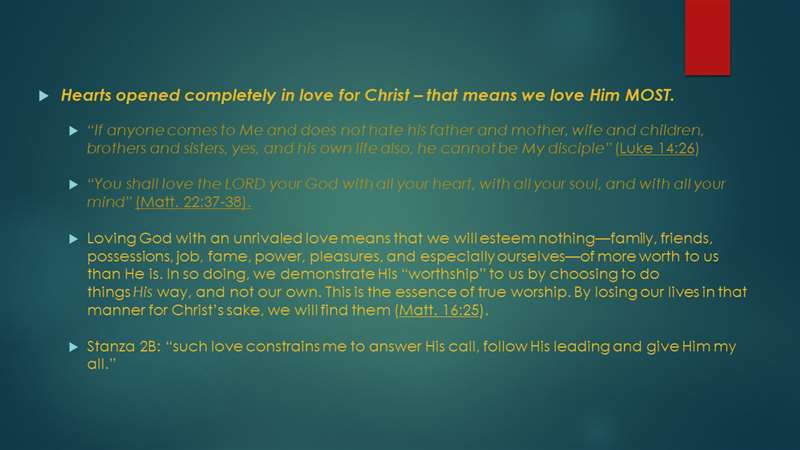
Now, what does loving God with an unrivaled supreme love mean? It means that we will esteem nothing, family, friends, possession, job, fame, power, pleasure, and especially ourselves, of more worth than He is. He will be supreme. How do you measure that? Does anything rob the time that Jesus deserves? Then, you love that more than Him. Does anything cause you to hunger more after that than after Him? Then that is something that you love more. And so, that’s why we are to constantly be having a new beginning. We’re supposed to be confessing and turning from and repenting from anything that takes His place.
Such love constrains me. See, Chisholm was thinking through in his life, what does it mean to love Christ completely? What does it mean to open my heart completely? He said it, such love constrains me to answer His call. What was His call? Love the Lord your God with all of your heart. To answer His call, to follow His leading, and give Him my all. My all what? All my desire? All my attention? All my hopes, my dreams. You see, the Early Church and the great saints through the centuries were those that were consumed with one thing, pleasing God. They measured everything by would it please the Lord or not? I wonder, can you say in consecration to of the Lord, I love You so much, it constrains me to answer Your call. To love You most. I want to follow Your leading. I want to give You my all. The disciples were constantly confronted with this and what did they say? Lord, help us to have more faith. Help us to understand that. See, we’re the same.
It’s not like you get one big lightning bolt that forever gets you exactly lined up. You can’t have one tuning. Our piano at home keeps, my piano players tell me it keeps slowly moving out of tune. Did you know that’s a picture of what our spiritual lives are like? We are slowly getting out of tune with the Lord. And it’s not like you can get really ratcheted up one time at some meeting, or at some conference, or at some camp, and it just gets you for life. It is a constant recalibrating your heart and your life back to the right orientation. And what we’re supposed to do is have our heart open completely, in love, to Christ. And we’re supposed to say with Chisolm’s second line, such love constrains me to answer Your call, to keep following Your leading, to give You my all. Loving the Lord, demonstrates He is worthy. We choose to do things His way, not our own. This is the essence of true worship.
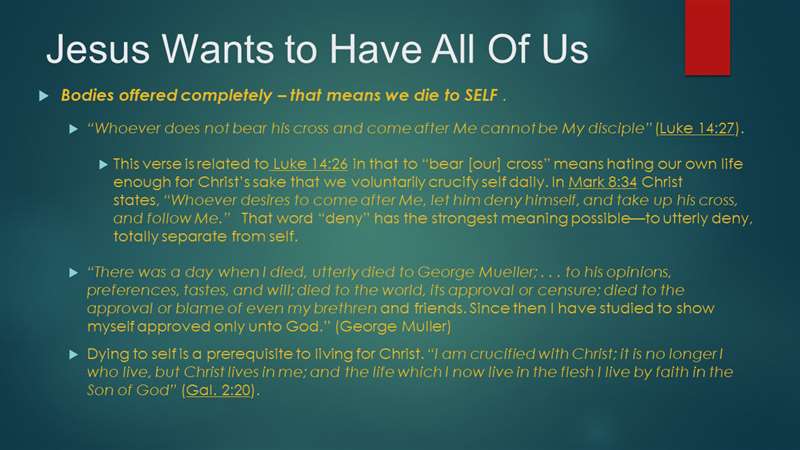
Now, look at verse 27 of Luke 14. There’s a second element that I’m going to point out to you in this hymn, but I want you to see it in the very words of Jesus. Jesus says in Luke 14, in verse 27, and whoever does not bear his cross, and come after Me, cannot be My disciple. Now the first time He said, if you don’t have a love for Me that makes everything else look like hatred you can’t be My disciple. Now, He adds this line to it. Now, this is Jesus speaking. He’s telling this in a call to follow Him, and in utter devotion. And what He says is, if you don’t bear your cross, bearing our cross means hating our own life enough for Christ’s sake, we voluntarily crucify ourselves daily.
In fact, Jesus says this back in the Gospel of Mark, Chapter 8, Verse 34. He says, whoever desires to come after Me, let him deny himself, and take up his cross and follow Me. What does that mean? I believe it means we have bodies that are offered completely to Him. Crucifiction, crucified a body to a cross, a tree. It was a body that was put out of commission. It was no longer free to do what it could formerly do. That was the idea. Now, the body, of course, was containing the life, the spirit, the personality, everything else. But all that’s tied to the body.
And so, what Jesus is saying is, I want your body offered completely to me. I want you to die to your own self running the show. Most of us, we like to control things. We like to control our environment. We like to control the comfort level around us. We like to control the wider sphere of circumstances. And we like to control in ever widening circles. We like control. Jesus said, surrender the control. Give up. I want you to yield to Me. I want you to bear your cross. I want you to die to yourself. I want you to offer your body completely to Me. Taking up our cross, He says, is to deny ourself. That idea of taking up our cross, as it says in Mark 8, denying our self, is the strongest meaning possibly. It means to utterly deny and totally separate from self-rule of our life. Self-sufficiency, autonomy, doing things my way. Taking up our cross by denying our self is an imperative.
It’s impossible, Jesus said, to serve two masters. Now, keep your finger here in Luke, but look back at Matthew 6. Jesus could say so much in so few words. Matthew 6 in verse 24. Look what Jesus said so clearly. He just explains things completely. Verse 24. He says, no one can serve two masters. You can’t serve yourself and Me. You can’t serve your career and Me. You can’t serve your pleasure and Me. You cannot serve two masters. You can’t have two masters, for either you will hate the one and love the other, or else you will be loyal to the one, verse 24 of Matthew 6 says, and despise the other. You cannot serve God and mammon, money, the world, what we live for.
By the way, money is just distilled power. It buys you the power to do things, to possess things, to go places, to have things. It’s distillation of time into a commodity that you can have your own way with it. That’s what money’s all about. And He says, you can’t serve God and money. It’s interesting, that in Matthew 6:24 Jesus was saying, there’s two choices, there’s two masters. Either you have your own master, or you let Me master you. You can’t have both.
Now, let me share with you what one person said, one of those whose lives I’ve read dearly all my life, George Mueller, the great orphanage man of Bristol, England. He wrote this and that describes this body offered completely. He said in his journal, there was a day when I died. I utterly died to George Mueller. I died to his opinions, to his preferences, to his tastes, and to his will. I died to the world, its approval or censure. I died to the approval or blame of even my brethren and friends. Since then, I have been continually studying to show myself approved only to God. Now that’s what Jesus is talking about.
Go back to Luke 14:27. He says it in Luke 14:27. If you won’t bear your cross, you’re carrying around the cross all day long. That means I’m constantly remembering that I am crucified with Christ, and yet I’m still alive.
Does that remind you of Paul? Galatians 2:20, carrying around our cross? He said, unless you bear your cross and come after me. So, we are not stationary up on some hill somewhere crucified. We are in a state of crucifixion. That means our bodies completely offered to him, dying to our selfish ways and desires. And we live then for Christ in spite of the cost of death to self, whatever personal suffering that may bring. A dedicated disciple follows Jesus with their body offered completely.
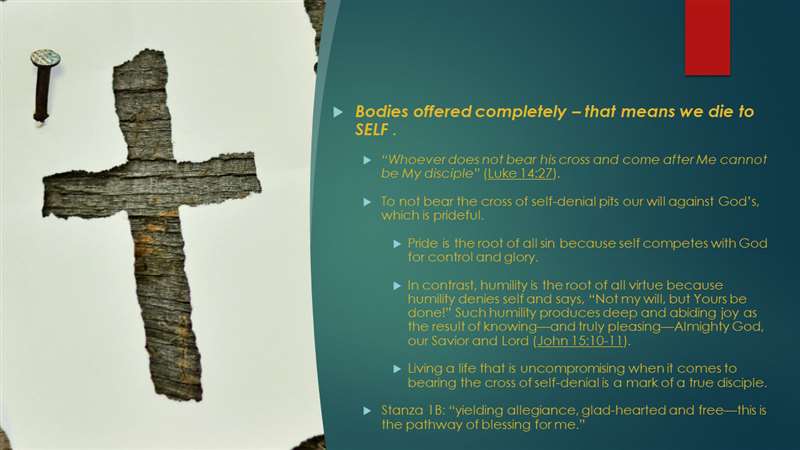
To not bear the cross of self-denial pits our will against God’s. Because He said, either you will love the one and hate the other, you despise one and cling to the other. He said, if my will is not crucified, if I am not consciously saying, not my will but Thine be done, I want Your way, I am crucified with You. If I’m not consciously doing that. Then my will is pitting itself against God’s will to see who will rule that day. Pride is the root of all sin because self competes with God for control and glory.
That’s what’s going on all the way through life with us. Our pride, we want our way, when we humble ourself, we are going His way. We are crucified. We are humbling ourselves. We are dying to ourselves. Such humility produces a deep and abiding joy because we know that we’re truly pleasing Almighty God and we are pleasing our Savior and Lord and we are living a life that is uncompromising to the world, to the flesh, to the devil because we want His will and not ours to be done.
How did old Chisholm put that? It’s the second half of the first stanza. Look what he says the first stanza on the second line down, Yielding allegiance, glad hearted and free, This is the pathway of blessing for me. He says this is how I have it, this is what I do, This is how I offer my body completely, This is how I open my heart to love Jesus the most.
I yield my allegiance glad hearted and free. I say, it is no longer I who live, but Christ who lives in me. It’s the life which I live in the flesh. I live by faith in the Son of God, that He can run life better than I can. That He knows my path and the way that I take, and I will trust in Him with all my heart. I won’t lean my own way, and I’ll let Him direct my path and show me the way. See, all the scriptures converge on this one point. Either it’s the Lord leading our life or it’s me. And if I lead my life, then it’ll be much like how I learned to drive.
I remember my dear dad, he let me practice driving up and down our little country road we lived on. And so often I would sit there, and I would look right in front of the car. And because I was looking in front of the car, I would not notice that we were slowly getting off. And I’d get in all the ruts, and I would get off into the ditch and I’d have to jerk it back. And what was so neat was those times that. My dad would reach over the wheel, he knew how to right the car. And if I would just do, he’d say look down the road, John. Don’t look right at the little thing on the end of the hood, the little insignia there. Look down the road, you’ll stay straight, and you’ll see the stuff coming.
You know the Lord says to us, He says, let Me. It’s better than having dad help you. He says, I’ll actually drive for you, the Lord says. I want you to surrender the wheel to Me. That’s what it means to yield allegiance, glad hearted and free. That’s what it means to bear our cross, to come after Him, and to be His disciple.
Is your heart completely open to love for Jesus Christ? Do you love Him more than everything else? Is your will crucified and yielded in allegiance to Him, so that your body will be healed? Goes His way and accomplishes his Purpose?
Here’s another one. Look at verse 33 of chapter 14 of Luke. Jesus had three right in a row. Luke 14:33 is another word from Christ, and this is what he says, Whoever of you, by the way, it just gets worse. This was a heavy-duty servant Jesus was preaching here. Luke 14:33, whoever of you does not forsake all that he has cannot be my disciple. Wow. Did you see the three heavy duty verses, back-to-back, 26. You can’t be My disciple unless your total devotion makes your love for Me make everything else seem like hatred.
Secondly, you can’t come to me unless you die to yourself. And finally, in verse 33, you cannot be my learner, my disciple. You cannot be my follower unless. You forsake all that you have.
By the way, we all have to do this sometime. You can’t take it with you, right? We can’t take our stuff with us. We’re going to forsake it either at death or at a point of consecration. If you forsake it only at death, it all is lost. But if, prior to death, you forsake the ownership of all in your life and transfer that ownership to a sacred trust, Now everybody in America, we’re doing this for tax purposes, you put it into the trust and shield it so that the taxes and the estate taxes and lawsuits or whatever can’t get it.
God says I have a better deal for you, if you entrust all that you have to me. If you forsake it, that means you walk away from it you give it to Me and you walk away from it and say, it’s no longer mine, but Yours. Your time, your life, your goals, it’s all Yours. I forsake it into Your hands. I totally turn it into a blind trust. It’s totally Yours. I’m not going to run this thing. You are. If we do that, He says, then You’re my disciple.
Why would we do that? We’ll look at 1 Corinthians 6, so go to the right. Because Paul was always explaining the concepts of Christ to the Early Church. How they can grasp into these huge levels of devotion to Christ. And this is what the Apostle Paul says to the Corinthians in chapter 6 in verse 19. He says, What? Do you not know that your body is the temple of the Holy Spirit? He is in you. You have from God, and you are not your own. Look at this, you were bought, verse 20, with a price. God says, I bought all of you. So, in other words, the Lord does own everything in our life. He already bought it. He just is waiting for us to acknowledge and yield the ownership of all that back to Him. It’s already His.
If you are saved, and when I was saved at that moment, The Lord took the title to all that’s in my life, all my time, all my energy, all my resources, and I merely became a steward of it, but sometimes I don’t acknowledge that, and that’s why Paul says, I want you to realize you were bought with a price, verse 20, therefore, By giving back the control, you glorify God in your body and in your spirit, which are already God’s.
What are we supposed to do? We’re supposed to surrender our wills unreservedly to Christ. That’s what He’s asking for. When He said, I want you to forsake all that you have. He says, I want you to surrender to Me.
I was rehearsing some of the events of World War II. Surrender of the emperor of Japan to the United States. And do you remember that on that great battleship, if you’ve ever watched the movies of it? He walked up and he had to take out his sword and lay it there in front of the representative, the United States government. The president wasn’t there, but he sent it the five-star general head to represent him, and he had to take out that sword and place it before. What he said is he had to surrender that he no longer was in possession of any armaments against the United States. They were surrendering completely, yielding.
You know what God says? I want you to give up resisting me and present your will. I want you to surrender unreservedly. As our Master, Christ has the right of disposal. Christ is the owner of all we have, and we are His stewards. We are only His employees.
Now how did Christians through the ages interpret this command? of forsaking all that you have, in Luke 14, or of Paul saying you’re bought with a price, glorify God. Let me read you just three. Martin Luther said, 500 years ago, he said, I’ve held many things in my hands, I’ve lost every one of them, but whatever I have placed in God’s hands, I still possess. Now there’s a great perspective. Everything I hold on to and grasp and want, I lose. And everything that I acknowledge his ownership of, lasts forever.
Here’s another one. Charles Wesley, I value all things only by the price they will gain me in eternity. That’s a great one. We spend so much of our time for what will cease to be important one instant after we die. And a lot of them before that time.
Here’s what David Livingstone said, I place no value on anything I possess except in relation to the kingdom of God. And that’s what drove him to the thousand campfires he saw in the deep jungles of Africa to people who had never heard of Christ. These men truly forsook everything for the cause of Christ.
And Jesus says to us, out of love for Me, forsake all that you own, and your life will be truly blessed. And we should be so captivated with the Lord that we invest all that we have in Him. Letting nothing take a higher priority, that’s loving Him. A life given unreservedly back to God is a love offering.
And that’s what stewardship means. Time and life are greater treasures than money and possessions. And first and foremost, God wants our time and our lives completely. Look back at your hymn. Because Thomas Chisholm considered the implications of what Jesus said in Luke 14 and said, unless you give Me all that you have and forsake it into My control, you can’t be My disciple.
So, he wrote the chorus based on that thought and look again at this chorus and what he says, because of what you said Lord Jesus that if I do not forsake all I cannot be Your disciple then this is what I say to You, Lord Jesus. Oh, Jesus Lord and Savior, I give myself to Thee. For Thou in Thine atonement didst give Thyself for me. I own no other master Nothing else is going to master me, but You. My heart is Your throne. My life I give to henceforth ongoingly live, O Christ, for Thee alone.
The essentials of discipleship are not easy. We must desire to evidence an unrivaled love for Christ. That means that we love Him supremely. We must want an uncompromising life of self-sacrifice. That means we take up our cross and die to self, and we have to have an unreserved surrender of all to Christ. The Lord Jesus says that we will be those who own no other master but Him. That’s what He wants from us.
Turn to John chapter 8. Jesus speaks again. Remember, six times He speaks to this essence of what the disciple truly is and what He wants from us. He said, if you’re going to come after Me, you got to hate your dearest ones. That’s our love, He says, if you come after Me, you got to be crucified. That’s our bodies. He says, if you don’t forsake all, you can’t come after Me. But now, look what he says in John 8:31.
Then Jesus said, John 8:31, to the Jews who believed Him. He says, Now I’m going to know if this is real belief. Now I’m going to know if you’ve got the genuine, good heart. Here’s the way I know. If you abide in My Word, you are My disciples, indeed. Now, what’s He saying there? If we have our eyes, our hearts, our wills focused intently on Him and His word-
I’m not a doctor or a nurse, but I did listen with our eight children going through the pediatricians. We, with eight children, you meet a lot of pediatricians over the years. And I remember we would be all those nervous new parents and say, oh, they have a fever. You call in for an appointment, say they have a fever. And they always would say, do they still have an appetite? I still remember that. Do they still have an appetite? We’d go, yeah. Oh, don’t worry about it. You can bring them in, but don’t worry about it. And we’d say, oh, they’ve got these spots all over them. And they’d say, do they still have an appetite? My kids always have had an appetite. They’re just always hungry. Say, yeah. They say, oh, don’t worry about it. Bring them in, but don’t worry about the spots, it’s nothing. And I thought, finally, I asked the doctor, I said, what that, they said, when they lose their appetite, they are getting very, very sick. When a child loses its appetite the, even as an infant, if they say they’re not interested in eating, rush them down.
Boy, I wish we had that service here, for the saints. We ought to have an emergency room for saints who have lost their appetite. They don’t even realize how critically ill they are. Because what did, look back at what Jesus said, if you abide in My Words, if you can’t live without My Words, if you realize you can’t live by bread alone, but by every Word of God, if you realize that it’s more than your necessary food, that Your Word has to be found and I have to eat it, and it will then become the joy and rejoice in my heart. If you don’t abide, John 8:31, if you don’t abide, you’re not My disciple. But if you abide in My Word, then you’re My disciples, indeed, and you shall know the truth, and the truth will set you free.
Basically, there’s a connection here. You’ve heard the old adage that God’s Word will keep me from sin, and sin keeps me from God’s Word. If I don’t have an appetite, it means I’m eating something else. It means something else is feeding my heart, and either sin, the world, the flesh, the devil will feed me, or God will. Either I will abide in the world or with the Lord. Either I’ll abide in the way around me that’s passing, or I’ll abide in the Word.
And what He’s saying is, eyes that are focused eagerly on God’s Word means we hunger and we want to see Him. And Jesus is addressing, in this passage, those who believed in Him. And abiding in His Word bears witness that we have received true life in Christ. In fact, that John 8 passage where it says if you abide, the word is meno, interesting Greek word, which primarily means to stay.
And he says the evidence of those who are mine, who belong to me, is they stay in my word. They’re not merely hearers. But what? Doers. Yes. Verse 31 primarily is talking about being a doer, staying. We know the truth experientially. We cry out to our God as Psalm 119. Here’s what it says in verse 119, verse 97. Oh, how I love Your Law. It’s my meditation all the day. It’s on my heart.
In fact, I told the high schoolers. I said, you ought to get in a habit. I’m not sure how many were there. Let me see, maybe 50 were there all told and I had them close their eyes and put their heads down. They said, how many of you have a regular time in the Word of God? I’d say maybe 15. So that’s a blessing, 30 percent of them. And I said, okay, that’s good. How many of you would like to cultivate an appetite for God and get in His Word every day? How many of you say, I’m going to start today? I want to start getting with God. Raise your hand. And you know what? I’d say probably half of them raise their hands. That reflected what all of us feel, right? We all know John 8:31, that we need to abide in His Words. But what we have to do is, we have to keep renewing that desire.
That’s what this hymn is all about. That’s why Chisholm wrote this hymn. He wrote it as his testimony. He says, I keep, Needing to remind myself that I have to offer my body completely, open my heart completely. I have to focus my eyes eagerly on You, O God. That’s what I want. Oh, that each of us would have such a passion for God and His Word. It’s such a treasure.
I’ve told you so many times, it only takes 12 minutes a day to read the whole Bible through in a year. If you do all 365 and a quarter day. That means nine minutes in the Old Testament, three minutes in the New Testament, you can read the whole Bible in a year. And there’s so much more than that we could do. We don’t just read it, we should find something, we should meditate upon that, and we should make it a part of our life every day. You should be able to find something in God’s Word today that you’ll remember tomorrow. I don’t mean a fact.
Last night I was, we were reading Deuteronomy 3 in our little read through the Bible time with our family, and I was checking to see if everybody was listening, and this is what I did last night, okay? I was in Deuteronomy 3, reading around the table, and, it had been a very good meal, and Bonnie is such a good cook, and I noticed a few people were rolling eyes, and so we were reading, and it says here, that the Kephtorites, and the, Hebanites, and the where are some of the rest of these? The Argobites. And it was just going through all these, and then I said, and then the Termites. And I just kept reading, and I looked, and I saw a couple of little heads. They went around like this, and I said, oh, you are listening out there, aren’t you? They knew that the Termites weren’t in there in Deuteronomy and in all those conquered peoples. But you know what, I’m not talking about learning a new -ite. I’m talking about grasping a hold of a truth about God. And then saying such a truth draws me. I want that God. I want to be humble in Your sight. I want to be pure in Your sight. I want my business to reflect Your holiness. I want my conduct in my recreation to reflect Your holiness.
I always remember when I was living in Southern California, we would sneak down after, when I was on staff, after MacArthur spoke, a lot of us would zip down the road, we’d go down to hear what Chuck was preaching on that day, because they had different service times. And so, I remember sneaking down, and Swindoll was speaking when he used to be down in Fullerton, and he said that he was out, I guess, on a golf course or something, and came up on someone from his church, and the guy went like that and then he went like this and stuck his hand in his pocket. He had been smoking and he didn’t want Chuck to see him, so he actually stuck it in his pocket and Swindoll said he made the most of it. He just talked to the guy and asked him about his clubs and asked him about his game and asked him how he was doing. He said finally he said there was smoke coming up the back of his collar and because it was burning his pants and coming through his and he finally said it’s okay, buddy. He said the Lord loves you just like you are you could pull that out of your pocket. I saw it already.
You know what, it is to be something that changes our conduct in our recreation, in our business, in our life. How do we keep eyes focused eagerly on the Lord’s Word? Look what he says, living for Jesus, four stanza, through Earth’s little while, my dearest treasure, the light of His smile.
How do you get the light of Christ’s smile on your life? Every time I open this Book, the Lord, the light of His Word is shining on my life, and when I look at it and I say, that’s what I want to do, that’s who I want to be, that’s how I want to yield my life to You, then I’m walking in the light of His smile.
And dear Father in Heaven, you’ve heard our words. May we have hearts completely open to you, bodies absolutely surrendered, wills completely yielded, possessions forsaken at Your feet, saying everything, all of I have, all I am, all I’ll ever be, I give to You. Lord, it would be so great to see what You can do with our lives completely devoted to You this week. In the name of Jesus, we offer ourselves to You. And all of God’s people said, Amen.
With the death and burial of our 40th President there has been a national resurrection of discussions about the greatness of Ronald Regan’s life. Perhaps the single greatest event he is remembered for is breaking down the walls of Communism and opening freedom to so many. The Iron Curtain enslaved millions largely because of the incredible dedication of the few. Those devoted followers of this atheistic philosophy were able to captivate much of the world in one generation.
Communism rapidly conquered much of the world because of the total dedication of a few. In 1903, one man with a handful of followers began Communism. His name was Vladimir Lenin (1870–1924). In 1917 he overthrew the Russian government with only 40,000 Communist Party members. His movement became the fastest growing system in the history of the world. By the 1950’s his followers controlled about 62 percent of the world—and brutally held on to their power.
Communism triumphed largely because of the complete devotion of its followers. Their dedication was typified in an actual letter written by a young Communist to his fiancée, breaking off their engagement. The girl’s pastor sent the letter to Billy Graham, who referred to it in a crusade message a number of years ago. The communist wrote:
There is one thing, which I am in dead earnest about, and that is the Communist cause. It is my life, my business, my religion, my hobby, my sweetheart, my wife, my mistress, and my bread and meat. I work at it in the daytime and dream of it at night. Its hold on me grows, not lessens, as time goes on; therefore, I cannot carry on a friendship, a love affair, or even a conversation without relating it to this force which both drives and guides my life. I evaluate people, looks, ideas, and actions according to how they affect the communist cause, and by their attitude toward it. I’ve already been in jail because of my ideals, and if necessary, I’m ready to go before a firing squad.
That is total dedication. Without divine help, God’s Grace, the Spirit’s power, or Christ’s love – look at the intense devotion humans can produce. Can you imagine what God does when He finds this level of dedication in our hearts, minds, and wills as His children? To answer that question, turn with me to the life of another man. In 1917 as Lenin was master to his deeply devoted revolutionaries, God was at work in the heart of one of His servants – drawing him to deeply devote himself to Jesus. This man was being mastered by the Master of Heaven and Earth – at the very same time Lenin was starting his destructive revolution.
Please open to Hymn # 372.
The words of this hymn were written when the author was 51, unable to finish the career he studied to do, weak and sickly, unemployed, and trying to make ends meet selling things door to door.
This hymn was his testimony of how he made it through life when it seemed everything was going against him, and the world around him was crumbling. Look at the bottom of page 372, what year did he write these words? 1917.
What was happening in the year 1917? Lenin was conquering Russia and World War I was grinding on across Europe. Hundreds of miles of trenches oozed with millions of fighting men in a river of death, gas warfare, and plagues. Now look at those words written in some of the darkest hours of human history. And from those times come one of the greatest hymns of our time!
“Living for Jesus”
Living for Jesus a life that is true, striving to please Him in all that I do, yielding allegiance, glad-hearted and free—this is the pathway of blessing for me.
Living for Jesus who died in my place, bearing on Calv’ry my sin and disgrace—such love constrains me to answer His call, follow His leading and give Him my all.
Living for Jesus thru earth’s little while, my dearest treasure the light of His smile, seeking the lost ones He died to redeem, bringing the weary to find rest in Him.
Chorus: O’ Jesus, Lord and Savior, I give myself to Thee, for Thou in Thine atonement didst give Thyself for me. I own no other Master—my heart shall be Thy throne: My life I give, henceforth to live, O’ Christ, for Thee alone.
Where did such a confession come from? A 1st century saint? No, just from a man who was too weak and sick to do what he wanted to do in life. He had to leave full time vocational ministry and do a door-to-door sales job just to stay alive and eat. His name was Thomas Obadiah Chisholm. Born in a humble log cabin in Franklin, Kentucky, on July 29, 1866; without the benefit of high school or advanced training, he began his career as a schoolteacher at the age of sixteen in the same country schoolhouse where he had received his elementary training.
Because of a weak body, poor health, and limited finances – Tom spent most of his long life indoors seated at a writing table. Writing, however, was always Mr. Chisholm’s first love, and he wrote more than 1,200 poems, of which 800 were published.
At 51 Tom wrote out his personal testimony of consecration in song. This poem, prayer, and consecration hymn has been the pathway of thousands who have sought to deepen their devotion to Jesus. “Living for Jesus” was published that same year in a hymnal, in 1917. Mr. Chisholm concluded a long and fruitful ministry on February 29, 1960, at the Methodist Home for the Aged in Ocean Grove, New Jersey.
How do we cultivate that level of dedication to Jesus? In Mark 4:20 Jesus calls this “accepting” the Word – welcoming into our hearts and lives His Word and His way as our own.
What does a heart look like that accepts the Word? How is a life lived that welcomes as its own Jesus Christ the Word of God? The Gospels capture six elements from the very lips of Jesus. Listen to Him. Accept His Word. Desire this depth of devotion, and welcome Him by giving yourself to Him.
JESUS WANTS TO HAVE ALL OF US
In the Gospels we can trace Christ’s call to commitment. He states we can’t be His disciples unless we desire to evidence these characteristics. Here are six ways that we evidence Christ as our Teacher, and that we are His Followers.
v 1st – Hearts opened completely in love for Christ – that means we love Him MOST.
“If anyone comes to Me and does not hate his father and mother, wife and children, brothers and sisters, yes, and his own life also, he cannot be My disciple” (Luke 14:26).
In this verse, the word “hate” essentially has to do with a comparison of loves. Simply put, our love for God is to be so great that, in comparison, love for even the dearest of relations should seem as hatred. This is based upon His first and greatest commandment:
“You shall love the LORD your God with all your heart, with all your soul, and with all your mind” (Matt. 22:37-38).
In both the good times and the bad, we will continually be confronted with whether we are going to obey Christ and His Word—or buckle under to pressures to compromise our faith and “go with the crowd.” Each opportunity to serve God represents this test: Who do we love most? If we do not give Christ the preeminence He deserves, He says that we are not worthy of Him (Col. 1:18; Matt. 10:37).
Loving God with an unrivaled love means that we will esteem nothing—family, friends, possessions, job, fame, power, pleasures, and especially ourselves—of more worth to us than He is. In so doing, we demonstrate His “worthship” to us by choosing to do things His way, and not our own. This is the essence of true worship. By losing our lives in that manner for Christ’s sake, we will find them (Matt. 16:25).
Stanza 2B: “such love constrains me to answer His call, follow His leading and give Him my all.”
v 2nd — Bodies offered completely – that means we die to SELF .
“Whoever does not bear his cross and come after Me cannot be My disciple” (Luke 14:27).
This verse is related to Luke 14:26 in that to “bear [our] cross” means hating our own life enough for Christ’s sake that we voluntarily crucify self daily. InMark 8:34 Christ states, “Whoever desires to come after Me, let him deny himself, and take up his cross, and follow Me.” That word “deny” has the strongest meaning possible—to utterly deny, totally separate from self. Taking up our cross by denying self is imperative because it’s impossible to serve two masters (Matt. 6:24). The following testimony by George Mueller beautifully describes the heart of such a life.
“There was a day when I died, utterly died to George Mueller; . . . to his opinions, preferences, tastes, and will; died to the world, its approval or censure; died to the approval or blame of even my brethren and friends. Since then I have studied to show myself approved only unto God.”
Dying to self is a prerequisite to living for Christ. Paul wrote of this when he said,
“I am crucified with Christ; it is no longer I who live, but Christ lives in me; and the life which I now live in the flesh I live by faith in the Son of God” (Gal. 2:20).
In spite of the cost of death to self, and whatever personal suffering that may bring, a dedicated disciple will follow after Christ, wherever He chooses to lead.
To not bear the cross of self-denial pits our will against God’s, which is prideful. Pride is the root of all sin because self competes with God for control and glory. In contrast, humility is the root of all virtue because humility denies self and says, “Not my will, but Yours be done!” Such humility produces deep and abiding joy as the result of knowing—and truly pleasing—Almighty God, our Savior and Lord (John 15:10-11). Living a life that is uncompromising when it comes to bearing the cross of self-denial is a mark of a true disciple.
Stanza 1B: “yielding allegiance, glad-hearted and free—this is the pathway of blessing for me.”
v 3rd — Wills surrender unreservedly to Christ – that means we will OBEY.
“Whoever of you does not forsake all that he has cannot be My disciple” (Luke 14:33).
Because Christ purchased us with His blood, we belong wholly to Him (1 Cor. 6:19-20). In light of this, He expects us to acknowledge His rightful ownership by not holding back anything for ourselves.
As our Master, Christ has the right of disposal of all our possessions (Matt. 19:21). Christ is the Owner; as His stewards, we are only employees. Consider the testimonies of such godly disciples as Martin Luther, John Wesley, and David Livingstone.
- Martin Luther once said, “I have held many things in my hands and I have lost them all. But whatever I have placed in God’s hands, that I still possess.”
- “I value all things,” said Wesley, “only by the price they shall gain in eternity.”
- Similarly, Livingston stated, “I place no value on anything I possess except in relation to the Kingdom of God.” These men truly forsook everything for the cause of Christ!
Christ says to us likewise, “Out of love for Me, forsake all you own—and your life will be truly blessed!” We should be so captivated with the Lord that we invest all we have for Him, letting nothing take higher priority than obedience and worship of Christ. A life given unreservedly back to God as a love offering is what stewardship is all about. Stewardship is not only about money, it is about life itself. Time and life are far greater treasures than money and possessions. First and foremost, God wants us—unreservedly!
The essentials of discipleship aren’t easy. We must desire to evidence an unrivaled love for Christ, an uncompromising life of self-sacrifice, and an unreserved surrender of all to Christ. The Lord Jesus Christ says that the following characteristics will be manifested in true disciples, and that others will notice that allegiance to Him because of it.
Chorus: “I own no other Master—my heart shall be Thy throne: My life I give, henceforth to live, O Christ, for Thee alone.”
v 4th — Eyes focused eagerly on God’s Word – that means we hunger to see Him in His Word.
“Then Jesus said to those Jews who believed Him, ‘If you abide in My word, you are My disciples indeed. And you shall know the truth, and the truth shall make you free’” (John 8:31-32).
Note that Jesus is addressing those who “believed Him”; belief in Christ as personal Savior and Lord is the first step of discipleship (John 3:16-18). Abiding in His Word bears witness that we have true life in Christ. In Greek, “abide” (meno) in verse 31 primarily means “to stay.” By staying in His Word, becoming not only a “hearer” but also a “doer,” we show that His love is in us (James 1:22-25; John 15:10-11). As we know Truth experientially, we too, like the psalmist, ought to cry out to our awesome Lord:
“Oh, how l love Your law! It is my meditation all the day. . . . I have restrained my feet from every evil way, That I may keep Your word. I have not departed from Your judgments, For You Yourself have taught me. How sweet are Your words to my taste, Sweeter than honey to my mouth! Through Your precepts I get understanding; Therefore I hate every false way” (Ps. 119:97; 101-104).
Oh, that each of us would have this same passion for God and His Word! In light of the rich treasures to be had, it’s inconceivable that the majority of Christians today have not read the Bible through even once—especially since it takes an average reader only 15 minutes daily. If you haven’t already been doing so, I challenge you to begin reading the Bible through no less than once a year. Beyond reading the Word faithfully, we should also do word studies to pursue a theme of interest; read commentaries; do Bible study guides; memorize Scripture, and meditate upon it daily.
If all we do is hear the Word preached, we’re like a person trying to grasp a softball with just our little finger. Adding hearing plus faithful reading is better, and adding study is better still. But we cannot get much of a hold on the ball with only three fingers. We need all four fingers and an opposing thumb to firmly grasp a softball, and we need to hear, read, study, memorize, and meditate upon God’s Word in order to firmly grasp the Scriptures. Thus when the storms of life assail, our foundation is secure because it’s grounded in the Rock (Matt. 7:24-25).
We will never become genuine disciples without having an unbounded passion to read, study, and obey His precious Word. This is what will inspire us to truly love Christ and others as He has commanded, all relationships are centered in fulfilling these two loves (Matt. 22:37-40).
Stanza 3A: “Living for Jesus thru earth’s little while, my dearest treasure the light of His smile.”
v 5th — Actions focused on a selfless love for others – that means we love with Christ’s LOVE .
“A new commandment I give to you, that you love one another; as I have loved you, that you also love one another. By this all will know that you are My disciples, if you have love for one another” (John 13:34-35).
The commandment to love was not new, but the manner of love to be shown was now taking on a new dimension—to love as Christ has loved. What type love had His disciples experienced from Christ up to that point? Matthew Henry writes:
“He spoke kindly to them, concerned himself heartily for them, and for their welfare, instructed, counseled, and comforted them, prayed with them and for them, vindicated them when they were accused, took their part when they were run down, and publicly owned them to be dearer to him than his mother, or sister, or brother. He reproved them for what was amiss, and yet compassionately bore with their failings, excused them, made the best of them, and passed by many an oversight. Thus he had loved them, and just now washed their feet [vv. 12-17]; and thus they must love one another, and love to the end.”
And love to the end Christ did—all the way to Calvary—a final example of what it means to love “as He has loved us.” He loved us unconditionally, and that is the way He wants us to love one another:
“Greater love has no one than this, than to lay down one’s life for his friends”(John 15:13).
Our homes are the basic testing grounds for learning how to love Christ’s way. It is much easier to fool others who don’t know about all our weaknesses, but it is the day-to-day relationships within our families that reveal our true character.
Personal relationships should not be guided by whether we feel like loving at any particular moment. Loving as Christ loves involves commitment: With a voluntary act of our wills, we choose, by God’s grace, to always act in the best interest of others, regardless of their responses to us.(Rom. 13:10).
Our wives and children need to see Calvary’s love compelling us to live sacrificially for Christ’s sake and theirs. This is how the world will distinguish us from Satan’s crowd, they will know we are clearly Christ’s disciples. (2 Cor. 5:14-15)
Stanza 3B: “seeking the lost ones He died to redeem, bringing the weary to find rest in Him.
v 6 th — Lives spent intentionally on fruit bearing for God’s glory – that means Walk in the SPIRIT.
“If you abide in Me, and My words abide in you, you will ask what you desire, and it shall be done for you. By this My Father is glorified, that you bear much fruit; so you will be My disciples” (John 15:7-8).
The ultimate goal of discipleship is this: “. . . be imitators of God as dear children. And walk in love, as Christ also has loved us and given Himself for us, an offering and a sacrifice to God for a sweet-smelling aroma” (Eph. 5:1-2). This is an ongoing, lifelong process by which the Holy Spirit uses the Word of God, to conform the child of God, into the image of God, for the glory of God. In so doing, He produces in us the fruit of love, joy, peace, longsuffering, kindness, goodness, faithfulness, gentleness, and self-control (Gal. 5:22). That fruit is manifested in a true disciple’s life as an:
Stanza 2B: such love constrains me to answer His call, follow His leading and give Him my all.
TAGS: 040627AM
Open with me to Mark 4:20 where Jesus explains the acceptance of the Word.
With the death and burial of our Fortieth President there has been a national resurrection of discussions about the greatness of Ronald Regan’s life. Perhaps the single greatest event he is remembered for is breaking down the walls of Communism and opening freedom to so many. The Iron Curtain enslaved millions largely because of the incredible dedication of the few. Those devoted followers of this atheistic philosophy were able to captivate much of the world in one generation.
Communism rapidly conquered much of the world because of the total dedication of only a few. In 1903, one man with a handful of followers began Communism. His name was Vladimir Lenin (1870-1924). In 1917 he overthrew the Russian government with only 40,000 Communist Party members. His movement became the fastest growing system in the history of the world. By the 1950’s his followers controlled about 62 percent of the world-and they brutally held on to their power.
Communism triumphed largely because of the complete devotion of its followers. Their dedication was typified in an actual letter written by a young Communist to his fiancée, breaking off their engagement. The girl’s pastor sent the letter to Billy Graham, who referred to it in a crusade message a number of years ago. The Communist wrote:
There is one thing, which I am in dead earnest about, and that is the communist cause. It is my life, my business, my religion, my hobby, my sweetheart, my wife, my mistress, and my bread and meat. I work at it in the daytime and dream of it at night. Its hold on me grows, not lessens, as time goes on; therefore, I cannot carry on a friendship, a love affair, or even a conversation without relating it to this force which both drives and guides my life. I evaluate people, looks, ideas, and actions according to how they affect the communist cause, and by their attitude toward it. I’ve already been in jail because of my ideals, and if necessary, I’m ready to go before a firing squad.[i]
That is total dedication. Without divine help, God’s grace, the Spirit’s power, or Christ’s love-this is the intense devotion humans can produce. Can you imagine what God does when He finds this level of dedication in our hearts, minds, and wills as His children? To answer that question, look with me to the life of another man. In 1917 as Lenin was master to his deeply devoted revolutionaries, God was at work in the heart of one of His servants-drawing him to deeply devote himself to Jesus. This man was being mastered by the Master of Heaven and Earth-at the very same time Lenin was starting his destructive revolution.
The words of “Living for Jesus” were written when the author was fifty-one, unable to finish the career he studied for, weak and sickly, unemployed, and trying to make ends meet selling things door to door.
This hymn was his testimony of how he made it through life when it seemed everything was going against him and the world around him was crumbling.
He wrote these words in 1917. What was happening in the year 1917? Lenin was conquering Russia and World War I was grinding on across Europe. Hundreds of miles of trenches oozed with millions of fighting men in a river of death, gas warfare, and plagues. Now look at those words written in some of the darkest hours of human history. And from those times come one of the greatest hymns of our time!
Living for Jesus
Living for Jesus a life that is true,
Striving to please Him in all that I do,
Yielding allegiance, glad-hearted and free-
This is the pathway of blessing for me.
Living for Jesus who died in my place,
Bearing on Calv’ry my sin and disgrace-
Ssuch love constrains me to answer His call,
Follow His leading and give Him my all.
Living for Jesus thru earth’s little while,
My dearest treasure the light of His smile,
Seeking the lost ones He died to redeem,
Bringing the weary to find rest in Him.
Chorus:
O Jesus, Lord and Savior, I give myself to Thee,
For Thou in Thine atonement didst give Thyself for me.
I own no other Master-my heart shall be Thy throne:
My life I give, henceforth to live, O Christ, for Thee alone.
Where did such a confession come from? A first century saint? No, from just a man who was too weak and sick to do he wanted to do in life. He had to leave full time vocational ministry and do a door-to-door sale job just to stay alive and eat. His name was Thomas Obadiah Chisholm. Born in a humble log cabin in Franklin, Kentucky, on July 29, 1866, without the benefit of high school or advanced training, he began his career as a schoolteacher at the age of sixteen in the same country schoolhouse where he had received his elementary training.
Because of a weak body, poor health, and limited finances Tom spent most of his long life indoors seated at a writing table. Writing, however, was always Mr. Chisholm’s first love, and he wrote more than 1,200 poems, of which 800 were published.
At age fifty-one Tom wrote out his personal testimony of consecration in song. This poem, prayer, and consecration hymn has been the pathway of thousands who have sought to deepen their devotion to Jesus. “Living for Jesus” was published that same year in a hymnal.[ii] Mr. Chisholm concluded a long and fruitful ministry on February 29, 1960, at the Methodist Home for the Aged in Ocean Grove, New Jersey.
How do we cultivate that level of dedication to Jesus? In Mark 4:20 Jesus calls this “accepting” the Word-welcoming into our hearts and lives His Word and His way as our own.
What does a heart look like that accepts the Word? How is a life lived that welcomes as its own Jesus Christ the Word of God? The Gospels capture six elements from the very lips of Jesus. Listen to Him. Accept His Word. Desire this depth of devotion, and welcome Him by giving yourself to Him.
Jesus Wants To Have All of Us
In the Gospels we can trace Christ’s call to commitment. He states we cannot be His disciples unless we desire to evidence these characteristics.[iii] Here are six ways that we evidence Christ as our Teacher, and that we are His Followers.
First, we show Him hearts opened completely in love for Christ-that means we love Him most.
“If anyone comes to Me and does not hate his father and mother, wife and children, brothers and sisters, yes, and his own life also, he cannot be My disciple” (Luke 14:26).
In this verse, the word “hate” essentially has to do with a comparison of loves. Simply put, our love for God is to be so great that, in comparison, love for even the dearest of relations should seem as hatred. This is based upon His first and greatest commandment:
“You shall love the LORD your God with all your heart, with all your soul, and with all your mind” (Matthew 22:37-38).
In both the good times and the bad, we will continually be confronted with whether we are going to obey Christ and His Word or buckle under to pressures to compromise our faith and “go with the crowd.” Each opportunity to serve God represents this test: Whom do we love most? If we do not give Christ the preeminence He deserves, He says that we are not worthy of Him (Colossians 1:18; Matthew 10:37).
Loving God with an unrivaled love means that we will esteem nothing-family, friends, possessions, job, fame, power, pleasures, and especially ourselves-of more worth to us than He is. In so doing, we demonstrate His “worthship” to us by choosing to do things His way, and not our own. This is the essence of true worship. By losing our life in that manner for Christ’s sake, we will find life again (Matthew 16:25).
Stanza 2B: “Such love constrains me to answer His call, follow His leading and give Him my all.”
Second, we show Him bodies offered completely-that means we die to self.
“Whoever does not bear his cross and come after Me cannot be My disciple” (Luke 14:27).
This verse is related to Luke 14:26 in that to “bear [our] cross” means hating our own life enough for Christ’s sake that we voluntarily crucify self daily. In Mark 8:34 Christ states, “Whoever desires to come after Me, let him deny himself, and take up his cross, and follow Me.” That word “deny” has the strongest meaning possible-to utterly deny, totally separate from self. Taking up our cross by denying self is imperative because it’s impossible to serve two masters (Matthew 6:24). The following testimony by George Mueller beautifully describes the heart of such a life.
“There was a day when I died, utterly died to George Mueller; . . . to his opinions, preferences, tastes, and will; died to the world, its approval or censure; died to the approval or blame of even my brethren and friends. Since then I have studied to show myself approved only unto God.”[iv]
Dying to self is a prerequisite to living for Christ. Paul wrote of this prerequisite when he said,
“I am crucified with Christ; it is no longer I who live, but Christ lives in me; and the life which I now live in the flesh I live by faith in the Son of God” (Galatians 2:20).
In spite of the cost of death to self, and whatever personal suffering that may bring, a dedicated disciple will follow after Christ, wherever He chooses to lead.
To not bear the cross of self-denial pits our will against God’s, which is prideful. Pride is the root of all sin because self competes with God for control and glory. In contrast, humility is the root of all virtue because humility denies self and says, “Not my will, but Yours be done!” Such humility produces deep and abiding joy as the result of knowing-and truly pleasing-Almighty God, our Savior and Lord (John 15:10-11). Living a life that is uncompromising when it comes to bearing the cross of self-denial is a mark of a true disciple.
Stanza 1B: “Yielding allegiance, glad-hearted and free-this is the pathway of blessing for me.”
Third, we show Him wills surrendered unreservedly to Christ-that means we will obey.
“Whoever of you does not forsake all that he has cannot be My disciple” (Luke 14:33).
Because Christ purchased us with His blood, we belong wholly to Him (1 Corinthians 6:19-20). In light of this, He expects us to acknowledge His rightful ownership by not holding back anything for ourselves.
As our Master, Christ has the right of disposal of all our possessions (Matthew 19:21). Christ is the Owner; as His stewards, we are only employees. Consider the testimonies of such godly disciples as Martin Luther, John Wesley, and David Livingstone.
- Martin Luther once said, “I have held many things in my hands and I have lost them all. But whatever I have placed in God’s hands, that I still possess.”
- “I value all things,” said Wesley, “only by the price they shall gain in eternity.”
- Similarly, Livingston stated, “I place no value on anything I possess except in relation to the Kingdom of God.” These men truly forsook everything for the cause of Christ!
Christ says to us likewise, “Out of love for Me, forsake all you own-and your life will be truly blessed!” We should be so captivated with the Lord that we invest all we have for Him, letting nothing take higher priority than obedience and worship of Christ. A life given unreservedly back to God as a love offering is what stewardship is all about. Stewardship is not only about money; it is about life itself. Time and life are far greater treasures than money and possessions. First and foremost, God wants us-unreservedly!
The essentials of discipleship aren’t easy. We must desire to evidence an unrivaled love for Christ, an uncompromising life of self-sacrifice, and an unreserved surrender of all to Christ. The Lord Jesus Christ says that the following characteristics will be manifested in true disciples, and that others will notice that allegiance to Him because of it.
Chorus: “I own no other Master-my heart shall be Thy throne: My life I give, henceforth to live, O Christ, for Thee alone.”
Fourth, we show Him eyes focused eagerly on God’s Word-that means we hunger to see Him in His Word.
“Then Jesus said to those Jews who believed Him, ‘If you abide in My word, you are My disciples indeed. And you shall know the truth, and the truth shall make you free'” (John 8:31-32).
Note that Jesus is addressing those who “believed Him”; belief in Christ as personal Savior and Lord is the first step of discipleship (John 3:16-18). Abiding in His Word bears witness that we have true life in Christ. In Greek, “abide” (meno) in verse 31 primarily means “to stay.” By staying in His Word, becoming not only a “hearer” but also a “doer,” we show that His love is in us (James 1:22-25; John 15:10-11). As we know Truth experientially, we too, like the psalmist, ought to cry out to our awesome Lord:
“Oh, how l love Your law! It is my meditation all the day. . . . I have restrained my feet from every evil way, That I may keep Your word. I have not departed from Your judgments, For You Yourself have taught me. How sweet are Your words to my taste, Sweeter than honey to my mouth! Through Your precepts I get understanding; Therefore I hate every false way” (Psalm 119:97; 101-104).
Oh, that each of us would have this same passion for God and His Word! In light of the rich treasures to be had, it’s inconceivable that the majority of Christians today have not read the Bible through even once-especially since it takes an average reader only fifteen minutes daily for a year. If you haven’t already been doing so, I challenge you to begin reading the Bible through no less than once a year. Beyond reading the Word faithfully, we should also do word studies to pursue a theme of interest: read commentaries, do Bible study guides, memorize Scripture, and meditate upon it daily.
If all we do is hear the Word preached, we’re like a person trying to grasp a softball with just our little finger. Adding hearing plus faithful reading is better, and adding study is better still. But we cannot get much of a hold on the ball with only three fingers. We need all four fingers and an opposing thumb to firmly grasp a softball, and we need to hear, read, study, memorize, and meditate upon God’s Word in order to firmly grasp the Scriptures. Thus when the storms of life assail, our foundation is secure because it’s grounded in the Rock (Matthew 7:24-25).
We will never become genuine disciples without having an unbounded passion to read, study, and obey His precious Word. This is what will inspire us to truly love Christ and others as He has commanded; all relationships are centered in fulfilling these two loves (Matthew 22:37-40).
Stanza 3A: “Living for Jesus thru earth’s little while, my dearest treasure the light of His smile.”
Fifth, we show Him actions focused on selflessly on love for others-that means we love with Christ’s love.
“A new commandment I give to you, that you love one another; as I have loved you, that you also love one another. By this all will know that you are My disciples, if you have love for one another” (John 13:34-35).
The commandment to love was not new, but the manner of love to be shown was now taking on a new dimension-to love as Christ has loved. What type love had His disciples experienced from Christ up to that point? Matthew Henry writes:
He spoke kindly to them, concerned himself heartily for them, and for their welfare, instructed, counseled, and comforted them, prayed with them and for them, vindicated them when they were accused, took their part when they were run down, and publicly owned them to be dearer to him than his mother, or sister, or brother. He reproved them for what was amiss, and yet compassionately bore with their failings, excused them, made the best of them, and passed by many an oversight. Thus he had loved them, and just now washed their feet [vv. 12-17]; and thus they must love one another, and love to the end.[v]
And love to the end Christ did-all the way to Calvary-a final example of what it means to love “as He has loved us.” He loved us unconditionally, and that is the way He wants us to love one another:
“Greater love has no one than this, than to lay down one’s life for his friends” (John 15:13).
Our homes are the basic testing grounds for learning how to love Christ’s way. It is much easier to fool others who don’t know about all our weaknesses, but it is the day-to-day relationships within our families that reveal our true character.
Personal relationships should not be guided by whether we feel like loving at any particular moment. Loving as Christ loves involves commitment: With a voluntary act of our wills, we choose, by God’s grace, to always act in the best interest of others, regardless of their responses to us (Romans 13:10).
Our wives and children need to see Calvary love compelling us to live sacrificially for Christ’s sake and theirs. This is how the world will distinguish us from Satan’s crowd, they will know we are clearly Christ’s disciples (2 Corinthians 5:14-15).
Stanza 3B: “Seeking the lost ones He died to redeem, bringing the weary to find rest in Him.”
Sixth, we show Him lives spent intentionally on fruit bearing for God’s glory-that means we walk in the Spirit.
“If you abide in Me, and My words abide in you, you will ask what you desire, and it shall be done for you. By this My Father is glorified, that you bear much fruit; so you will be My disciples” (John 15:7-8).
The ultimate goal of discipleship is this: “Be imitators of God as dear children. And walk in love, as Christ also has loved us and given Himself for us, an offering and a sacrifice to God for a sweet-smelling aroma” (Ephesians 5:1-2). This is an ongoing, lifelong process by which the Holy Spirit uses the Word of God to conform the child of God into the image of God for the glory of God. In so doing, He produces in us the fruit of love, joy, peace, longsuffering, kindness, goodness, faithfulness, gentleness, and self-control (Galatians 5:22).
Stanza 2B: “Such love constrains me to answer His call, follow His leading and give Him my all.”
TAGS: 040627AM
Open with me to Mark 4:20 where Jesus explains the acceptance of the Word.
With the death and burial of our Fortieth President there has been a national resurrection of discussions about the greatness of Ronald Regan’s life. Perhaps the single greatest event he is remembered for is breaking down the walls of Communism and opening freedom to so many. The Iron Curtain enslaved millions largely because of the incredible dedication of the few. Those devoted followers of this atheistic philosophy were able to captivate much of the world in one generation.
Communism rapidly conquered much of the world because of the total dedication of only a few. In 1903, one man with a handful of followers began Communism. His name was Vladimir Lenin (1870-1924). In 1917 he overthrew the Russian government with only 40,000 Communist Party members. His movement became the fastest growing system in the history of the world. By the 1950’s his followers controlled about 62 percent of the world-and they brutally held on to their power.
Communism triumphed largely because of the complete devotion of its followers. Their dedication was typified in an actual letter written by a young Communist to his fiancée, breaking off their engagement. The girl’s pastor sent the letter to Billy Graham, who referred to it in a crusade message a number of years ago. The Communist wrote:
There is one thing, which I am in dead earnest about, and that is the communist cause. It is my life, my business, my religion, my hobby, my sweetheart, my wife, my mistress, and my bread and meat. I work at it in the daytime and dream of it at night. Its hold on me grows, not lessens, as time goes on; therefore, I cannot carry on a friendship, a love affair, or even a conversation without relating it to this force which both drives and guides my life. I evaluate people, looks, ideas, and actions according to how they affect the communist cause, and by their attitude toward it. I’ve already been in jail because of my ideals, and if necessary, I’m ready to go before a firing squad.[i]
That is total dedication. Without divine help, God’s grace, the Spirit’s power, or Christ’s love-this is the intense devotion humans can produce. Can you imagine what God does when He finds this level of dedication in our hearts, minds, and wills as His children? To answer that question, look with me to the life of another man. In 1917 as Lenin was master to his deeply devoted revolutionaries, God was at work in the heart of one of His servants-drawing him to deeply devote himself to Jesus. This man was being mastered by the Master of Heaven and Earth-at the very same time Lenin was starting his destructive revolution.
The words of “Living for Jesus” were written when the author was fifty-one, unable to finish the career he studied for, weak and sickly, unemployed, and trying to make ends meet selling things door to door.
This hymn was his testimony of how he made it through life when it seemed everything was going against him and the world around him was crumbling.
He wrote these words in 1917. What was happening in the year 1917? Lenin was conquering Russia and World War I was grinding on across Europe. Hundreds of miles of trenches oozed with millions of fighting men in a river of death, gas warfare, and plagues. Now look at those words written in some of the darkest hours of human history. And from those times come one of the greatest hymns of our time!
Living for Jesus
Living for Jesus a life that is true,
Striving to please Him in all that I do,
Yielding allegiance, glad-hearted and free-
This is the pathway of blessing for me.
Living for Jesus who died in my place,
Bearing on Calv’ry my sin and disgrace-
Ssuch love constrains me to answer His call,
Follow His leading and give Him my all.
Living for Jesus thru earth’s little while,
My dearest treasure the light of His smile,
Seeking the lost ones He died to redeem,
Bringing the weary to find rest in Him.
Chorus:
O Jesus, Lord and Savior, I give myself to Thee,
For Thou in Thine atonement didst give Thyself for me.
I own no other Master-my heart shall be Thy throne:
My life I give, henceforth to live, O Christ, for Thee alone.
Where did such a confession come from? A first century saint? No, from just a man who was too weak and sick to do he wanted to do in life. He had to leave full time vocational ministry and do a door-to-door sale job just to stay alive and eat. His name was Thomas Obadiah Chisholm. Born in a humble log cabin in Franklin, Kentucky, on July 29, 1866, without the benefit of high school or advanced training, he began his career as a schoolteacher at the age of sixteen in the same country schoolhouse where he had received his elementary training.
Because of a weak body, poor health, and limited finances Tom spent most of his long life indoors seated at a writing table. Writing, however, was always Mr. Chisholm’s first love, and he wrote more than 1,200 poems, of which 800 were published.
At age fifty-one Tom wrote out his personal testimony of consecration in song. This poem, prayer, and consecration hymn has been the pathway of thousands who have sought to deepen their devotion to Jesus. “Living for Jesus” was published that same year in a hymnal.[ii] Mr. Chisholm concluded a long and fruitful ministry on February 29, 1960, at the Methodist Home for the Aged in Ocean Grove, New Jersey.
How do we cultivate that level of dedication to Jesus? In Mark 4:20 Jesus calls this “accepting” the Word-welcoming into our hearts and lives His Word and His way as our own.
What does a heart look like that accepts the Word? How is a life lived that welcomes as its own Jesus Christ the Word of God? The Gospels capture six elements from the very lips of Jesus. Listen to Him. Accept His Word. Desire this depth of devotion, and welcome Him by giving yourself to Him.
Jesus Wants To Have All of Us
In the Gospels we can trace Christ’s call to commitment. He states we cannot be His disciples unless we desire to evidence these characteristics.[iii] Here are six ways that we evidence Christ as our Teacher, and that we are His Followers.
First, we show Him hearts opened completely in love for Christ-that means we love Him most.
“If anyone comes to Me and does not hate his father and mother, wife and children, brothers and sisters, yes, and his own life also, he cannot be My disciple” (Luke 14:26).
In this verse, the word “hate” essentially has to do with a comparison of loves. Simply put, our love for God is to be so great that, in comparison, love for even the dearest of relations should seem as hatred. This is based upon His first and greatest commandment:
“You shall love the LORD your God with all your heart, with all your soul, and with all your mind” (Matthew 22:37-38).
In both the good times and the bad, we will continually be confronted with whether we are going to obey Christ and His Word or buckle under to pressures to compromise our faith and “go with the crowd.” Each opportunity to serve God represents this test: Whom do we love most? If we do not give Christ the preeminence He deserves, He says that we are not worthy of Him (Colossians 1:18; Matthew 10:37).
Loving God with an unrivaled love means that we will esteem nothing-family, friends, possessions, job, fame, power, pleasures, and especially ourselves-of more worth to us than He is. In so doing, we demonstrate His “worthship” to us by choosing to do things His way, and not our own. This is the essence of true worship. By losing our life in that manner for Christ’s sake, we will find life again (Matthew 16:25).
Stanza 2B: “Such love constrains me to answer His call, follow His leading and give Him my all.”
Second, we show Him bodies offered completely-that means we die to self.
“Whoever does not bear his cross and come after Me cannot be My disciple” (Luke 14:27).
This verse is related to Luke 14:26 in that to “bear [our] cross” means hating our own life enough for Christ’s sake that we voluntarily crucify self daily. In Mark 8:34 Christ states, “Whoever desires to come after Me, let him deny himself, and take up his cross, and follow Me.” That word “deny” has the strongest meaning possible-to utterly deny, totally separate from self. Taking up our cross by denying self is imperative because it’s impossible to serve two masters (Matthew 6:24). The following testimony by George Mueller beautifully describes the heart of such a life.
“There was a day when I died, utterly died to George Mueller; . . . to his opinions, preferences, tastes, and will; died to the world, its approval or censure; died to the approval or blame of even my brethren and friends. Since then I have studied to show myself approved only unto God.”[iv]
Dying to self is a prerequisite to living for Christ. Paul wrote of this prerequisite when he said,
“I am crucified with Christ; it is no longer I who live, but Christ lives in me; and the life which I now live in the flesh I live by faith in the Son of God” (Galatians 2:20).
In spite of the cost of death to self, and whatever personal suffering that may bring, a dedicated disciple will follow after Christ, wherever He chooses to lead.
To not bear the cross of self-denial pits our will against God’s, which is prideful. Pride is the root of all sin because self competes with God for control and glory. In contrast, humility is the root of all virtue because humility denies self and says, “Not my will, but Yours be done!” Such humility produces deep and abiding joy as the result of knowing-and truly pleasing-Almighty God, our Savior and Lord (John 15:10-11). Living a life that is uncompromising when it comes to bearing the cross of self-denial is a mark of a true disciple.
Stanza 1B: “Yielding allegiance, glad-hearted and free-this is the pathway of blessing for me.”
Third, we show Him wills surrendered unreservedly to Christ-that means we will obey.
“Whoever of you does not forsake all that he has cannot be My disciple” (Luke 14:33).
Because Christ purchased us with His blood, we belong wholly to Him (1 Corinthians 6:19-20). In light of this, He expects us to acknowledge His rightful ownership by not holding back anything for ourselves.
As our Master, Christ has the right of disposal of all our possessions (Matthew 19:21). Christ is the Owner; as His stewards, we are only employees. Consider the testimonies of such godly disciples as Martin Luther, John Wesley, and David Livingstone.
- Martin Luther once said, “I have held many things in my hands and I have lost them all. But whatever I have placed in God’s hands, that I still possess.”
- “I value all things,” said Wesley, “only by the price they shall gain in eternity.”
- Similarly, Livingston stated, “I place no value on anything I possess except in relation to the Kingdom of God.” These men truly forsook everything for the cause of Christ!
Christ says to us likewise, “Out of love for Me, forsake all you own-and your life will be truly blessed!” We should be so captivated with the Lord that we invest all we have for Him, letting nothing take higher priority than obedience and worship of Christ. A life given unreservedly back to God as a love offering is what stewardship is all about. Stewardship is not only about money; it is about life itself. Time and life are far greater treasures than money and possessions. First and foremost, God wants us-unreservedly!
The essentials of discipleship aren’t easy. We must desire to evidence an unrivaled love for Christ, an uncompromising life of self-sacrifice, and an unreserved surrender of all to Christ. The Lord Jesus Christ says that the following characteristics will be manifested in true disciples, and that others will notice that allegiance to Him because of it.
Chorus: “I own no other Master-my heart shall be Thy throne: My life I give, henceforth to live, O Christ, for Thee alone.”
Fourth, we show Him eyes focused eagerly on God’s Word-that means we hunger to see Him in His Word.
“Then Jesus said to those Jews who believed Him, ‘If you abide in My word, you are My disciples indeed. And you shall know the truth, and the truth shall make you free'” (John 8:31-32).
Note that Jesus is addressing those who “believed Him”; belief in Christ as personal Savior and Lord is the first step of discipleship (John 3:16-18). Abiding in His Word bears witness that we have true life in Christ. In Greek, “abide” (meno) in verse 31 primarily means “to stay.” By staying in His Word, becoming not only a “hearer” but also a “doer,” we show that His love is in us (James 1:22-25; John 15:10-11). As we know Truth experientially, we too, like the psalmist, ought to cry out to our awesome Lord:
“Oh, how l love Your law! It is my meditation all the day. . . . I have restrained my feet from every evil way, That I may keep Your word. I have not departed from Your judgments, For You Yourself have taught me. How sweet are Your words to my taste, Sweeter than honey to my mouth! Through Your precepts I get understanding; Therefore I hate every false way” (Psalm 119:97; 101-104).
Oh, that each of us would have this same passion for God and His Word! In light of the rich treasures to be had, it’s inconceivable that the majority of Christians today have not read the Bible through even once-especially since it takes an average reader only fifteen minutes daily for a year. If you haven’t already been doing so, I challenge you to begin reading the Bible through no less than once a year. Beyond reading the Word faithfully, we should also do word studies to pursue a theme of interest: read commentaries, do Bible study guides, memorize Scripture, and meditate upon it daily.
If all we do is hear the Word preached, we’re like a person trying to grasp a softball with just our little finger. Adding hearing plus faithful reading is better, and adding study is better still. But we cannot get much of a hold on the ball with only three fingers. We need all four fingers and an opposing thumb to firmly grasp a softball, and we need to hear, read, study, memorize, and meditate upon God’s Word in order to firmly grasp the Scriptures. Thus when the storms of life assail, our foundation is secure because it’s grounded in the Rock (Matthew 7:24-25).
We will never become genuine disciples without having an unbounded passion to read, study, and obey His precious Word. This is what will inspire us to truly love Christ and others as He has commanded; all relationships are centered in fulfilling these two loves (Matthew 22:37-40).
Stanza 3A: “Living for Jesus thru earth’s little while, my dearest treasure the light of His smile.”
Fifth, we show Him actions focused on selflessly on love for others-that means we love with Christ’s love.
“A new commandment I give to you, that you love one another; as I have loved you, that you also love one another. By this all will know that you are My disciples, if you have love for one another” (John 13:34-35).
The commandment to love was not new, but the manner of love to be shown was now taking on a new dimension-to love as Christ has loved. What type love had His disciples experienced from Christ up to that point? Matthew Henry writes:
He spoke kindly to them, concerned himself heartily for them, and for their welfare, instructed, counseled, and comforted them, prayed with them and for them, vindicated them when they were accused, took their part when they were run down, and publicly owned them to be dearer to him than his mother, or sister, or brother. He reproved them for what was amiss, and yet compassionately bore with their failings, excused them, made the best of them, and passed by many an oversight. Thus he had loved them, and just now washed their feet [vv. 12-17]; and thus they must love one another, and love to the end.[v]
And love to the end Christ did-all the way to Calvary-a final example of what it means to love “as He has loved us.” He loved us unconditionally, and that is the way He wants us to love one another:
“Greater love has no one than this, than to lay down one’s life for his friends” (John 15:13).
Our homes are the basic testing grounds for learning how to love Christ’s way. It is much easier to fool others who don’t know about all our weaknesses, but it is the day-to-day relationships within our families that reveal our true character.
Personal relationships should not be guided by whether we feel like loving at any particular moment. Loving as Christ loves involves commitment: With a voluntary act of our wills, we choose, by God’s grace, to always act in the best interest of others, regardless of their responses to us (Romans 13:10).
Our wives and children need to see Calvary love compelling us to live sacrificially for Christ’s sake and theirs. This is how the world will distinguish us from Satan’s crowd, they will know we are clearly Christ’s disciples (2 Corinthians 5:14-15).
Stanza 3B: “Seeking the lost ones He died to redeem, bringing the weary to find rest in Him.”
Sixth, we show Him lives spent intentionally on fruit bearing for God’s glory-that means we walk in the Spirit.
“If you abide in Me, and My words abide in you, you will ask what you desire, and it shall be done for you. By this My Father is glorified, that you bear much fruit; so you will be My disciples” (John 15:7-8).
The ultimate goal of discipleship is this: “Be imitators of God as dear children. And walk in love, as Christ also has loved us and given Himself for us, an offering and a sacrifice to God for a sweet-smelling aroma” (Ephesians 5:1-2). This is an ongoing, lifelong process by which the Holy Spirit uses the Word of God to conform the child of God into the image of God for the glory of God. In so doing, He produces in us the fruit of love, joy, peace, longsuffering, kindness, goodness, faithfulness, gentleness, and self-control (Galatians 5:22).
Stanza 2B: “Such love constrains me to answer His call, follow His leading and give Him my all.”
[i] William MacDonald, True Discipleship (Kansas City, KS: Walterick Publishers, 1975), p. 33.
[ii] In 1917 alone 2,676 ships would be sunk in the warfare and hundreds of thousands would die. America had sat out much of the war, but then came April 6 and America entered the War as we declared war on Germany and later on Austria-Hungary. By July waves of boys that would end up totaling 4.3 million American soldiers began to start their journey toward the front where 57,476 would die. World War I saw 65 million soldiers fight, 8 ½ million killed, and 21 million returned home without the health and body they had before the war because of being wounded. And in the lands to which they stumbled back they found them ravaged by war and 10 million of their own relatives dead as civilian casualties.
[iii] For an excellent exposition on these points, see: J. Oswald Sanders’ Spiritual Discipleship (Moody Press, 1994), p. 19.
[iv] Mrs. Charles E. Cowman, Springs in the Valley (Grand Rapids, MI: Zondervan, 1939), p. 13.
[v] Matthew Henry, Matthew Henry’s Commentary, Vol. V.-Matthew to John (McLean, VA: MacDonald Publishing Company), p. 1104.


